How AI Replaced 8 Improv Actors Per Venue Per Night

Russell Williamson


Project Snapshot
Industry | Live Entertainment |
Duration | 4 Months |
AI Models | 2 |
Character Modules Deployed | Multiple |
Lore Accuracy | 95%+ |
Guest Engagement Increase | 3x |
Actors Replaced Per Venue | 8+ per night |
New Character Spin-Up | Hours, not weeks |
A haunted attraction's best asset is immersion. The worst thing that can happen is a guest breaking the spell. The client needed every animatronic in every room to feel alive, responsive, and in-character, and they needed it to work the same way on night 47 as it did on night 1.
The Operation
Haunted attractions live and die on one thing: the moment a guest believes the character in front of them is real. The best experiences use live improv actors who can read a room, respond to what guests say, and stay in-character under pressure. The problem is finding, training, and retaining those actors.
The client was staffing 8+ specialized improv performers per venue per night. Turnover was constant. Training took weeks per character because every role required deep knowledge of the attraction's lore, backstory, and world-building. When an actor called in sick, that room went dark or ran on a static script that guests saw through immediately.
The business was scaling to multiple venues. The actor model that barely worked for one location couldn't stretch across several. They needed the immersion of live performance with the consistency and scalability of a system.
What I Built
I designed a modular AI system called "Possession Kits," where each kit is a self-contained character module that can be deployed to any animatronic or environmental trigger point in any venue. Feed it a lore document, configure the personality parameters, and the character is live.
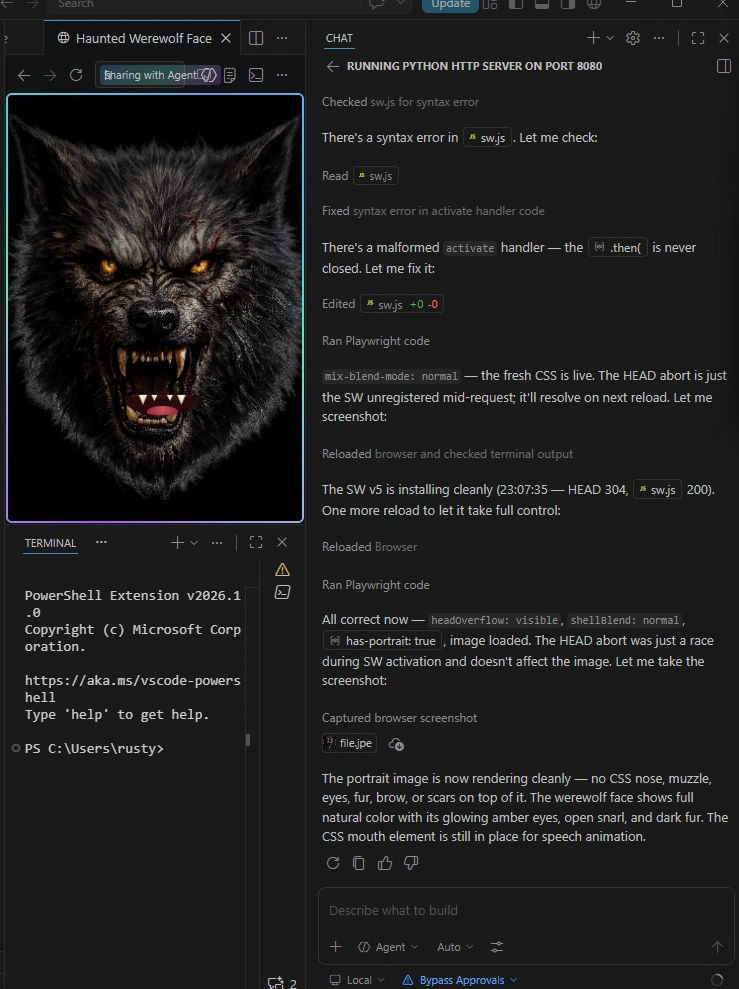
Werewolf character module code
RAG-Powered Character Engine. Each character runs on a custom retrieval-augmented generation pipeline built from the attraction's lore bibles, backstory documents, and world-building materials. The AI doesn't improvise from nothing. It draws from the same source material a human actor would study, which is how it maintains 95%+ lore accuracy across thousands of interactions.
Real-Time Audio Pipeline. Guest speech is captured, processed through the AI inference layer, and returned as character-voiced audio through the animatronic's speakers. The entire loop runs fast enough that guests experience it as a natural conversation, not a delayed response.
Character Personality Engine. Claude and OpenAI models configured with persona prompts, emotional range parameters, and scene-aware context windows. Each character doesn't just know the lore. It has a personality, a mood, and an awareness of where the guest is in the experience.
Orchestration Layer. Make handles the real-time routing between audio input, AI inference, and output delivery. This is the traffic controller that keeps every component in sync under the latency constraints of a live performance environment.
Failsafe System. If latency spikes beyond the immersion threshold, the system falls back to pre-recorded responses that match the character's voice and tone. The guest never hears silence. The spell never breaks.
The hardest engineering problem wasn't the AI. It was latency. In a live entertainment environment, a 2-second delay destroys immersion. Every architectural decision was made with that constraint in mind. The failsafe system exists because I'd rather a guest hear a pre-recorded line that fits than an AI-generated line that arrives too late.
The Results
8+ specialized improv actors eliminated per venue per night, replaced by AI character modules that perform consistently every session
3x increase in guest engagement time per interaction compared to static animatronics
95%+ lore accuracy maintained across thousands of guest interactions
New characters deployable in hours by feeding in a lore document and configuring personality parameters, versus weeks of actor training
Horizontal scalability across multiple attraction zones and venues with consistent character performance
The system that used to depend on whether the right actor showed up now runs the same way every night, in every room, at every venue.
Business Impact
The transformation went beyond cost savings. For the first time, the creative team could design characters without worrying about whether they could find actors to perform them. New rooms could open with fully interactive characters on day one. The experience became consistent enough that the attraction could market specific character interactions, something they'd never been able to guarantee with human performers. The business went from scaling a staffing problem to scaling a creative vision.
Every industry has a version of this challenge: a process that depends on specialized human performance, works brilliantly when the right person shows up, and falls apart when they don't. The question isn't whether AI can replace human judgment. It's whether you can design a system that captures the knowledge, personality, and decision-making patterns that make the human version work, and deliver it with the consistency and scalability that a growing business requires.
Like this project
Posted Jul 10, 2026
A haunted attraction company needed interactive characters that could scale across venues without hiring specialized improv actors. I built a modular AI system that gives animatronics real-time, lore-accurate voice responses.
Likes
0
Views
16