How a Roofing Company Eliminated $70K/Year in Manual Operations

Russell Williamson


Project Snapshot
Industry | Commercial Roofing |
Duration | 5 Weeks |
System Components | 5 |
AI Models | 2 |
Automations | 18 |
Human Approval Points | 3 |
Vendor Formats Supported | 15+ |
Annual Savings | $70,000 |
A 4-person manual process became a zero-touch pipeline. A roofing company was running their entire inventory and procurement operation by hand, and the errors weren't just slipping through — they were compounding.
The Operation
Hostetler Roofing had two full-time employees dedicated to data entry. Incoming vendor invoices were processed line by line. Pick tickets were created from scratch every morning. Reorder decisions depended on someone remembering to check stock levels. When they forgot, the warehouse ran out of materials mid-job.
The official process said invoices got checked against deliveries. What actually happened was someone eyeballed the pallet, said "looks right," and moved on. That gap is where the 7% inventory loss was hiding.
I spent more time standing in the warehouse watching people work than I did writing code. The way the team described their workflow and the way they actually did it were two different things. You can't find that kind of gap in a Zoom call. You find it by being the kind of person who's stood on that warehouse floor before.
What I Built
I designed a closed-loop system that took over the entire inventory lifecycle, from the moment a vendor email arrives to the moment a purchase order goes back out the door. Five tightly integrated components working as one business system with zero manual data entry.
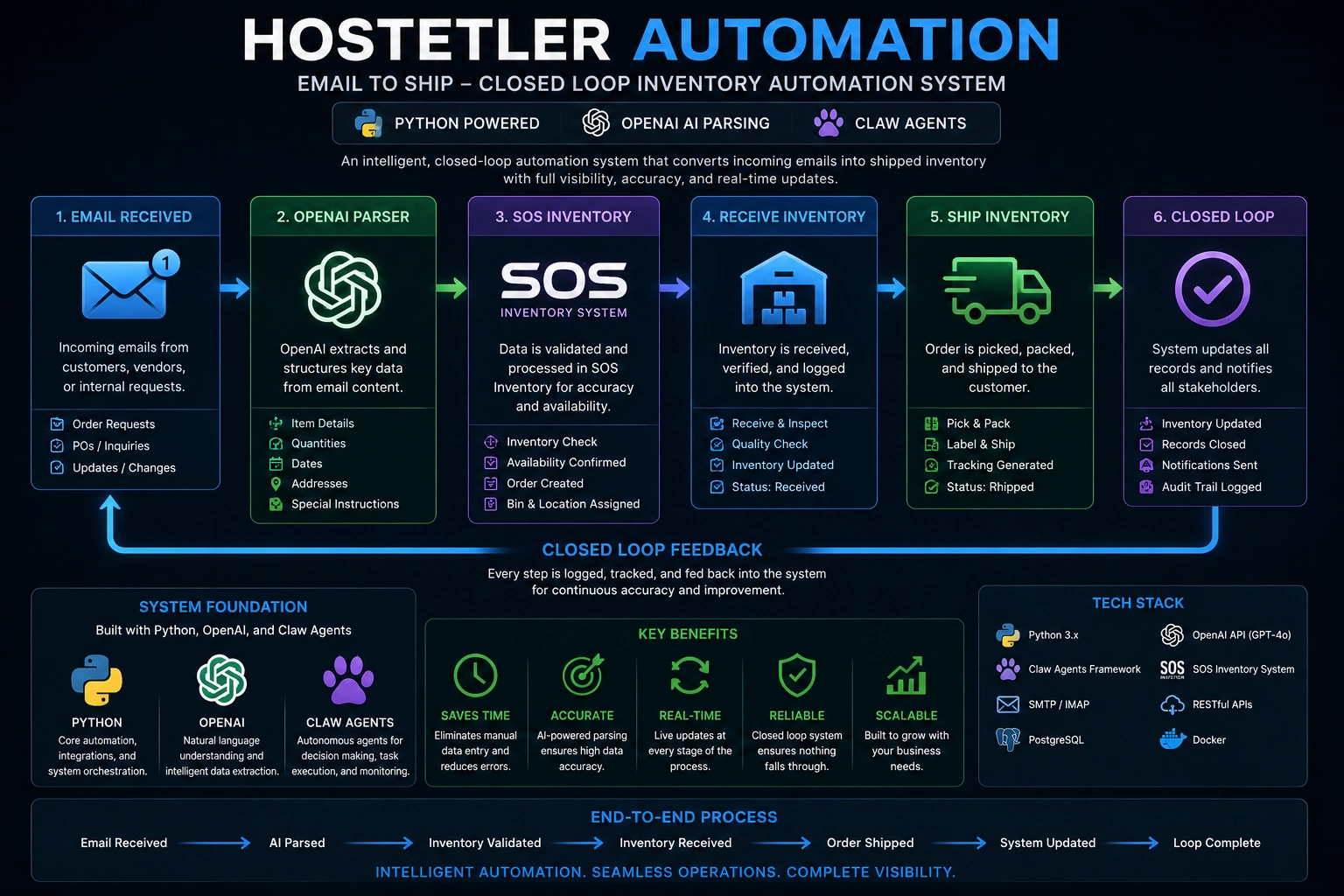
Roofing operations flow breakdown
Invoice Ingestion. AI agents scan incoming vendor emails, extract line items, quantities, and pricing, then push everything directly into inventory. No human touches it. Getting this right was the hardest part of the build. Vendor invoice formats are wildly inconsistent, and training AI agents to reliably parse 15+ different vendor templates took more iteration than I expected.
Inventory Verification. The system automatically verifies that received counts match what was invoiced and updates stock levels in real time. This is the component that closed the gap I found in the warehouse. No more eyeballing pallets.
Work Order Generation. Each evening, the system generates the next day's worklist and creates pick tickets for products that need to be pulled. Ready before the warehouse crew clocks in.
Accounts Receivable. Once product is picked and shipped, an invoice fires to accounts receivable automatically. No handoffs, no delays, no waiting for someone to remember.
Automated Reordering. A watcher agent monitors par levels across every product. When stock hits a reorder point, it generates a purchase order and routes it to the manager's phone. One tap to approve, and it goes straight to the vendor.
The system combines Python, Airtable, AI, and custom automation into a single connected platform where every component feeds the next. The result is a business process that largely manages itself while keeping human approval exactly where it belongs.
The Results
$70,000/year in labor costs eliminated by replacing 2 full-time data entry positions with autonomous processing
7% reduction in inventory loss in the first year by closing the gap between what was invoiced and what was actually received
Zero manual invoice processing across 15+ vendor formats, handled entirely by AI agents
Automated reorder cycle that prevents stockouts without anyone watching spreadsheets
Daily pick tickets generated overnight, ready before the warehouse opens every morning
What used to take 3 people and a prayer is now a single manager reviewing AI-generated purchase orders on their phone.
Business Impact
The biggest transformation wasn't the automation. It was operational confidence. Managers stopped wondering whether inventory was accurate. Warehouse staff started every morning with work already prepared. Purchasing became proactive instead of reactive. Instead of spending time chasing information, the team could spend time running the business.
I've found this same pattern in companies of every size and industry. A process that depends on memory instead of systems. Information that exists in three different places. Manual work that quietly consumes hours every week because "that's just how we've always done it."
The technology to solve those problems already exists. The challenge is designing a system around how people actually work — not how we wish they worked.
Like this project
Posted Jul 10, 2026
Hostetler Roofing was spending $70k a year on manual inventory and procurement. I replaced it with a closed-loop system that runs without human data entry.