From Hiring Round to One Button: An AI Content Pipeline

Russell Williamson


Project Snapshot
Industry | SaaS / Affiliate Marketing |
Duration | 1 Month |
Pipeline Steps | 5 |
AI Models | 1 |
Review Turnaround | Hours → Minutes |
Writers Needed | 0 |
Content Output | SEO-Optimized, Publish-Ready |
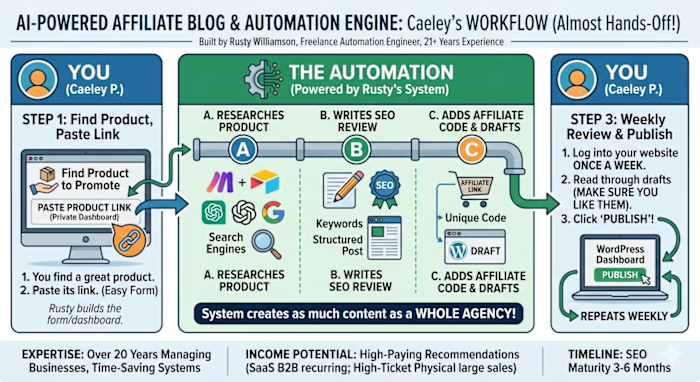
The client was about to post job listings for affiliate writers. Instead, they got a text box and a button. Drop a product link in, hit "Process," walk away. A publish-ready review lands in WordPress before the coffee gets cold.
The Operation
A SaaS affiliate site owner was preparing to hire a team of writers and data entry specialists to build out product reviews across roughly 10 pages. Every new affiliate product meant the same manual cycle: research the product, study the competitive landscape, write the review, optimize for SEO, format it for WordPress, and publish. Each review took hours. Scaling meant hiring more people and managing more output.
The economics were straightforward but painful. Writers cost money. Managing writers costs time. And the content still needed SEO research, formatting, and publishing steps that added overhead to every single piece. The site was small enough that the owner was doing most of this work personally, but the growth plan required content velocity that one person couldn't sustain.
The choice looked like: hire a content team and accept the overhead, or find a way to produce the same quality output without the manual pipeline.
What I Built
I designed a fully automated content pipeline that takes a single input (an affiliate product link) and produces a complete, SEO-optimized, publish-ready review with zero manual writing, formatting, or publishing steps.
Airtable Input Layer. The client drops a product link into a single field and hits "Process." That's the entire human interaction. Airtable captures the link and triggers the automation pipeline.
Make Orchestration. Make runs the entire workflow, passing data between services in sequence. It's the backbone that connects every step: from the initial product link through AI processing, content generation, quality staging, and final publishing.
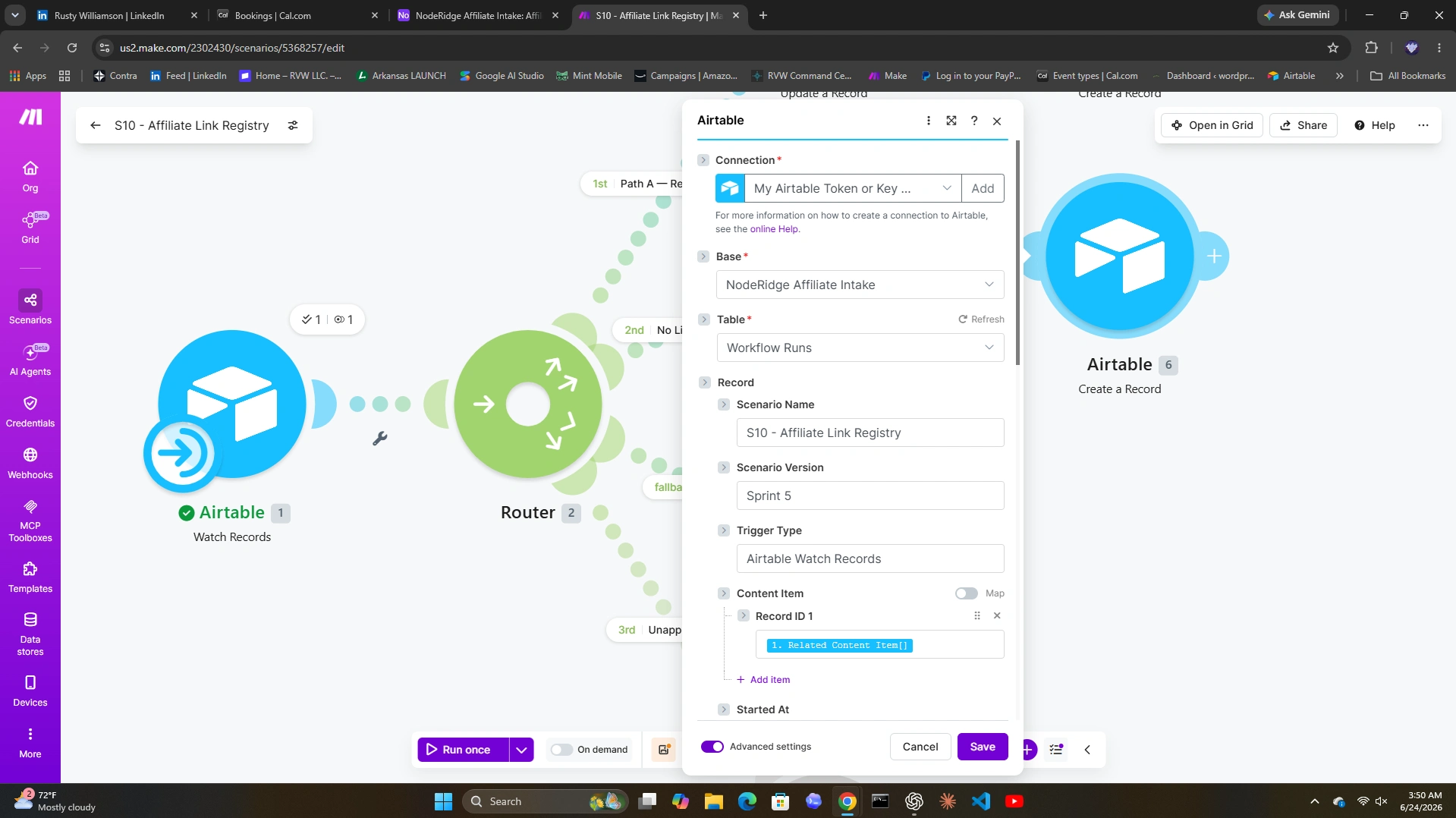
Make.com scenario — orchestration pipeline
AI Research and Writing Engine. OpenAI ingests the product link, conducts SEO keyword research, analyzes the competitive landscape, and generates a full affiliate review. The output isn't a rough draft that needs editing. It's structured, optimized content ready for publication.
Make.com scenario — AI research and content generation
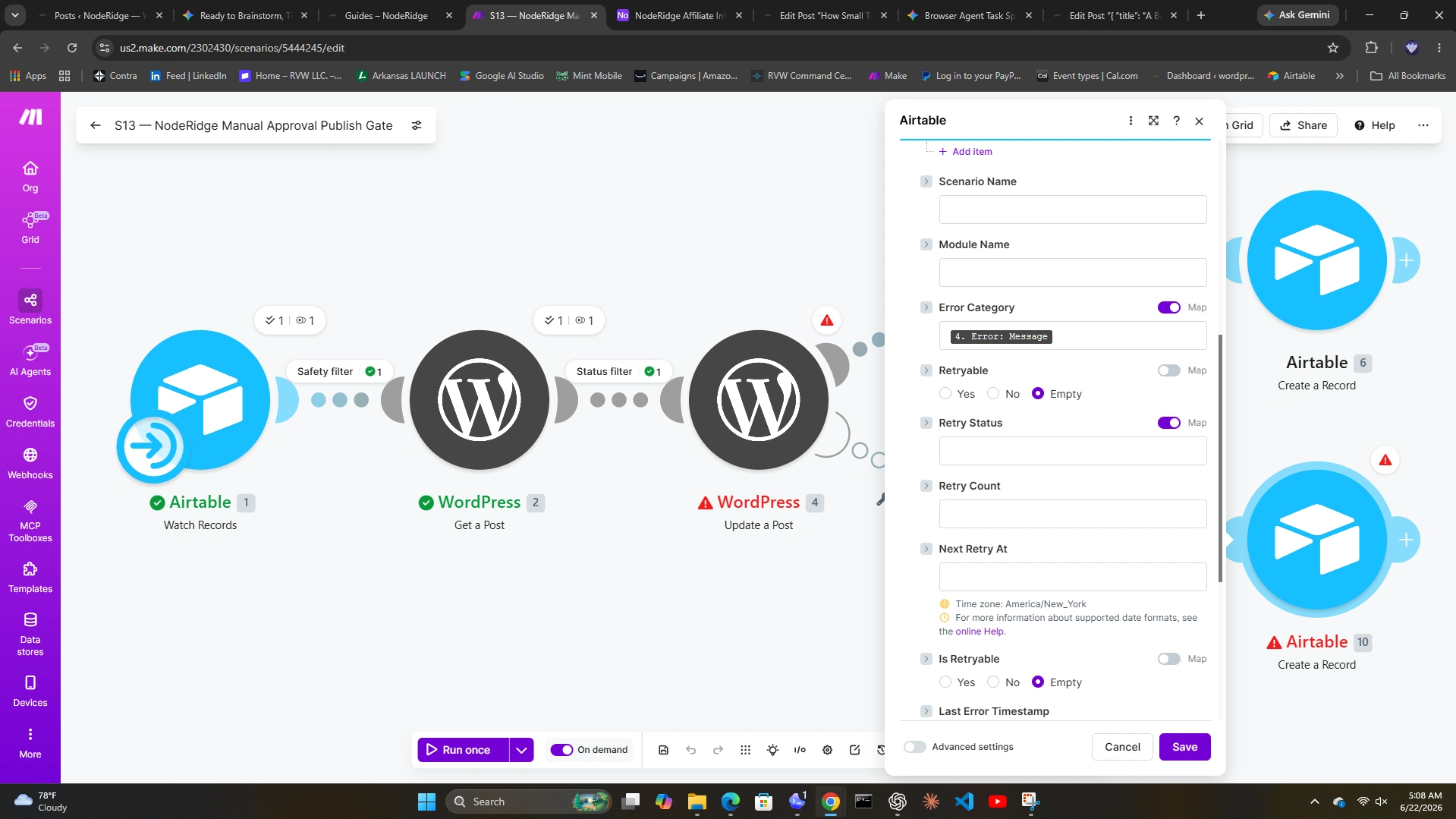
Quality Staging. The finished review routes back into Airtable for a quick human review before publishing. This is the one approval point in the pipeline, and it exists because publishing content that represents the client's brand should always have a human checkpoint.
WordPress Publishing. Approved content pushes directly into WordPress, fully formatted and ready to drive organic traffic. No copy-pasting, no reformatting, no manual CMS work.
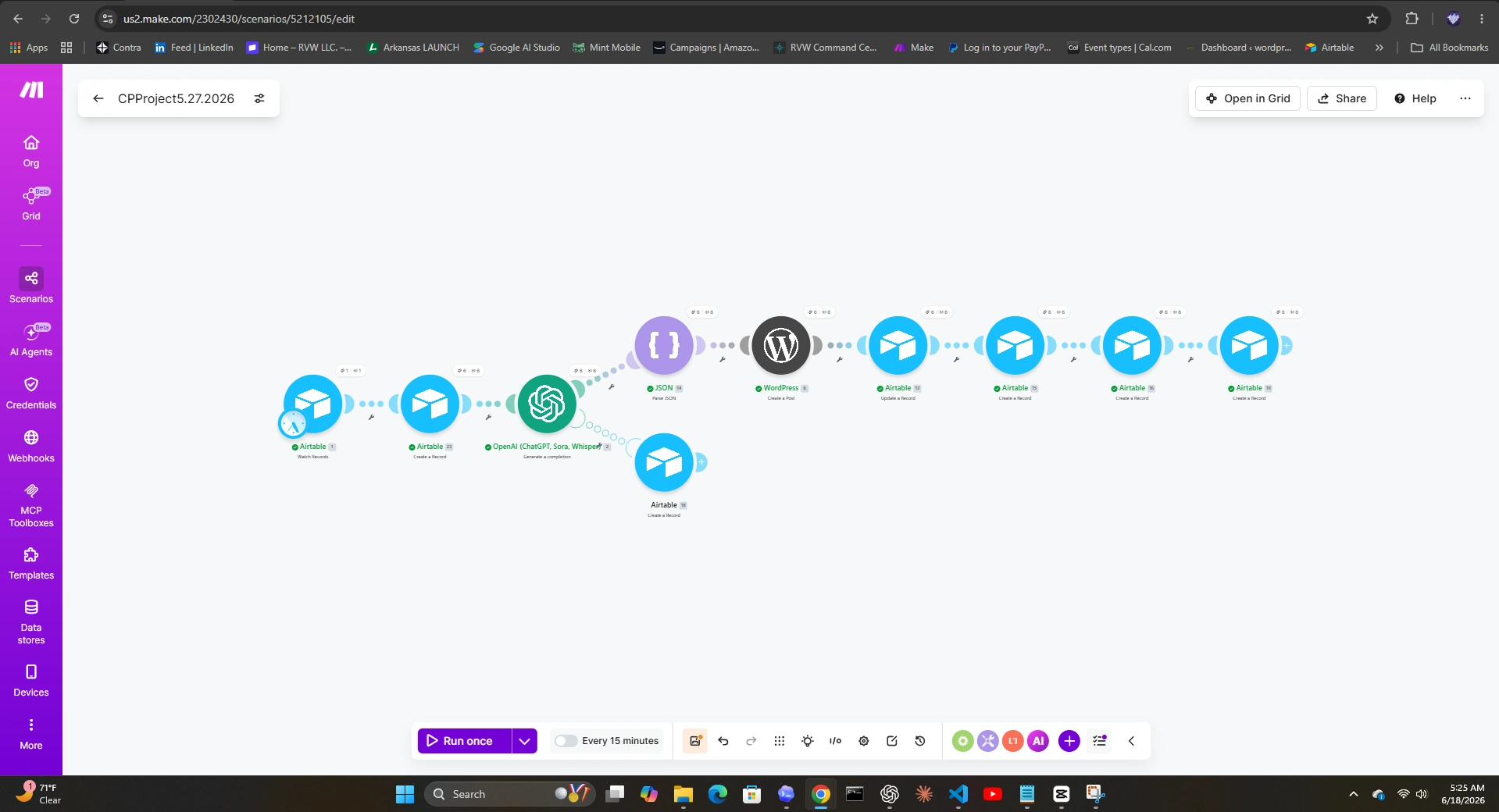
Make.com scenario — WordPress publishing automation
The design philosophy was simple: minimize the distance between "I want to review this product" and "the review is live and ranking." Every step that used to require a human decision was either automated or eliminated, except the one that shouldn't be.
The Results
Eliminated the need to hire affiliate writers entirely, saving thousands in planned annual labor costs
Per-review turnaround dropped from hours to minutes, with the full pipeline running autonomously after a single click
SEO-optimized output drives organic traffic without manual keyword research or content strategy per piece
10-page SaaS affiliate site scales content production with zero additional headcount
One-person content operation replaced what was projected to require a 3-person team
The client went from planning a hiring round to running the entire content operation solo from a single input field.
Business Impact
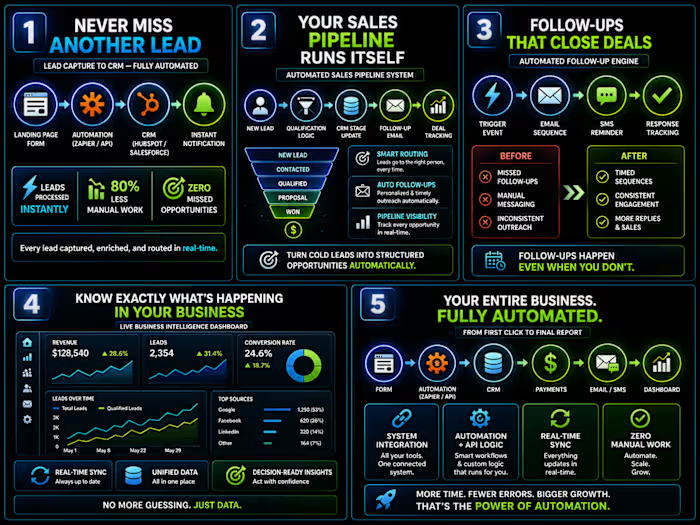
The real win wasn't the automation. It was the business model shift. The site owner went from thinking about content as a cost center that required headcount to thinking about it as a system that runs on a per-unit cost measured in API calls. Growth stopped being a staffing question and became a strategy question: which products to review, which niches to enter, which keywords to target. The constraint moved from "can we produce enough content" to "which content is worth producing."
Every content-driven business hits the same wall. The strategy says "publish more," but the operation says "we need more people to do that." The assumption is that content requires writers, and scaling content means scaling a team.
Sometimes that's true. But for structured, research-driven content like affiliate reviews, the bottleneck isn't creativity. It's the mechanical pipeline between "we need this piece" and "it's live." When you automate the mechanical parts, you don't lose quality. You free the human to focus on the decisions that actually require judgment: what to write about, how to position it, and where the real opportunities are.
Like this project
Posted Jun 4, 2026
A SaaS affiliate site owner was about to hire a team of writers. I built an automated pipeline that turns a product link into a publish-ready, SEO-optimized review in minutes, with zero manual writing.