Geethasree Naguboina's Work | ContraWork by Geethasree Naguboina
Geethasree Naguboina
pro

Geethasree Naguboina

Excel & KPI Dashboards for Small Business Decisions

New to Contra

Geethasree is ready for their next project!

Cover image for Why Excel still beats expensive
Why Excel still beats expensive software for small businesses Most small business owners I talk to feel like they should be using some fancy CRM or ERP system. But here's the truth nobody tells you: For businesses under 50 people, Excel done right beats expensive software almost every time. Here's why 👇 1. You already have it No subscription. No onboarding. No monthly fees. Excel is sitting right there. 2. It bends to your business Software forces you into its structure. Excel fits around your workflow — your terms, your columns, your logic. 3. Your team already knows it No training required. Everyone from the accountant to the sales person can open and read a well-built Excel file. 4. One clean file beats 3 scattered tools I've seen businesses track leads in WhatsApp, revenue in a notebook and expenses in their head. One organized Excel dashboard brings it all together. The problem was never Excel. The problem was never having it set up properly. What tool does your business currently use to track data?
3
5
141
Cover image for Patient Appointment Dashboard for Eye Care Clinic
Patient Appointment Dashboard for Eye Care Clinic
1
0
Cover image for The biggest pain point I
The biggest pain point I see with business data: Everyone has a CRM. Almost no one trusts the reports it generates. Here's why that happens — CRMs are built to store data. Not to analyze it. Not to present it. Not to answer the specific questions your business actually needs answered. So what do most business owners and managers do? They export the data to Excel anyway. But here's the real problem — the exported data is messy. Duplicate entries, inconsistent naming, blank fields, merged cells that break everything. The CRM gave you the data but not the clarity. This is exactly where I see businesses lose hours every week — manually cleaning exports, rebuilding the same reports, and still not getting a clear picture of performance. What actually helps: ✅ A clean Excel structure that works with your CRM export — not against it ✅ Automated formatting so every export lands clean ✅ A dashboard that answers your actual business questions — revenue by period, pipeline by stage, team performance — in one view Your CRM tracks your business. Excel helps you understand it. If your team is still spending hours cleaning CRM exports every month, that's a problem worth solving. #Excel #DataAnalysis #CRM #Dashboard #SmallBusiness #Hyderabad #Freelance
1
5
175
Cover image for 5 signs your business needs
5 signs your business needs a dashboard — not just a spreadsheet You spend more time updating the file than reading it Different people have different versions of the same data Basic questions take 10 minutes to answer Your numbers live across WhatsApp, email and Excel You're always deciding based on last month's data A spreadsheet shows you what happened. A dashboard shows you what's happening — right now. One looks back. The other drives forward. Still learning. Still building. — Geethasree
1
4
87
Cover image for The difference between a report
The difference between a report and a dashboard Most people use these words interchangeably. They're not the same thing. A report tells you what happened. A dashboard shows you what's happening. The difference: Report → static, detailed, built for documentation Dashboard → dynamic, visual, built for decisions The mistake I see most often: People build dashboards that are actually just reports. The result? — Decision makers scroll through pages of data — Numbers are outdated by the time anyone reads them — No one knows what to act on The fix is simple: A report answers: "What happened last month?" A dashboard answers: "What do I need to do right now?" When you design for the right purpose: Reports become clear records. Dashboards become decision tools. One looks back. The other drives forward.
2
3
172
Cover image for Most people think a spreadsheet
Most people think a spreadsheet and a dashboard are the same thing. They're not. A spreadsheet is where data lives. A dashboard is where decisions happen. The difference: Spreadsheet → raw, editable, flexible, built for input Dashboard → structured, visual, built for reading and decisions The mistake I see most often: People try to do both in the same sheet. The result? Decision makers see too much raw data Numbers get accidentally edited No one knows what to trust The fix is simple: Keep your data layer and your presentation layer separate. Raw data in one sheet. Dashboard in another. One is for building. One is for reading. When you separate them, updates become clean, mistakes become rare, and your reports actually get used. A spreadsheet stores your data. A dashboard tells its story.
4
6
195
Cover image for Optimize Your Spreadsheets: Structure Over Formulas for Success
Most spreadsheet problems are not Excel problems. They’re structure problems. I often see spreadsheets where: • formulas reference half the sheet • headers change across tabs • logic is embedded inside long nested formulas • no one knows where the numbers actually come from The result? Small updates quietly break the entire model. A simple structure solves most of this: Raw Data → Processing → Output → Documentation Raw data stays untouched. Processing handles the logic. Output shows only what decision-makers need. Documentation explains how metrics are calculated. Clean structure reduces fragility and makes updates predictable. Good spreadsheets aren't just about formulas. They’re about clear data flow and transparent logic.
3
3
234
Cover image for Most dashboards don’t have a
Most dashboards don’t have a visualization problem. They have a KPI problem. I’ve reviewed dozens of reporting systems recently and the pattern is consistent: Metrics are defined differently across sheets “Revenue” means one thing in finance and another in marketing KPIs are tracked… but not tied to decisions Dashboards look clean but don’t answer operational questions When metric logic isn’t aligned, teams don’t have a data problem. They have a decision problem. That’s why I’ve started offering a structured KPI & Revenue Diagnostic Audit — focused on: • Metric consistency • Reporting logic • Revenue driver alignment • Decision-readiness If you're building dashboards or scaling reporting systems, this layer matters more than design.
8
8
337
Cover image for Most dashboards fail before they
Most dashboards fail before they are even built. Not because of bad charts. Not because of wrong formulas. Because the data underneath is structurally broken. Here’s what I see often in small businesses: • Dates stored as text • Multiple columns for the same metric • Inconsistent naming (Revenue / Sales / Total Sales) • Manual copy-paste every week • No clear data flow Then they ask: “Why doesn’t this dashboard update properly?” A dashboard is just a mirror. If the data structure is messy, the reflection will be distorted. Before I build any report, I focus on 3 things: Standardized column logic Single source of truth Repeatable data flow (no manual dependency) Clean structure → Reliable metrics → Better decisions. If your reporting feels fragile, the issue usually isn’t Excel. It’s the foundation.
15
8
364
Cover image for Most spreadsheets don’t have a
Most spreadsheets don’t have a formula problem. They have a structure problem. When reporting feels unreliable, it’s rarely because Excel is limited. It’s usually because the data flow was never designed. Before I build any dashboard, I check: 1️⃣ Where does the data originate? 2️⃣ Is there one clear source of truth? 3️⃣ Are inputs separated from calculations? 4️⃣ Can someone else maintain this in 6 months? Dashboards are the visible layer. Structure is the foundation. When the structure is right: ✔️ Reports update automatically ✔️ Errors drop ✔️ Decisions get faster If your spreadsheet needs manual fixing every week, the issue probably isn’t formulas — it’s system design. What’s the biggest spreadsheet headache you’re dealing with?
5
252
Cover image for Messy Excel data → Decision-ready
Messy Excel data → Decision-ready dashboard 📊 A recent Excel workflow I worked on involved raw, unstructured data that wasn’t usable for analysis or reporting. What I did: Cleaned and structured the raw dataset Fixed formatting and consistency issues Built pivot tables and an interactive Excel dashboard Result: ✔️ Clear insights ✔️ Faster reporting ✔️ No manual rework This is the kind of Excel cleanup + reporting support I help teams with regularly. If you’re dealing with messy spreadsheets and need clean, reliable Excel reports — happy to help.
5
6
288
Cover image for Executive Excel Dashboard for Business Reporting
Executive Excel Dashboard for Business Reporting
5
5
Cover image for Market & Competitor Research (E-Learning Industry)
Market & Competitor Research (E-Learning Industry)
2
3
Cover image for Turning messy Excel data into an interactive dashboard 📊 In...
Turning messy Excel data into an interactive dashboard 📊 In my latest Excel case study, I worked with a raw, unstructured dataset (8,700+ rows) and focused on doing the fundamentals right: • Cleaned inconsistent time, date, and text values • Structured the data for accurate analysis • Built pivot tables with day, month, and time logic • Added slicers and conditional formatting for interactivity No fancy tools — just solid Excel workflows that make data reliable and easy to explore. This is exactly how I approach real client data: clean first → structure next → visualize last. 👉 Full case study is live on my profile.
6
10
351
Cover image for Excel Data Cleaning & Dashboard Reporting
Excel Data Cleaning & Dashboard Reporting
4
8
Cover image for 📊 Clean Excel Data = Better Decisions Most teams don’t have...
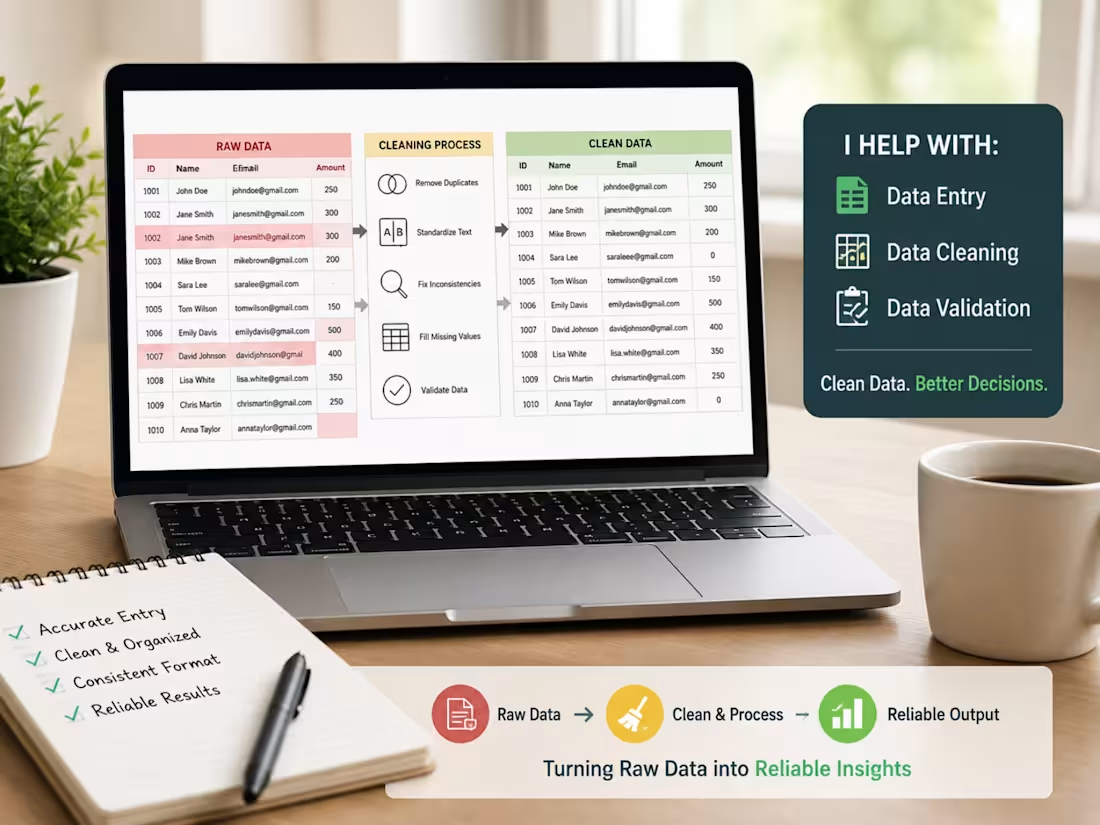
📊 Clean Excel Data = Better Decisions Most teams don’t have a data problem — they have a messy Excel problem. Common issues I see: ❌ Broken formulas ❌ Manual workflows ❌ Reports that fail with new data When Excel data is structured properly: ✅ Dashboards stay accurate ✅ Automation works ✅ Decisions get faster Clean data isn’t about neat sheets — it’s about trustworthy insights. I help teams clean, structure, and automate Excel data for decision-ready reporting.
4
6
272
Cover image for Verified Web Research for Business Decisions
Verified Web Research for Business Decisions
2
2
Cover image for Excel Data Cleanup → Dashboard Reporting
Excel Data Cleanup → Dashboard Reporting
2
10
Cover image for Why Clean Data = Better Decisions 🧼📊 Most teams don’t have...
Why Clean Data = Better Decisions 🧼📊 Most teams don’t have a data problem — they have a messy data problem. Dirty data causes: ❌ Wrong insights ❌ Slow reporting ❌ Confusing dashboards ❌ Missed opportunities But when your data is clean and structured: ✅ Decisions get faster ✅ Dashboards get clearer ✅ Teams trust the numbers ✅ Automation works ✅ Revenue opportunities appear Clean data isn’t “making it look nice.” It’s the foundation of accurate forecasting, better targeting, and smarter strategy. If your business is running on messy spreadsheets, you’re not just losing time — you’re losing clarity. I help teams turn chaotic data into clean, decision-ready datasets. Need help cleaning or organizing your data? Let’s talk 🤝
4
252
Cover image for Here’s one of my favorite Excel tricks that saves 40–60% cle...
Here’s one of my favorite Excel tricks that saves 40–60% cleanup time—instantly. Whenever I receive messy spreadsheets, I start with this quick trio: 🟢 =TRIM() – removes unwanted spaces 🟢 =CLEAN() – fixes hidden formatting issues 🟢 =PROPER() – makes text clean + uniform You’d be surprised how many “complex” data issues are solved with these three simple functions. I use this approach in my client projects before building dashboards, reports, or analyses—it ensures the entire workflow is smooth and error-free. If you want your Excel files cleaned, structured, or automated, I offer professional Excel support for both short and long projects.
7
273
Cover image for 🚀 Automating Small Tasks = Big Productivity Gains One thing...
🚀 Automating Small Tasks = Big Productivity Gains One thing I’ve noticed while working across Excel, data cleanup, and workflow optimization: Most teams don’t need a full system rebuild — they just need small automations that remove daily friction. Here are 3 micro-automations I recently built that made a big impact: 🔹 Smart data cleanup rules — auto-standardizing names, dates, and formats 🔹 Auto-generated summaries — creating insights without manually filtering every time 🔹 Monthly rollover logic — treating late-month income/expenses as the next month’s budget These tiny improvements save hours, reduce errors, and make tools easier for anyone to use — not just “Excel experts.” If you could automate one small task in your workflow, what would it be? 👇 #Excel #Automation #Productivity #DataEntry #WorkflowOptimization
9
6
311