Freelancers using Google Drive in Sydney
Sign Up
Post a job
Sign Up
Log In
Filters
2
Projects
People
Victor T Tam Yan
pro
Sydney NSW 2000, Australia
Ghostwriter for Business & LinkedIn Copywriter for Founders
New to Contra
Follow
Message
Ghostwriter for Business & LinkedIn Copywriter for Founders
0
Victor T Tamyan vtbizonline@gmail.com
0
15
1
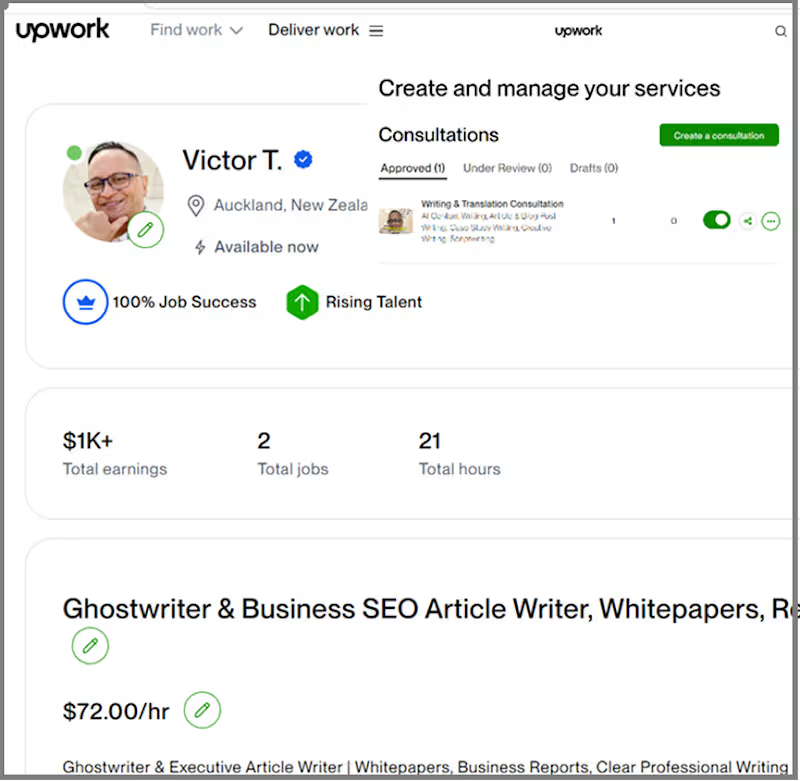
Marketplace Performance Audit & Vetted Strategic Consultancy Status The Narrative: "In the B2B and Fintech landscape, the primary hurdle for any founder is the 'Risk of the Unknown.' To mitigate this friction for my partners on Contra, I am providing a transparent audit of my performance across global executive marketplaces. This 'Proof of Authority' reflects three critical mechanical benchmarks: 100% Job Success Rate: A verified indicator of consistent, high-stakes project execution and client satisfaction. Rising Talent Designation: Successfully secured within 60 days, reflecting the high-velocity professional standards I bring to every narrative architecture. Approved Strategic Consultant Status: Formally vetted to offer high-level consultancy—a credential reserved for specialists who translate complex business logic into growth-focused communication. The Strategy: I am currently maintaining a Discovery Rate of $72/hr specifically for the Contra ecosystem. This allows high-intent founders to access Senior Accountant-level precision and Master of International Business strategy at an optimized entry point while I integrate my established 17-year methodology into this platform's network."
1
186
0
I explored two creative directions for a home‑services brand to demonstrate range, tone flexibility, and fast AI‑assisted design. Concept A focuses on a professional icon‑driven identity. Concept B explores a minimalist wordmark with subtle architectural cues. Both concepts were refined using modern design tools and structured brand‑identity principles. This sample shows how I approach branding for early‑stage founders who need clean, modern, and fast identity work.
0
133
1
Seller‑Side Due Diligence: What a Good Accountant Must Do Before a Business Sale in Australia Selling a business in Australia is one of the most significant financial events a small‑to‑medium business owner will ever experience. It’s not just a transaction — it’s the culmination of years (sometimes decades) of work, risk, sacrifice, and personal investment. As an accountant acting for the seller, my role is to ensure the business is presented with clarity, accuracy, and defensible financial logic. That means preparing the business for scrutiny before the buyer even begins theirs. This process is known as seller‑side due diligence, and when done properly, it protects the seller, strengthens valuation, reduces negotiation friction, and increases the likelihood of a clean, successful sale. With 15 years in Australian tax, business services, and forensic accounting, I’ve learned that seller‑side due diligence is not just about numbers — it’s about narrative, transparency, and anticipating the questions a sophisticated buyer (or their accountant) will ask. Below is the framework I use when preparing a business for sale. 1. Understanding the Entity Structure — The Foundation of Everything Before touching a spreadsheet, I need to understand how the business is structured, because the entity type determines: how goodwill is treated whether CGT concessions apply how assets are transferred what liabilities follow the sale whether the owner’s personal assets are exposed how the sale price is allocated In Australia, small businesses are commonly structured as: Sole traders Partnerships Discretionary or unit trusts Pty Ltd companies Each structure has different tax consequences. For example, a sole trader selling a business they’ve operated for over 15 years may be eligible for the Small Business 15‑Year CGT Exemption, which can eliminate capital gains tax entirely if conditions are met. A company, however, may need to consider the 50% active asset reduction, retirement exemption, or rollover provisions instead. Understanding the structure early allows me to shape the sale strategy, the valuation narrative, and the tax planning opportunities available. 2. Preparing the Financial Core — The Documents No Buyer Will Proceed Without A buyer’s accountant will always ask for the same foundational documents. If the seller cannot provide them quickly and cleanly, confidence drops and valuation suffers. The essential documents include: Profit & Loss Statements (3–4 years minimum) Balance Sheets for the same period Tax Returns (entity and individual, where relevant) BAS statements General ledger extracts Depreciation schedules Asset registers Loan agreements and finance schedules Employee entitlement summaries Superannuation compliance records Tax returns are particularly important because they show actual tax depreciation, not just accounting depreciation. Buyers look for consistency between accounting profit and taxable income — discrepancies must be explained. If the financials are unaudited, I perform a forensic-style review to ensure accuracy, identify anomalies, and prepare explanations before the buyer asks. 3. Normalising Earnings — The Heart of Valuation Most small businesses have discretionary expenses, owner wages, or one‑off costs that distort true profitability. As the seller’s accountant, I prepare a normalised earnings statement that adjusts for: owner’s salary (if above or below market) personal expenses run through the business one‑off legal or repair costs non‑recurring revenue related‑party transactions abnormal stock adjustments private vehicle or travel expenses This is where forensic accounting skills matter. Buyers want to see sustainable, repeatable earnings, not inflated numbers. My job is to present a fair, defensible picture that supports the seller’s valuation without crossing into exaggeration. 4. Trend Analysis — Showing the Story Behind the Numbers A single year’s profit means nothing without context. I analyse: revenue growth or decline margin stability customer concentration seasonality cost trends cashflow patterns debtor and creditor movements A business with stable margins and predictable cashflow commands a higher valuation. A business with volatile revenue needs explanation. Trend analysis also helps identify risks before the buyer does. If revenue dipped in one year, I prepare the explanation upfront — new competitor, owner illness, supply chain issue, etc. Transparency builds trust. 5. Reviewing Contracts, Leases, and Operational Dependencies Financials tell one story; contracts tell another. I review: customer contracts (especially if one client represents >20% of revenue) supplier agreements equipment leases property leases insurance policies licences and permits intellectual property documentation Buyers want to know: what obligations they’re inheriting whether key relationships are secure whether the business can operate without the current owner If the business relies heavily on the owner’s personal relationships, I highlight this early and help the seller prepare a transition plan. 6. Employee Entitlements and ATO Compliance Employee liabilities are a major due‑diligence focus. I verify: annual leave long service leave superannuation payments payroll tax workers compensation award compliance Superannuation compliance is critical. Any unpaid super is a red flag that can derail a sale. I also check for ATO payment plans, outstanding BAS, or historical issues. Buyers will find them — better that I prepare the explanation first. 7. Valuation Scenarios — Presenting a Range, Not a Guess A good accountant never presents a single valuation number. Instead, I prepare valuation scenarios, such as: valuation based on normalised EBITDA valuation based on net tangible assets valuation based on discounted future cashflow valuation after applying CGT concessions valuation after adjusting for working capital This gives the seller a realistic range and prepares them for negotiation. 8. Capital Gains Tax Planning — The 15‑Year Concession and Other Small Business Reliefs For many small business owners, CGT is the biggest financial event of their life. Australia’s Small Business CGT Concessions can dramatically reduce or eliminate tax on the sale. Key concessions include: 15‑Year Exemption — if the business has been owned for 15+ years and the owner is over 55 and retiring, the entire capital gain may be tax‑free. 50% Active Asset Reduction — reduces the capital gain by half. Retirement Exemption — up to $500,000 can be contributed to super tax‑free. Small Business Rollover — defers CGT if proceeds are reinvested in another active asset. My role is to determine eligibility early, model the tax outcomes, and structure the sale to maximise concessions. 9. Preparing the Business Overview — The Document Buyers Actually Read Once the financial and operational due diligence is complete, I prepare a business overview that includes: business history revenue breakdown customer profile operational structure financial highlights normalised earnings valuation summary risk factors transition plan This is the document the buyer reads before deciding whether to proceed to formal due diligence. A clear, honest overview builds trust and positions the seller as organised and credible. 10. Anticipating Buyer Questions — The Forensic Mindset Finally, I prepare the seller for the questions buyers will ask, such as: Why are you selling? What would happen if you stepped away tomorrow? Are there any disputes, liabilities, or compliance issues? How dependent is the business on key staff or customers? What risks should we be aware of? A seller who answers confidently and transparently is far more likely to secure a strong offer. Closing Thoughts Seller‑side due diligence is not about making the business look perfect — it’s about presenting it honestly, clearly, and professionally. When the financials are clean, the narrative is coherent, and the risks are acknowledged upfront, buyers feel safer, negotiations run smoother, and valuations hold firm. As an accountant with experience in business sales, forensic analysis, and Australian tax law, my goal is simple: protect the seller, strengthen their position, and ensure the business is presented with the clarity it deserves. __________________________________________________________________ Written by Victor Tyan MIntBus, BComm
1
243
Google Drive
(15)
Follow
Message
Emma Tamaoki
Sydney NSW, Australia
Full-Service Branding for Founders + Creatives

Top
Follow
Message
Full-Service Branding for Founders + Creatives

0
Bijoux de Clouds
0
27
0
Brow Confidence
0
39
1
Cosmopolitan Australia + Middle East
1
26
0
Pepita Baby
0
12
Google Drive
(1)
Follow
Message
James Zipeure
Sydney NSW, Australia
DRIVING SUCCESS WITH INNOVATION FOR BUSINESS GROWTH AND ROI

Follow
Message
DRIVING SUCCESS WITH INNOVATION FOR BUSINESS GROWTH AND ROI

0
How Data and technology deliver increased ROI
0
26
0
Mastering media deals
0
16
0
Maximising trade desk potential
0
14
0
Driving cashflow, P&L and M&A
0
18
Google Drive
(1)
Follow
Message
Cormac Lavery
Sydney NSW, Australia
Direct Response Copywriter Specialising in Email Copywriting
Follow
Message
Direct Response Copywriter Specialising in Email Copywriting
0
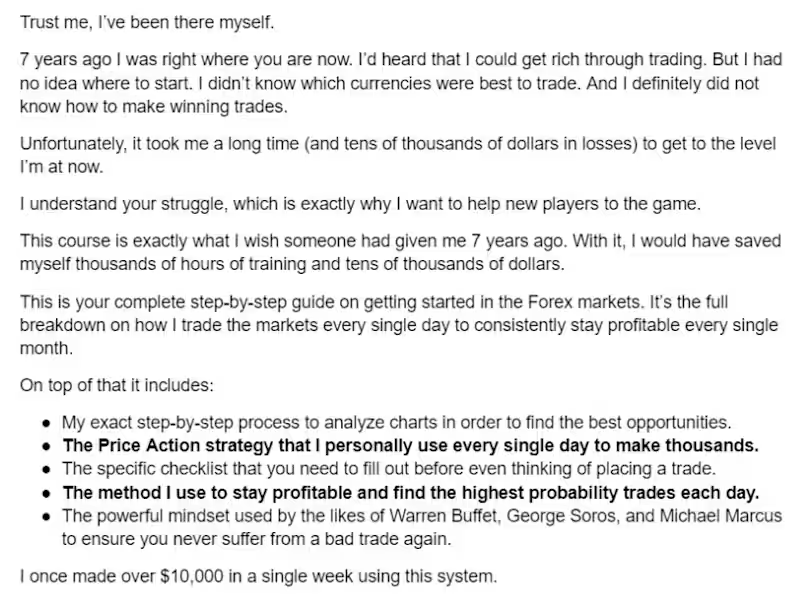
Productivity Course Email Series
0
3
0
Weight Loss Program Emails
0
9
0
Anxiety Coaching Program Emails
0
3
View more →
Google Drive
(1)
Follow
Message
Lucila Zakowicz
Sydney NSW 2000, Australia
Brand voice for people who hate boring content.

New to Contra
Follow
Message
Brand voice for people who hate boring content.

0
Content writing for a perfumery brand about incense, rituals and a new perception of time.
0
22
1
An editorial reflection on scent, beauty, and the quiet pressure to become more acceptable. The piece moves between personal insight and cultural observation to question the standards that shape how beauty is perceived and performed.
1
104
1
A-typical photoshooting. A visual project inspired by four scents, each represented by a different body. Using macro photography, the shoot explored scent through shapes, forms, and textures, revealing the subtle similarities between the body and the natural world. Rather than illustrating fragrance literally, it approached perfume as something embodied — organic, tactile, and deeply felt.
1
88
1
Atypical - The Atlas. A monthly Ebook. A slow practice: one ingredient per month—its aromatic profile, traditional uses, and new ways to meet it through story, ritual, and form
1
101
Google Drive
(1)
Follow
Message
Sukhjeet Singh
Sydney NSW, Australia
Experienced Business Consultant & Analyst

Follow
Message
Experienced Business Consultant & Analyst

0
Offshore Team Management
0
3
0
Strategy Consulting
0
1
0
Start-Up Business Consulting
0
1
View more →
Google Drive
(1)
Follow
Message
Rayan
Sydney NSW 2000, Australia
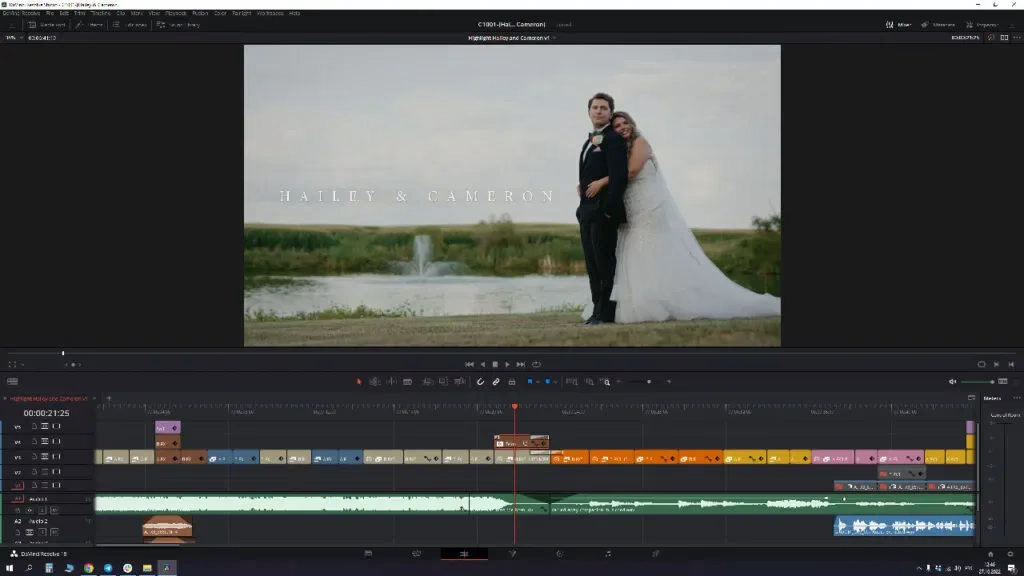
🎥 Crafting Visual Stories & Compelling Copy ✍️

Follow
Message
🎥 Crafting Visual Stories & Compelling Copy ✍️
0
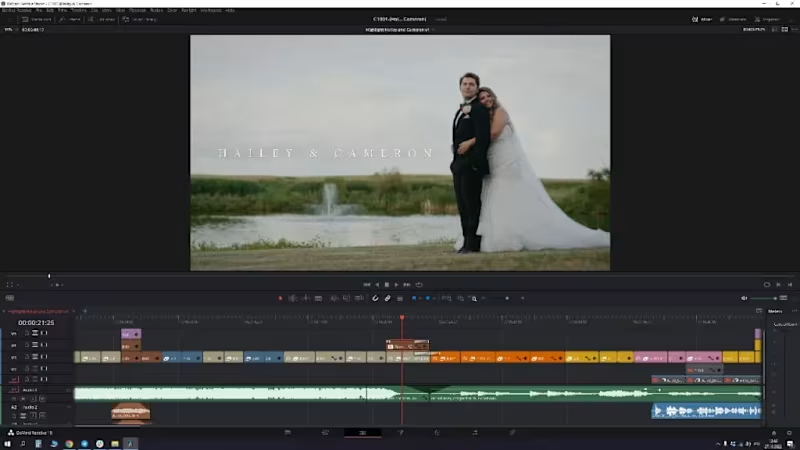
Rayan Portfolio
0
0
0
video editing
0
1
0
Rayan
0
2
View more →
Google Drive
(1)
Follow
Message
Explore people