
AI Automation Engineer | Full-Stack Apps & Integrations


AI Automation Engineer | Full-Stack Apps & Integrations




AI System Architect | Database Expert | Data Analyst
- $25k+
- Earned
- 1x
- Hired
- 5.0
- Rating
- 92
- Followers
AI System Architect | Database Expert | Data Analyst


AI Automation & Business Systems Expert | Make.com, Zapier
AI Automation & Business Systems Expert | Make.com, Zapier
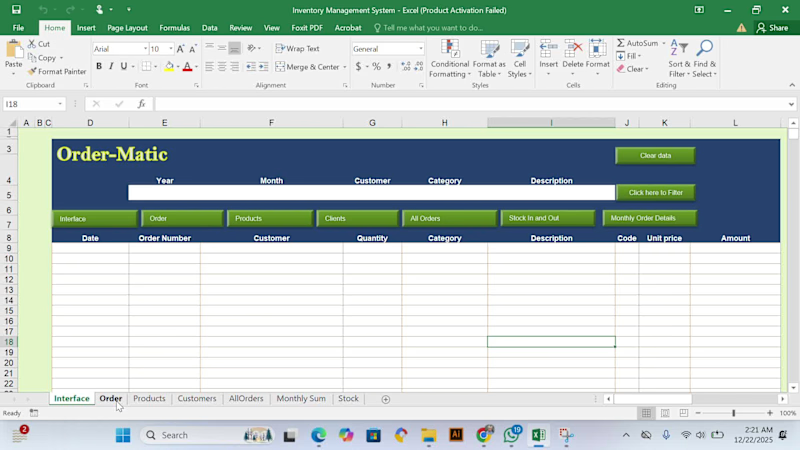
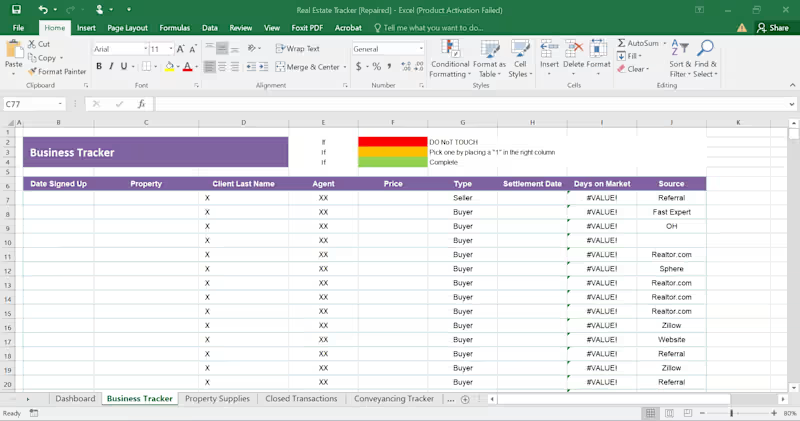
📊 Just completed a Real Estate Tracker in Excel, built to help agents and teams track deals, leads, and performance in one clean dashboard.
It includes:
📈 Sales summary by agent
🧲 Lead tracking (weekly + pipeline stages)
🏠 Properties by buyer/rental/seller
✅ Tabs for business tracking, property supplies, closed transactions, and conveyancing flow
If you need a custom Excel tracker for your real estate business (leads, listings, closings, commissions), message me, and I’ll build it around your workflow.
0
270




Enterprise Cloud · DevOps · AI/ML · Email · Marketing Expert
- $10k+
- Earned
- 13x
- Hired
- 4.6
- Rating
- 46
- Followers
Enterprise Cloud · DevOps · AI/ML · Email · Marketing Expert


I’m Usama Idrees, IT & AI Specialist based in Islamabad, Pakistan. Thrilled to be part of this amazing community and to connect with talented Professionals from around the world! 🚀
A little about me:
What I do: I lead tech and product strategy, focusing on building innovative solutions that empower businesses and individuals.
Passion: Creativity meets technology — I love turning ideas into impactful products.
Looking for: Collaborations with designers, developers, and creative minds who want to build something extraordinary.
Excited to learn, share, and grow together here. If you’re working on something cool or looking for a tech partner, let’s connect! 💡
What’s your current creative project? Drop it below — I’d love to check it out. 👇
2
30
951

Creative Ops & Production | Ads, Explainers & Motion

I fix warehouse chaos SOPs, SAP & Excel system for ops team
- 5.0
- Rating
- 8
- Followers
I fix warehouse chaos SOPs, SAP & Excel system for ops team

Why ERP systems like SAP, Oracle, and Odoo won't save your business — and what will
After years in FMCG warehouse operations and now working as a freelance supply chain consultant, I keep seeing the same mistake in local industries across Pakistan.
Every business owner, every operations manager, every CEO believes the same thing:
"If we get SAP, everything will be fixed."
It won't. Here's why — and what actually will.
The misconception
ERP systems — SAP, Oracle, Odoo, Microsoft Dynamics — are seen as the solution to every operational problem. Inventory inaccurate? Get an ERP. Deliveries delayed? Get an ERP. Team making mistakes? Get an ERP.
But this thinking gets it completely backwards.
ERP systems are tools. Powerful ones. But they are only as good as the humans using them — and humans, trained or untrained, make mistakes every single day in every single company.
What I saw firsthand
I consulted with a company that had spent millions implementing SAP.
Six months after go-live, their inventory data was still wrong.
The reason? Nobody had agreed on what a "received" delivery actually meant.
Was it received when the truck arrived? When the goods were scanned? When they were inspected? When they were put away in the correct location?
No SOP. No definition. No standard.
Every operator decided for themselves. The ERP logged whatever they entered.
Garbage in. Garbage out.
SAP didn't cause the problem. The missing process did. SAP just made it faster and more expensive.
The truth about AI
Now everyone is talking about AI as the next fix.
AI will not save you either.
AI works on specific, structured, accurate knowledge. If your fundamentals are missing — if your SOPs don't exist, your processes aren't documented, your data isn't clean — AI has nothing meaningful to work with.
I've seen this firsthand too. A business tried to use AI-powered demand forecasting on inventory data that hadn't been accurately recorded for 18 months. The AI produced confident, detailed forecasts. Every single one was wrong — because the underlying data was wrong.
The AI wasn't the problem. The missing process was.
What actually holds a company together
The backbone of every thriving operation is not its software. It's its systems and fundamentals:
→ SOPs — documented, followed, and updated regularly
→ Work processes — clear steps that any trained team member can follow
→ SLAs — defined expectations between teams, suppliers, and customers
→ Data standards — everyone agrees on what "received", "dispatched", and "completed" actually mean
Get these right first.
Then your ERP becomes powerful — because it's recording accurate, consistent data.
Then your AI becomes useful — because it has clean data to learn from.
Then your team stops making the same mistakes every quarter — because there's a standard to follow.
The formula
Software is the amplifier. Your fundamentals are the signal.
If the signal is broken, no amplifier in the world will fix it.
What this means for your business
Before your next software investment, ask these questions:
Do we have documented SOPs for our core processes?
Does every team member know what "done" means for their task?
Are our SLAs defined and measured?
Is our data accurate enough to trust?
If the answer to any of these is no — fix that first. The software can wait.
Need help with this?
This is exactly what my Warehouse SOP Audit service covers. In 5 days I'll review your current processes, identify where your fundamentals are missing, and give you a prioritised action plan — before you spend another rupee on software.
👉 Book a discovery call or view my services below.
https://contra.com/tabish_khan_r5d8g4t1/services?r=tabish_khan_r5d8g4t1
0
85
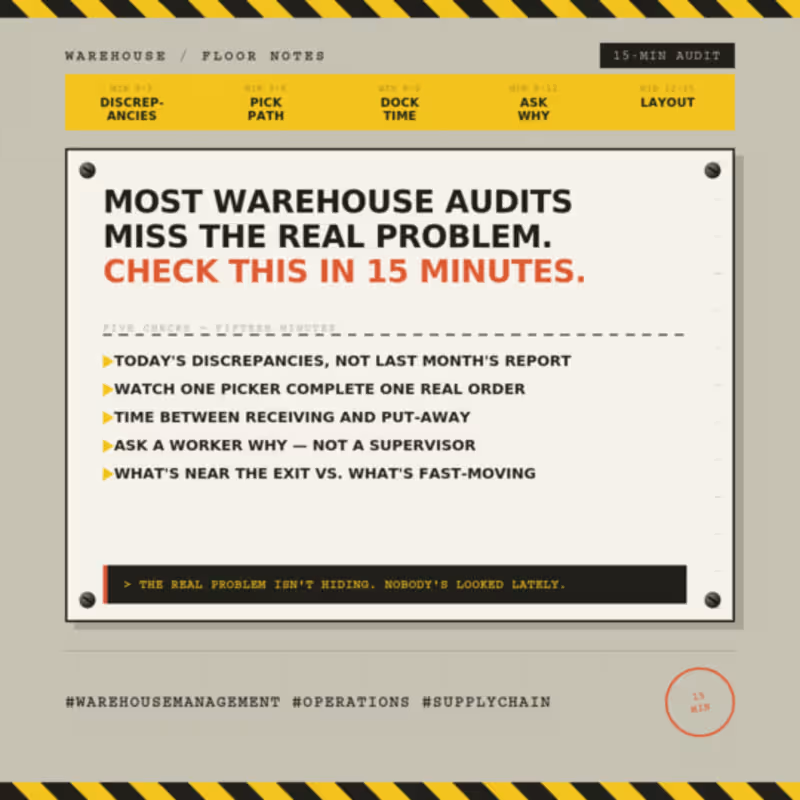
Most warehouse audits I've seen focus on the wrong things first. Neat labels, clean floors, a binder full of SOPs nobody's opened in months — all of it can look great and still sit on top of a warehouse that's quietly bleeding money.
And the SOP binder is usually worse than just outdated. Somewhere along the way, the actual process changed — someone found a faster way to do something, or worked around a problem — and that change lived in their head, not in the document. Everyone just adapts and moves on. Then that person leaves, and suddenly nobody can explain why the process works the way it does, because the only place it was ever really "written down" walked out the door.
If I only had fifteen minutes to walk a warehouse, here's honestly what I'd check.
I'd skip the month-end accuracy report and ask what's mismatched right now, today. A clean number at month-end really just tells you how good someone is at patching things up before a deadline. Asking about today tells you whether the process actually holds up when nobody's paying special attention to it.
Then I'd go find one picker and just watch them complete one real order, start to finish — not a demo, an actual order in the middle of a shift. You learn more in five minutes of watching someone walk a pick path than you do in an hour of reading reports. How far they're walking, how often they double back, how many times they have to stop and ask someone where something actually is.
I'd also want to know how long stock sits between receiving and put-away. Not how fast it gets scanned in — how long it physically sits on the dock before it's properly stored. That gap, more than almost anything else, is where damage, shrinkage, and "we can't find it" problems quietly start.
And I'd ask a warehouse worker why something's done a certain way — not a supervisor. If the answer is "that's just how we've always done it," that's usually a process nobody's questioned in years, or worse, a workaround that only exists in that one person's head.
Last thing, I'd look at what's actually sitting near the exit versus what's actually fast-moving. Layouts get set once and almost never revisited. More often than you'd think, the stuff people grab constantly is buried in the back, and something nobody's touched in months is sitting right up front for reasons nobody remembers anymore.
None of this needs a clipboard or a formal audit template. It just needs fifteen minutes and being willing to ask "why" one more time than feels comfortable — because the answer might only exist in one person's head, and that's the real audit finding.
0
107
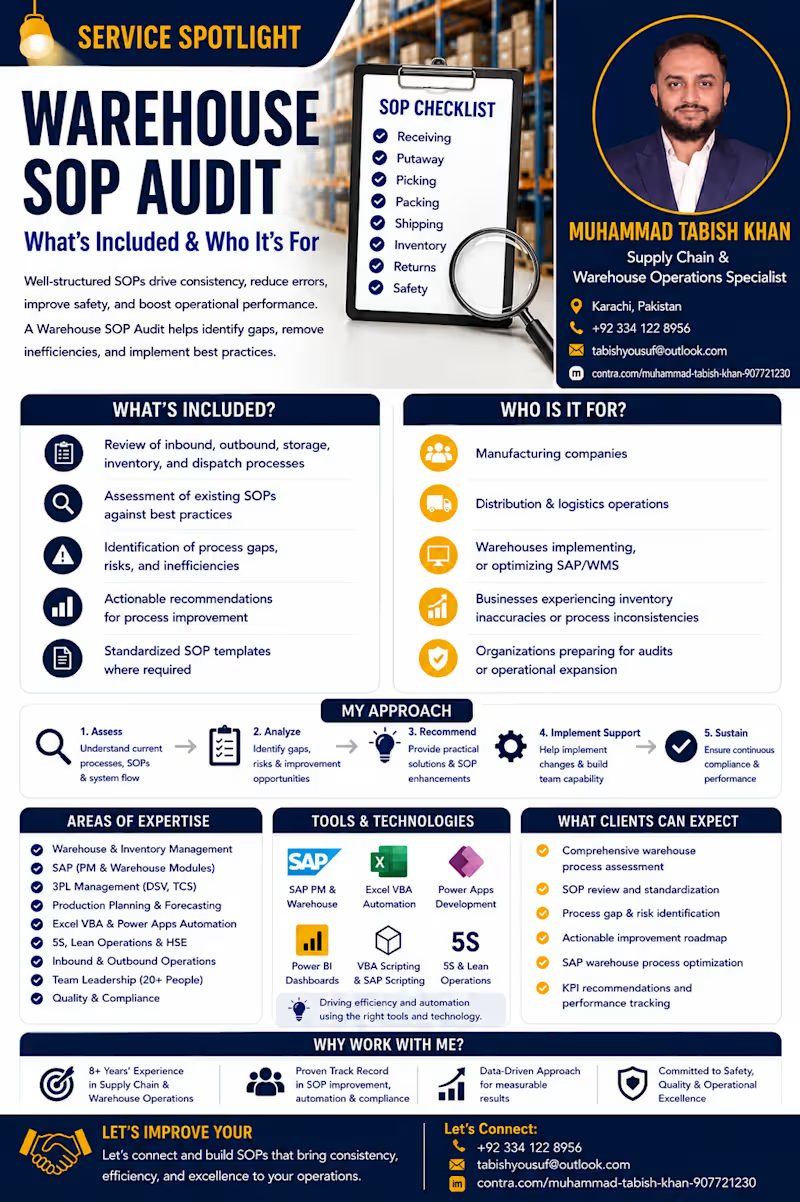
📦 Service Spotlight: Warehouse SOP Audit
Warehouse problems rarely start on the warehouse floor—they start with inconsistent processes.
Poorly documented or outdated SOPs can lead to inventory inaccuracies, production delays, audit findings, and unnecessary operational costs.
I help manufacturing and distribution businesses identify these gaps through a Warehouse SOP Audit.
What you'll get:
✔ Comprehensive warehouse process assessment
✔ SOP review and standardization
✔ Process gap & risk identification
✔ Actionable improvement roadmap
✔ SAP warehouse process optimization
✔ KPI recommendations for continuous improvement
Whether you're implementing SAP, scaling operations, or preparing for an audit, my goal is to help you build efficient, standardized warehouse processes that support long-term operational excellence.
With 8+ years of experience in Supply Chain & Warehouse Operations, I've worked extensively with warehouse management, inventory control, SAP, automation, and continuous improvement in a fast-paced manufacturing environment.
If you're looking to improve your warehouse operations, I'd be happy to help.
👉 Check out my Warehouse SOP Audit service on Contra or send me a message to discuss your requirements.
Helping manufacturers and distribution businesses build efficient, standardized warehouse operations through SOP audits and process improvement.
0
123
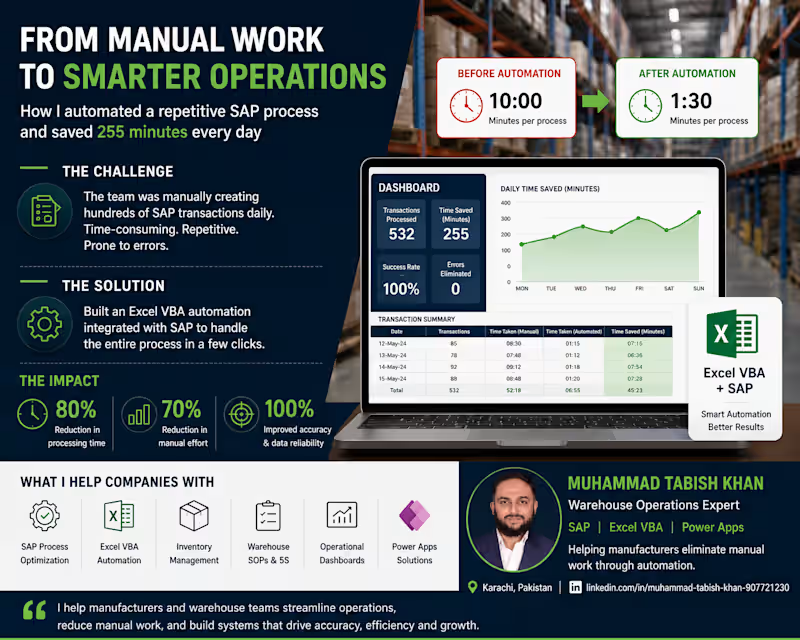
The most expensive warehouse problem usually isn't inventory.
It's repetitive work.
Recently, I analyzed a warehouse process where the team was manually creating SAP transactions every day. The process itself wasn't difficult—it was just repeated hundreds of times.
By building an Excel VBA automation integrated with SAP, I was able to:
✅ Reduce processing time by around 80%
✅ Cut manual effort by 70%
✅ Eliminate repetitive data entry
✅ Allow the team to focus on operational decisions instead of administrative work
The best part?
It required zero additional software investment. We improved the existing process instead of replacing it.
Many companies believe they need a new WMS or another expensive platform.
In reality, the biggest opportunities often come from improving the systems they already have.
I specialize in helping manufacturing and warehouse teams streamline operations through:
• SAP process optimization
• Excel VBA automation
• Warehouse SOP development
• Inventory management improvements
• Custom operational dashboards
• Power Apps solutions
If your warehouse team spends hours every week on repetitive tasks, there is probably a faster way.
Let's optimize the process before investing in new software.
0
255

Versatile wordsmith and design enthusiast





FinTech developer building secure, modern web platforms.
New to Contra
FinTech developer building secure, modern web platforms.
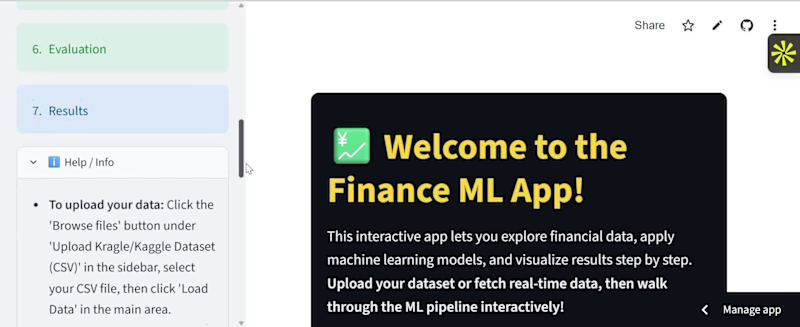
Overview
This project provides an interactive platform for financial data analysis and predictive modeling. Built with Python and Streamlit, it enables users to visualize financial trends and explore machine learning-driven insights through an intuitive, web-based interface.
Key Features
Data Pipeline: Automated ingestion and cleaning of financial datasets.
Feature Engineering: Implementation of financial indicators and technical features to capture market dynamics.
Predictive Modeling: A streamlined training and evaluation workflow using robust machine learning algorithms.
Interactive Visualization: Real-time dashboards allowing users to experiment with different parameters and model configurations.
Technical Workflow
Data Loading: Robust ingestion of historical financial data.
Preprocessing: Handling missing values, noise reduction, and data normalization.
Feature Engineering: Extraction of meaningful market features (e.g., technical indicators, volatility metrics).
Model Training & Evaluation: A modular approach to training, testing, and validating model performance using industry-standard metrics.
Experience It Live
Explore the application and interact with the model here:
👉 Financial ML Dashboard (https://vtt4xouy7ifekdm7s5c4zj.streamlit.app/)
0
130
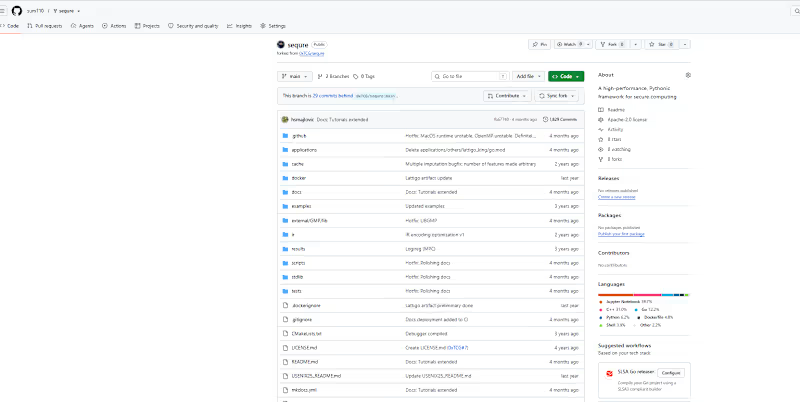
Project Title: Privacy-Preserving Sepsis Prediction Model
Role: AI Research Intern
The Challenge:
Integrating complex Recurrent Neural Network (RNN) architectures within a privacy-preserving Multi-Party Computation (MPC) environment.
Addressing the "fixed-point arithmetic" limitations inherent in cryptographic frameworks when handling 48-hour sequential medical data.
My Approach:
Mentored by a Yale University researcher to bridge the gap between AI and secure cryptographic protocols.
Independently engineered custom normalization and clipping techniques to resolve data overflow issues caused by sequential computation loops.
Successfully optimized the model for the MIMIC-III dataset, ensuring high-quality, functional code performance.
The Outcome:
Successfully contributed the finalized research implementation to the official open-source repository.
Demonstrated technical maturity in handling complex engineering bottlenecks while adhering to formal research methodologies.
Here is my repo link: https://github.com/sum710/sequre
0
125
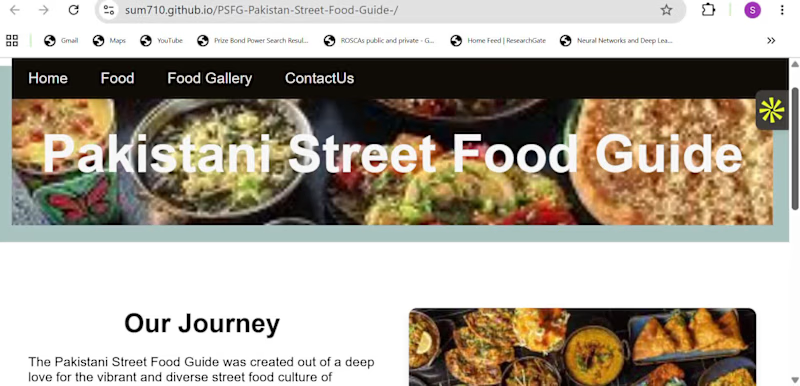
Project Name: Pakistan Street Food Guide
Project Overview
Designed and developed a multi-page, custom website celebrating the rich culinary heritage and vibrant street food culture of Pakistan. The "Pakistan Street Food Guide" serves as a digital exploration of traditional recipes, local favorites, and the stories behind regional street food vendors.
Key Features & Deliverables
Custom Multi-Page Architecture: Structured a seamless navigation experience across dedicated sections, including the homepage, a visual Food Gallery, and a Contact portal.
Lightweight Front-End Engineering: Built entirely from scratch using clean HTML5, CSS3, and vanilla JavaScript. By avoiding heavy external frameworks, the site maintains rapid load times and a highly optimized codebase.
Semantic UI/UX Design: Developed an intuitive, image-focused layout designed to highlight cultural storytelling and visual content effectively across different screen sizes.
#html #CSS#Frontend #javascript#webdevelopment
0
108

Title: Civitas: Digitizing Community Savings & Financial Trust with AI
Description:
Traditional community-based saving groups (committees/ROSCA) have always been built on trust, but they often struggle with manual record-keeping, transparency issues, and security risks.
I am excited to share Civitas, a full-stack FinTech solution designed to modernize the committee system. Civitas transforms how communities save and contribute money by blending automated financial management with AI-driven security.
Key Features:
Digital ROSCA Management: A transparent platform where users can join, track, and manage their committee contributions automatically.
AI-Powered Trust Engine: A scoring logic that tracks payment consistency and user reliability, ensuring a safe ecosystem.
Payout Security: Payouts are protected with mandatory Two-Factor Authentication (2FA) and Google OAuth integration.
Modern Tech Stack: Built with React 19, Supabase Cloud, and AI financial advisors.
Why Civitas?
In the world of FinTech, trust is everything. Civitas replaces paper-based tracking with a permanent, automated digital ledger, reducing human error and building a stronger, more reliable financial community.
Explore the live project here: https://civitas-backend.vercel.app/
I’d love to hear your thoughts on how digital transformation is changing the landscape of community-based finance!
#FinTech #WebDevelopment #FullStack #AI #ProductDesign #Civitas #FinancialInclusion
0
133