The network for creativity
Join 1.25M professional creatives like you
Connect with clients, get discovered, and run your business 100% commission-free
Creatives on Contra have earned over $150M and we are just getting started
Back to feedPost
🚨 MOST PRODUCTIVITY APPS DON’T HAVE A RETENTION PROBLEM.
THEY HAVE A VALUE-COMPOUNDING PROBLEM.
They help users capture more:
📝 More notes
🔗 More links
📸 More screenshots
🎙️ More voice memos
But a larger archive does not automatically become a more valuable product
The real test starts later:
❓ WHAT HAPPENS AFTER THE USER HAS ALREADY CAPTURED 300 THOUGHTS?
That is where most products quietly fail. Because the archive grows. But the user’s understanding does not.
A voice note from Monday.
A screenshot from Thursday.
An article saved two weeks later.
A sentence typed at 1 AM.
Individually, they look unrelated.
But sometimes they are the same unresolved question appearing in different forms.
And this is where AI becomes genuinely interesting.
Not when it summarizes another note.
Not when it rewrites another paragraph.
Not when it gives users another chat box.
But when it recognizes:
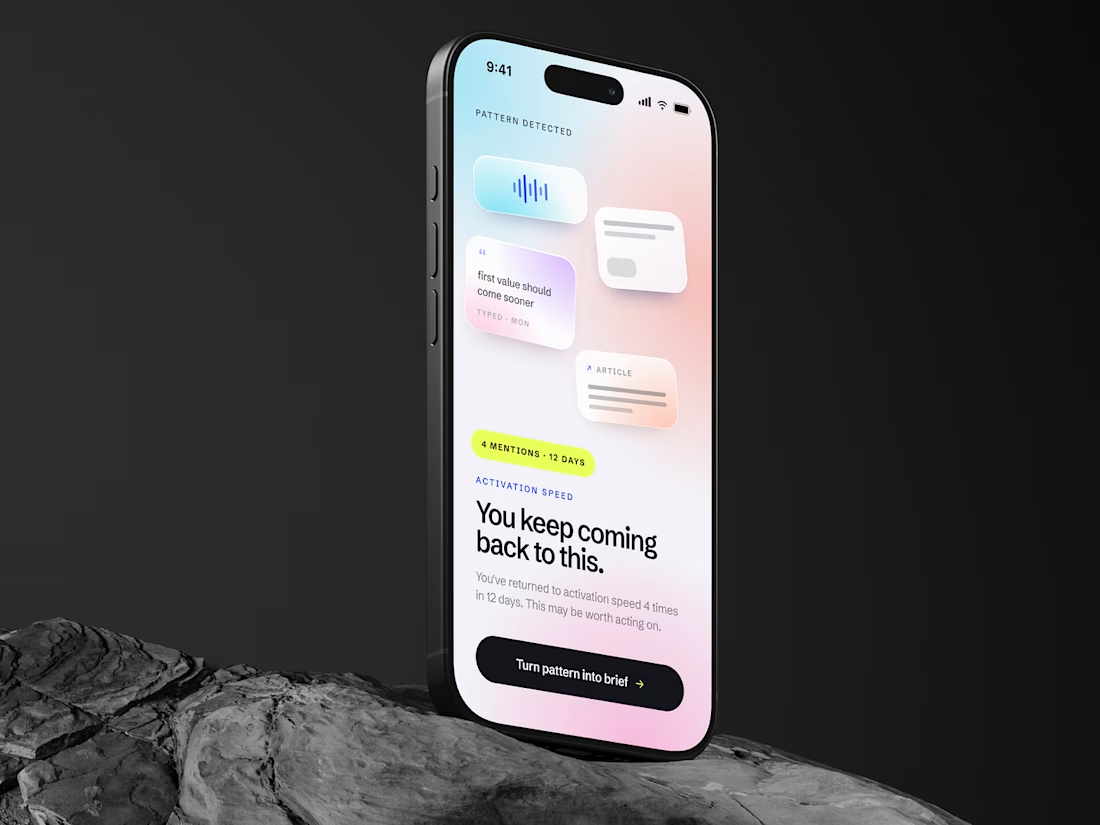
🧠 YOU HAVE BEEN CIRCLING THE SAME PROBLEM FOR 12 DAYS.
For this concept, the core mechanic was built around one distinction:
⚡ FREQUENCY IS NOT REPETITION.
REPETITION IS EVIDENCE.
A thought mentioned once may be noise.
A thought mentioned four times across different contexts may be a signal.
And a product that can detect that signal can create value a normal archive cannot.
01 - CAPTURE
🎙️ The thought should enter the system before it disappears.
No folders.
No tagging.
No forced structure.
02 - UNDERSTAND
AI extracts the underlying meaning.
“Maybe onboarding should get people to value faster…”
becomes:
💡 REDUCE TIME TO FIRST VALUE.
That is already more useful than transcription. But it is still not the interesting part.
03 - CONNECT
The system sees another thought about activation.
Then an article about onboarding. Then a screenshot. Then another voice note. Now the product has enough context to say:
🔁 YOU KEEP COMING BACK TO THIS.
4 mentions.
12 days.
At that moment, the system is no longer helping the user remember information.
It is helping the user recognize importance.
04 - TURN CONTEXT INTO VALUE
This is where the growth logic changes. Most retention loops ask users to come back and repeat the same action:
📝 Create another note
📊 Track another habit
🍽️ Log another meal
✅ Complete another task
A stronger loop can work differently:
📈 EVERY NEW INPUT INCREASES THE VALUE OF PREVIOUS INPUTS.
The product becomes better not simply because the user used it more often, but because accumulated context creates new insight. That creates compounding value.
Day 1:
The product understands what you said.
Day 10:
It understands what keeps repeating.
Day 30:
It may understand what deserves action.
That is a much more defensible form of retention. Because the user’s history is no longer just stored data. It becomes product intelligence.
✨ AI SHOULD NOT JUST HELP USERS PRODUCE MORE.
IT SHOULD HELP THEM NOTICE WHAT THEY ARE ALREADY REVEALING THROUGH THEIR OWN BEHAVIOR. That is where a note-taking product stops being an archive. And starts becoming a thinking system.
👇 FULL CASE STUDY BELOW
👉 BOOK A MOBILE APP SESSION


Thanks


The value-compounding problem part really makes sense. A product becoming more useful because of what you’ve already added is such a strong idea.
Exactly. That’s the shift I find most interesting: from measuring retention by how often users return to measuring how much additional value their accumulated context creates. Usage alone isn’t the moat. Compounding context can be.


the "circling the same problem for 12 days" bit is too real
Haha, exactly 😄 That’s probably the most human part of the whole concept. We think we’re having different thoughts, but half the time we’re just approaching the same unresolved thing from different angles.
facts, my notes app is a graveyard


Maybe the strongest retention loop isn’t habit at all. It’s accumulated context becoming too valuable to abandon.
Yes and that changes what we should optimize for. Not just return frequency, but the value of the user’s accumulated history. The stronger that value becomes over time, the less retention needs to be artificially manufactured.

😍 😍 😍

Love this!

Well done
Thank you! Glad it resonated 🙌

The 'repetition is evidence' reframe is the sharpest part of this for me, most teams treat repeat mentions as noise to filter out. Have you gotten pushback from PMs who built their roadmap around the capture-more model, or has this framing landed easily with clients?
That’s exactly where the tension usually appears.
“Noise” is often defined from the system’s perspective: repeated input looks redundant. But from the user’s perspective, repetition can mean an unresolved need, recurring anxiety, or a decision they still haven’t made.
So I...
Reframing it as 'what useful signal are we deleting' instead of 'should we allow duplicate notes' is such a sharp way to get PM buy in without asking them to change how they store anything. Have you actually shipped that separation between capture and intelligence layers yet, or...

Great work, Anna.
Thanks😍


Good work🔥👏
Thanks😍


Amazing Project
Thanks😍

really like your work and that kind of style! wow!


Nice work
Thank you! Glad it resonated 🙌


Spot on! Shifting from an archive to a true thinking system is the future of AI productivity tools
Exactly. And I think the real shift is from “help me retrieve what I saved” to “help me understand what all of this means together.”
Search and summaries make an archive easier to use. But connecting patterns across weeks or months can actually change the value of everything the user has already captured.


Impressive work !
Thanks😍


Great thoughts and cool project.
Thank you! What I enjoyed most here was going beyond the interface and asking what would actually make the product more valuable after months of use, not just on day one.

👍 🔥
😍

Amazing work
Thank you so much! Glad you liked both the concept and the visual direction 🙌

Exactly. Capture creates the raw material, but the real product value appears when that material starts working for the user later. If something I saved three months ago can help me understand a decision I’m making today, the archive stops being storage and starts becoming an asset

Great points. How do you show these repeating patterns to users without cluttering the app or slowing down quick note taking?
I’d keep pattern detection completely outside the capture flow. Capturing should remain almost frictionless.
The product should surface a pattern only when the confidence and potential value are high enough to justify the interruption for example when several semantically...

You explained this idea so clearly. Thank you for such a great post🤩
Thank you! 😄 I’m really interested in the point where AI stops being an extra feature and starts changing the underlying value of the product. This concept was a fun way to explore that

The "repetition is evidence" reframe is such a sharp idea, most tools just treat repeated notes as clutter to clean up instead of signal. What made you land on 4 mentions across 12 days as the threshold instead of something looser?
The 4 mentions / 12 days threshold was illustrative rather than a rule I’d hard-code into the product.
In a real system, I’d probably avoid a universal numerical threshold altogether. Repetition count is only one signal semantic similarity, time span, specificity, context, and...

This is a much better way to think about retention. Give users a reason to return because the product understands them better over time, not because you’ve created another notification or streak.
Exactly. There’s a big difference between engineering another reason to open the app and making the product genuinely more valuable because the user has been using it.
A streak can increase tomorrow’s session. Accumulated understanding can increase the cost of leaving the product...

The “every new input increases the value of previous inputs” idea is really interesting. That feels like a much stronger retention loop than simply giving users more reasons to capture things. Curious how you’d handle false patterns though—when does repetition become a meaningful signal vs. just noise?

Awesome 🔥

This is such a standout piece!

Turning raw captures into repeating pattern recognition is peak product intelligence. Moving from a storage archive to a true "thinking system" creates incredible compounding value. Spot-on analysis and stunning mobile UI! 💡🚀


Really like this perspective. The best use of AI isn’t just helping people save more information but helping them understand the patterns in what they’ve already saved. When a product can connect those dots over time, that’s where it starts becoming genuinely useful.

The network for creativity
Join 1.25M professional creatives like you
Connect with clients, get discovered, and run your business 100% commission-free
Creatives on Contra have earned over $150M and we are just getting started



Challenges
View all


Related posts


Engaging website for a New York–based architecture and construction studio, balancing bold typography, immersive imagery and a minimal editorial layout.


Two case studies, two totally opposite registers.
One is carved in stone and says nothing.
One drips off a spoon and won't shut up about which field it came from.
Which one do you want first?
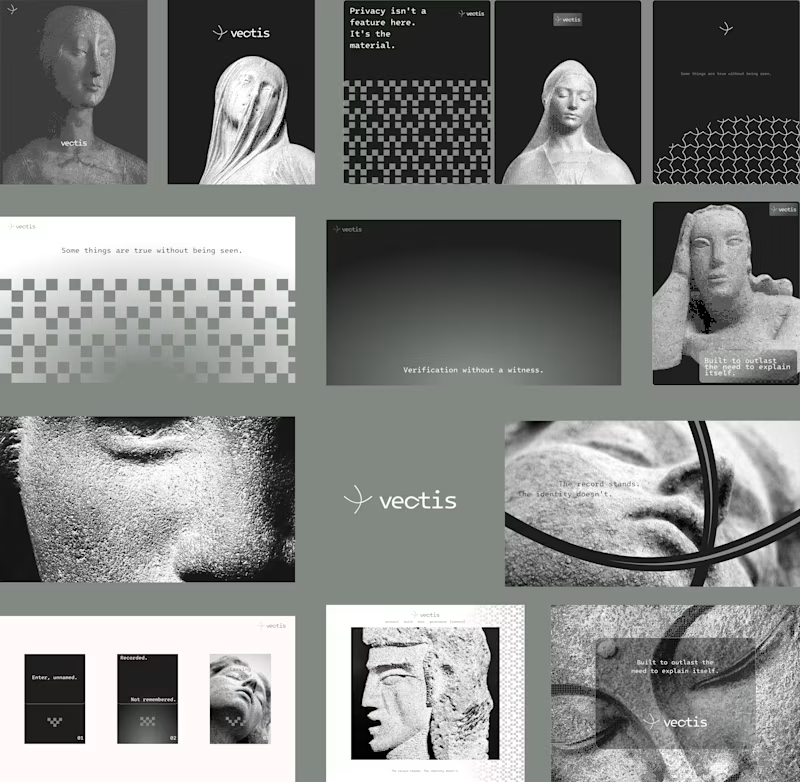
vectis — zero-knowledge privacy, dithered like a forgotten statue
HIVE INDEX — raw honey with a paper trail. No two lots taste the same, and we don't correct for that.
45 voted
51%
43 voted
49%

88 votes
Closed

Vectis

Ledger — AI CFO Platform
Ledger is an AI platform that acts as an always-on Chief Financial Officer for founders — connecting to accounts, learning cash rhythm, and surfacing risks before they become real problems. I designed the full landing page.
My role: UI/UX Design
Scope: Landing page
Financial tools for founders usually feel either cold (dashboards) or intimidating (accounting software).
For Ledger, we borrowed from old-world institutional finance instead — serif type, oil-painting textures, classical architecture — so an AI CFO feels like real authority, not another app.


This color pallet works so well with data and makes everything look premium. love it!


