Construction Operations Workflow System

Julissa Roa


Comapa — Construction Operations Workflow Transformation
Designing a centralized operational system for a construction company — replacing fragmented spreadsheets with a structured Airtable workflow that connects field data capture, equipment tracking, maintenance scheduling, and automated reporting.
The Problem
Operational data scattered. Maintenance reactive. Reporting manual.
Construction operations run on a constant flow of moving parts — active project timelines, labor coordination, machinery across multiple sites, fuel consumption, and service intervals that, if missed, carry direct cost consequences.
At Comapa, this data lived across multiple Excel files per machine, team-specific logs, and scattered communication threads.
There was no single source of truth.
Project managers couldn’t get a consolidated view of equipment performance. Maintenance was handled after problems surfaced rather than before. And operational reporting required manually compiling numbers from multiple sources — time spent aggregating data instead of making decisions.
An untracked breakdown or missed service interval isn't just an inconvenience — it's a direct cost that could have been avoided with the right system.
The System
Built around the actual workflow — not an ideal one.
The goal wasn’t to introduce a complex new tool. It was to meet the team where they already worked and impose structure on top of it.
Airtable was selected for its relational tables, native form builder, and scripting capabilities — allowing non-technical field operators to capture structured data while maintaining a clean linked data model for reporting.
The design principle was simple:
Operators enter data once. Everything else happens automatically.
Summaries, maintenance forecasts, and equipment history are generated from the same data source without manual reporting.
Workflow Framework
One pipeline from field entry to management insight
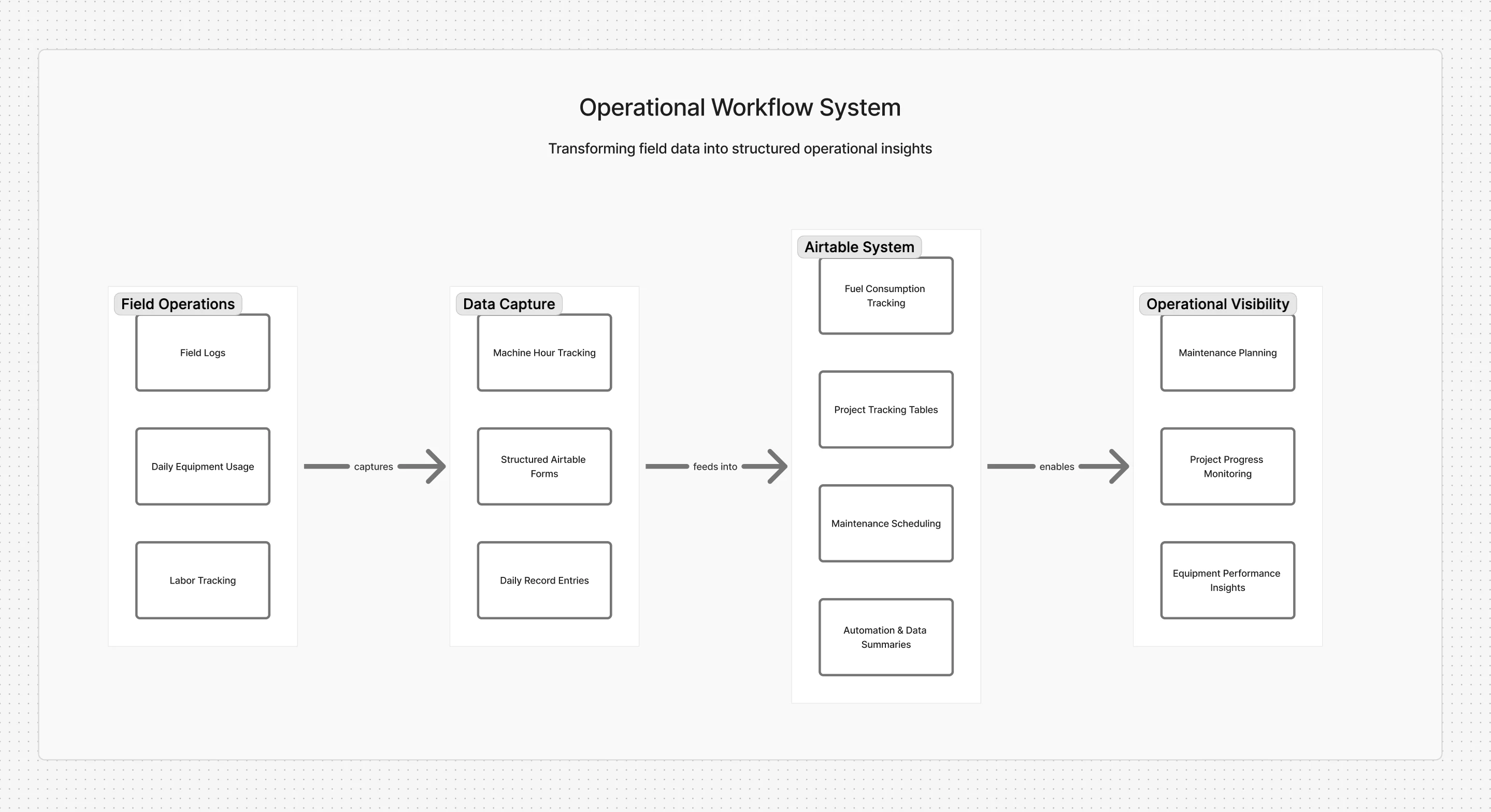
The system operates as a single, structured data pipeline.
Field operators capture daily operational data through Airtable forms. That data flows into linked tables which trigger automations that generate operational summaries and maintenance forecasts for management review.
The structure eliminates manual aggregation and ensures critical operational data is always captured consistently.
Core System Components
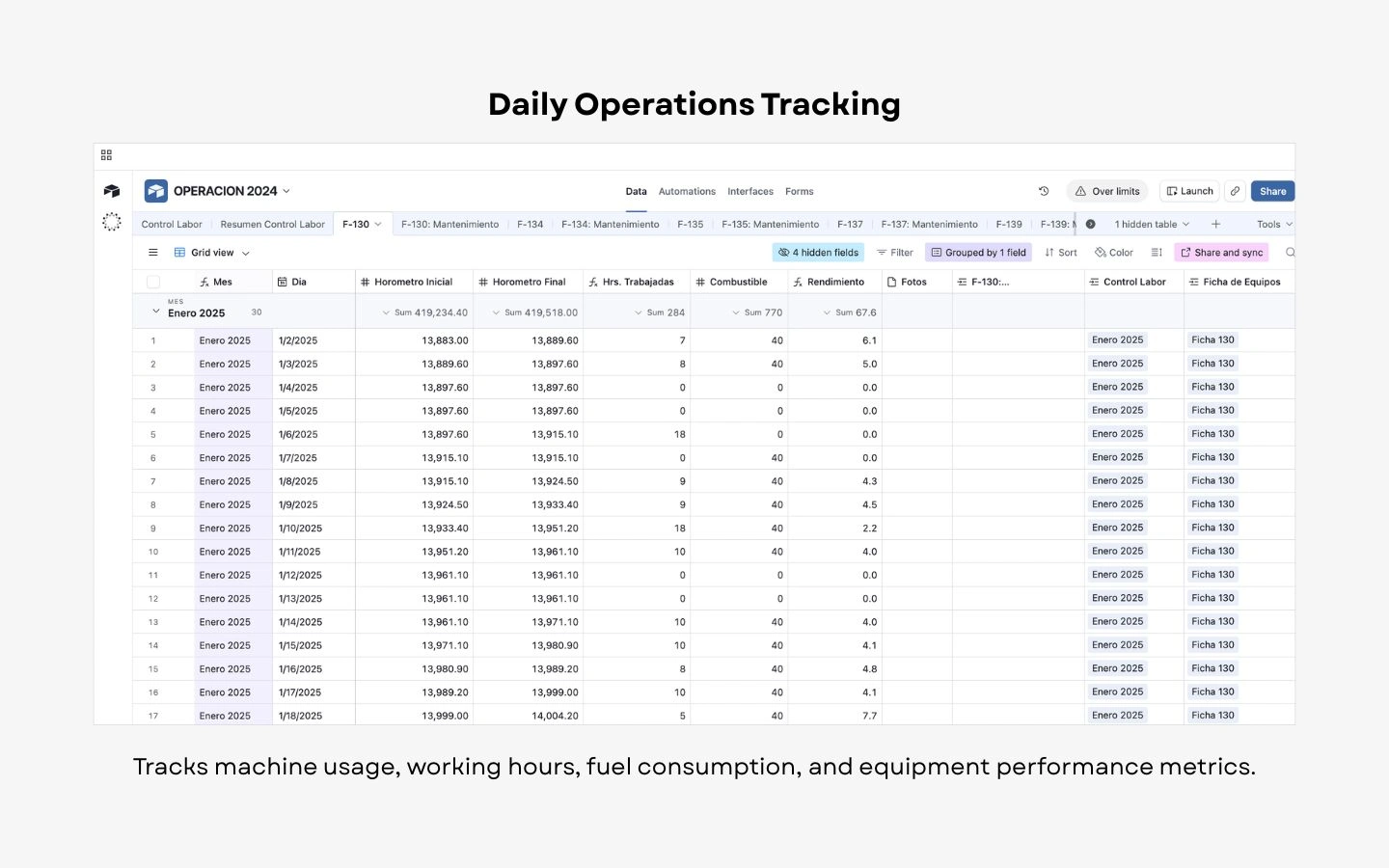
Captures initial and final horometer readings, hours worked, fuel consumption, and a calculated performance metric per machine per day.
Records are grouped by month and linked to equipment IDs for filtering and reporting.
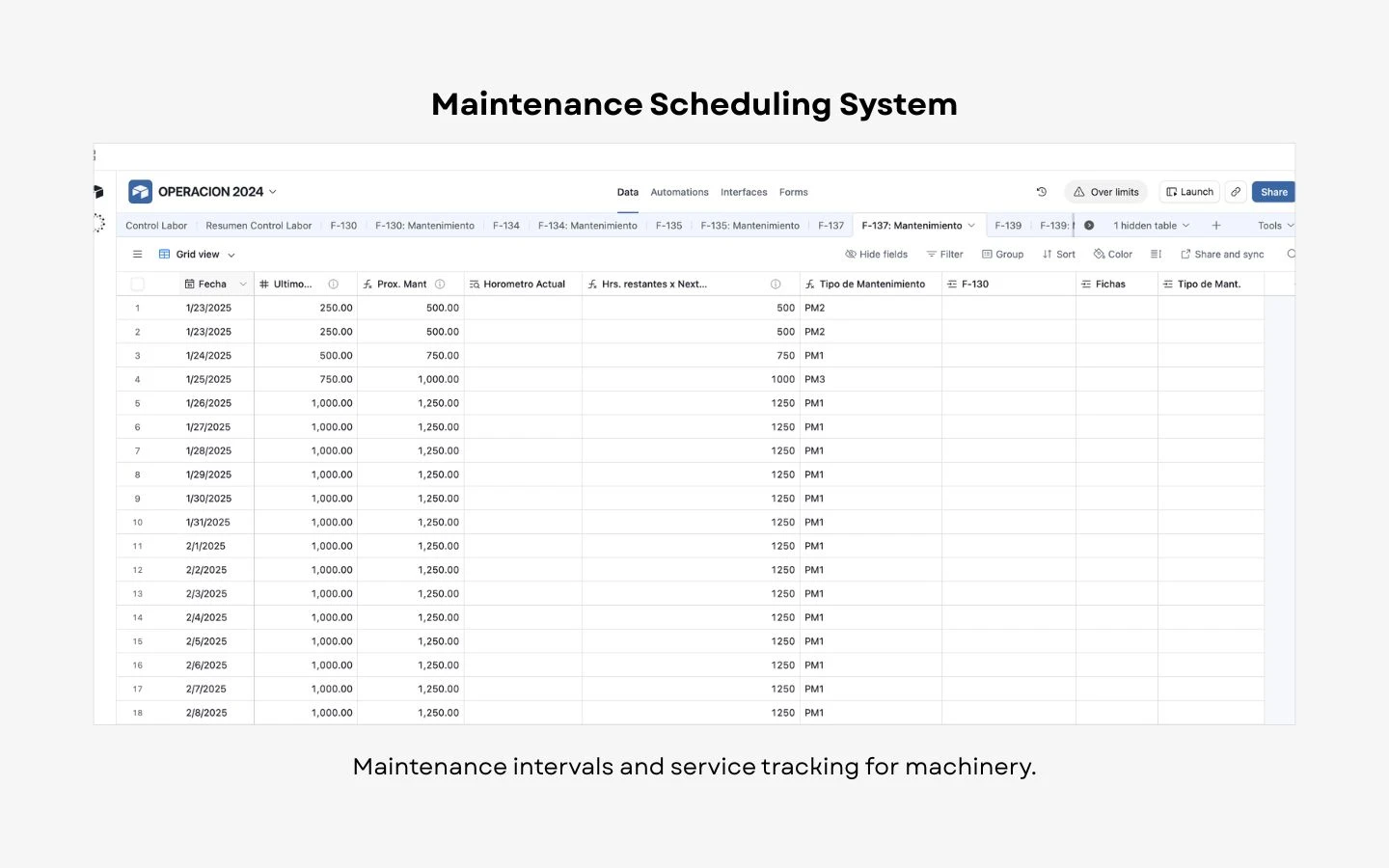
Each maintenance record pulls the live horometer reading and calculates hours remaining until the next preventive maintenance interval (PM1, PM2, PM3).
Maintenance becomes a scheduled process instead of a reactive one, allowing teams to anticipate service needs before issues occur.
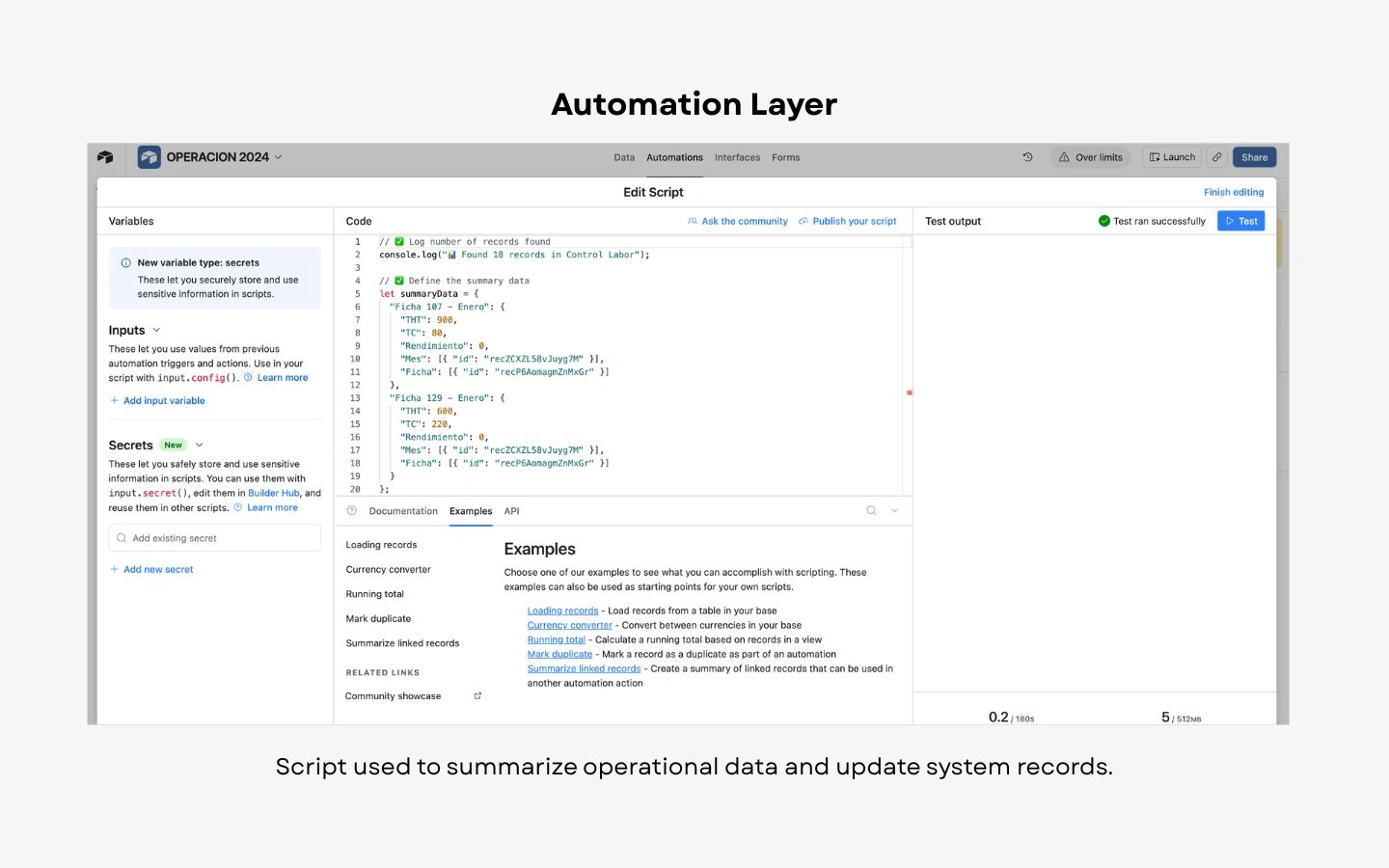
Custom JavaScript automations aggregate daily operational records into monthly summaries including:
• total hours worked
• fuel consumption
• average machine performance
These summaries are automatically written back to linked records — eliminating manual reporting entirely.
Outcome
One system. Full visibility. Zero manual reporting.
The system replaced a web of disconnected spreadsheets with a centralized operational source of truth.
Field operators enter data once. Everything else — monthly summaries, maintenance forecasts, and equipment history — is generated automatically.
Management now has a real-time operational picture without additional reporting effort.
The most immediate impact is the shift from reactive to scheduled maintenance. Instead of responding to equipment failures, teams now anticipate service needs days or weeks ahead and plan around active projects
Available for projects
Need a system like this built for your operation?
I design and implement operational workflow systems using Airtable, automation, and structured data capture — helping teams move from fragmented spreadsheets to scalable operational infrastructure.
Like this project
Posted Mar 26, 2026
Operational workflow system built in Airtable to centralize project tracking, machinery management, and daily construction operations.