AI Opportunity Mapper | Practical AI Discovery

Amy Frank

Introduction
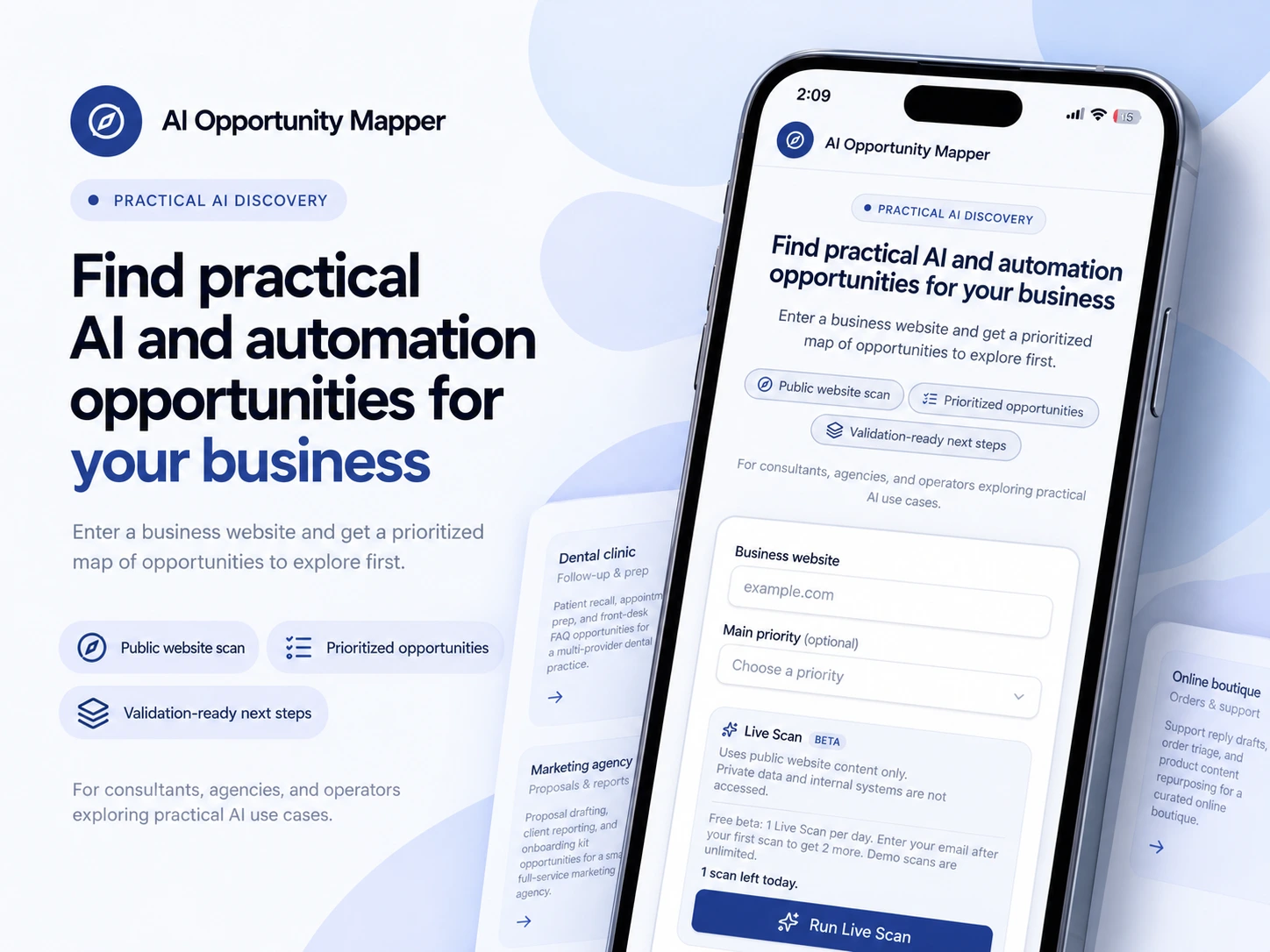
AI Opportunity Mapper helps consultants, agencies, and business operators turn a broad interest in AI into practical opportunities to explore. Users enter a business website, optionally choose a priority, and receive a structured starting point for discovery and validation.
I designed and built this independent product to connect business analysis, responsible AI enablement, and practical custom software.
The Problem
Businesses often know they want to use AI but struggle to decide where it could help. Generic idea lists offer little guidance on relevance, implementation effort, or the risks of automating a process too early.
The product addresses an early discovery question: which opportunities deserve a closer look, and what should the business validate before investing in a build?
The Solution
The Live Scan beta uses public website content to infer business context and likely workflow areas. It produces a business snapshot, three ranked AI and automation opportunities, a top recommendation with rationale, quick wins, and a starter roadmap preview.
Each recommendation connects an observed or inferred public signal to a likely pain point and suggested improvement. An impact-versus-ease heatmap makes the tradeoffs easier to explore. Sample maps for a dental clinic, marketing agency, and online boutique let users try the experience before scanning a website.
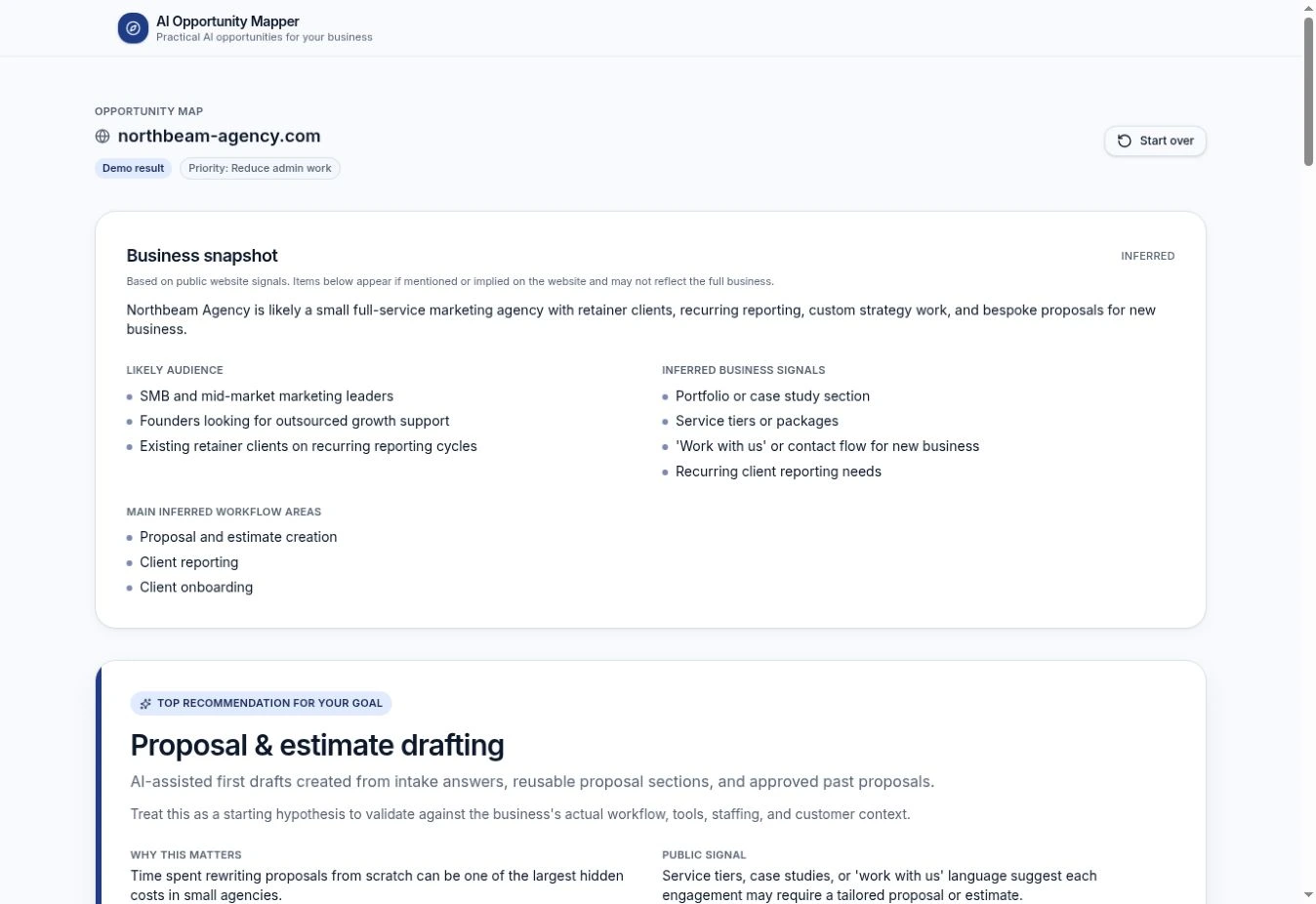
Marketing agency demo: inferred business context and the recommended starting opportunity.
Product Design
I structured the experience around prioritization rather than a long list of AI ideas. Recommendations are weighted toward the user’s goal and presented with inferred impact, effort, confidence, and automation risk. The heatmap and suggested sequencing help users compare potential value with implementation difficulty before choosing where to investigate.
The design separates evidence from interpretation. Public signals, likely pain points, and suggested improvements are shown distinctly, while “inferred” labels make uncertainty visible. Confidence communicates how well an opportunity appears to fit; automation risk highlights where human review matters.
The navy-blue and indigo palette, light-gray surfaces, clear cards, and progressive detail support a calm, readable experience. The user can move from a concise business snapshot to recommendations and initial next steps without needing technical expertise.
Responsible AI boundaries
The tool does not access private business data or internal systems. Recommendations are hypotheses to validate against actual workflows, staffing, tools, budget, and customer needs. Website content can only provide a partial picture of a business.
Demo results use sample business patterns. If a website cannot be reached, the app falls back to prototype mode, using the URL, selected priority, and business-type patterns. These modes are distinguished from a Live Scan.
Built today and planned next
The current beta includes public website scanning, sample maps, ranked opportunities, a heatmap, quick wins, and a starter roadmap preview. Expanded analysis is planned and not yet available. Deeper reporting, expanded roadmap detail, and exportable reports are presented as future capabilities.
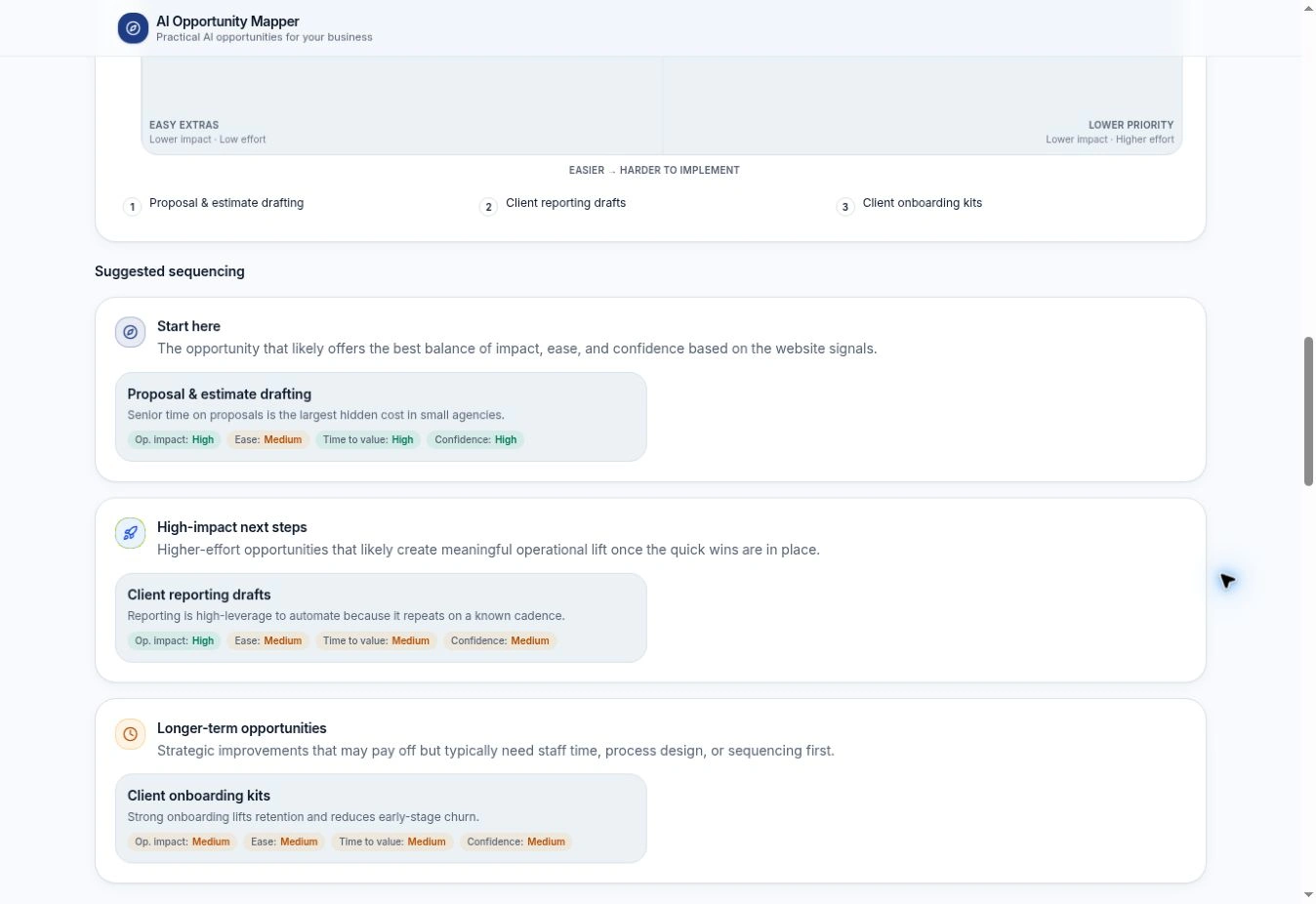
Marketing agency demo: suggested sequencing with inferred impact, ease, time to value, and confidence.
My Role
I led the project end to end: concept development, problem definition, business analysis, feature scoping, requirements, UX, application development, and iterative testing. I translated a broad discovery problem into a focused user flow and structured outputs that support a business conversation.
My work included the recommendation framework, prompt and result logic, sample business experiences, Live Scan flow, responsible AI messaging, and evaluation of output clarity and relevance. I built and refined the application in Lovable, connecting product decisions with hands-on implementation.
The Outcome
The result is a working public beta that turns a business website and an optional priority into a structured AI opportunity map. Users can explore recommendations, compare tradeoffs, and identify initial steps to validate with their team.
This project demonstrates how I connect business analysis with practical software development: defining the problem, translating it into requirements, designing useful AI outputs, and building an experience that makes the next decision clearer.
This project demonstrates how I connect business analysis with practical software development: defining the problem, translating it into requirements, designing useful AI outputs, and building an experience that makes the next decision clearer.
Like this project
Posted Oct 12, 2026
An AI discovery app that turns public website signals into prioritized opportunities, quick wins, and a starter roadmap for business validation.