The Closing Tear: A Spanish-to-English Voice Adaptation

Mario Abbate


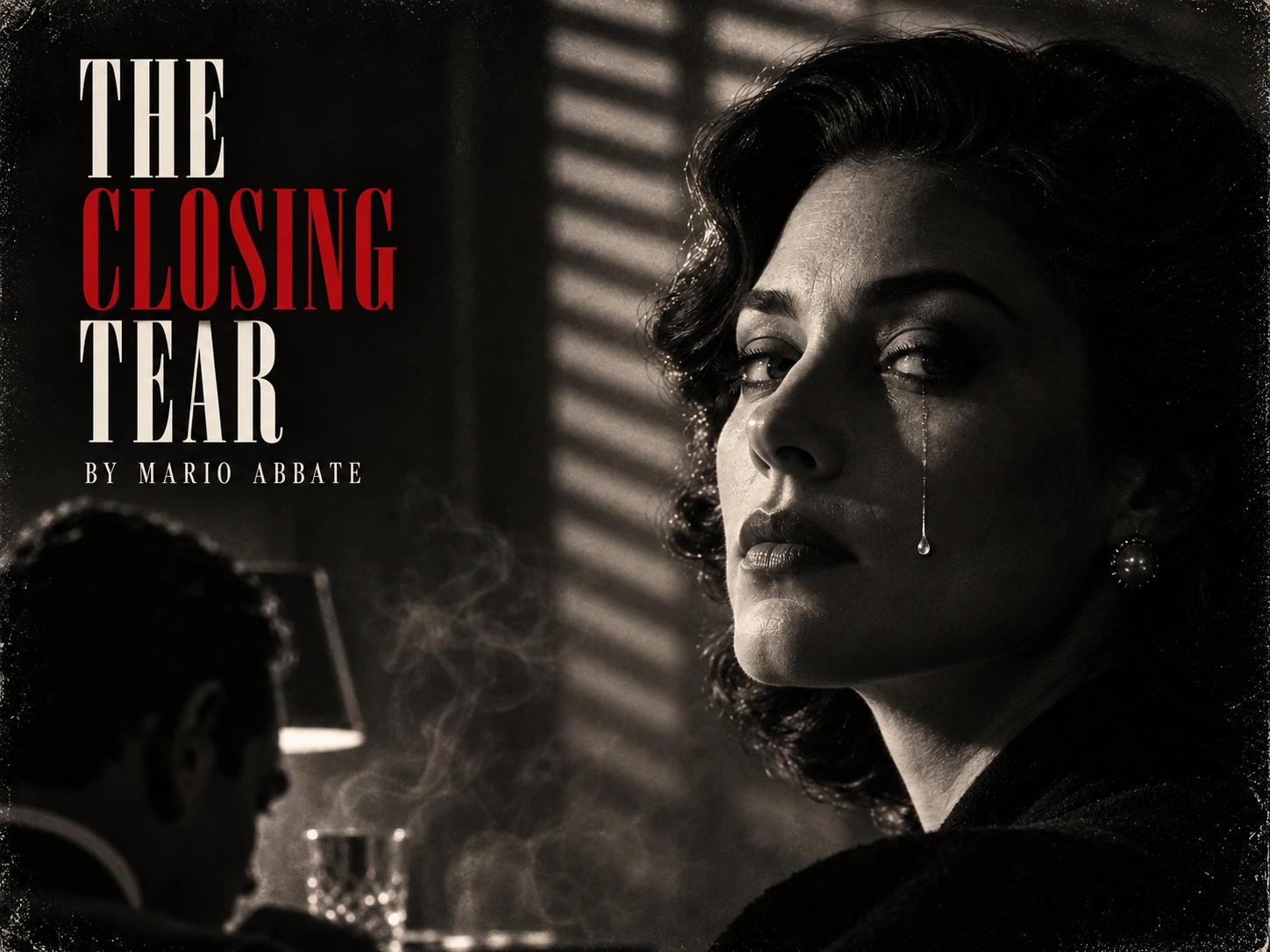
The Closing Tear
Spanish-to-English voice adaptation · Self-directed editorial case study · Neo-noir cultural essay
The brief
Adapt a deliberately provocative Spanish essay into idiomatic English without sanding away its voice. The piece depends on compression, legal imagery, repetition, and the moral ambiguity of classic noir. The task was not to translate sentence by sentence, but to preserve pressure: every paragraph had to tighten the argument or sharpen the atmosphere.
The essay speaks through a deliberately adversarial male narrator. The adaptation preserves that persona as a feature of the writing; it does not present his perspective as neutral social analysis.
The source and the English adaptation are my own work. This is not a client commission and makes no claim of publication, endorsement, or commercial performance.
Source opening — Spanish
“No llora porque le duele. Llora porque ganó.
Hay un momento en cualquier discusión con una mujer en que el argumento deja de importar. No porque haya sido refutado. No porque alguien haya dicho algo definitivo. Sino porque aparecen las lágrimas, y en ese instante todo lo que él había dicho —por más razonable, por más documentado, por más verdadero que fuera— se convierte en la causa de ese llanto. Él quedaba como el villano. Ella, como la herida. El juicio terminó antes de que pudiera presentar su defensa.”
English adaptation
She is not crying because she is hurt. She is crying because she won.
There comes a moment in an argument with a woman when the argument itself ceases to matter. Not because it has been refuted. Not because someone has delivered the final word. But because the tears appear—and in that instant, everything he has said, however reasonable, however well documented, however true, becomes the cause of those tears. He becomes the villain. She, the wounded party. The trial is over before he has had a chance to present his defense.
Kevin Samuels popularized a label for it: SIGN Language. Not sign language—the other kind. The one people use when they feel themselves losing ground: Shame, Insults, Guilt, and the Need to be right. Shame first, to make him doubt himself. Insults when shame is not enough. Guilt to paralyze him. And finally, the compulsive need to be right—not to find the truth, but to possess it—which turns any conversation into a war of position where substance is irrelevant and victory is all that counts.
The closing tear is the period at the end of that sequence.
The weapon that leaves no fingerprints.
Chandler understood the dramatic possibilities of that distinction. In the moral logic of his fiction, tears could express pain—or perform it. Marlowe's gift was not immunity to emotion, but suspicion of anything arriving at exactly the right moment. Noir was born, among other things, from men who had learned to ask what a gesture was trying to achieve.
The problem is that biology may conspire against that distinction. A 2011 Science study, “Human Tears Contain a Chemosignal,” reported that exposure to women’s emotional tears reduced sexual arousal and testosterone in men. That finding does not turn every tear into a chemical weapon, nor does it establish anyone’s intention. But it does mean the response is not merely symbolic. The body is already in the room.
The most sophisticated thing about SIGN Language is that it does not require conscious intent to work. I am not saying that every woman who cries is lying. I am saying that some people learn, without ever being formally taught, that tears can end conversations that arguments cannot.
And a man who understands that is not insensitive.
He has simply learned how to read.
How many times did you think you were winning an argument with a woman—until the first tear appeared?
Editorial decisions
Narrative stance. The essay uses a deliberately adversarial male persona. The English version preserves that charged viewpoint while identifying it as voice rather than neutral reportage.
Voice over literalism. “No de encontrarla, de tenerla” became “not to find the truth, but to possess it.” The English is less literal, but it preserves the opposition between inquiry and ownership.
Rhythm as meaning. The isolated lines—“The weapon that leaves no fingerprints” and “He has simply learned how to read”—remain short because their force depends on silence around them.
Legal imagery. “The trial is over before he has had a chance to present his defense” preserves the essay’s governing metaphor without extending it past its useful limit.
Attribution and scientific caution. The adaptation distinguishes popularization from authorship, interpretation from quotation, and a reported physiological effect from any claim about conscious intent.
Cultural register. The prose retains the hard, understated cadence of classic noir without imitating a specific passage or presenting a paraphrase as a quotation.
Deliverable
A publication-ready English adaptation, a documented rationale for the principal departures from literal translation, and a neo-noir visual identity reformatted for an international portfolio.
Like this project
Posted Sep 21, 2026
Edited and adapted a provocative neo-noir essay into natural English, preserving its cadence while tightening attribution and factual precision.
Likes
0
Views
1