Built with Kajabi
Kajabi Funnel Design & Implementation for Matias Cardozo

Poncho Black

Matias Cardozo:
Kajabi Funnel Design & Implementation
Project overview
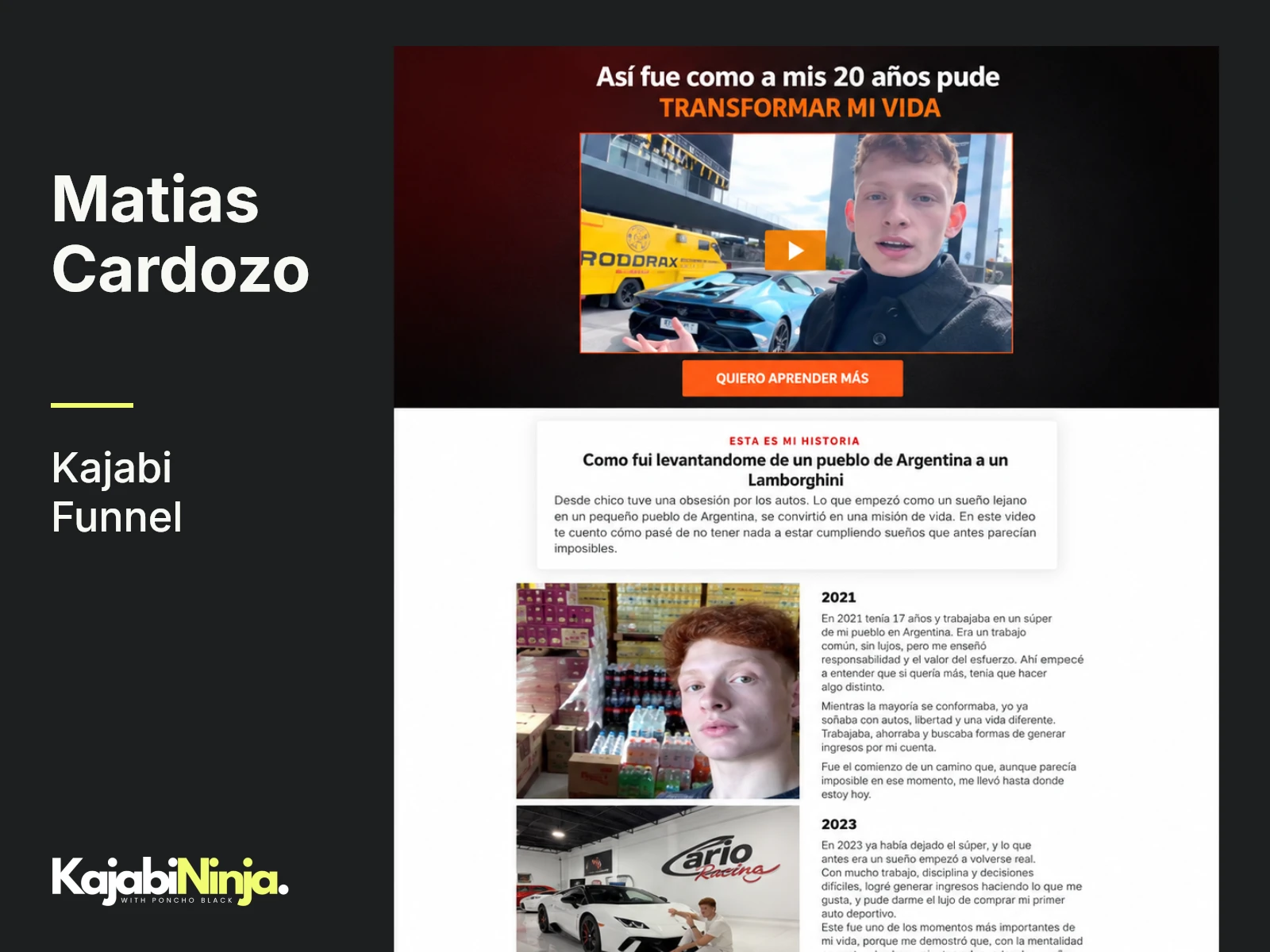
Matias Cardozo’s online business combines coaching and education around personal development, e-commerce, and personal branding.
His personal story is a prominent part of how he introduces his work. Alongside that story, visitors encounter information about his training, mentorship, and opportunities to work with him.
I worked on a Kajabi funnel for Matias, handling the funnel’s design and implementation within the platform.
The project focused on organizing the online experience around an intended next action. My role was to bring the page presentation, information sequence, and visitor-facing connections together within Kajabi.
The objective
A coaching offer asks visitors to make a considered decision.
They need to understand who is behind it, what the offer involves, whether it relates to their situation, and how to take the next step.
I approached the funnel around those questions.
The objective was to give the content a purposeful sequence, with each part helping visitors understand the offer before reaching the associated action.
The priorities were:
Introduce Matias and the context behind his work.
Organize the information explaining the offer.
Give the intended next action a clear place within the experience.
Carry the presentation consistently through the funnel.
These priorities provided a basis for the page design and implementation.
My role
I handled the Kajabi funnel work directly.
The scope brought together page layout, content presentation, calls to action, and the connections forming the visitor journey.
I considered how these elements worked together. The opening content needed to establish context. Supporting sections needed to develop the offer. Buttons and links needed to communicate where a visitor would go next.
My responsibility was to translate that structure into an implemented experience within Kajabi.
Organizing the funnel content
Establishing context at the entry point
The opening section needed to help visitors orient themselves.
For a personal brand, that includes the relationship between the person and the offer. Visitors may recognize the name while still needing an explanation of the opportunity being presented.
I considered how the introductory message, imagery, and supporting content could establish that context.
The intention was to make the purpose of the page understandable before asking visitors to explore the details.
Giving the offer room to be understood
The offer explanation formed another important part of the page structure.
Coaching and education can include several elements, and presenting them together requires attention to hierarchy. Visitors need to distinguish the main proposition from the supporting information.
I arranged the content into sections with defined roles.
Headings introduced the main ideas. Supporting text provided explanation. Spacing separated the sections so that visitors could read the page in sequence or scan for information relevant to them.
The structure was intended to support an informed next step.
Connecting the content with the action
The calls to action were considered alongside the information surrounding them.
A button’s position influences the point at which a visitor is invited to continue. Its wording also sets an expectation about the destination.
I approached those elements together, considering what visitors had encountered before the action and what they would see after selecting it.
This connected the page design with the practical journey being implemented.
The visual approach
The funnel needed a consistent presentation across its components.
I worked with the relationship between typography, imagery, spacing, and buttons to establish a shared visual direction.
The hierarchy gave different content elements appropriate emphasis. Introductory material, section headings, supporting explanations, and actions each had a role within the layout.
Images also needed to sit comfortably within that structure. Their placement was considered alongside the surrounding text, helping the page communicate through both visual and written content.
The focus was on a coherent presentation that supported the offer’s explanation.
Implementing the journey in Kajabi
The funnel structure needed to work within the platform.
I implemented the page layouts in Kajabi and connected the visitor-facing elements associated with the intended next step.
This involved considering the relationship between the visible page and its destinations. The wording of a link or button needed to agree with where it led.
I reviewed the relevant connections as part of the implementation, looking at the experience from the visitor’s perspective.
The aim was to make the transition between information and action understandable.
Adapting the experience to mobile
I considered how the funnel’s presentation changed on smaller screens.
On mobile, text occupies more vertical space, images may move above or below their accompanying content, and sections that sit beside one another on desktop become a single reading sequence.
Those changes affect how visitors encounter the offer.
I reviewed the order of the content, the spacing between sections, and the placement of calls to action within the responsive layouts.
The focus was on preserving the purpose of the page as its layout adapted, keeping the main information readable and the relevant actions identifiable.
Implementation and review
I approached the work through four stages:
1. Establish the page sequence
Identify the information visitors needed and the intended next action.
2. Develop the layouts
Arrange the content, imagery, and calls to action into a consistent presentation.
3. Implement within Kajabi
Build the layouts and configure the visitor-facing connections included in the scope.
4. Review the experience
Check the presentation, relevant destinations, and responsive behavior of the implemented funnel.
This sequence connected the design decisions with the practical work of bringing the funnel into the platform.
Delivered work
The project resulted in a Kajabi funnel implemented for Matias Cardozo.
My contribution covered the funnel’s page presentation, content structure, and visitor-facing connections within Kajabi.
The work brought those elements together around the intended next action, giving the offer a defined online presentation within the platform.
Project details
Client: Matias Cardozo
Platform: Kajabi
Service: Funnel design and implementation
Specialist: Poncho Black, Kajabi Ninja
Have an offer that needs a Kajabi funnel?
Share your offer, any existing pages, and the action you want visitors to take.
We can review the journey, define the pages and connections required, and discuss the project scope and next steps.

Like this project
Posted Oct 9, 2026
Built Matias Cardozo’s Kajabi funnel, connecting landing pages and calls to action into a clear path for visitors to explore his offer.
Likes
0
Views
0