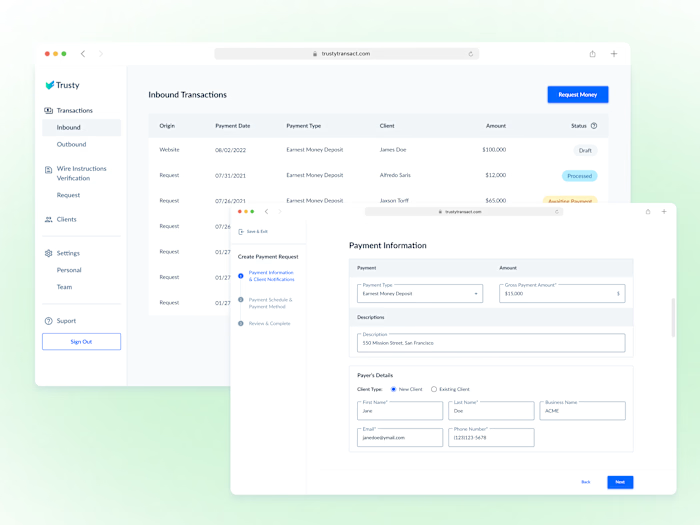
Wire Instruction Verification Feature for Trusty

Summer Yim

Trusty is a web app designed to facilitate real estate payments. While developing our Earnest Money Deposits Collection feature, we encountered technical, regulatory, and policy constraints that prevented our product from effectively facilitating payments through the real-time payments (RTP) and ACH networks. To work within the existing limitations, we introduced Wire Instructions Verification, a feature that enables settlement agents to verify instructions before initiating wire payments.
As the sole designer for this project, I was responsible for conducting quantitative and qualitative research, generating ideas, creating visual designs, and prototyping. I also worked closely with the the C-suite, product manager, and engineer to establish product requirements
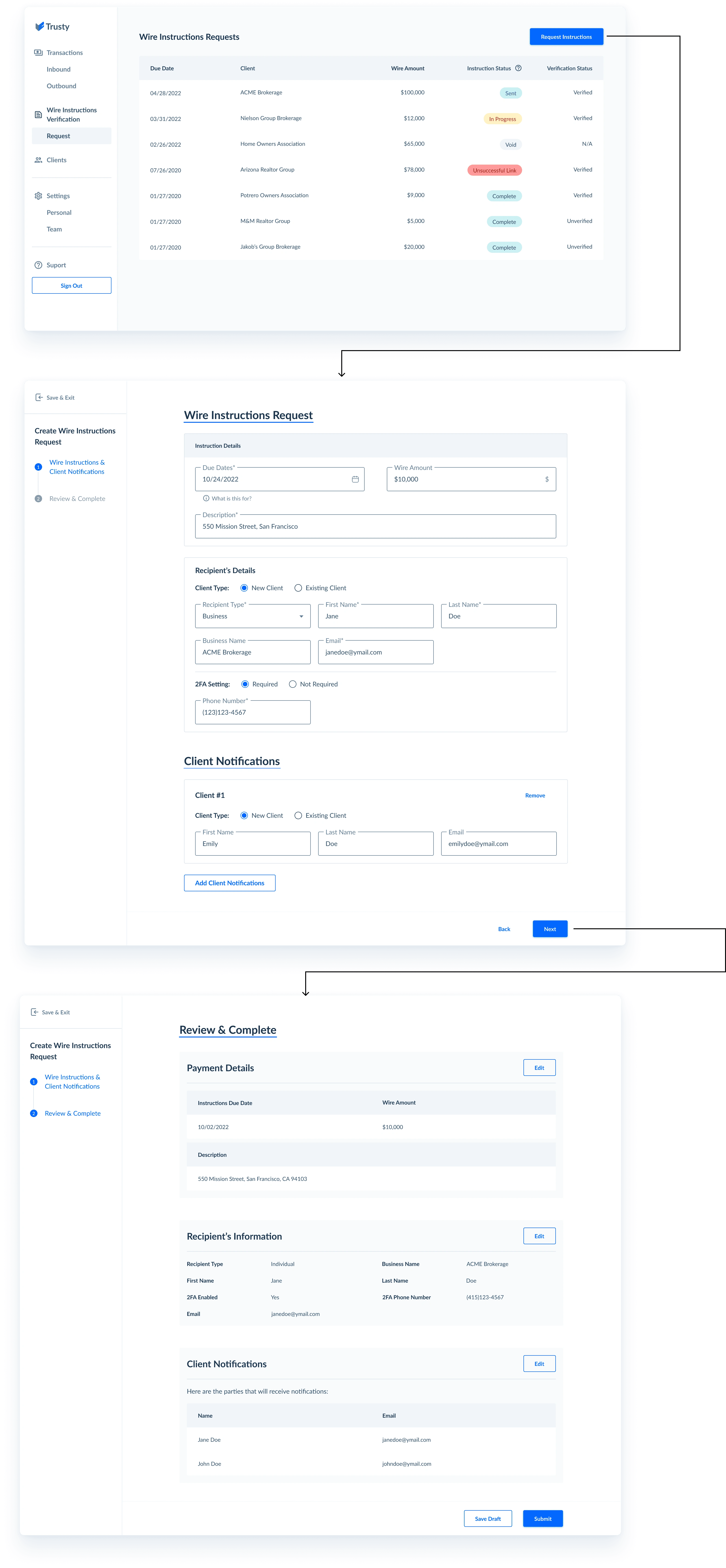
Settlement agents send a wire instruction request to the recipient with details such as due dates, descriptions, and client notifications.
Enter Wire Instructions
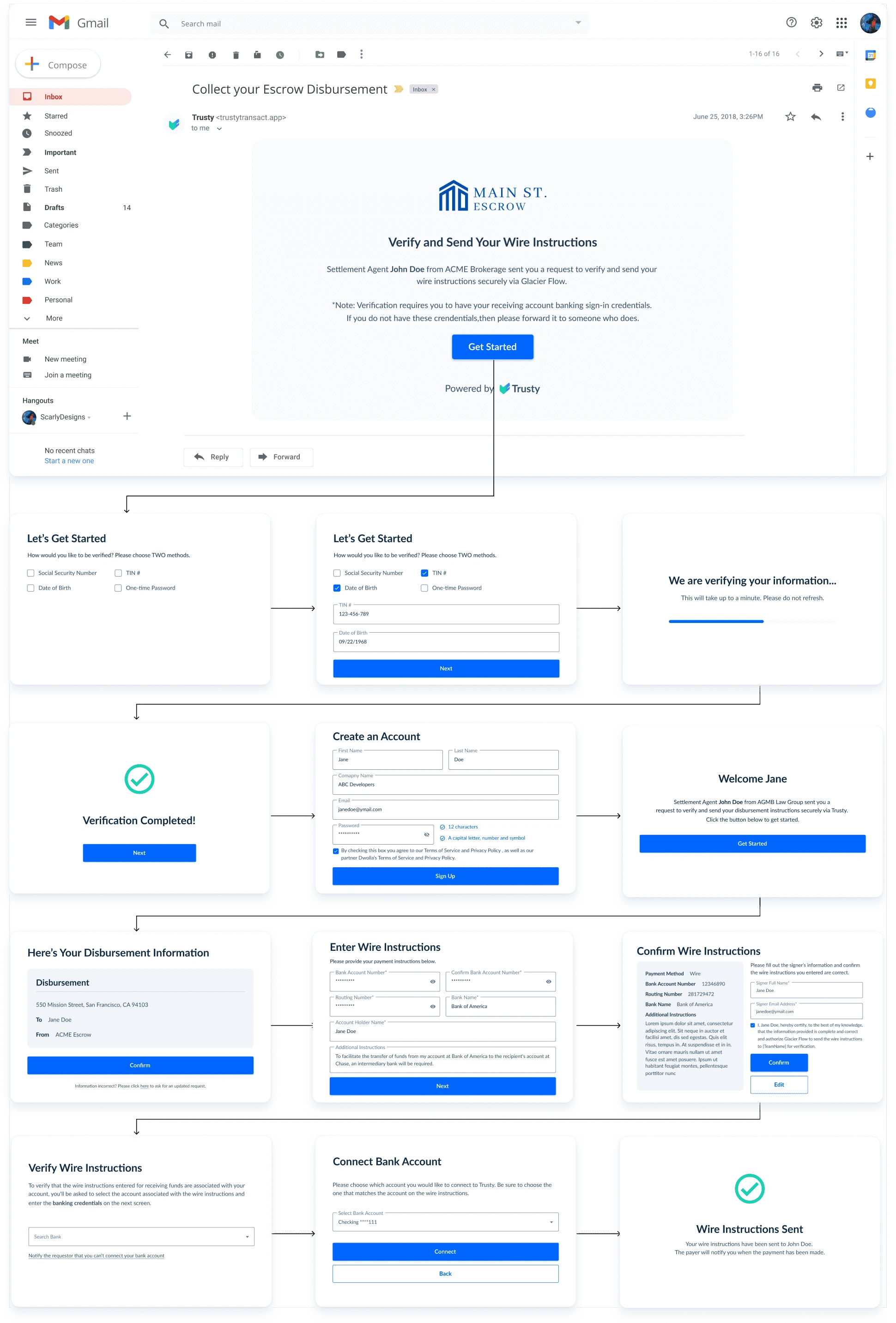
Payment recipients enter wire instructions and verify the payment destination by connecting their bank accounts via Plaid or Finicity.
Approve Wire Instructions
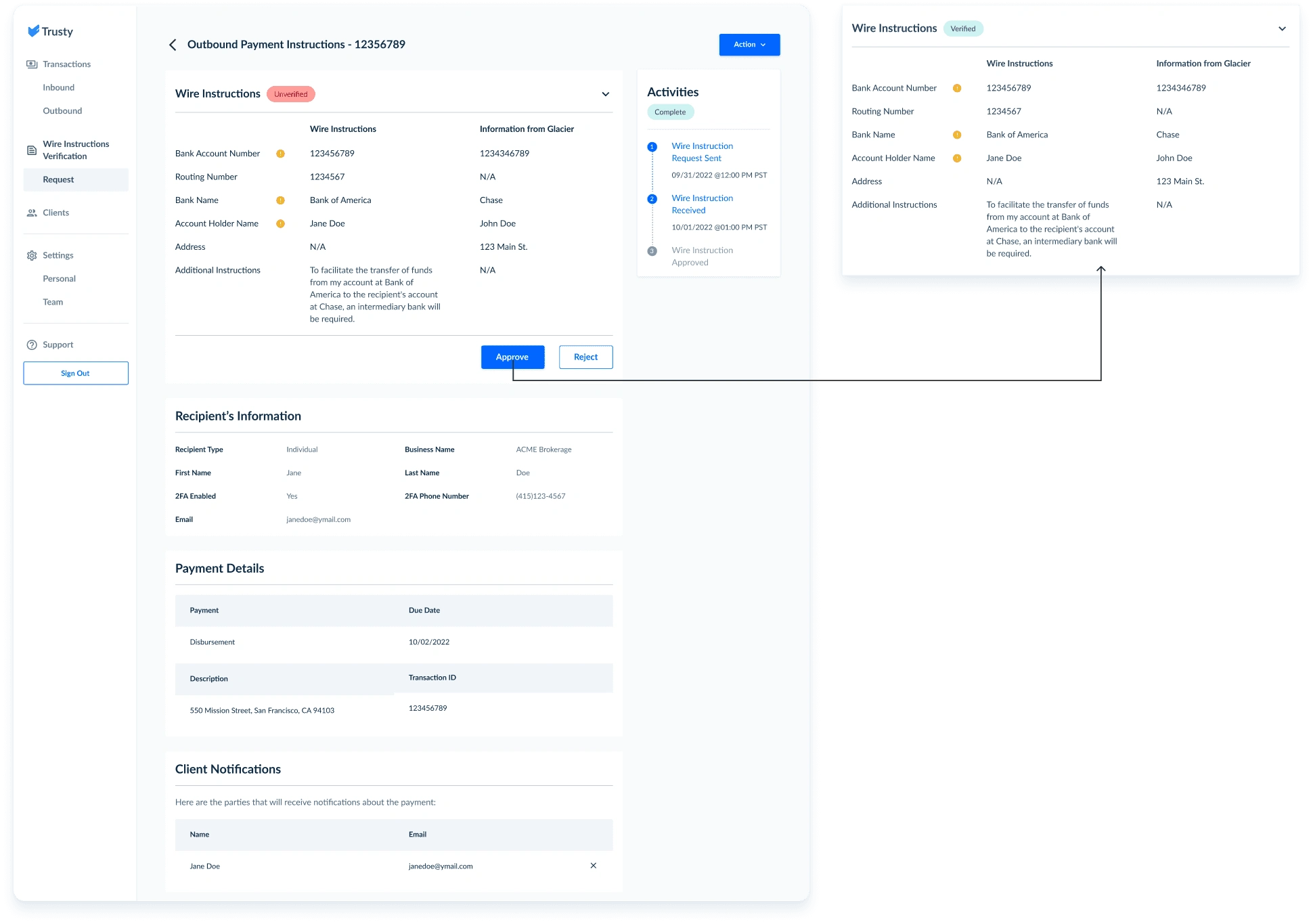
Settlement agents can track the progress of their wire instructions and verify that the information matches what they requested.
Settlement companies are susceptible to wire fraud
Settlement companies are facing a significant risk of loss due to wire fraud. To mitigate this risk, there are various ACH digital payment solutions available in the market. However, the use of these solutions in real estate transactions is limited in some states, such as California, due to the reversible nature of ACH payments. As a result, many settlement agents stick to using wire as their primary payment method and resort to using phone calls to verify wire instructions with their clients. This method is not only time-consuming but also inefficient.
To address these challenges, the executive team decided to focus on developing a product that verifies wire instructions for outbound transactions. Based on past data we gathered from interviewing settlement companies, the executive team believes that outbound money is the most pressing concern for settlement companies and that addressing this will bring significant opportunities for the business.
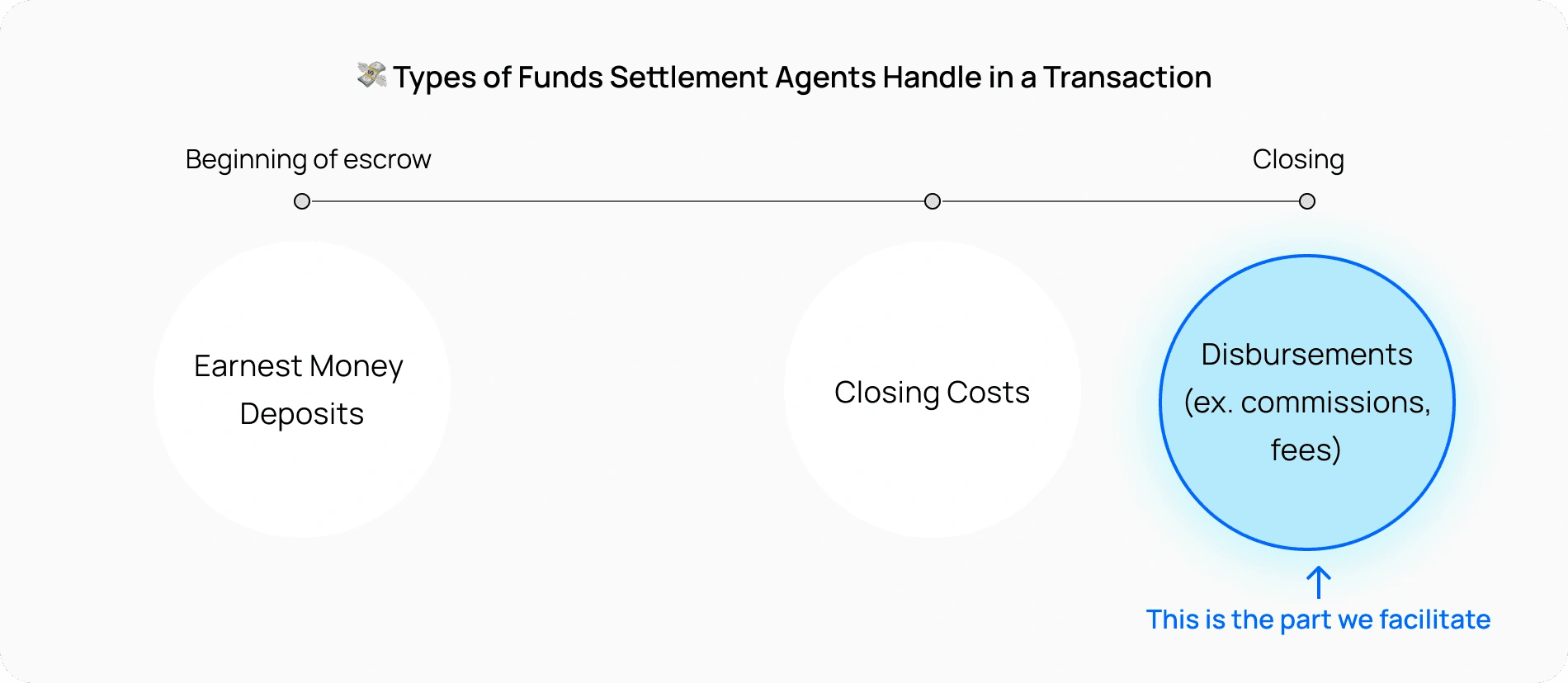
Using phone calls to verify wire instructions is the most painful part of the wire transfer process
With the existing data, I also created a user journey map to visualize the settlement agent's journey when disbursing commissions using wire. I identified the pain points and potential opportunities to alleviate them.
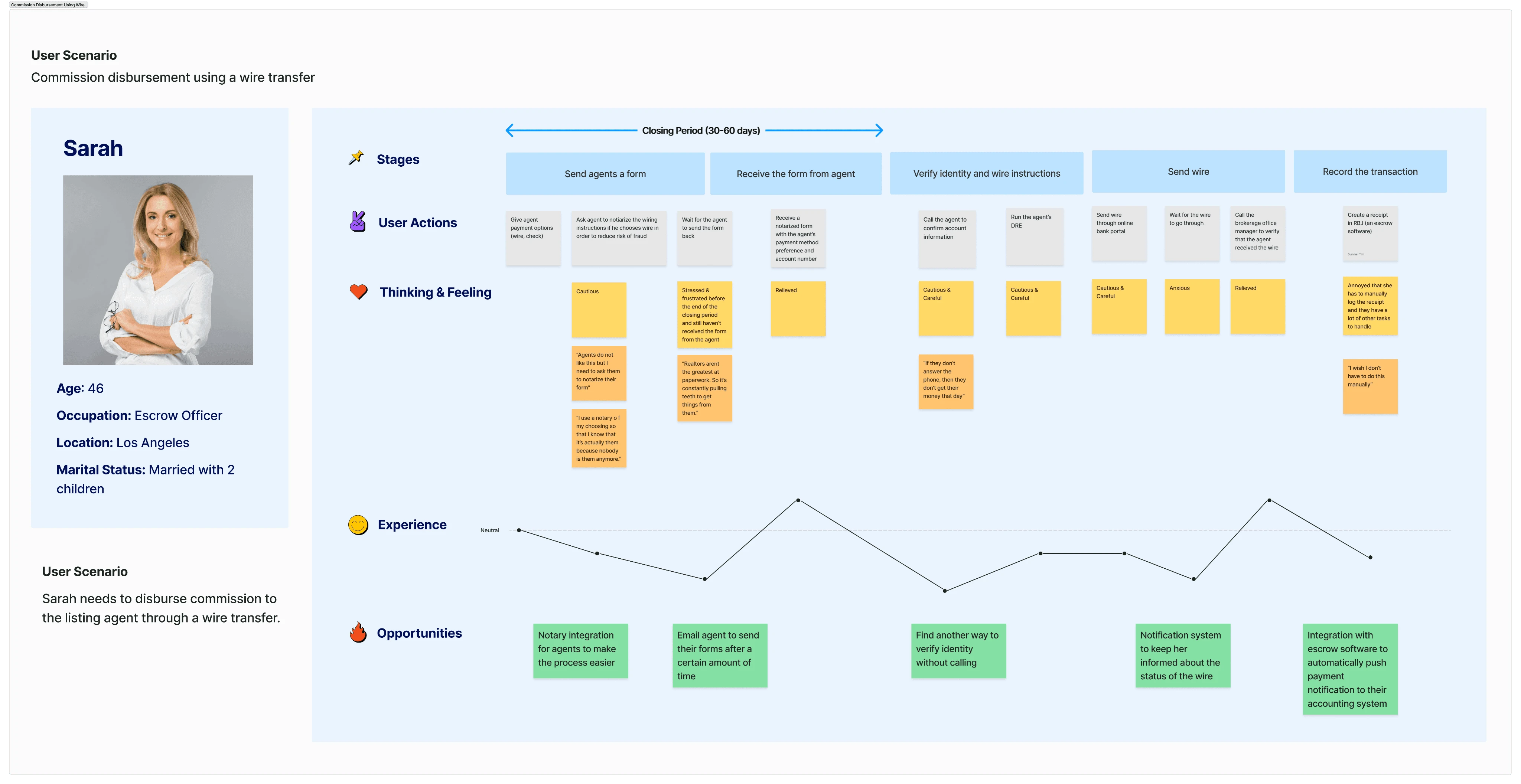
Among the ideas suggested, the product team and the engineering team agreed that our product should start with focusing on eliminating the use of phone calls to verify wire instructions by facilitating the wire instructions transfer process online because it’s the most direct solution to solving the pain point and it’s the most financially feasible solution.
The current solutions in the market still expose settlement agents to the risk of wire fraud
From our previous research for the inbound and outbound payment facilitation projects, we were aware there are a few popular companies in the market that also helps settlement agents verify wire instructions.
However, we had limited knowledge about what they actually offer. Therefore, I conducted a competitive analysis to compare their features in order to identify the advantages and weaknesses of their products.
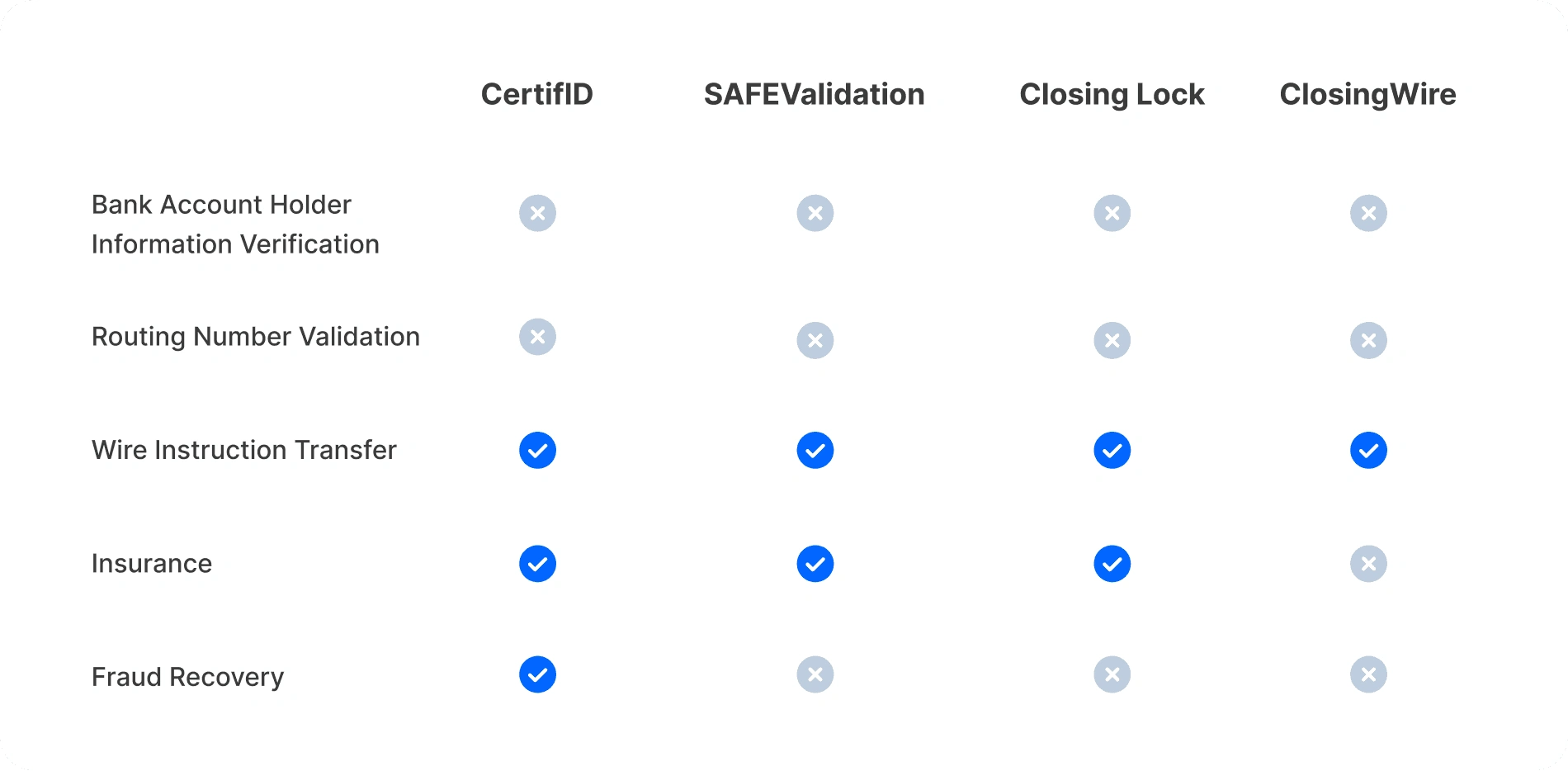
From the analysis, we realized that our competitors only verify the recipient's personal identity but do not verify the destination of the wire payments.
This is a problem because fraudsters can still spoof the system if they already have access to the victim's personal information by hacking their email and spoofing phone calls, which means the settlement companies are still exposed to the risk of wire fraud.
Creating a secure and reliable method that helps settlement companies verify the destination of the wire payments and enhances efficiency by streamlining their workflow.
Defining the main flows to support the functionality of the product
After consulting the engineering team, we confirmed that we could use a third-party vendor solution to help the settlement company to verify the destination account of their payment. We would do so by accessing a national bank account information database and compare the account information provided by the payment recipient and the information in the database.
1️⃣ Settlement Agent creates a wire instruction request
2️⃣ Recipient receives the request, enter their wire instructions, and link their bank account via Plaid or Finicity
3️⃣ Settlement Agent cross-references the wire instructions from the client and the instructions pulled from third-party software via Trusty
Prioritizing security, simplicity, and ease of use to meet settlement agents' needs
Settlement agents prioritize security because they are dealing with a large amount of money. Therefore, our product needs to incorporate security features and instill a sense of trust.
Settlement agents often resist adopting new technology due to the time and effort required for learning. Therefore, our product's interface needs to prioritize simplicity, enabling quick integration into their workflow.
As our product is utilized by individuals from diverse backgrounds and varying levels of technological literacy, it is essential that the client-facing aspect is easily comprehensible.
For this flow, I used a consistent layout similar to that of our other payment products to enhance familiarity and maintain consistency across our products.
The payment recipient receives the request, enter their wire instructions, and link their bank account
This is a client-facing flow with a large range of users coming from different age groups and levels of technological literacy. Therefore, my goal when designing this flow was to make it as user-friendly and intuitive as possible such that anyone can easily navigate through the flow regardless of their level of technical literacy.
Settlement agent cross-references the wire instructions from the client and the instructions from Trusty
In this step, the settlement agents manually compare the information provided by the client with the instructions pulled by Trusty. To minimize human error, I used the warning icons to emphasize areas where the information does not match, alerting the settlement agent to potentially fraudulent transactions.
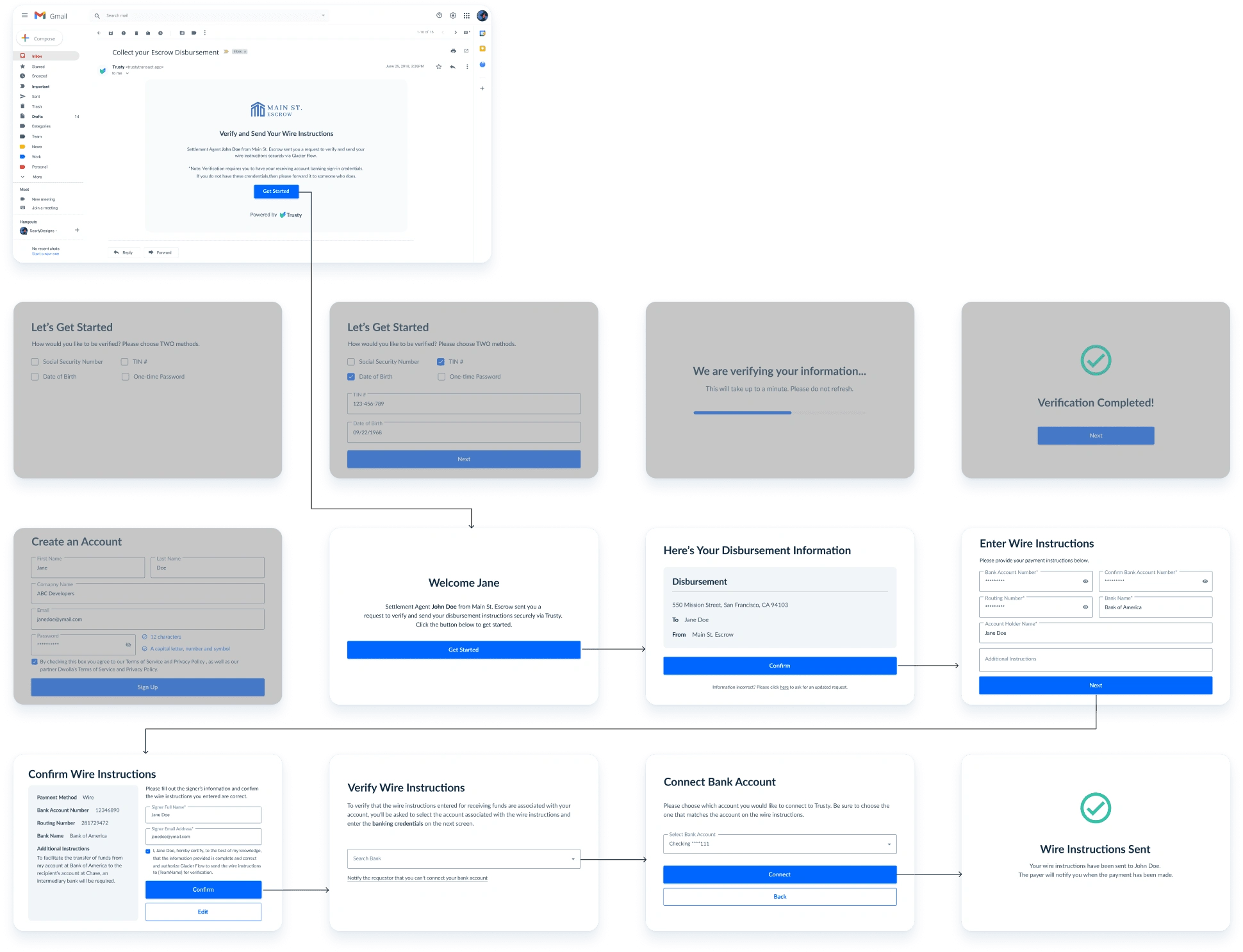
Eliminating less crucial steps to further simplify workflow
Before presenting the prototype to the engineering team, we sought feedback from potential customers on our design. Our objectives were to assess how the product integrates with the settlement agent's workflow and address any security and usability concerns.
After talking to multiple settlement firms, we realized that an identity verification process for recipients is not crucial, as long as they can confirm the payment destination. As a result, we decided to eliminate the identity verification steps to further simplify the workflow for recipients.
Shipping the MVP & iterating again
With the prototype, we decided that it was good enough to be developed and shipped as an MVP product and be tested by our beta customers.
Over the next 4 weeks, we met with our beta group once a week to get their feedback on the product and iterate the design accordingly. We made 3 major iterations since the launch of the product.
Based on our user's feedback, the warning icon was too small and not conspicuous enough to capture the attention of the users. Given their busy schedule, it was possible for them to overlook the warning icon and accidentally approve a fraudulent wire instruction.
Solution: Make the warning icon bigger and turn the icon and the mismatched fields red.
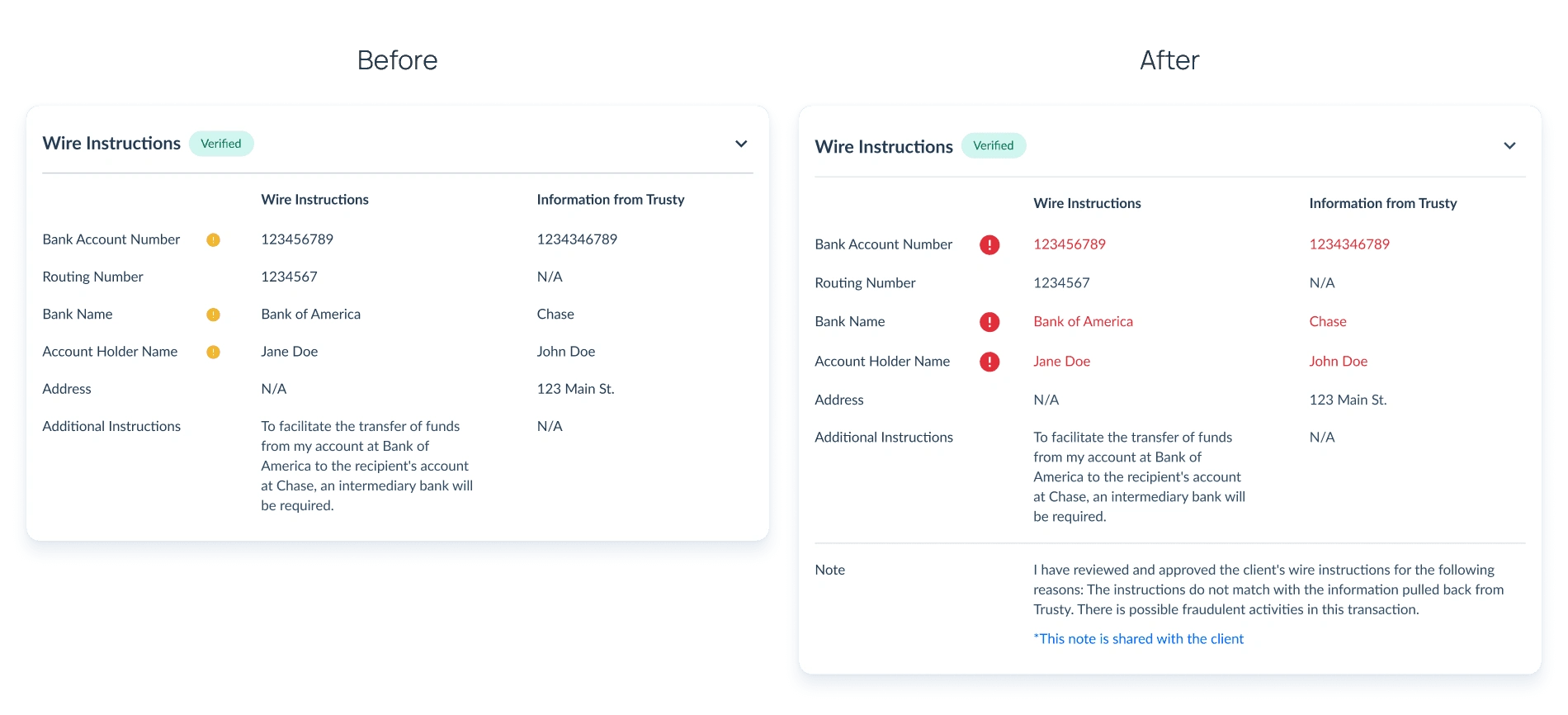
Adding a note modal for documentation purposes
After talking to our customers, we discovered a need for the documentation of reasons for approving or rejecting wire instructions.
Solution: Add an optional "Add Note" modal after the settlement agents approve, reject, or void wire instructions. The notes will be present on the receipt and this documentation would enable our customers to securely store the information in their internal records for future reference.
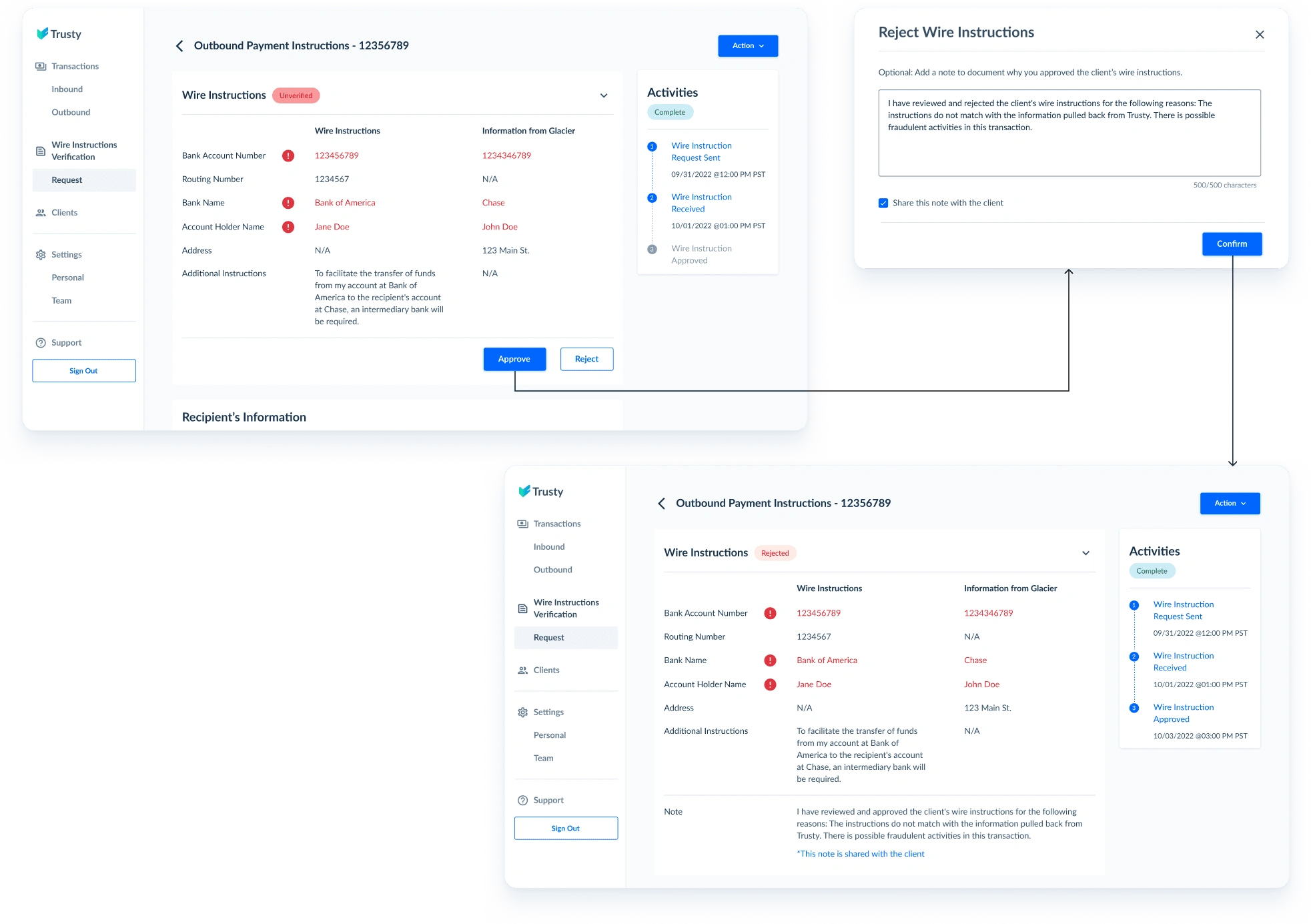
Creating a mobile solution to accommodate clients' needs
Finally, our customers also highlighted the requirement for a mobile version of the wire instruction entry process for their clients. They anticipate that over half of their clients will access the wire instructions request through their smartphones, making a mobile solution necessary.
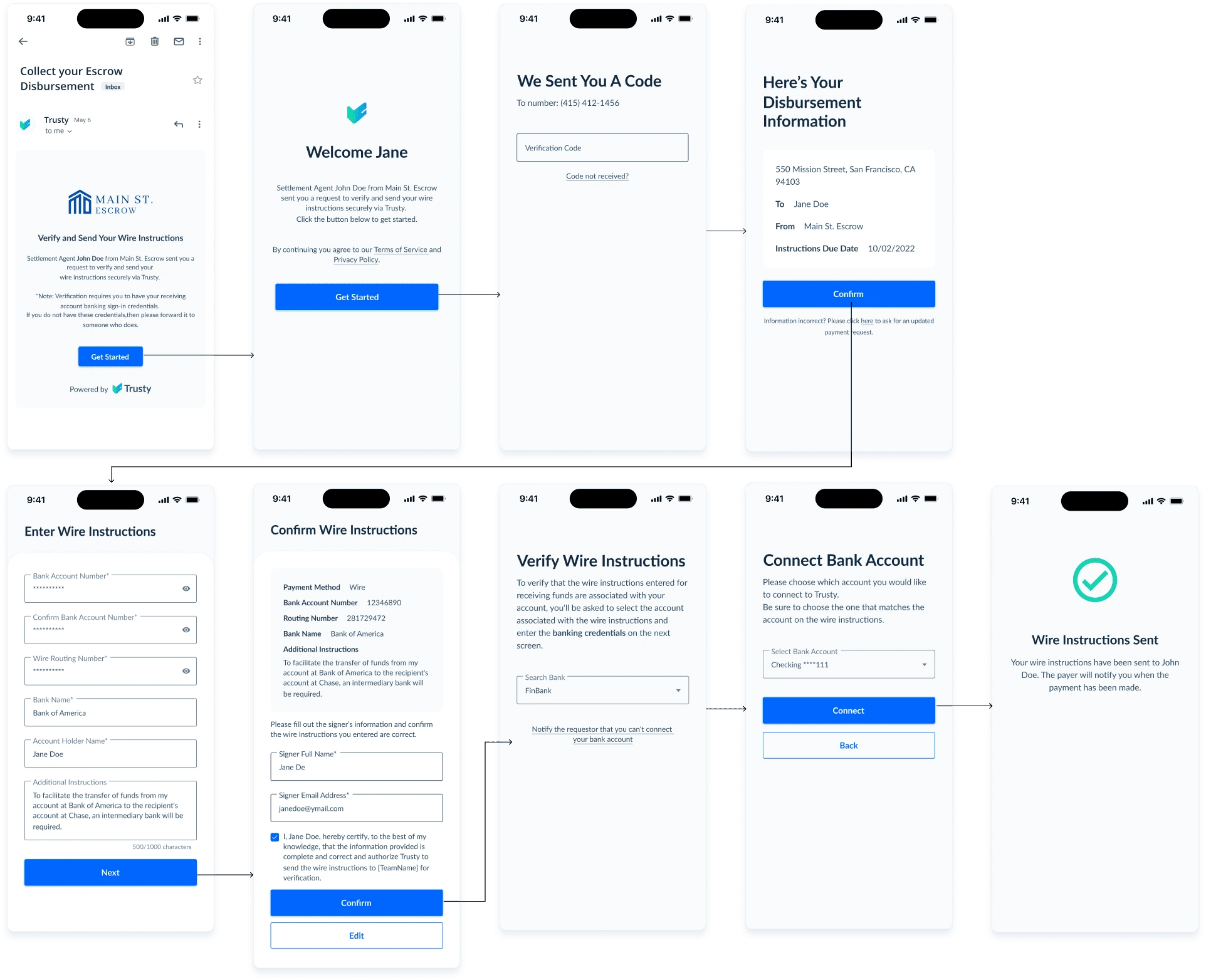
This wire instruction verification product has brought significant impact on Trusty's growth. Not only has it enabled Trusty to acquire 2 new settlement company clients and expand to 13 branches with over 80 employees, but it has also become the company's most profitable product to-date. This product led to a 300% increase in the company’s revenue. Through this product, Trusty was able to establish itself as a main player in the real estate industry and continue to grow and thrive in a highly competitive marketplace.
Like this project
Posted Aug 25, 2025
Designed a wire instruction verification feature for Trusty, enhancing security and efficiency in real estate payments.
Likes
0
Views
9
Timeline
Jan 9, 2023 - Apr 30, 2023