VERA Research UI | Evidence-Aware Research Dashboard

Phillip Wells


From scattered research to a usable interface
I wanted a clearer way to work with a research system whose rules, test outputs, and review records were spread across files and conversations. The goal was an interface that made the next step understandable without hiding the condition of the evidence behind a polished chart.
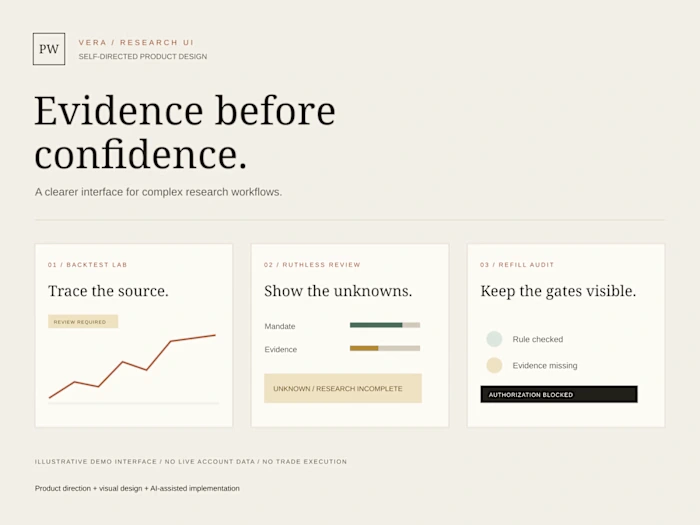
VERA Research brings three workflows into one visual language: Backtest Lab, Ruthless Review, and Refill Audit.
My role
I directed the product concept, workflow requirements, visual identity, and acceptance criteria. Implementation and testing were AI-assisted. My focus was translating a rule-heavy system into an interface that could explain what had been checked, what remained unknown, and what was not yet authorized.
The interface
Backtest Lab: A workspace for scenario inputs, experiment types, comparisons, and source provenance.
Ruthless Review: A structured review of a holding and its alternatives, with missing evidence presented as an explicit unknown rather than a pass.
Refill Audit: A gate-based planning view that separates illustrative sizing from permission to act. Incomplete evidence keeps authorization blocked.
The visual system uses warm paper tones, near-black typography, restrained burnt-orange accents, and an editorial hierarchy. Desktop and mobile views share the same emphasis on readable inputs, visible status, and concise explanations.
Making evidence part of the design
The deployed private version separates genuine historical source artifacts from a fictional interactive sandbox. Saved results carry source references and limitations. The demo is clearly labeled and does not imply access to a live account.
That separation matters: an uploaded result is not automatically a validated result, and a functioning interface is not proof that the research behind it is complete.
What was built and checked
A private HTML/CSS/JavaScript site, a separate fictional interaction sandbox, source-hash checks for the historical artifacts, and regression tests for the interface's gate and allocation behavior. Private pages and data routes require the owner's sign-in.
The underlying engine also has a separately reviewed repair branch. At this milestone, its GitHub CI passed 22 tests, including a test covering 250 randomized allocation-cap cases. A synthetic workflow check retained three non-overlapping queued jobs and produced structured test artifacts; persistence was tested against an isolated temporary Git remote. The repair pull request remains open and unmerged. These checks do not establish real-repository persistence, private-ledger or live-feed acceptance, investment performance, or a completed live financial run.
Boundaries
This is a self-directed product and workflow-design project, not client investment work. The portfolio visuals use fictional data. The app does not place trades, provide a live brokerage connection, or establish validated investment performance.
Like this project
Posted Oct 23, 2026
A private research dashboard that makes source quality, missing evidence, and incomplete work visible across backtesting, portfolio review, and capital-planning workflows.
Likes
0
Views
1