Adaptive Day-Trading Training System

Phillip Wells


The problem
Most training — human or AI — tells people the outcome and then pretends they learned the decision. It also breaks the moment the interface gets complicated, which is why a lot of training tools look impressive and teach very little.
What I built
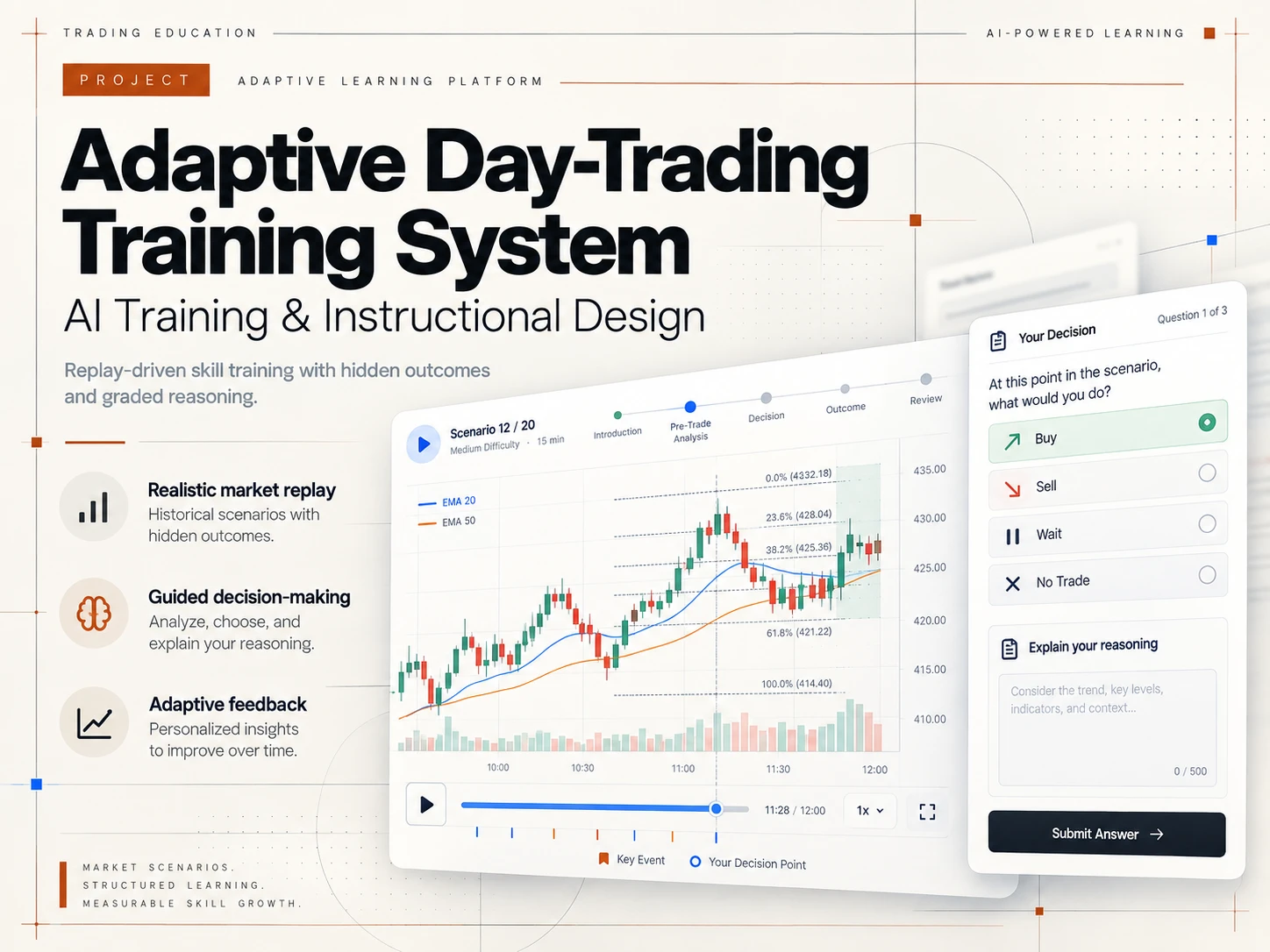
An adaptive, rule-based training system for day trading, developed iteratively from real failure in the interface itself:
Hidden outcomes — the learner commits to a call before seeing what happened
Structure-first grading, with indicators (EMA / Fibonacci / VWAP) as secondary confluence, not the decision itself
Deliberately hard cases — near-invalidation and controlled false alarms, so learners can't just pattern-match easy examples
Failure-driven UI iteration: when interaction reliability failed, a chat-native fallback preserved the training function, and a later stable HTML implementation became the preferred version — function over flash
What I can do for a client
Design an AI-powered trainer / simulator for a skill your team or customers need to learn (sales calls, compliance decisions, technical diagnosis, trading, operations, onboarding)
Build grading logic that evaluates reasoning and process, not just right/wrong answers
Design practice case libraries — including the hard, ambiguous, edge cases that actually build competence
Rescue or redesign a training tool that looks good but isn't teaching
Attribution: Phillip Wells owns problem framing, system/workflow design, constraints, evaluation standards, failure diagnosis, revision decisions, and documentation. AI platforms provided implementation and analytical assistance under that direction.
Like this project
Posted Oct 5, 2026
I build rule-based AI trainers that teach a complex skill, hide the answer until you've committed, and grade the reasoning — not just the result.
Likes
0
Views
0