VERA Operator — Multi-System AI Control Plane

Phillip Wells


THE PROBLEM
Specialist AI systems can each produce plausible answers while still disagreeing with one another, using stale state, missing decision-critical unknowns, or quietly crossing authority boundaries.
WHAT I DESIGNED
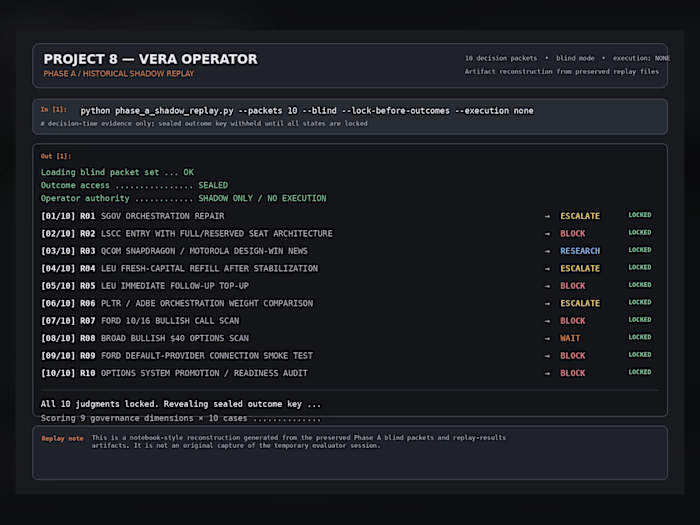
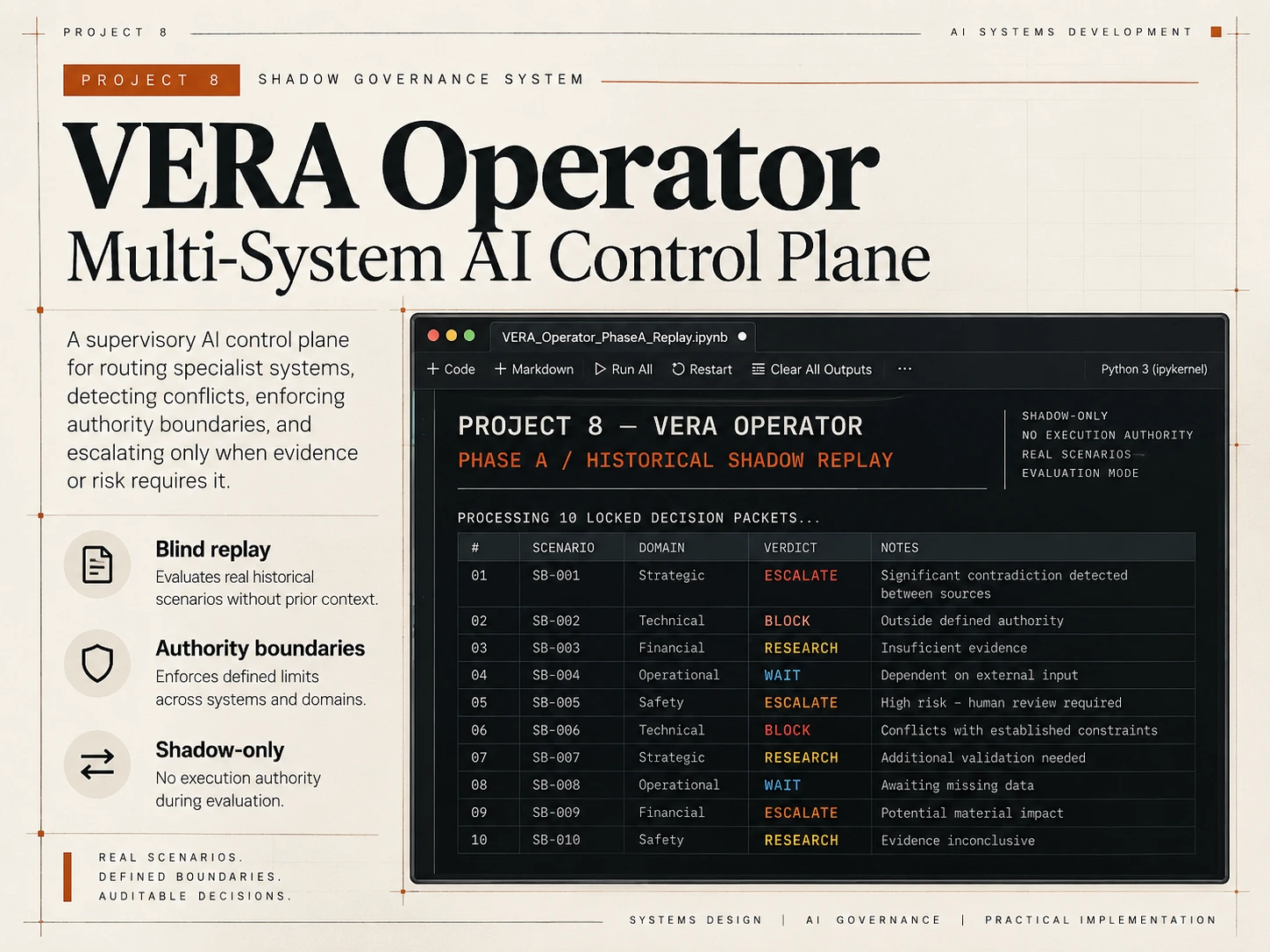
VERA Operator is a supervisory control plane that evaluates specialist-system outputs before consequential decisions are made. It standardizes what each specialist hands upward, checks evidence and source state, identifies conflicts, and returns bounded outcomes such as PASS, BLOCK, ESCALATE, RESEARCH, CONFLICT, or WAIT.
The architecture keeps specialist systems separate rather than merging their state. Consequential authority remains human-controlled, and the Operator does not grant itself execution rights.
Key design features include:
standardized specialist packets for evidence, assumptions, unknowns, confidence, requested authority, and requested state changes
explicit project and source-state isolation
decision-critical unknown promotion
lowest-sufficient-authority / escalation-economy rules
regression testing when a governance defect is found
shadow-mode validation before any later authority expansion is considered
VALIDATION
The first blind historical replay used 10 cases and scored 88/90 (97.8%). The only deductions exposed a specific calibration defect: one decision-critical unknown was not promoted formally, and one case escalated unnecessarily.
I converted those failures into reusable governance rules, then ran a focused clean-context regression. The repaired version passed with the intended outcome: RESEARCH, Decision-Critical Unknown = YES, and Human Approval Required Now = NO.
CURRENT STATE
Phase B live-shadow evaluation is active under read-only authority. A later live-routing test exposed an infrastructure problem: standing authorization alone did not create a reliable invocation hook. I redesigned the routing path around a synchronous pre-decision capture step and preserved the failed attempt as infrastructure evidence rather than counting it as a clean benchmark case.
Fresh-session routing validation remains the next gate. No trade execution, specialist-canon mutation, money movement, or cross-account synchronization authority is granted.
WHY IT MATTERS
The project demonstrates a way to make multi-agent AI systems more governable: specialists can remain useful and independent while a separate supervisory layer checks conflicts, evidence quality, uncertainty, and authority before action.
Like this project
Posted Oct 5, 2026
Supervisory AI control plane to route specialist systems, detect conflicts, enforce authority boundaries, and escalate only when evidence or risk requires it.