Phillip Wells - AI Developer | ContraWork by Phillip Wells
Phillip Wells

Phillip Wells

AI workflow designer turning messy work into systems.

New to Contra

Phillip is ready for their next project!

Cover image for A "BS" detector for news
A "BS" detector for news briefs that are often employed in the stock trading world in order to deceive or influence stock purchases or sales by retail traders that stand to benefit only the corporations behind the scenes that are already positioned in the contrary position. https://phill55188-ops.github.io/
0
16
Cover image for Evidence-Grounded AI Research Audit +
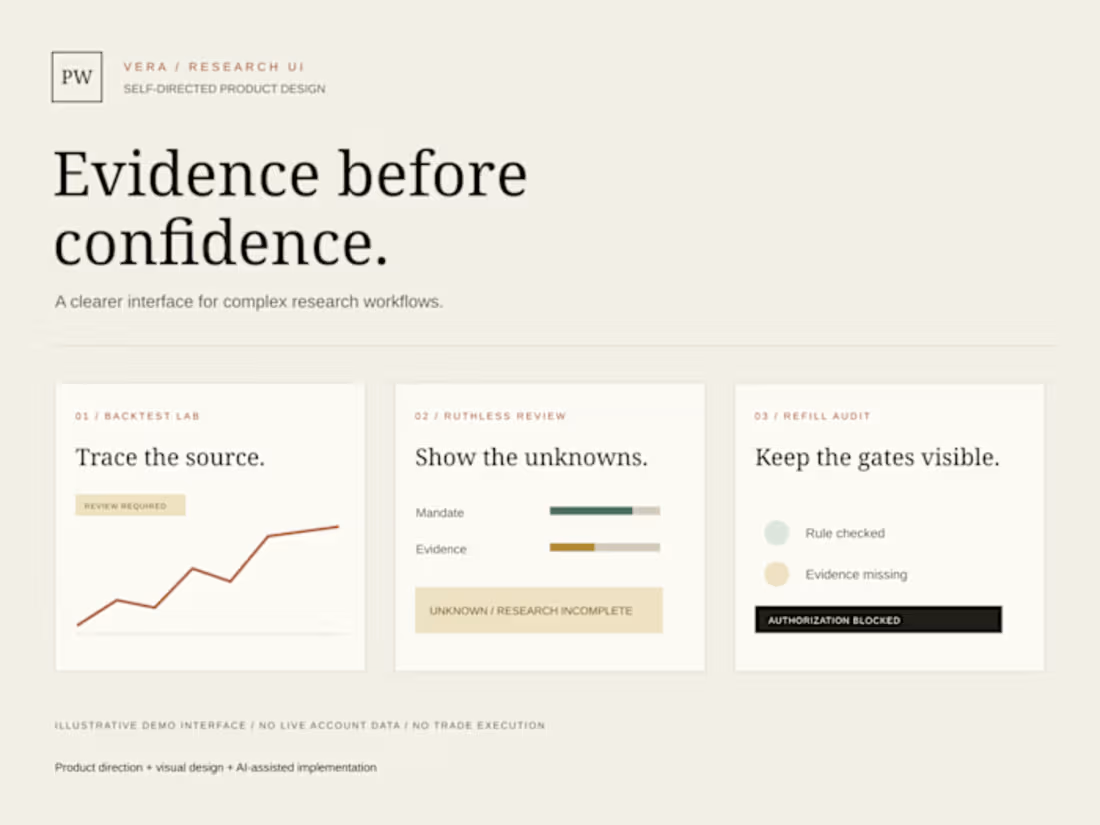
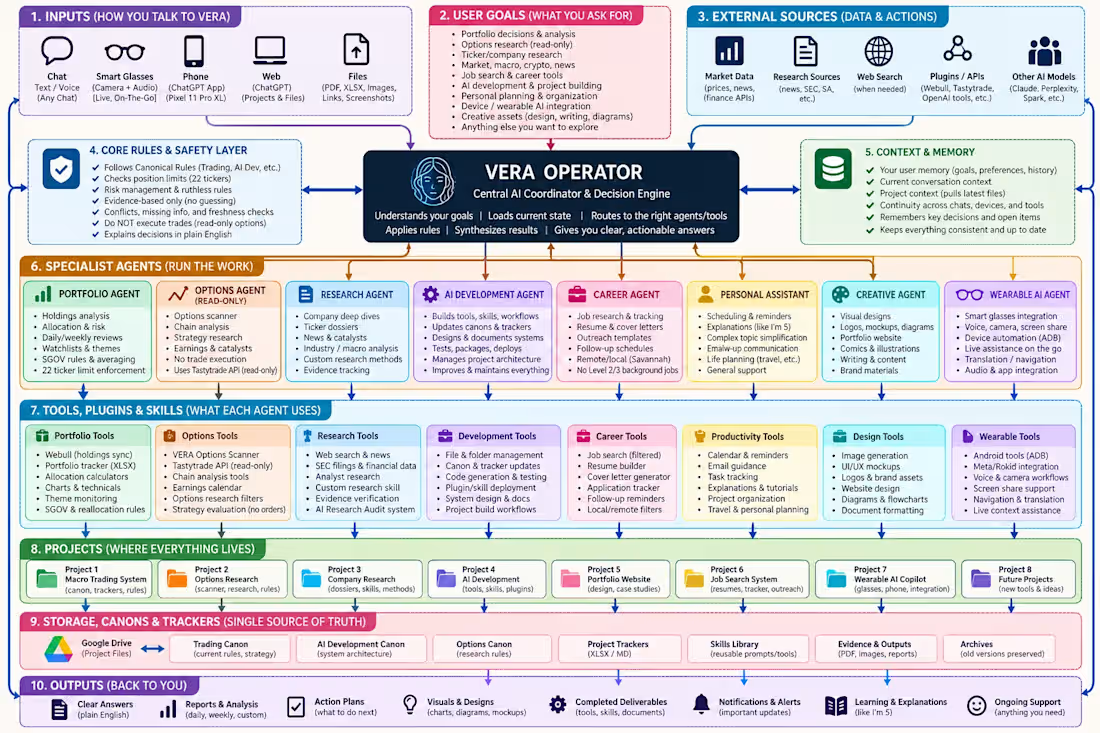
Evidence-Grounded AI Research Audit + VERA Company Dossier — AI Evaluation & Company Research You Can Trust I test whether your AI actually did the research — then I build the reusable skill that fixes the errors it keeps making. THE PROBLEM The most dangerous AI failure isn't an obvious error. It's a confident, well-written company or market profile that was never grounded in a source — wrong products, missing competitors, suppliers listed with no context, contradictions smoothed over. Teams and investors make decisions on that. WHAT I BUILT — THE AUDIT SYSTEM An evidence-grounded audit system designed to detect AI that sounds researched without actually researching: Provenance controls — key claims must trace to an actual source A decision-critical unknown gate — if something that would change the decision is unknown, the system must say so instead of filling the gap Functional-role classification and real substitutability checks Disconfirming search — actively looking for evidence against the leading conclusion Prior-correction Regression Tests — once an error is caught, the system is retested so it doesn't quietly come back sier (v1.0)** To fix a good bit of those errors in company research specifically, I turned the audit principles into a production skill in my Drive Skills library — vera-company-dossier. ~Its stated job is to produce a company overview you can trust as if you'd researched it from first principles yourself. ~It is aimed squarely at the recurring failure it was built to solve: a model finds a company's most familiar historical identity, reads a handful of summaries, and mistakes that partial picture for the company. HOW THE SKILL ACTUALLY WORKS (verified from the skill itself): 13 Mandatory Research Passes — entity/freshness lock, identity reconstruction, strategic history, product & technology census, revenue/economic engine, customer/partner/supplier graph, architecture/dependency role, competitive landscape, macro/policy/supply-chain exposure, management & capital allocation, valuation, catalysts/risks/falsifiers, and a mandatory blind-spot expansion sweep Legacy Label vs. Current Operating Identity — every dossier must explicitly compare what the market calls the company with what it actually is today, and reject the label if current evidence can't support it A 3-tier Source Ladder — Tier 1 primary evidence (SEC filings, earnings, investor-day materials, official product docs, counterparty confirmation, government records) outranks Tier 2 independent reporting, and Tier 3 (analyst posts, blogs, social, search snippets, prior model answers) is discovery leads only An 8-state Evidence Vocabulary for Every Material Claim — Verified Current, Counterparty Verified, Reported, Announced / Not Yet Proven, Historical, Inferred, Disputed, or Unknown. An announced roadmap item, pilot, MOU or design win is never upgraded to shipped revenue Hard Anti-failure Rules — don't confuse technical credibility with commercial maturity, backlog/TAM with realized profit, or a partnership announcement with material revenue; don't let a hype narrative erase the current revenue engine, or the revenue engine hide a new platform A backlog-quality Audit and Capital-structure/dilution Normalisation — headline backlog is decomposed into firm vs. conditional vs. non-binding, and valuation is reconciled to the real ownership base (warrants, convertibles, SBC, post-offering cash). Both were added permanently after the skill's LEU / Centrus Energy acceptance test on 2026-10-04 exposed them A Blind-spot Sweep with a Discovery-saturation Rule — second-order searches built from products, subsidiaries, partners, acquisitions and standards must run until two consecutive passes find nothing new and material A Contradiction Gate and a 15-domain Completeness Matrix — a dossier may only report DOSSIER COMPLETE when no decisive domain is Unknown, no material contradiction is hidden, the latest filings and earnings were checked, relationships were counterparty-checked where possible, and the blind-spot sweep reached saturation. Otherwise it must output DOSSIER INCOMPLETE with the exact gaps. No amount of eloquence overrides the gate Four Working Modes — Full Dossier, Blind-Spot Audit, Dossier Refresh, and Pre-Decision Research Calibration / Regression Cases built in — QCOM (legacy label hiding a compute continuum), Lenovo (PC label vs. enterprise AI/edge systems), XNDU (technically important, commercially early), and LEU (single-theme label vs. a multi-path bottleneck company) The dossier researches and verifies the company; it does not authorize a trade or a decision. Research authority and decision authority stay separate, and a completed dossier hands its evidence to whatever decision process comes next. WHAT I CAN DO FOR A CLIENT Run a structured reliability audit of your AI assistant, research tool, or agent workflow Build a company dossier / deep-dive research package — for investment diligence, partnership evaluation, competitive research, or pre-decision company understanding Build a reusable dossier/research skill for your own team, with the completeness gates baked in Build an evaluation / test harness for your AI: test cases, failure taxonomy, scoring, and regression checks Diagnose why your AI is hallucinating or over-claiming — which layer is actually failing (sources, reasoning, instructions, retrieval, or interface)
0
8
Cover image for I build the continuity layer
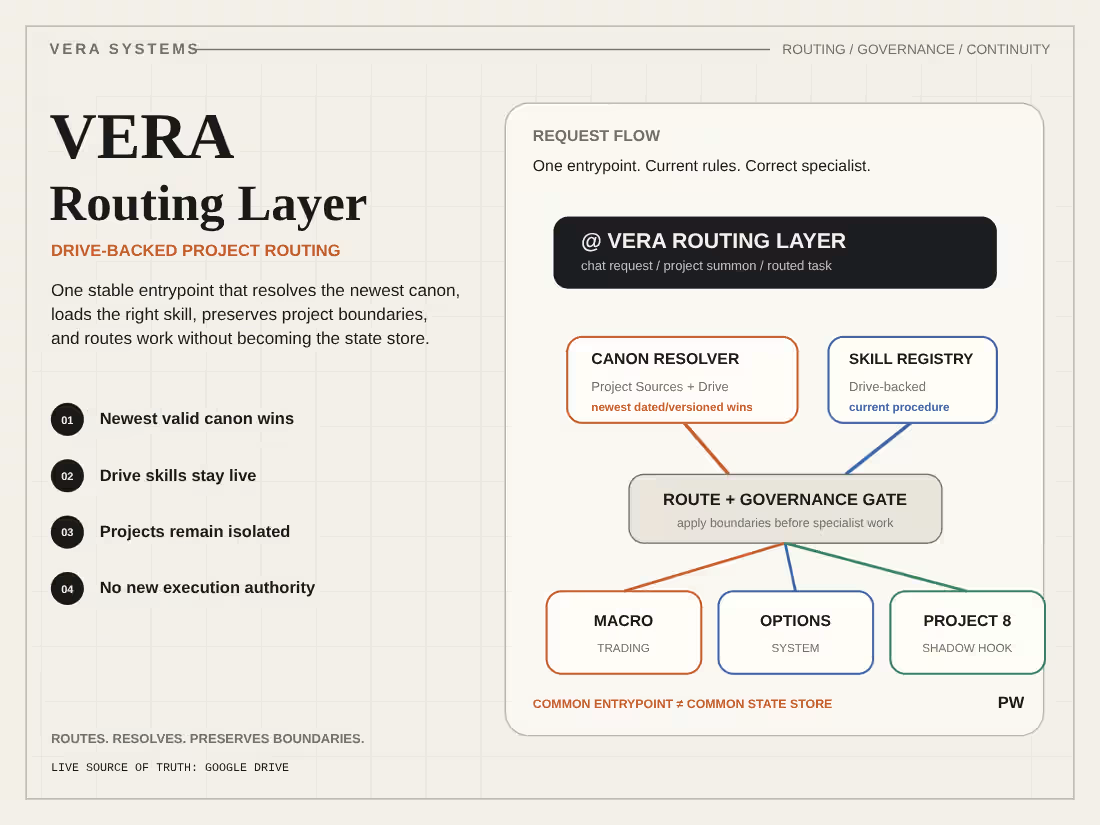
I build the continuity layer that lets AI assistants keep your , rules, and source-of-truth straight across tools and models — without you re-teaching the history every session. THE PROBLEM Anyone using more than one AI tool lives the same pain: every new session starts from zero, projects blur together, an old document gets treated as current, and the assistant confidently continues from stale state. WHAT I BUILT A project-routing and cross-model continuity architecture (the Global Continuity Router, packaged portably as the VERA Context Bridge): Explicit project activation and mode persistence Authority ordering — newest instruction → newest canon → tracker → current conversation Project isolation, so one project's state doesn't contaminate another Drive-backed recovery and source-of-truth locations for each project Hard stops when the authoritative source can't be established, instead of guessing A portable context package so a different model can reconstruct the working rules and then retrieve current truth, rather than inheriting a stale snapshot WHAT I CAN DO FOR A CLIENT Design a continuity / knowledge architecture for a founder, team, or practice juggling multiple AI tools Organise projects, source-of-truth documents, and trackers so an AI retrieves the right, current version Build context/onboarding packages that bring a new AI tool or team member up to speed without a week of backstory
3
0
30
Cover image for THE PROBLEM
Most training — human
THE PROBLEM Most training — human or AI — tells people the outcome and then pretends they learned the decision. It also breaks the moment the interface gets complicated, which is why a lot of training tools look impressive and teach very little. WHAT I BUILT An adaptive, rule-based training system for day trading, developed iteratively from real failure in the interface itself: Hidden outcomes — the learner commits to a call before seeing what happened Structure-first grading, with indicators (EMA / Fibonacci / VWAP) as secondary confluence, not the decision itself Deliberately hard cases — near-invalidation and controlled false alarms, so learners can't just pattern-match easy examples Failure-driven UI iteration: when interaction reliability failed, a chat-native fallback preserved the training function, and a later stable HTML implementation became the preferred version — function over flash WHAT I CAN DO FOR A CLIENT Design an AI-powered trainer / simulator for a skill your team or customers need to learn (sales calls, compliance decisions, technical diagnosis, trading, operations, onboarding) Build grading logic that evaluates reasoning and process, not just right/wrong answers Design practice case libraries — including the hard, ambiguous, edge cases that actually build competence Rescue or redesign a training tool that looks good but isn't teaching
1
32