VERA Routing Layer — AI Project Routing & Governance

Phillip Wells


The problem
A strong specialist skill is useless if the wrong system gets invoked. Long-running AI work breaks in boring, expensive ways: the assistant loads yesterday's canon, applies one project's rules to another, reconstructs thresholds from memory, skips a required governance wrapper, or sends the task to the wrong specialist and still sounds completely confident.
That is not a prompting problem. It is a routing and authority problem.
What I built
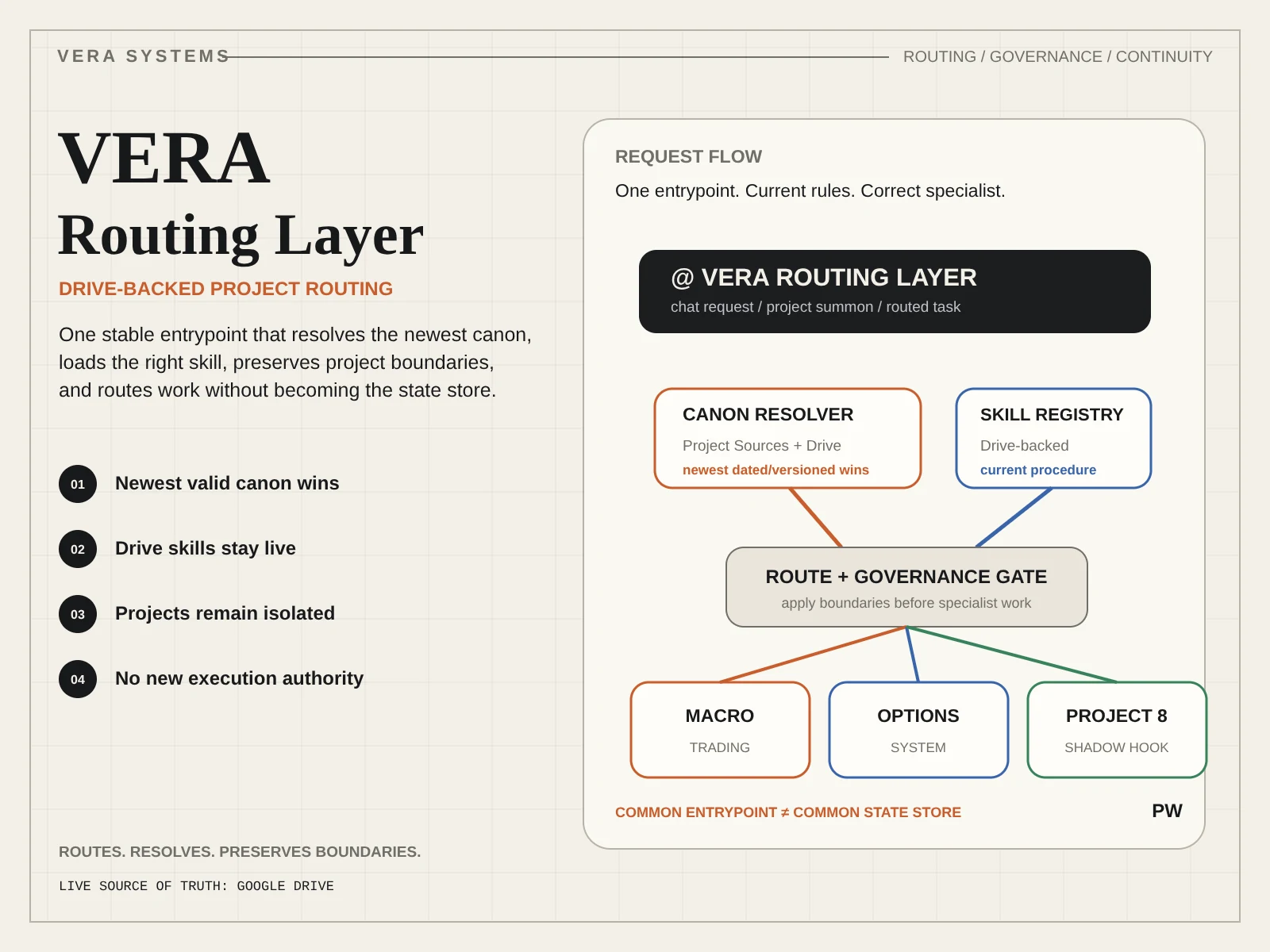
VERA Routing Layer (v0.2.1, installed as a private ChatGPT plugin and mirrored to Drive for recovery) is the installed entrypoint that resolves the active project, retrieves current authority, and hands the request to the correct Drive-backed procedure:
A stable @VERA Routing Layer entrypoint inside ChatGPT
Canon-first routing — continuity-sensitive work starts from the newest valid project canon rather than conversational memory
Drive-backed skill resolution so current procedures can change without rebuilding the plugin every time
Explicit authority order: newest user instruction → newest confirmed project canon → current Drive-backed skill → live task evidence → current conversation → older history
Project isolation — different systems can share a router without sharing one giant contaminated state
Specialist handoff to the correct reusable skill instead of rebuilding procedures ad hoc
Hard failure behavior when authoritative Drive state cannot be reconciled; missing state is surfaced rather than invented
A Drive source mirror for recovery and future rebuilds
How this differs from the VERA Context Bridge
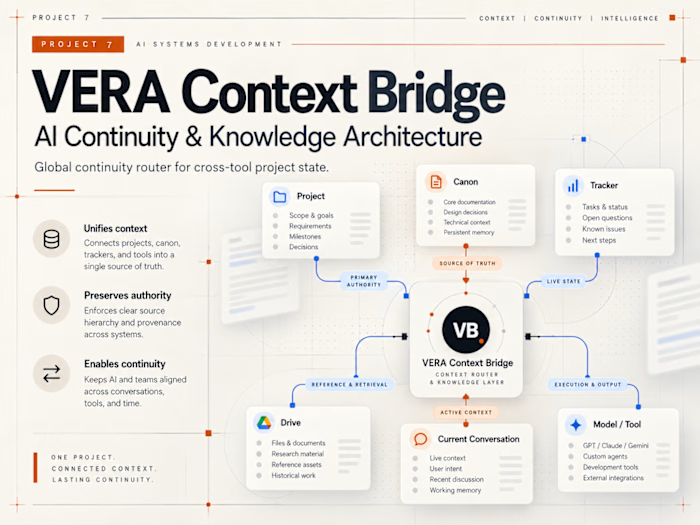
The Context Bridge is the portable continuity package that lets another model reconstruct the working architecture and find the current source of truth. The Routing Layer is the installed runtime dispatcher that activates the correct project and routes the live request. One makes the architecture portable. The other makes the live system choose correctly.
What I can do for a client
Build a project router for teams using multiple AI workflows, agents, or specialist assistants
Design source-of-truth resolution so the AI retrieves current rules instead of improvising from old chat memory
Create reusable skill registries and specialist handoff logic
Separate project state so unrelated workflows do not contaminate one another
Add governance wrappers, escalation hooks, and recovery mirrors around an existing AI stack
Attribution: Phillip Wells owns problem framing, system/workflow design, constraints, evaluation standards, failure diagnosis, revision decisions, and documentation. AI platforms provided implementation and analytical assistance under that direction.
Like this project
Posted Oct 5, 2026
I built the routing layer that stops an AI from answering the right question with the wrong project, stale rules, or the wrong specialist.
Likes
0
Views
0