Rug catalog cleanup: fictional demo

Jason Lathrop

Fictional demonstration
This self-directed sample uses invented rug products, prices and image references. It shows how an existing product table can be organized without guessing missing information.
Result
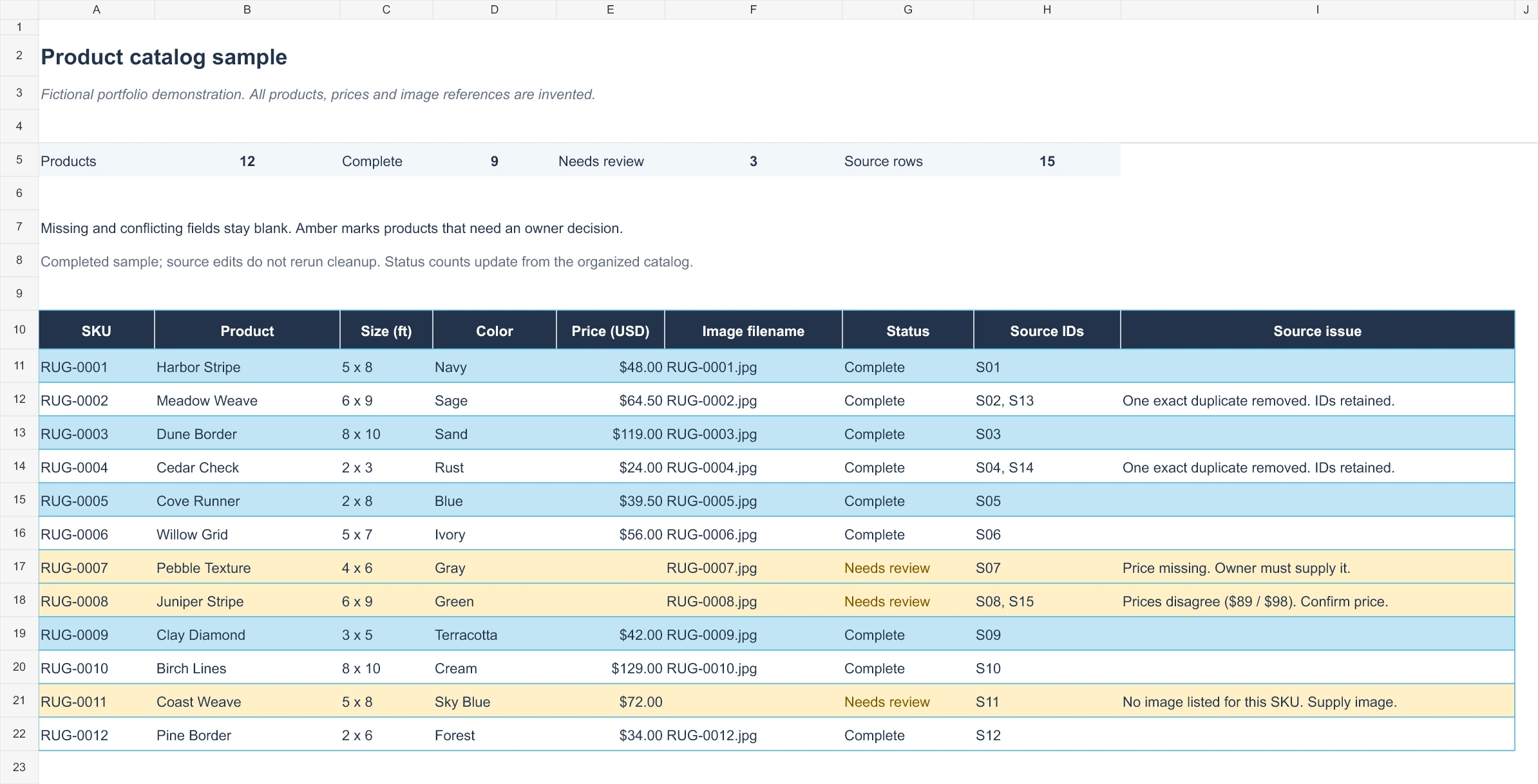
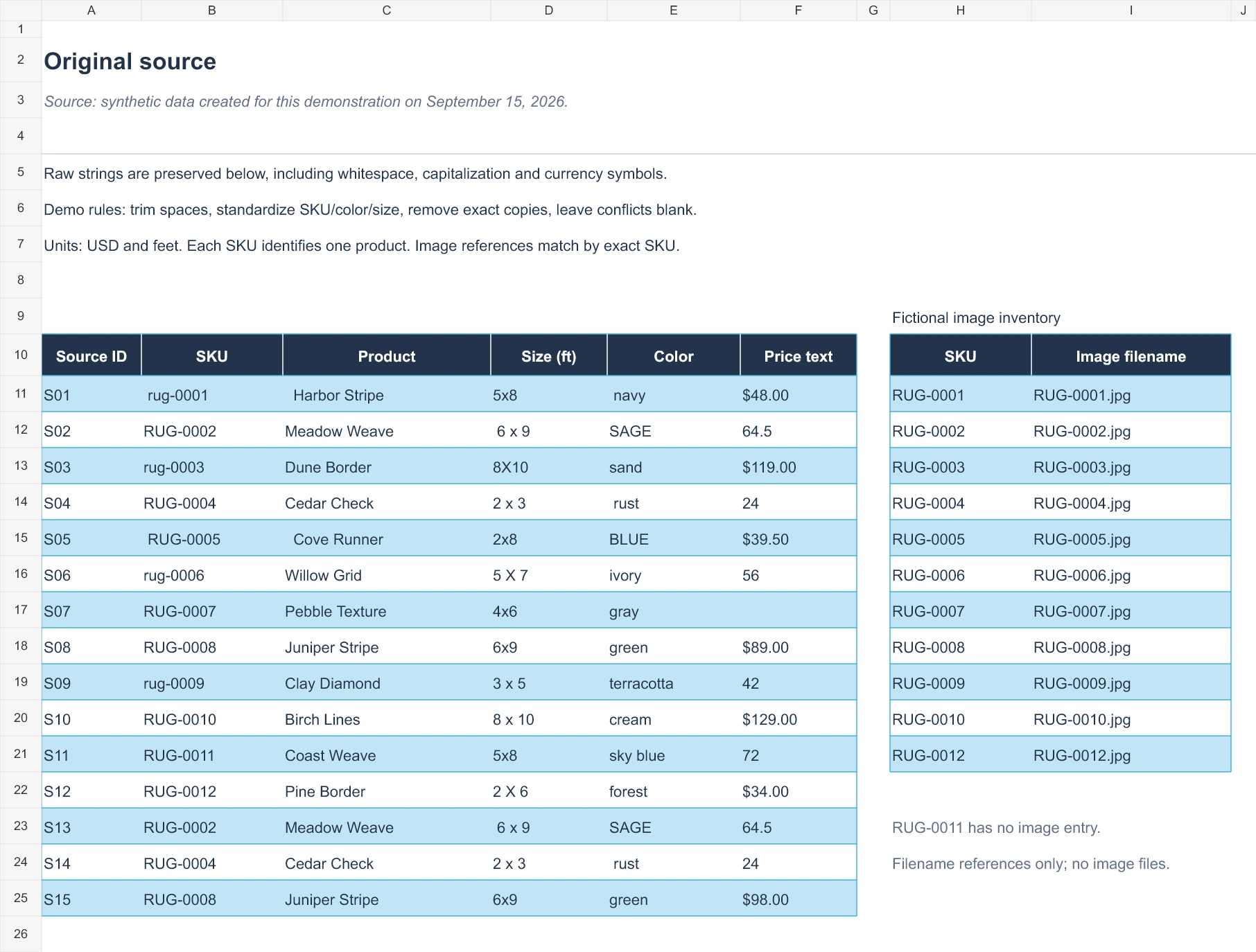
15 source rows organized into 12 unique product records.
Two exact duplicate copies removed, with every source ID retained.
11 image filename references matched by SKU.
Three products flagged for an owner decision.
What changed
Product IDs, spacing, colors and size notation were standardized. Prices were converted to numeric values. The original strings remain on a separate source sheet. The organized catalog can be filtered, and formulas update its status counts.
Questions left visible
RUG-0007: the source has no price.
RUG-0008: two source rows give different prices, $89 and $98.
RUG-0011: no image reference is supplied.
These fields stay blank until the owner supplies or confirms the information.
Checks performed
Every source ID is accounted for. Unique product counts, duplicate handling, image-key matches and blank-versus-zero price behavior were checked. Both workbook sheets were visually reviewed.
This is a completed sample rather than an automatic cleanup template. It contains image filenames, not product photographs. No live shop import was performed. Processing was AI-assisted with validation and final review.
Original source
The source table below preserves the supplied strings and the image inventory.
Download the sample
The Excel workbook includes the organized catalog and original source. All data is fictional.
Product-catalog-sample.xlsx
Like this project
Posted Sep 15, 2026
Fictional demo: 15 messy rows organized into 12 products, with two duplicate copies removed and three products flagged for missing or conflicting data.
Likes
0
Views
5