Kage: interactive Temple Walk

Omoniyi Daniel


Kage
A five-chapter, Three.js-rendered night walk through a Kyoto mountain temple — built to be read as slowly as it was written
Chapter 00 — Overview
Ninety minutes, told in five chapters
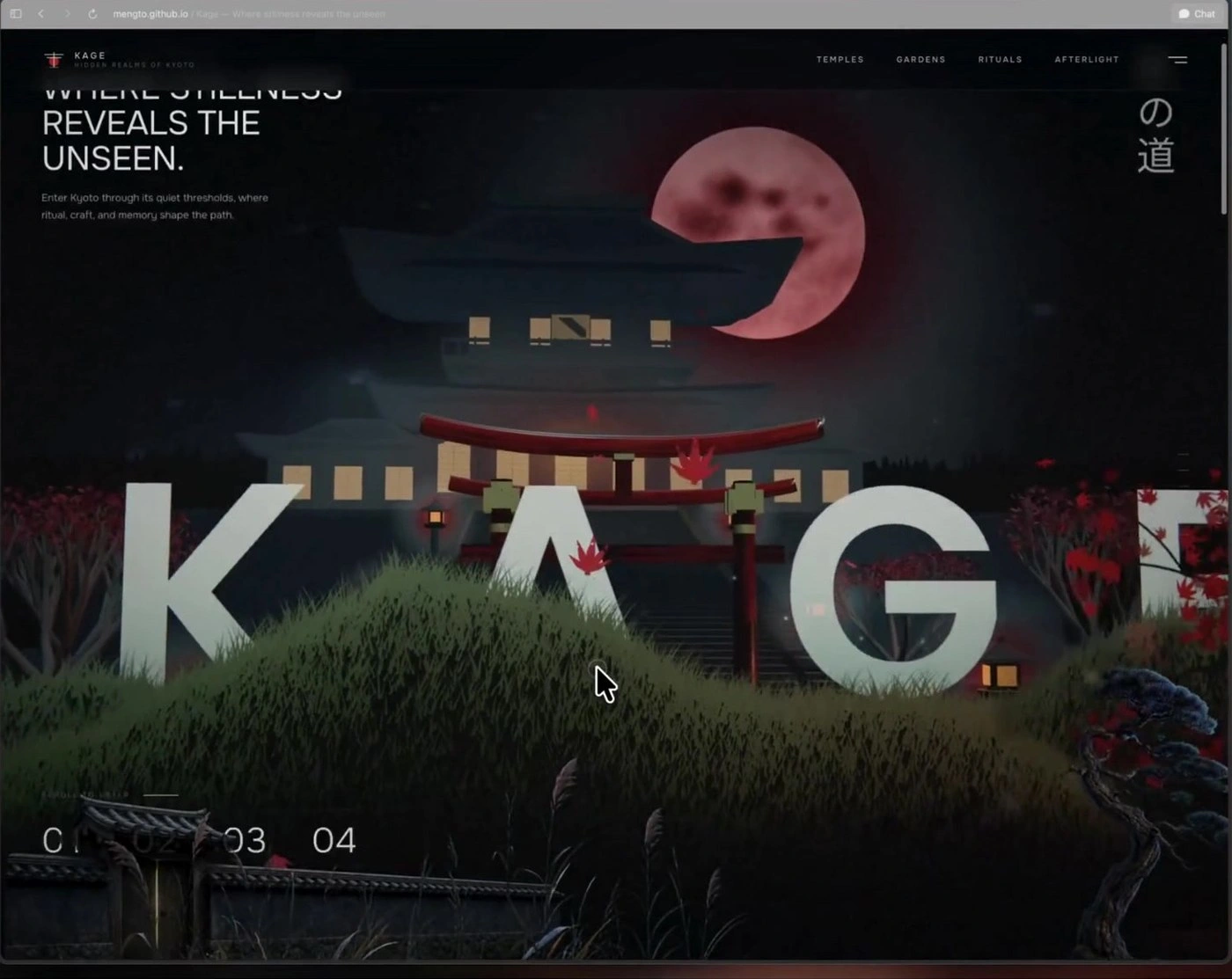
Kage is a five-chapter interactive site imagining a night walk through a mountain temple outside Kyoto — rendered live in Three.js and layered with cinematically generated imagery, from a blood-vermilion moon to the monumental sculptural wordmark sitting in the grass at the gate.
Its ninety minutes of content are organized into five named chapters — The Hidden Gate, Borrowed Scenery, Charred Cypress, Lantern Light, The Vermilion Moon — each grounded in a real piece of Japanese architectural or garden craft rather than generic "zen" iconography.
Chapter 01 — The Challenge
Atmosphere is easy. Specificity isn't
Most "atmospheric" web experiences lean on one of two crutches: stock photography with a dark overlay, or abstract generative art with no cultural specificity underneath it. Neither survives contact with someone who's actually been to Kyoto.
The implicit brief: build something that feels slow and contemplative — the opposite of most portfolio pieces, which are built to be scanned in five seconds — while staying specific enough, in real terms and real numbers, to hold up under a knowledgeable eye. And do it inside a single deployable file, with no build step to maintain.
Chapter 02 — Research & Insight
What separates homage from wallpaper
01
Specificity is the whole trick
"Zen garden" aesthetics are a cliché because they borrow the mood of Japanese design without its vocabulary. Shakkei (borrowed scenery), yakisugi (charred-wood preservation), tōrō (lantern) are real, teachable techniques — naming them is what separates homage from decoration.
02
A slow site has to earn the right to be slow
Ninety minutes of content, and a stat literally labelled "∞ Stillness," is a bet most visitors won't take on faith — it only works if the first ten seconds are good enough to make someone want the other 89 minutes.
03
Numbers persuade faster than adjectives
"05 Chapters · 92 Minutes · 1,611 Halls Raised" tells a visitor more about the depth of a project in four numbers than a paragraph of description would.
04
The chapter, not the scroll, is the right unit
Splitting a long experience into five named, independently-timed chapters gives a visitor permission to leave and come back, instead of demanding one unbroken sitting.
Chapter 03 — The Approach
Five decisions behind the walk
Let one wordmark carry the first impression
A single monumental "KAGE," sculptural, sitting in real grass and half-lit by a torii gate, does the job an entire hero section usually needs a headline, subhead and CTA to do.
Borrow real vocabulary, not just real mood
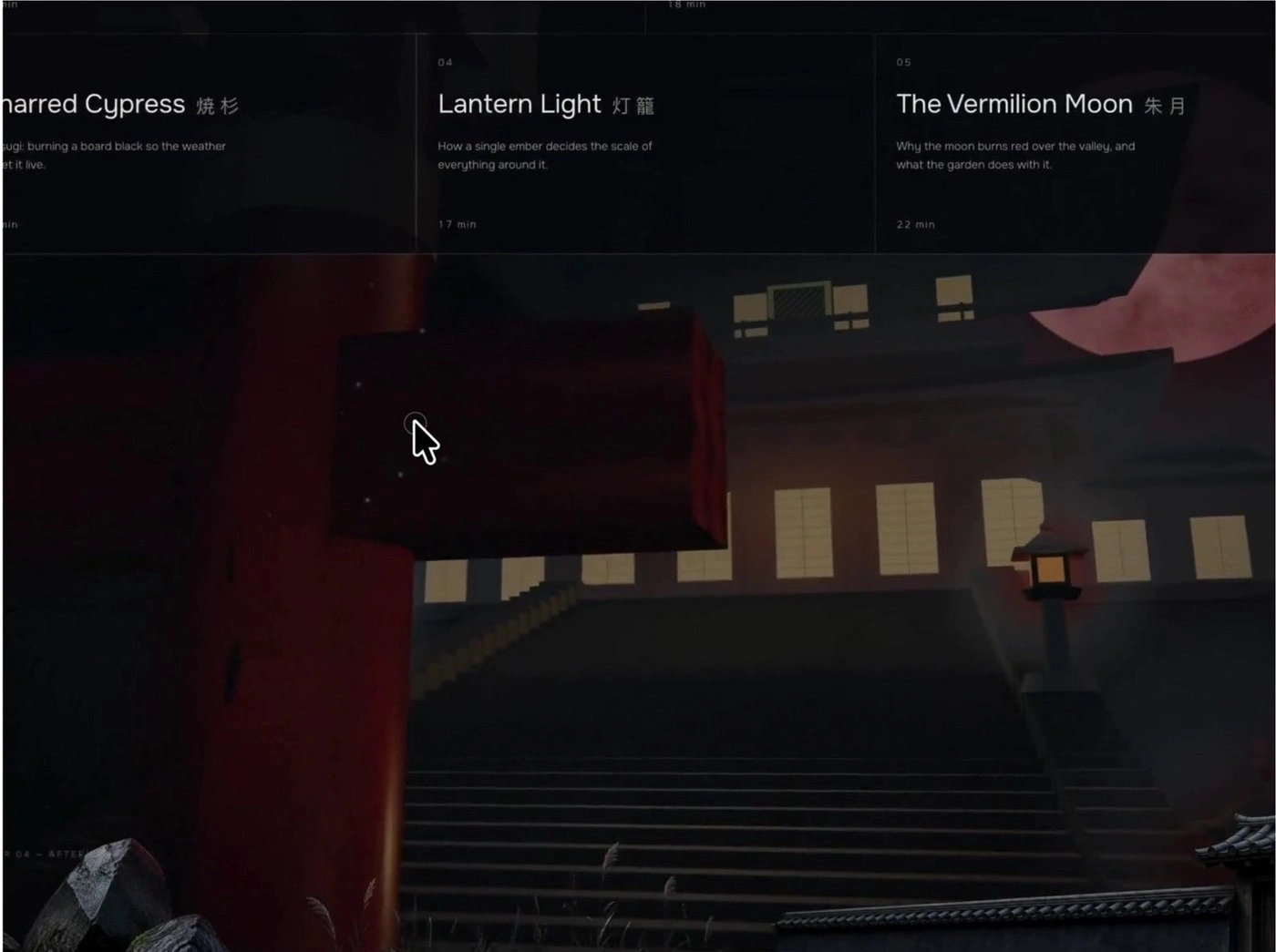
Every chapter pairs an English title with its actual Japanese term — Lantern Light / 灯籠, The Vermilion Moon / 朱月 — and a one-line description specific enough to teach something, not just evoke a feeling.
Write copy like a place, not a product
Lines describing how a falling maple leaf tumbles and catches the air read like field notes, not marketing copy — the site describes its own animation with the same patience it asks of the visitor.
Keep every technique honest about its own scope
The project's companion experiment, Wisps, states its own constraints in its subtitle — vanilla JavaScript and Canvas 2D, no shaders, no dependencies — the same restraint applied at a completely different scale.
Ship it as one deployable file
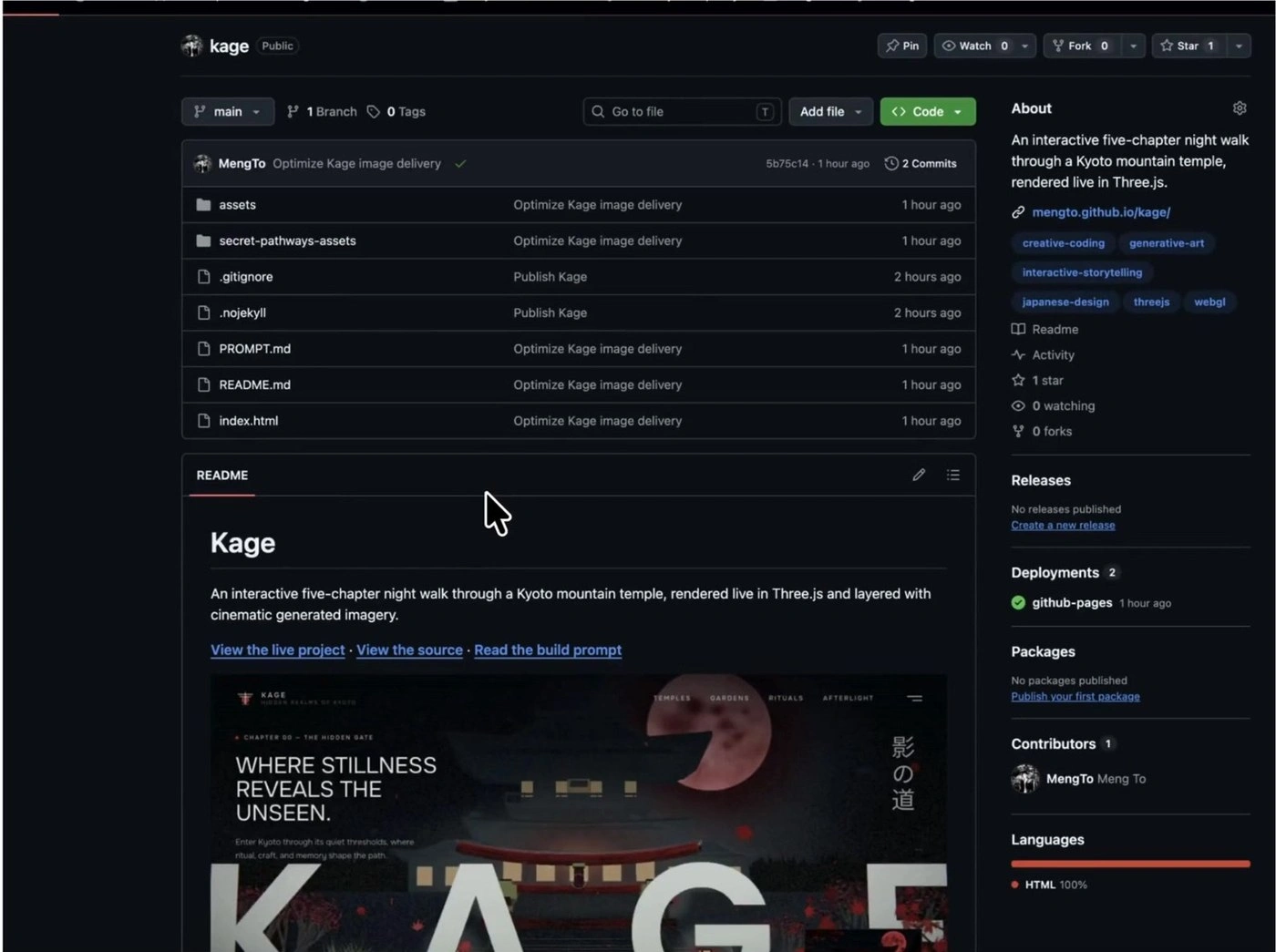
A hundred-percent-HTML repository, live on GitHub Pages within the hour of the last commit — the kind of constraint that keeps a highly art-directed project from becoming an unshippable one.
Chapter 04 — The Solution
What's actually live
The hero pairs the sculptural "KAGE" wordmark with a stats bar that translates the project's scope into four hard numbers — chapters, minutes, halls raised, stillness — before a visitor reads a line of chapter copy.
Each of the five chapters is browsable on its own terms rather than forced into one linear scroll, and each closes with a duration — 17 to 22 minutes — so the site is honest about the time it's actually asking for.
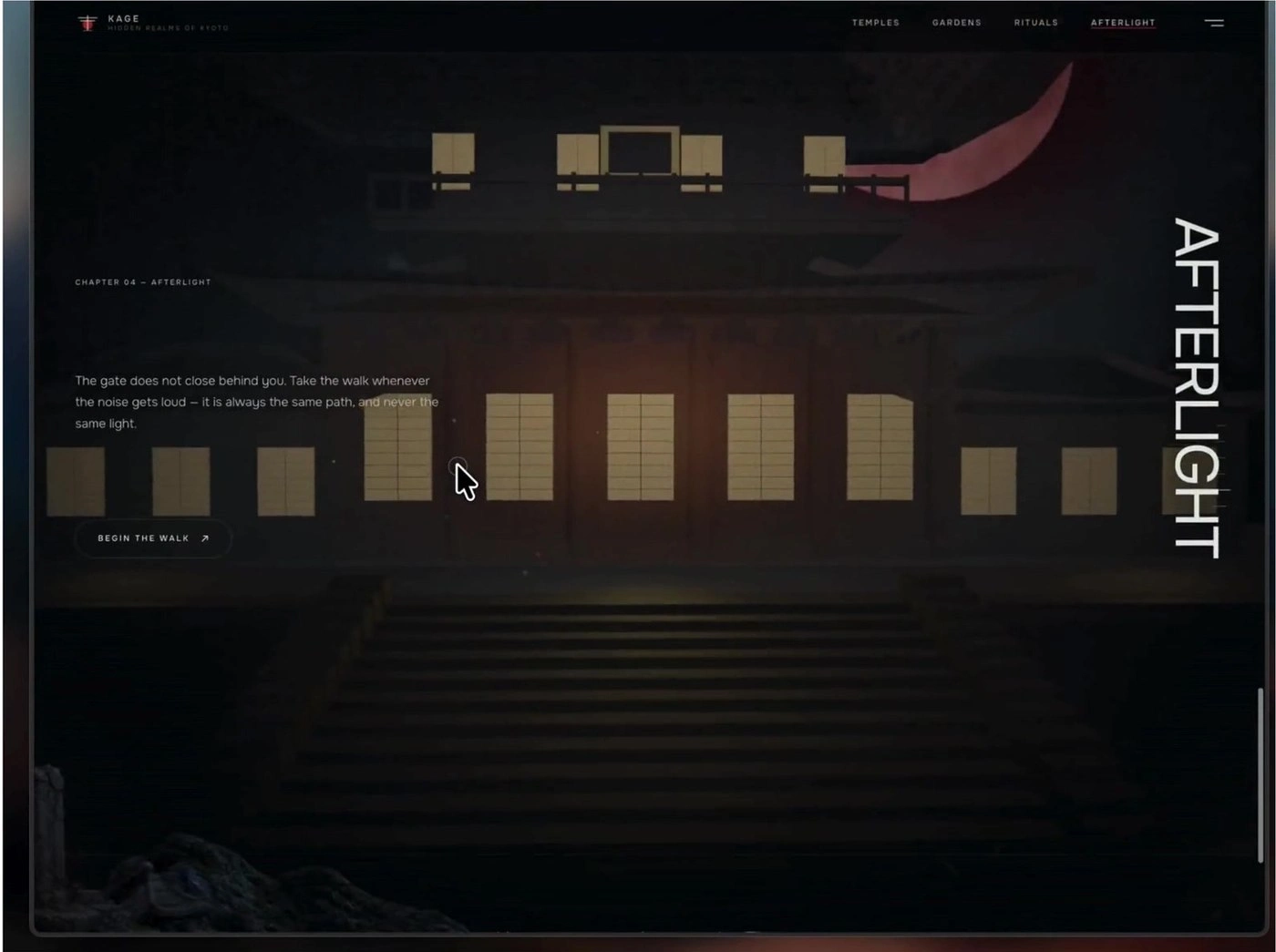
The closing chapter, Afterlight, drops the temple imagery for a wall of glowing paper-screen panels and a plain invitation: the gate doesn't close behind you.
Like this project
Posted Aug 18, 2026
Created an immersive 3D night temple walk site using Three.js.