Scroll-Driven Interactive Website for Ancient Egypt

Omoniyi Daniel


KEMET
A scroll-driven digital monument to ancient Egypt — where a single desert sky carries the visitor through four chapters of myth, history, and eternity.
Overview
KEMET reimagines ancient Egypt as a place you move through, not an article you read.
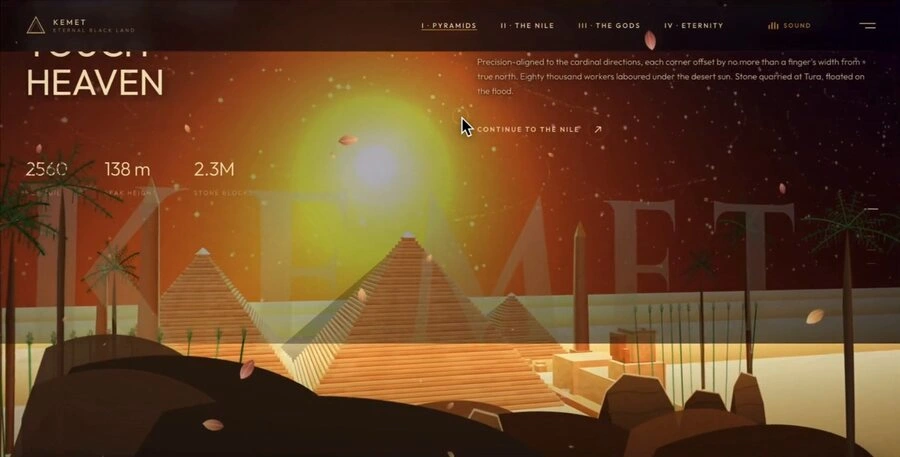
The site unfolds as one continuous desert sky — sunset bleeding into starfield — that visitors scroll through across four chapters: Pyramids, The Nile, The Gods, and Eternity. Rather than segmenting content into disconnected pages, every chapter is staged inside the same illustrated horizon, so history reads as a single unbroken journey rather than a stack of facts.
The experience closes on a "Return to the Beginning" link that loops the visitor back to the opening screen — a small interaction choice that mirrors ancient Egyptian belief in cyclical, eternal time.
The Challenge
Content about ancient civilizations tends to fall into one of two traps: a dry textbook layout that drains the subject of wonder, or a cluttered info-dump that buries real scholarship under decoration.
The challenge here was to hold both at once — precise, citable detail (construction dates, monument height, stone-block counts) delivered without breaking the mythic, atmospheric tone the subject deserves. The navigation itself is framed as chapters, not menu items — "I · Pyramids" reads like a table of contents in a book, setting the expectation that this is a journey to read through, not a site to click around.
Research & Insight
The specificity is the design. Real coordinates, real dates, real seasonal names — used as texture, not trivia.
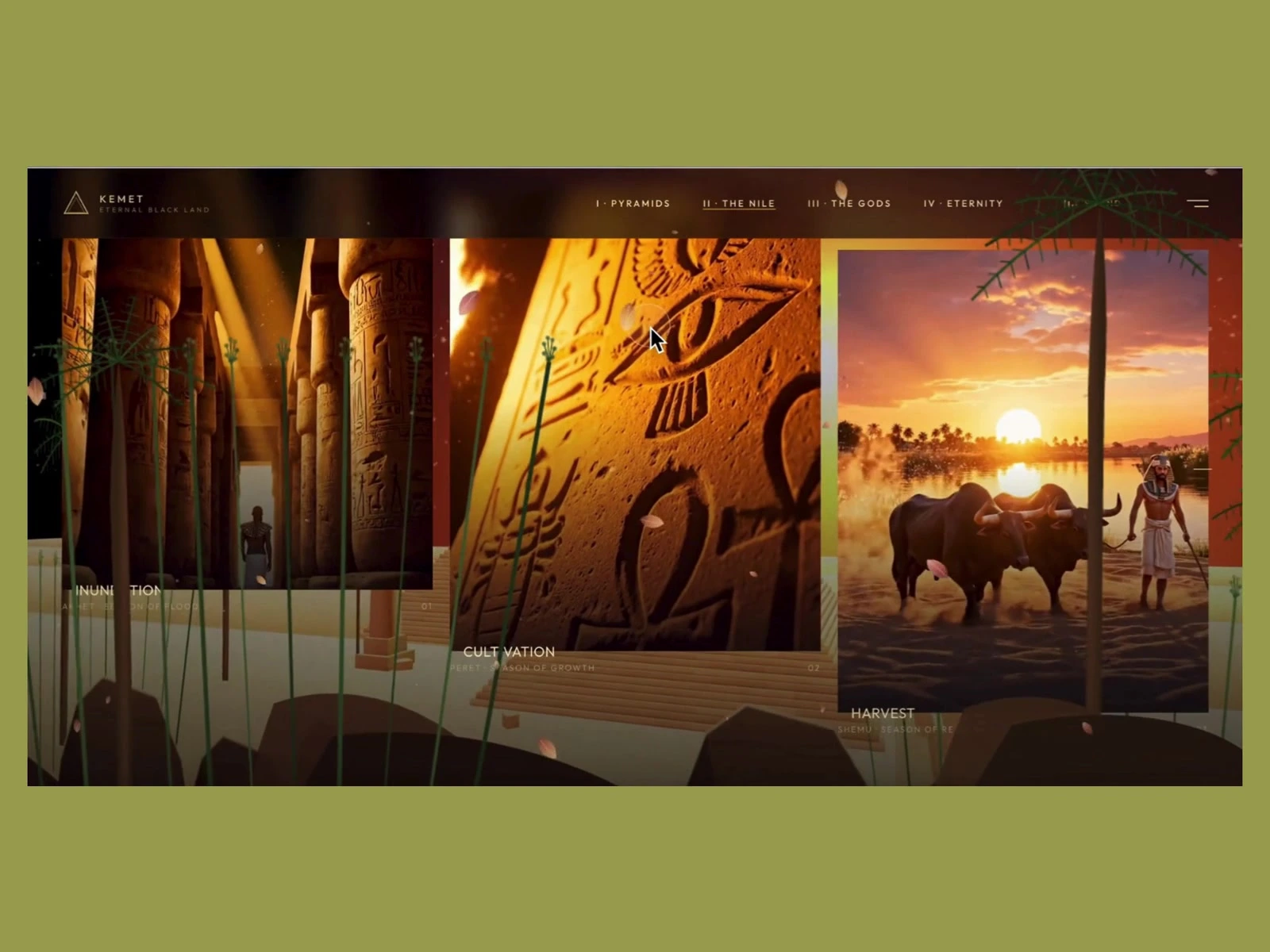
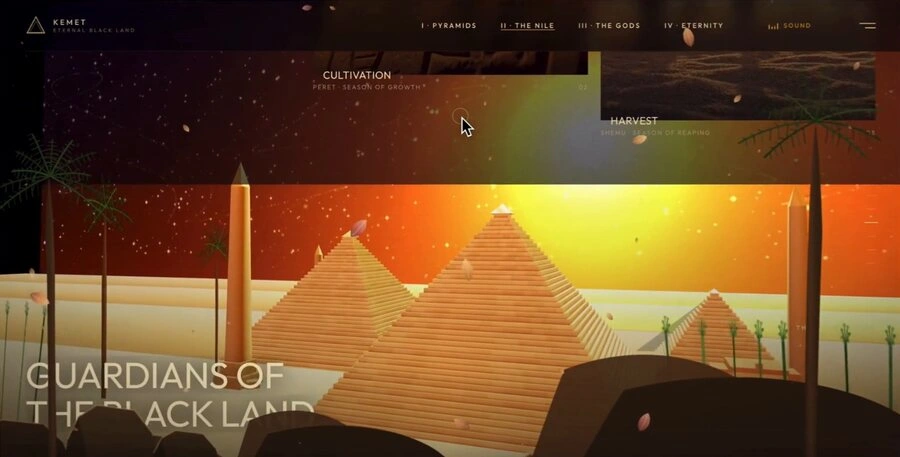
The footer anchors the whole site to Giza's actual coordinates (30°3′N, 31°13′E). The Nile chapter names the flood calendar's real agricultural seasons — Peret ("season of growth") and Shemu ("season of reaping") — instead of generic labels like "spring" or "summer." Even the Gods chapter opens by noting the pantheon held "over two thousand deities" before narrowing to four representative figures. That layered specificity is what keeps an atmospheric, illustrated site from reading as generic fantasy — every mood-setting detail is doing double duty as fact.
The Approach
01
One continuous backdrop, four chaptersA single sunset-to-starfield illustration persists across the whole scroll, so moving between "Pyramids" and "Eternity" feels like time passing over one landscape, not a page change.
02
Monument-scale typographyAn oversized "KEMET" wordmark is set directly into the illustration, ghosted behind the pyramids, so the logotype reads as scenery — as large and permanent as the monuments themselves.
03
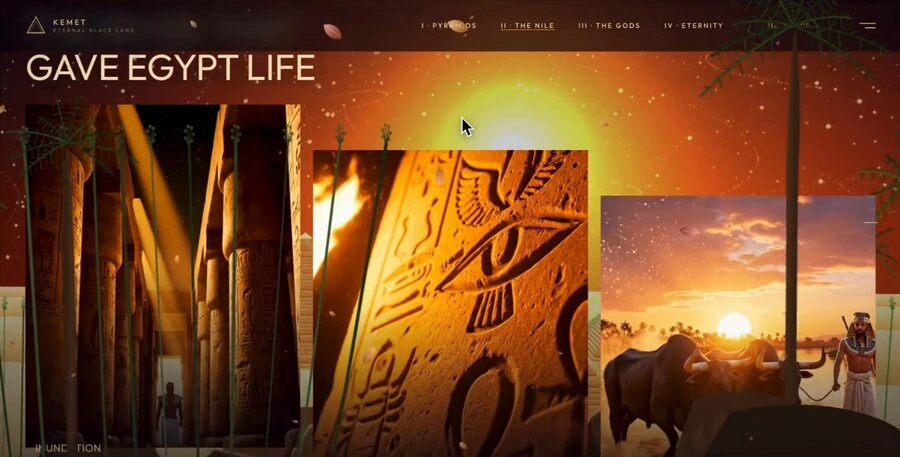
Mixed media by content typeFlat vector illustration carries the environment and mood; photographic and rendered close-ups (hieroglyph carvings, temple columns, a farmer with oxen at sunset) carry cultural specificity where illustration would flatten the detail.
04
Ambient ritual, not autoplayA "Sound" toggle in the header offers ambient audio as an opt-in layer of immersion rather than forcing it on load.
05
Circular structureThe closing chapter ends with "Return to the Beginning," turning the site's own navigation into a small piece of storytelling about eternity.
The Solution
The finished site plays as four chapters inside one world. Pyramids opens with construction facts staged like inscriptions. The Nile shifts to a photographic register — temple columns, carved hieroglyphs, a farmer at the water's edge — to ground the mythic tone in lived history.
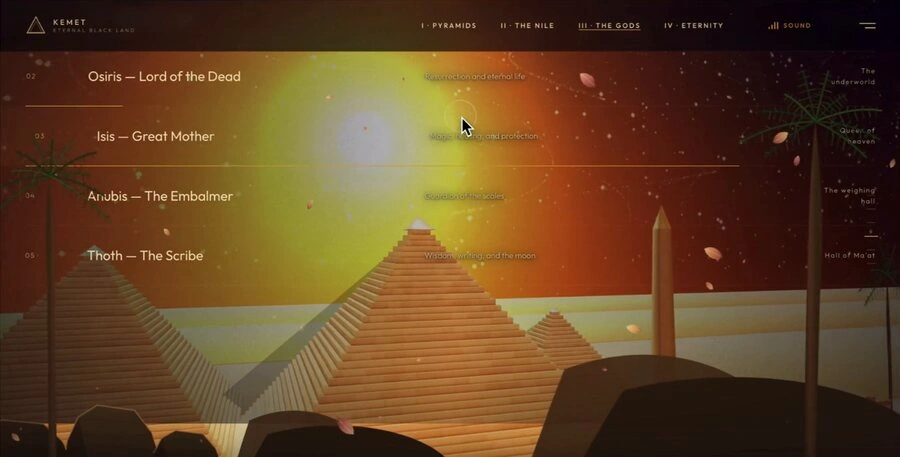
The Gods presents a numbered directory (Osiris, Isis, Anubis, Thoth, and more) each paired with a one-line domain, letting visitors skim a pantheon without a wall of text. Eternity closes the loop with "Beyond the Horizon" and the return-to-start link.
Impact & Results
Replaced a typical "facts about Egypt" page structure with a single sustained visual metaphor that holds four distinct content types together.
Balanced cited-feeling factual detail (dates, dimensions, coordinates, season names) with an atmospheric, editorial tone throughout.
Turned a structural navigation choice — looping back to the start — into part of the storytelling itself.
Like this project
Posted Aug 17, 2026
Designed a continuous, scroll-driven website about ancient Egypt.