
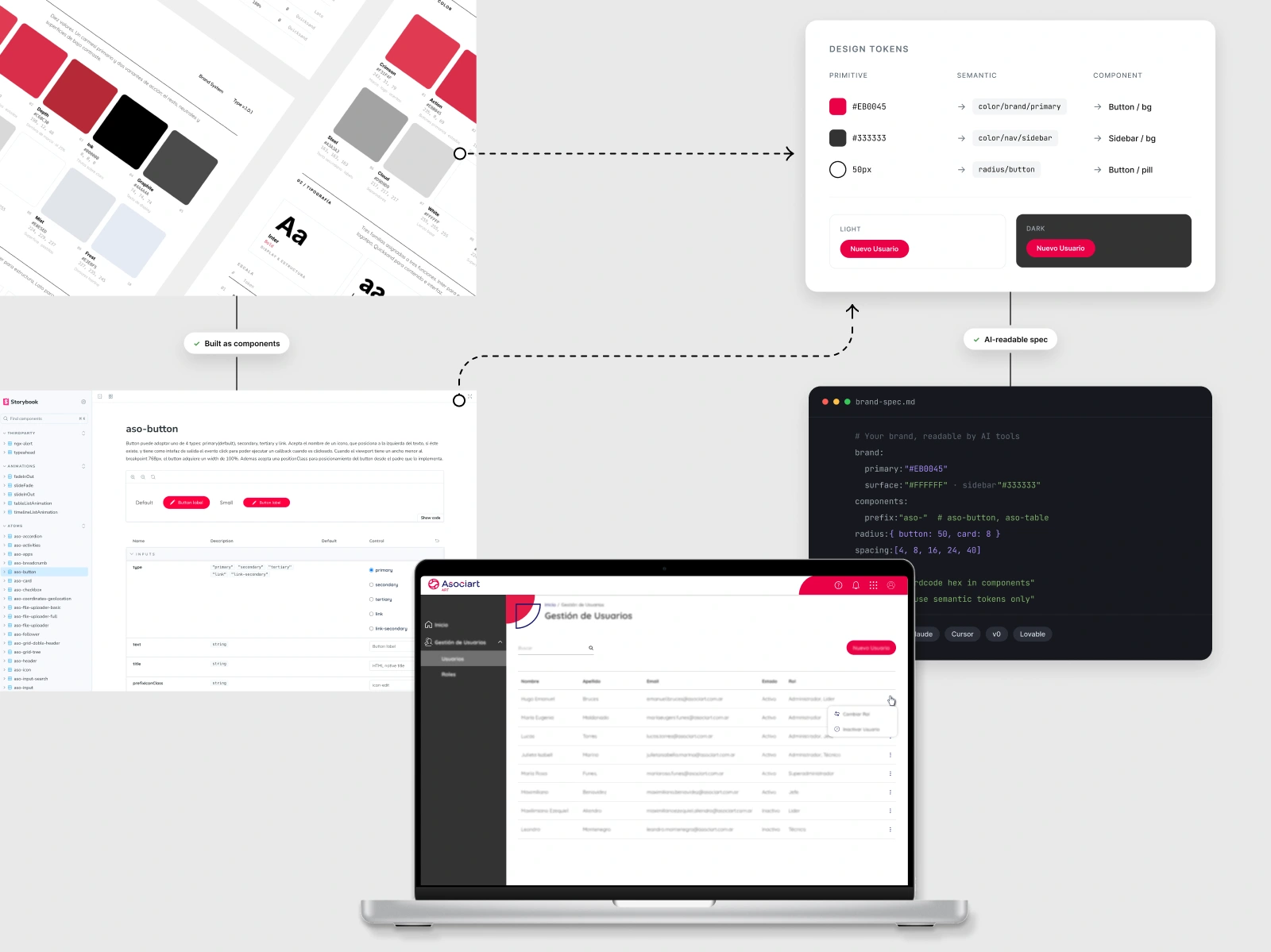
Enterprise Design System & AI Workflow: a 13-module insurance platform
Role: Senior UX/UI Designer, Design Systems lead (EPAM Systems, 2021–2026) — one direct report.
Context: A data-intensive insurance platform of 13 modules (claims, collections, recovery, services) that re-engineered a deeply embedded legacy system used daily by 500+ internal users. The business goal: cut the hours producers spend filing a claim.
Scope: UX foundation, Core Design System, complex operational flows, and an AI-assisted design workflow POC.
What I built😍 Core Design System: 71+ reusable components, design tokens, interaction patterns and Storybook documentation, shared across 13 modules and multiple teams. The library lived in Figma and Storybook with mirrored naming, so engineering could inspect every screen against its documentation.
Governance: the rule was extend by attributes before creating — every new component risks breaking modules already consuming the library in production. That discipline kept 98% design-to-build accuracy across 130+ sprints.
Data-dense interfaces: operational flows, reports and dashboards, simplified without breaking behaviors users had automated from memory — in internal tools, relearning costs more than the friction you remove.
AI workflow POC: I mapped how much of the repetitive screen demand was automatable and proposed it to stakeholders. The result: a pipeline that turns user stories into editable, design-system-based Figma screens — few-shot examples from approved past work, explicit UX rules, and structured Design System data exposed through a Figma MCP context layer. Human-in-the-loop: the designer keeps validation and final decisions.
Result: A production platform serving 500+ internal users, a design system that survived five years of evolution without fragmenting, and an AI workflow that turns the design system into something machines can build with — not just a component library.
0 likes · 0 views · Nov 5, 2026
Enterprise design system (71+ components, 500+ users, 98% design-to-build) + an AI workflow that builds Figma screens from user stories.


