QAOA Implementation for MAX-SAT Problems

Christian Neureuter

QAOA for MAX-SAT Problems
A comprehensive Python implementation of the Quantum Approximate Optimization Algorithm (QAOA) for solving MAX-SAT problems including Max-Cut and MAX 3-SAT using Google's Cirq quantum computing framework.
A deep dive into hybrid quantum-classical computing with a comprehensive implementation of the Quantum Approximate Optimization Algorithm (QAOA) to solve NP-hard combinatorial optimization problems. This project tackles multiple variants of the Maximum Satisfiability (MAX-SAT) problem, including Max-Cut on ring graphs (MAX-2-SAT) and general MAX-3-SAT with arbitrary boolean clauses. The implementation features a robust pipeline built with Python and Google's Cirq framework. It constructs parameterized quantum circuits that encode problem Hamiltonians, using standard ZZ gates for Max-Cut and novel, custom-built 3-qubit gates for the more complex MAX-3-SAT instances. A classical Nelder-Mead optimizer iteratively refines the circuit parameters to navigate the solution space and find high-quality approximate solutions. The project includes extensive performance analysis, calculating approximation ratios by benchmarking QAOA results against a classical brute-force solver and demonstrating performance scaling with increased circuit depth.
TECHNOLOGIES USED
Python • Google Cirq
KEY METRICS
2 NP-Hard Problem Classes Solved
90%+ Approximation Ratios Achieved
Project Overview
This project demonstrates a complete implementation of QAOA, a hybrid quantum-classical algorithm that combines quantum circuits with classical optimization to solve combinatorial optimization problems. The implementation covers multiple MAX-SAT problem variants including:
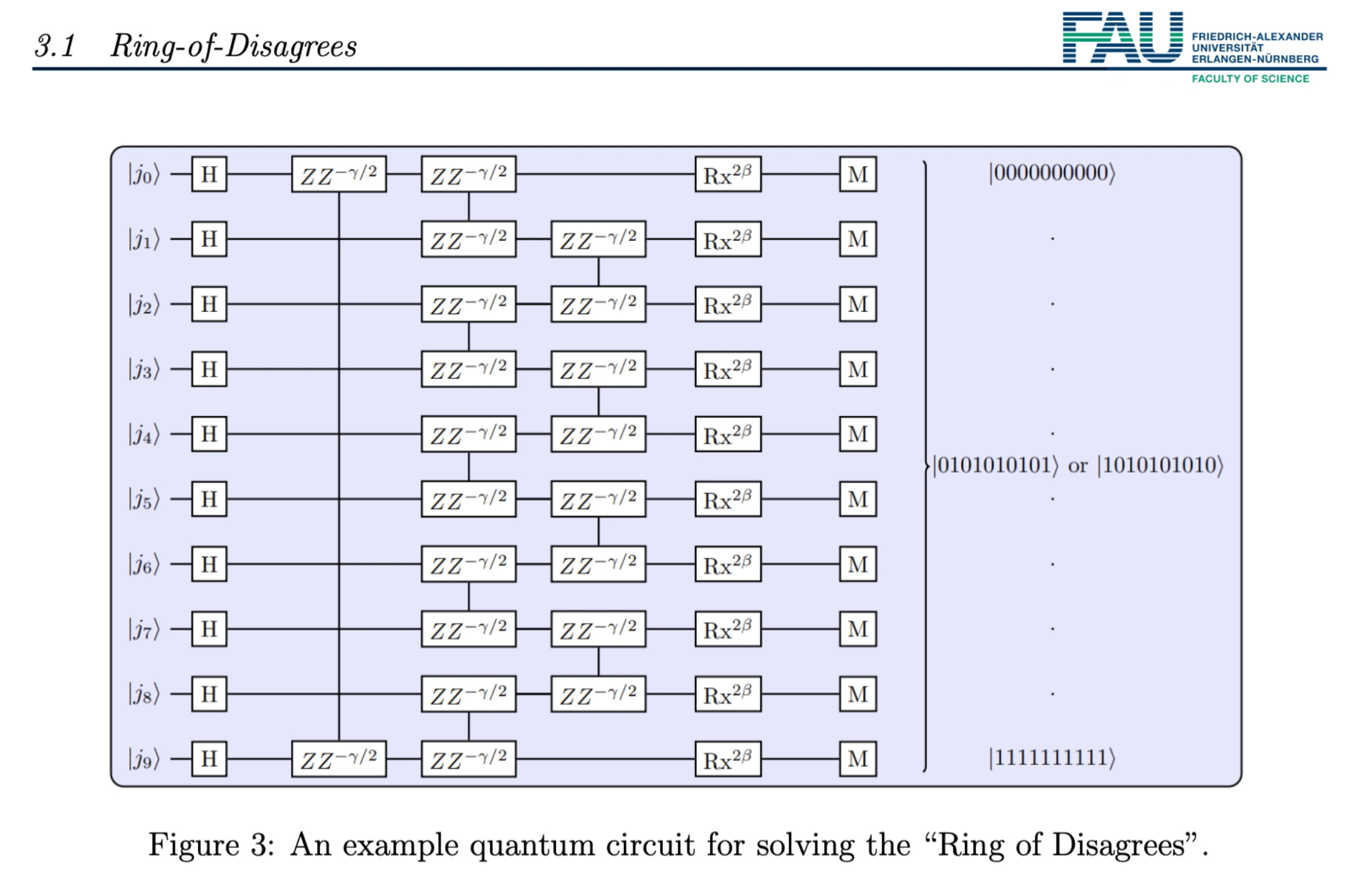
MAX 2-SAT (Ring of Disagrees): Max-Cut problem on ring graphs
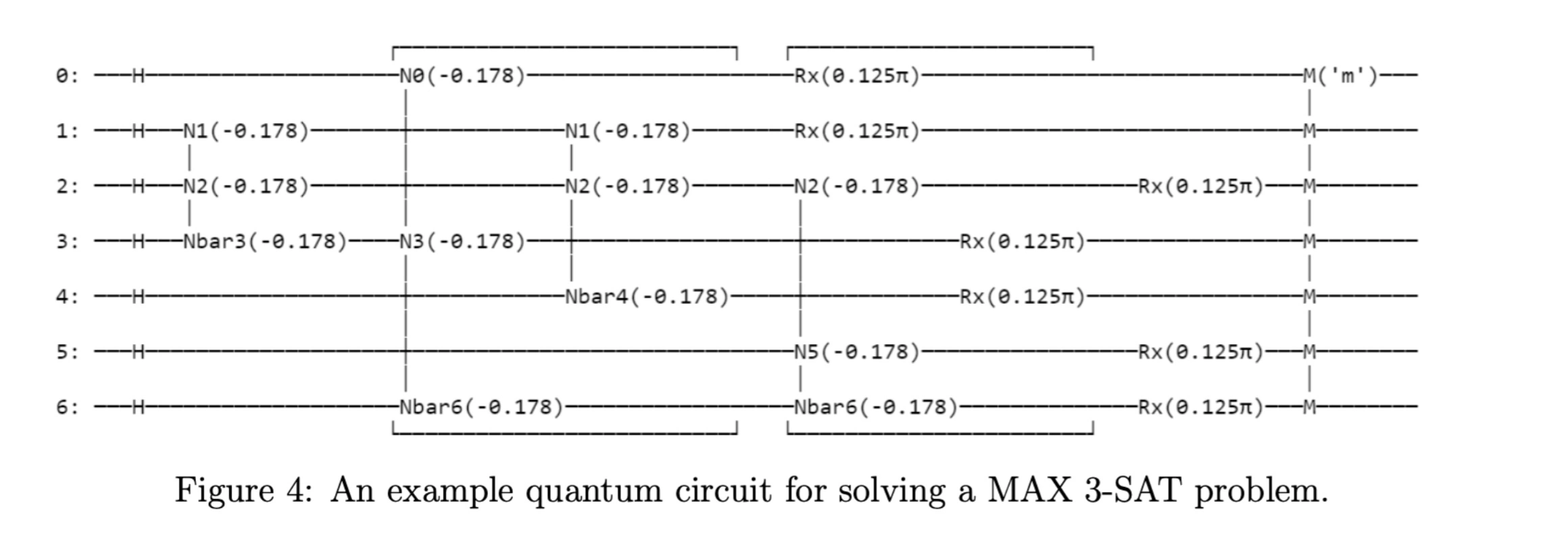
MAX 3-SAT: General 3-satisfiability problems with arbitrary boolean clauses
What is QAOA?
QAOA (Quantum Approximate Optimization Algorithm) is a variational quantum algorithm that:
Uses parameterized quantum circuits to prepare quantum states
Employs classical optimization to find optimal parameters
Provides approximate solutions to NP-hard combinatorial problems
Demonstrates potential quantum computational advantages
MAX-SAT Problems
This implementation addresses multiple SAT problem variants:
MAX 2-SAT (Ring of Disagrees):
Finding optimal vertex partitions to maximize disagreeing edges
Ring graph topology with neighboring vertex interactions
Cost function: C ( z ) = ∑ ⟨ j k ⟩ 1 2 ( 1 − σ j z σ k z )
MAX 3-SAT:
General satisfiability problems with 3-literal clauses
Arbitrary boolean clause structures
Custom 3-qubit gates for clause evaluation
Cost function: C ( z ) = ∑ i j k z i z j z k (with possible negations)
Applications: Network design, VLSI circuit design, clustering, constraint satisfaction, and combinatorial optimization
Project Structure
Getting Started
Prerequisites
Python 3.7+
Jupyter Notebook
pip or conda
Installation
Clone the repository:
Install dependencies:
Launch Jupyter:
Open and run
notebooks/qaoa-max-sat-implementation.ipynbKey Features
Complete QAOA Implementation
Parameterized quantum circuits using Cirq
ZZ gates for MAX 2-SAT (Ring of Disagrees) problems
Custom 3-qubit gates for MAX 3-SAT problems
Rx gates for mixing Hamiltonian
Multiple Problem Formulations
MAX 2-SAT implementation with ring topology
MAX 3-SAT implementation with arbitrary clauses
Proper operator construction for different eigenvalue requirements
Classical Optimization
Nelder-Mead optimization for parameter tuning
Performance tracking and analysis across problem types
Comprehensive Analysis
Circuit depth performance comparison
Approximation ratio calculations
Brute-force optimal solution verification
Statistical analysis of solution distributions
Professional Visualization
Circuit diagrams for different problem types
Performance plots and probability distributions
Clear documentation and explanations
Algorithm Details
Circuit Structure
The QAOA circuit consists of:
Initialization: Hadamard gates create uniform superposition
Problem Layers:
ZZ gates for MAX 2-SAT encoding
Custom 3-qubit gates for MAX 3-SAT encoding
Mixing Layers: Rx gates provide transitions between states
Measurement: Final measurement in computational basis
Mathematical Foundation
MAX 2-SAT (Ring of Disagrees):
Problem Hamiltonian: H C = ∑ ⟨ j k ⟩ 1 − Z j Z k 2
Uses Pauli-Z operators with eigenvalues {+1, -1}
MAX 3-SAT:
Problem Hamiltonian: H C = ∑ i j k z ^ i z ^ j z ^ k
Custom operators: z ^ = 1 2 ( 1 ± σ z ) with eigenvalues {0, 1}
Handles arbitrary 3-literal clause structures
Common Elements:
Mixing Hamiltonian: H M = ∑ i X i
QAOA State: | γ , β ⟩ = ∏ j = 1 p e − i β j H M e − i γ j H C | + ⟩ ⊗ n
Parameter Optimization
The algorithm optimizes two sets of parameters:
γ (gamma): Controls the strength of the problem Hamiltonian
β (beta): Controls the strength of the mixing Hamiltonian
Results
The implementation demonstrates:
Consistent high approximation ratios for both problem types
Performance scaling with increasing circuit depth (p=1,2,3)
Efficient classical optimization convergence
Verification against brute-force optimal solutions
Statistical analysis showing concentration around optimal values
Performance Highlights
Optimal Solutions: Consistently finds optimal solutions for small instances (n≤10)
Problem Versatility: Successfully handles both MAX 2-SAT and MAX 3-SAT formulations
Scalability: Demonstrates performance across different circuit depths
Accuracy: High approximation ratios achieved through parameter optimization
Educational Value: Complete implementation suitable for learning QAOA concepts
Usage Example
Contributing
This project welcomes contributions! Areas for enhancement:
Hardware-specific circuit optimizations
Additional SAT problem variants (MAX k-SAT for k>3)
Performance improvements and error mitigation
Extended documentation and tutorials
Quantum error correction integration
References
Farhi, E., Goldstone, J., & Gutmann, S. (2014). A quantum approximate optimization algorithm. arXiv:1411.4028
Google Cirq Documentation: https://quantumai.google/cirq
NetworkX Documentation: https://networkx.org/
Academic Paper: QAOA_for_MAX_SAT.pdf (included in docs/)
License
This project is licensed under the MIT License - see the LICENSE file for details.
Academic Context
This project was developed as part of advanced quantum computing coursework at FAU Erlangen-Nuremberg under supervision of Professor Michael Hartmann, demonstrating:
Practical implementation of variational quantum algorithms
Integration of quantum and classical computing paradigms
Performance analysis and optimization techniques
Academic rigor in algorithm development and testing
Professional documentation and presentation skills
Acknowledgments
Professor Michael Hartmann - Project supervision and academic guidance
FAU Erlangen-Nuremberg - Academic institution and research support
Google Cirq Team - Excellent quantum computing framework
NetworkX Development Team - Graph theory and visualization tools
Contact
For questions, suggestions, or collaboration opportunities, please open an issue on GitHub.
Built for quantum computing research and education
Keywords: Quantum Computing, QAOA, MAX-SAT, MAX-3-SAT, Max-Cut, Optimization, Cirq, Python, Boolean Satisfiability, Quantum Algorithms
Like this project
Posted Aug 29, 2025
Quantum computing algorithm development, implemented QAOA for MAX-SAT problems using Python and Cirq.
Likes
0
Views
14
Timeline
Dec 6, 2021 - Feb 7, 2022