Flusso: a money dashboard, end to end

Valerio Donfrancesco


Flusso is a money dashboard for people whose income arrives irregularly, in several currencies, from clients, platforms and subscribers. It's my own product: I designed and built it end to end, and it's live as a public demo with example data.
The problem
Budgeting apps assume a salary. With variable income the real question isn't where the money went, but how much you can spend today without running short in a quiet month or when a tax advance comes due.
My role
Everything: research, product strategy, information architecture, UX/UI, the visual system and the build in PHP and JavaScript, including open banking, the forecasts and a connector for Claude and ChatGPT.
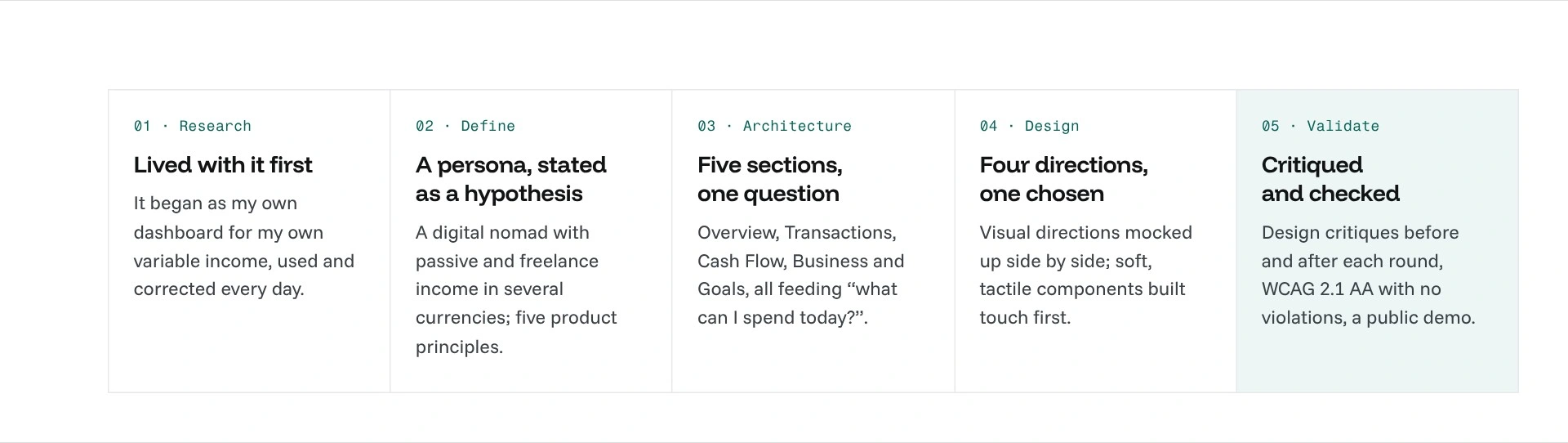
The process, end to end.
Research: living with it first
Flusso started as my own dashboard for my own variable income, opened every morning. Daily use shaped the model more than any brief. One example: in the current month, the number I wanted to type wasn't the month's total but what was still to come, so the plan works that way: what's recorded so far plus what's still to come.
To turn the tool into a product I wrote down the person it's for as a stated hypothesis, not a verified customer: a digital nomad with passive and freelance income, cards in several currencies, and miles and points. Five principles followed, starting with "the answer to how much can I spend comes first, in seconds, from the phone".
Information architecture: five sections around one question
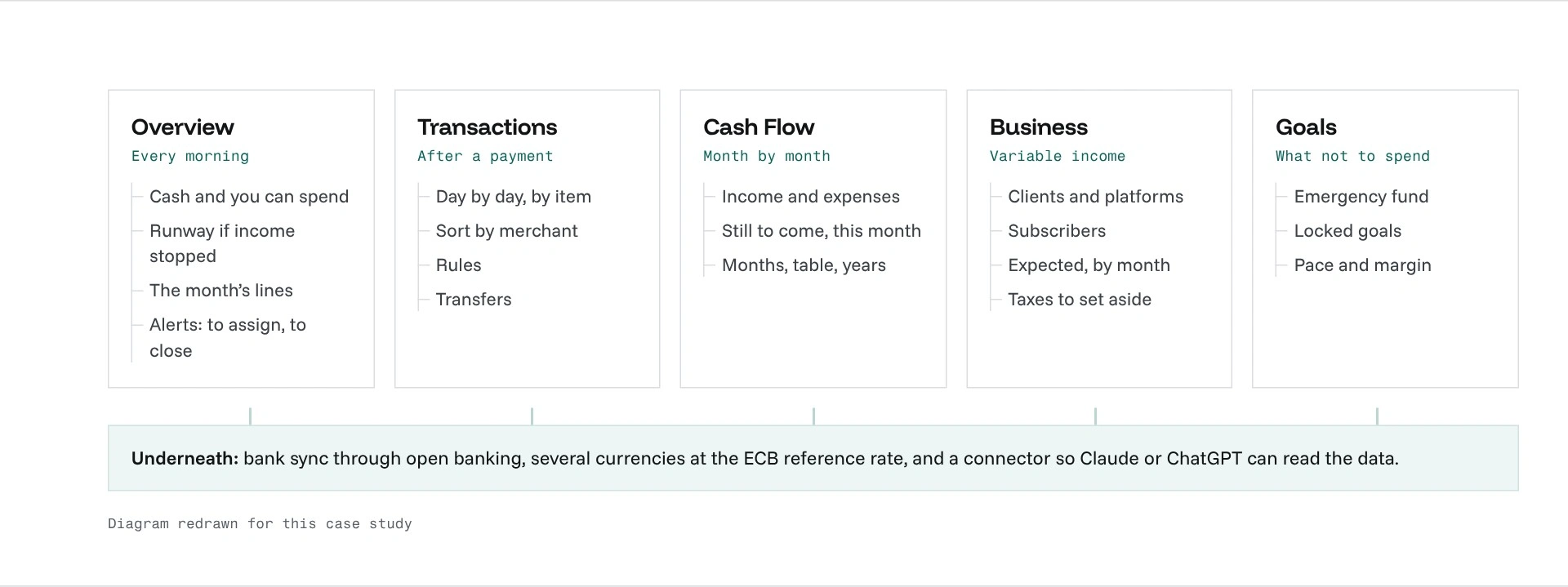
Every section feeds the number you can spend today.
The core flow: from a bank transaction to the plan
Transactions arrive from the bank through open banking. The few the app can't place go into a short queue, sorted by merchant: one choice assigns them all and becomes a rule, so the queue stays short next month.
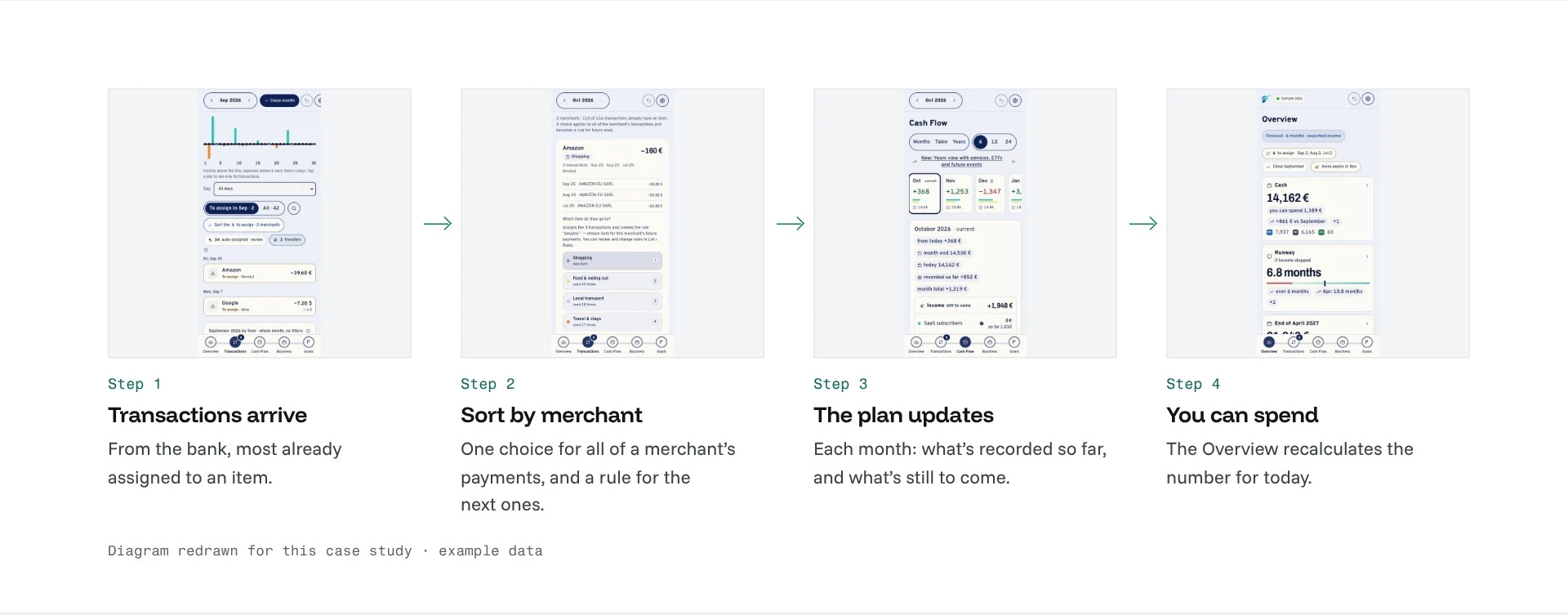
From a transaction to the number you can spend, with example data.
One number first, with its working shown
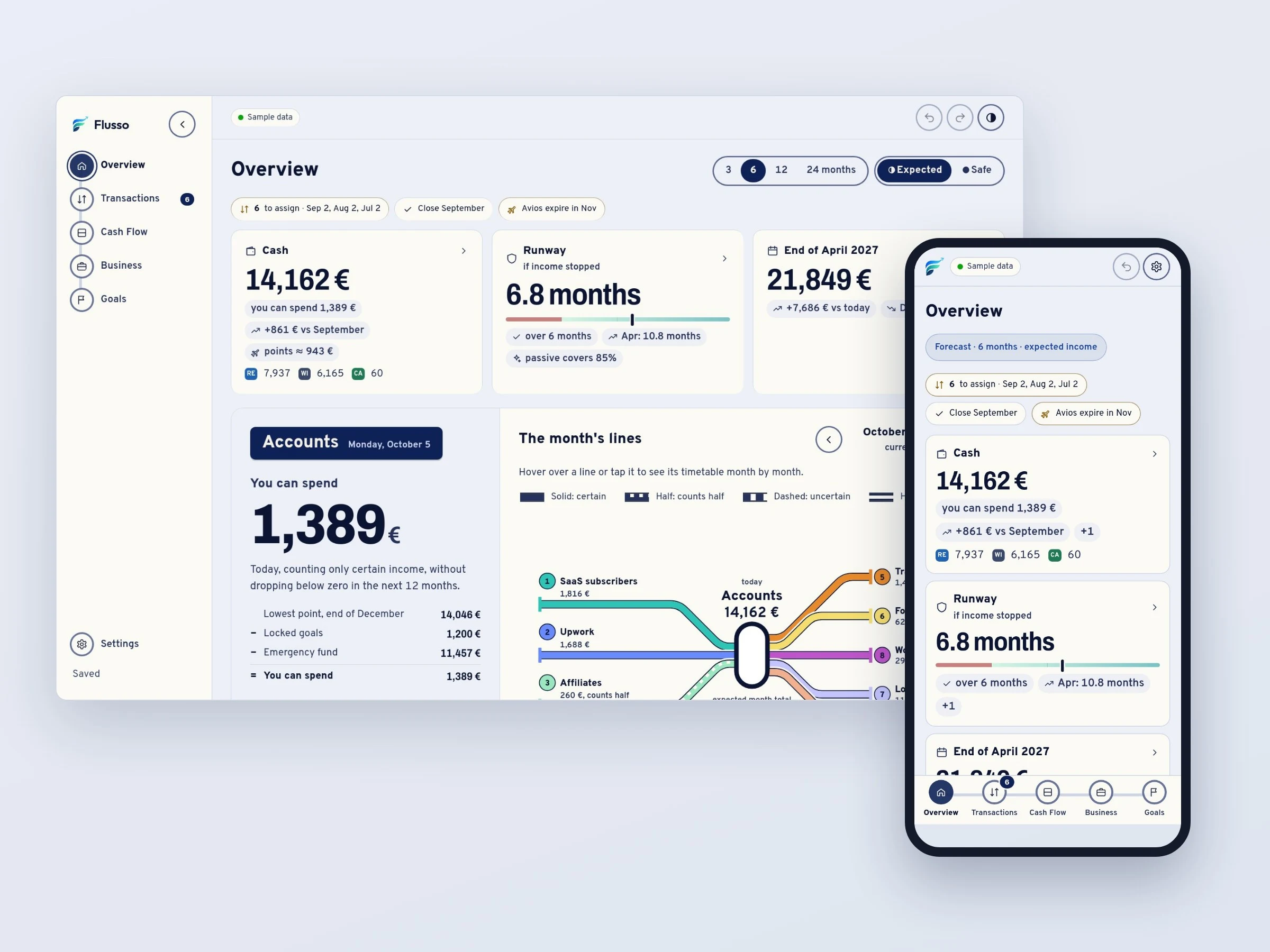
The Overview opens on what you can spend today: the lowest point of the next twelve months, minus locked goals and the emergency fund. Only income you can count on counts in full; half-certain income counts half. The calculation sits right below the number, so it never feels like a black box.

The calculation, as the app shows it.
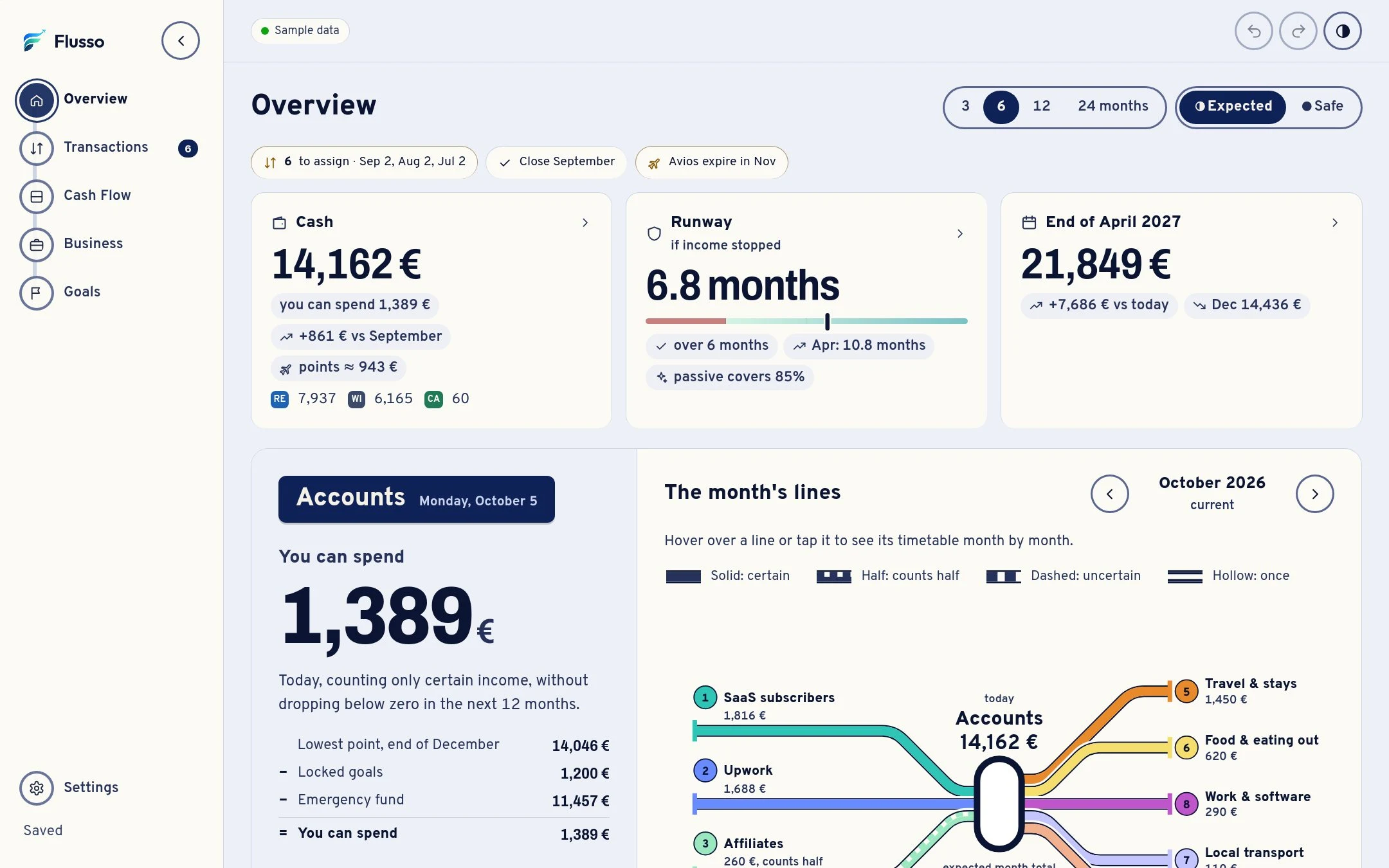
The Overview on desktop, with the month's lines.
Certainty you can see
Every income and expense is drawn as a line into or out of your accounts: solid lines count in full, half-dashed count half, dashed are uncertain and hollow ones happen once, so a forecast never looks surer than it is.
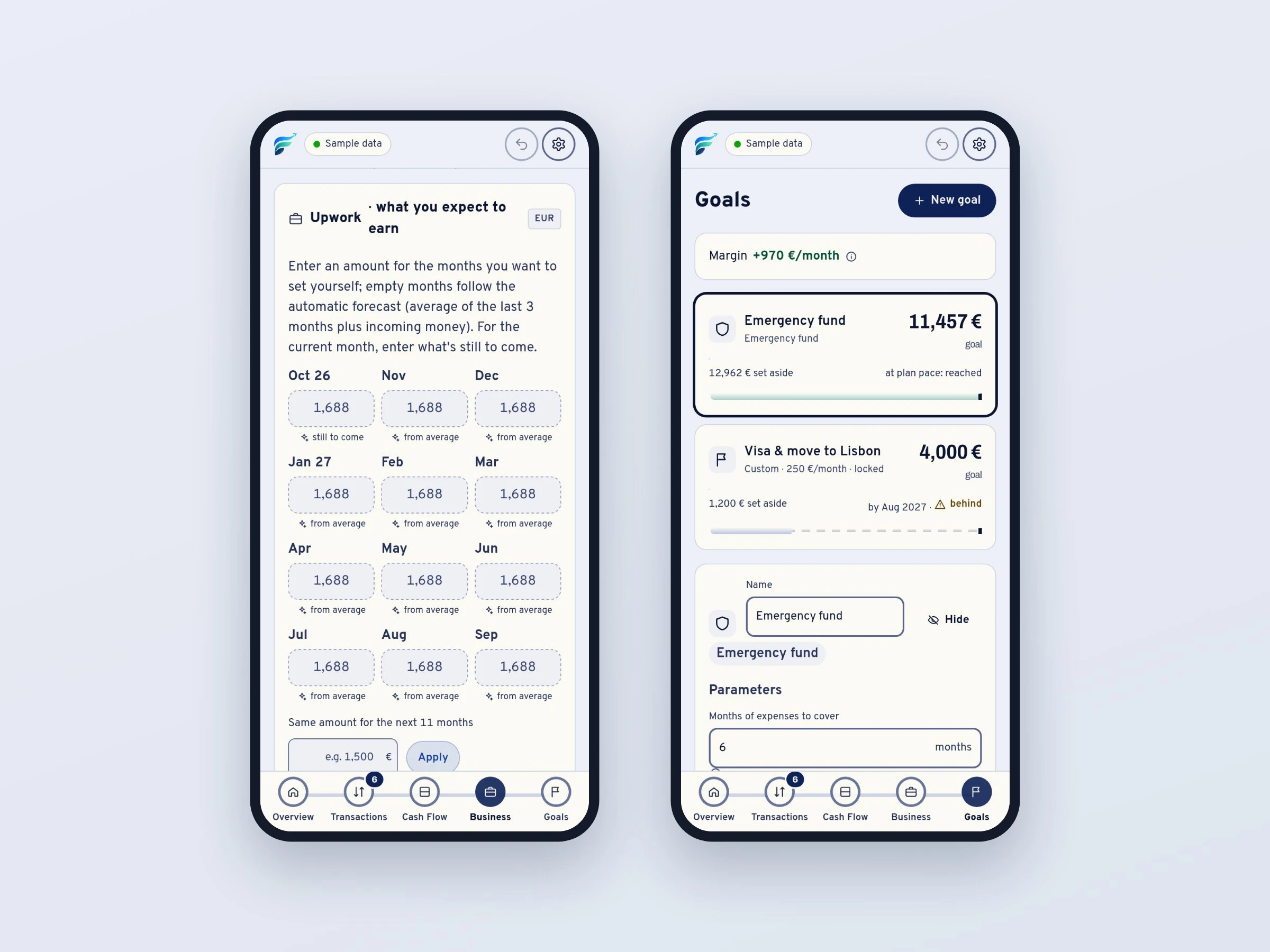
Expected income month by month, and goals with their pace.
Key decisions
Design around a person and a month: an invented digital nomad, Alex, followed for thirty-one days, with every screen answering one of Alex's questions.
Four visual directions mocked up side by side, one chosen; the brand kept, the interface refined rather than restyled.
AI that asks before changing: the connector reads everything but makes only a few targeted changes, each one undoable.
Touch first, checked: one interface for phone and desktop, touch targets of at least 44 points, and automated WCAG 2.1 AA checks with no violations.
Status
A public demo with example data is open at flussodash.com, with an early-access waiting list. No customers or adoption figures yet, so none are claimed here.
Like this project
Posted Oct 5, 2026
My own money dashboard for variable income, end to end: research from daily use, a stated persona, IA, flows and the reasoning behind each choice.