Caldera Films Cinematic Website Design

Victor Adebayo


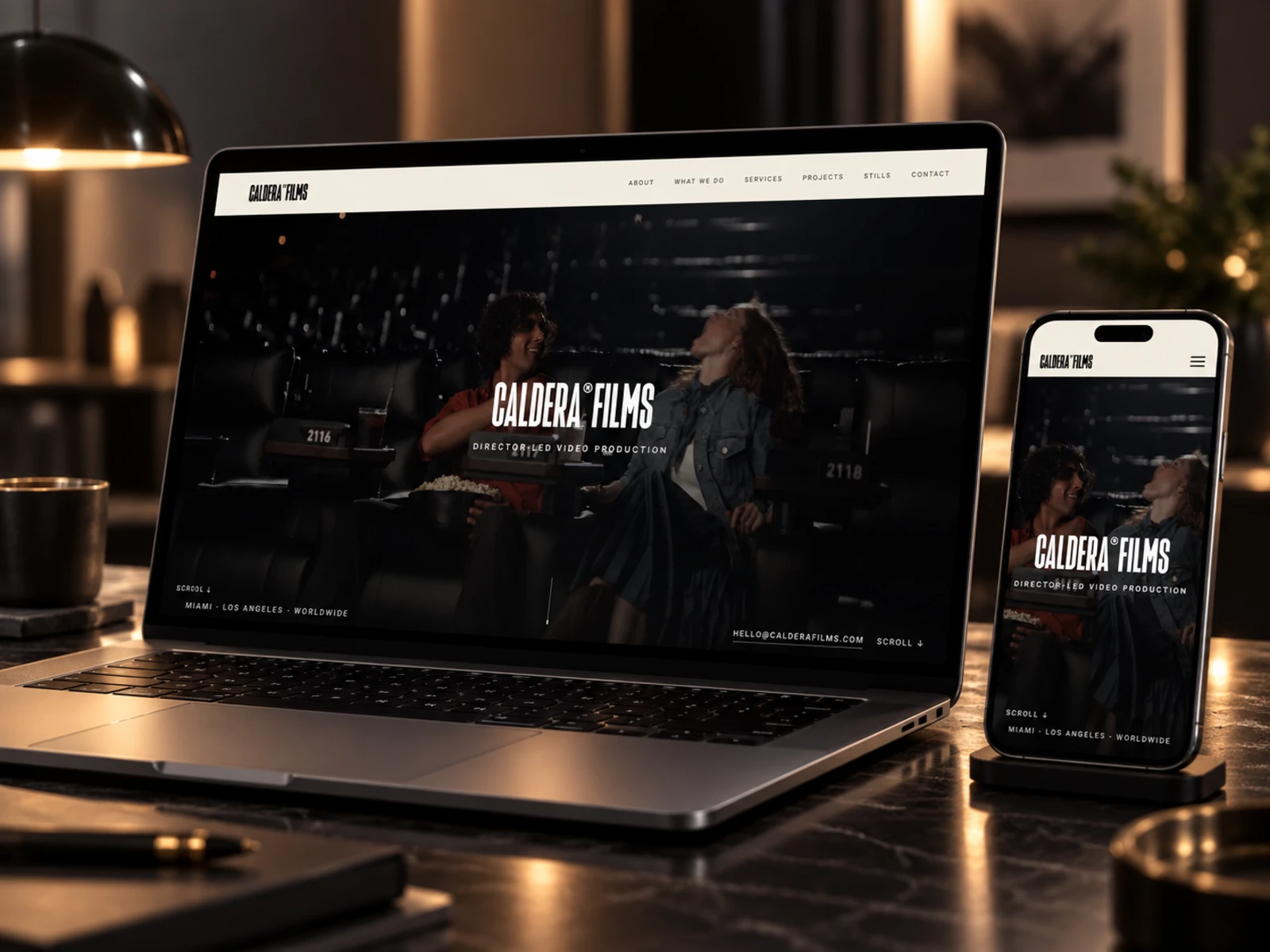
Caldera Films — Cinematic Production Company Website
UX/UI Design · Creative Portfolio · Responsive Development · CMS
Project Type: Film Production / Creative Studio / Portfolio
Primary Objective: Showcase cinematic work, communicate production capabilities, strengthen creative credibility, and generate qualified project enquiries
Role: Web Designer & Developer
Deliverables: UX/UI Design · Responsive Website Design · Portfolio Architecture · Project Case Studies · CMS Structure · Interactive Experiences · Lead Generation · SEO & Performance Optimization
1. Project Overview
Caldera Films is a director-led production company creating commercials, branded content, documentaries, corporate films, product campaigns, and live-event productions.
The company operates from Miami with production capabilities extending across major U.S. markets and international locations, serving brands ranging from growing companies to large organizations.
The website needed to do more than simply display videos.
It had to feel like an extension of the studio itself, cinematic, intentional, confident, and highly visual, while still helping prospective clients understand what Caldera produces, how the team works, where productions can take place, and how to begin a project.
My focus was to create an experience where the work remains the hero while the website quietly guides visitors from:
Discovery → Portfolio → Credibility → Capabilities → Project Inquiry
2. The Challenge
Film-production websites present a unique UX challenge.
The visual work needs space to create an emotional response, but prospective clients still need practical information before trusting a studio with a commercial or brand campaign.
For Caldera Films, the website needed to balance:
Cinematic storytelling
A large portfolio of projects
Multiple production disciplines
Director positioning
Production capabilities
National and international reach
Client credibility
Individual project case studies
Behind-the-scenes production information
Lead generation
The challenge was to present all of this without turning the site into a conventional agency website full of text-heavy service sections.
The website needed to feel more like a curated screening experience than a corporate brochure.
At the same time, visitors still had to understand what the company could produce and how to start a conversation.
3. Design Strategy
I structured the experience around four principles:
Work → Perspective → Capability → Conversation
Let the Portfolio Lead
For a production company, the strongest sales tool is the work itself.
Instead of opening with long explanations about the company, the homepage moves visitors quickly into selected films across branded content, corporate production, documentary, commercial, product, and live-event work.
This allows prospective clients to judge the creative standard immediately.
Create a Screening-Room Experience
The interface was designed around the idea that visitors should feel like they are exploring a body of cinematic work rather than browsing a standard service-business website.
Large project visuals, restrained copy, strong typography, numbered sections, video-led content, and generous spacing give individual projects room to create impact.
The design stays intentionally quiet around the media.
The films are the visual identity.
Differentiate Through Direction
A central positioning point is that Caldera is director-led by design.
The site emphasizes that projects are creatively shaped through direction rather than simply being managed as production jobs.
I treated this as a core part of the UX rather than burying it inside an About page.
Visitors move from seeing the work to understanding the creative thinking behind it.
Make Capabilities Tangible
Instead of presenting production capabilities as a generic service list, the website connects them to real environments and actual work.
Production settings include:
LED volume stages
Controlled sets
Real residential environments
On-location production
Each environment is supported by project examples, helping potential clients understand what those capabilities actually look like in practice.
4. UX/UI Design
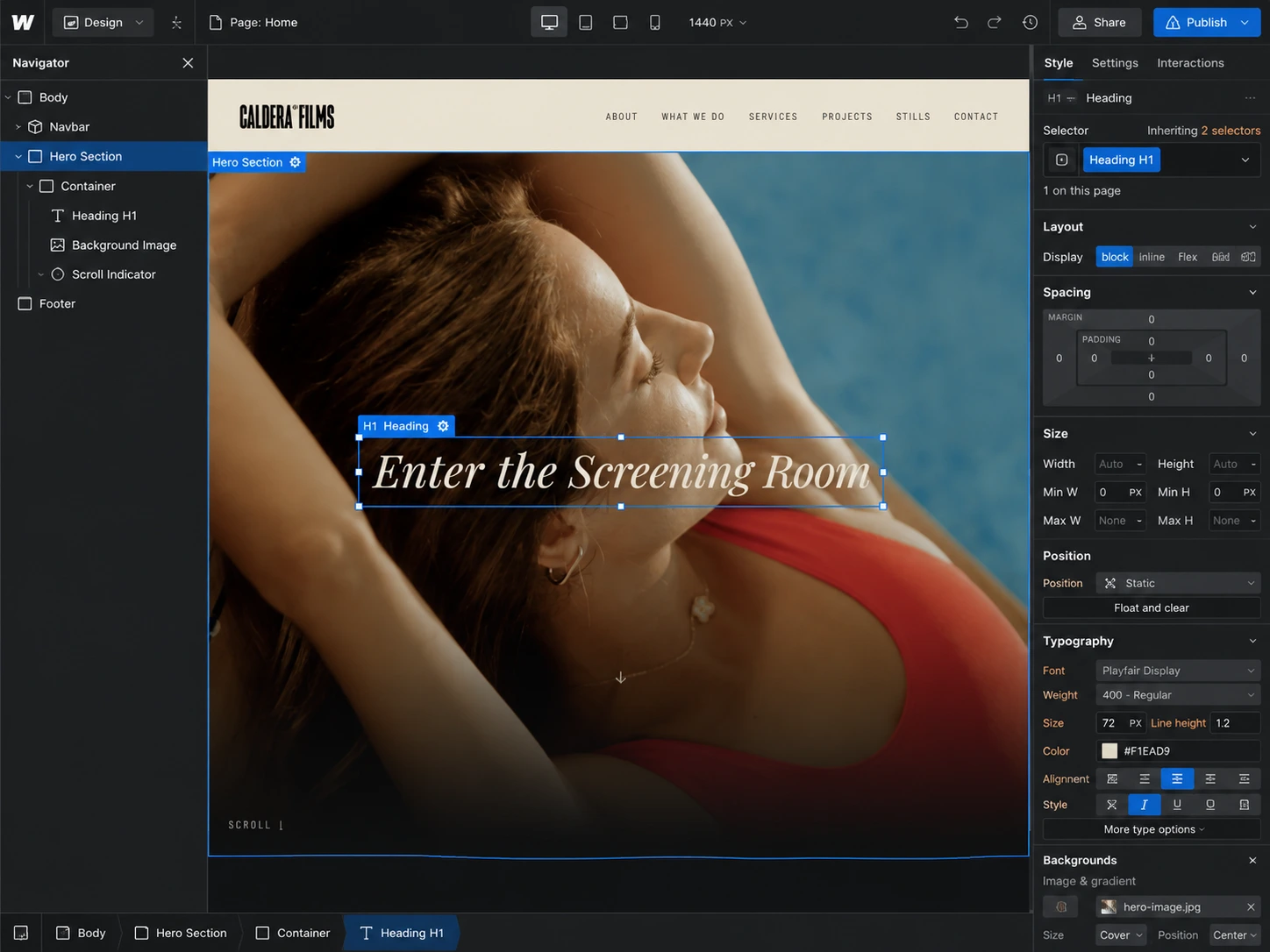
Cinematic Hero Experience
The opening section is intentionally minimal.
A concise positioning statement establishes Caldera as a director-led production company working across commercial, brand, and documentary cinema, while the primary action invites users to enter the work.
The hero avoids excessive copy because the visitor's next logical question is not:
“What else can you tell me?”
It is:
“Show me what you've made.”
That became the foundation of the homepage journey.
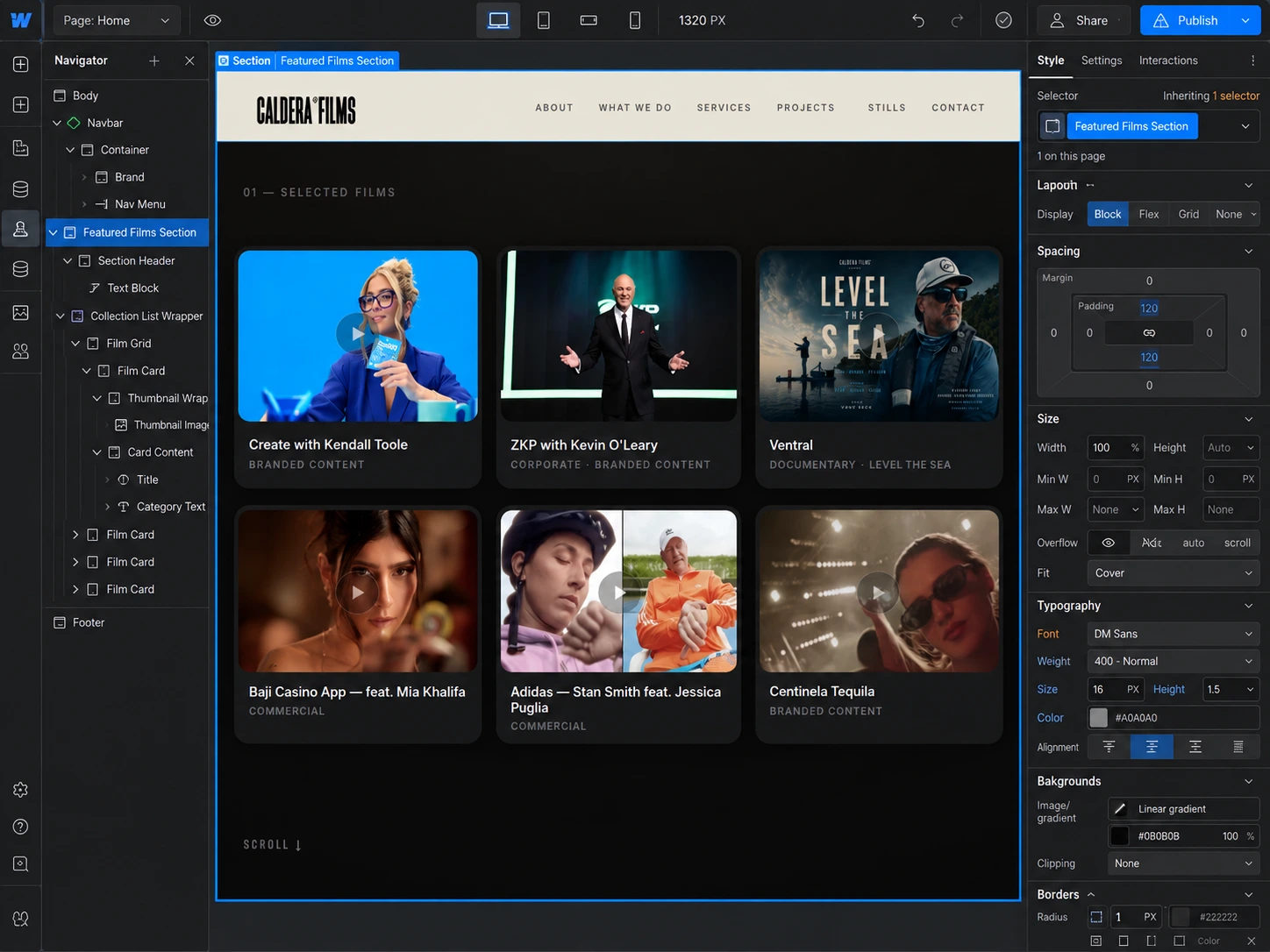
Selected Films
The portfolio appears early in the page and covers multiple production disciplines.
Featured projects include commercial campaigns, branded content, documentaries, corporate films, product work, and live experiences.
Instead of making visitors first choose a service category, the homepage exposes them to the range of the studio immediately.
This is particularly useful for clients who may know the outcome they want but not yet know how to classify the production.
Showreel Section
The reel provides another way to evaluate the studio quickly.
Rather than expecting a visitor to open several individual projects, the website packages years of work into a short showreel experience.
This creates a fast credibility moment for creative directors, marketers, founders, and agency partners reviewing multiple production companies.
Typography System
The typography direction was designed to feel editorial rather than promotional.
I established a clear hierarchy between:
Section numbering
Large cinematic headlines
Project titles
Production categories
Supporting descriptions
Director commentary
Project metadata
CTAs
Large-scale headlines create visual impact while the supporting copy stays restrained.
This prevents text from competing with film stills and video content.
Color & Visual Direction
The interface uses a restrained cinematic visual language that allows film imagery to provide most of the color and emotion.
Instead of introducing many decorative UI elements, the design relies on:
Strong contrast
Full-width media
Negative space
Editorial typography
Minimal navigation
Subtle interaction states
Structured numbering
High-quality project imagery
The result feels closer to a film title sequence or production treatment than a traditional corporate website.
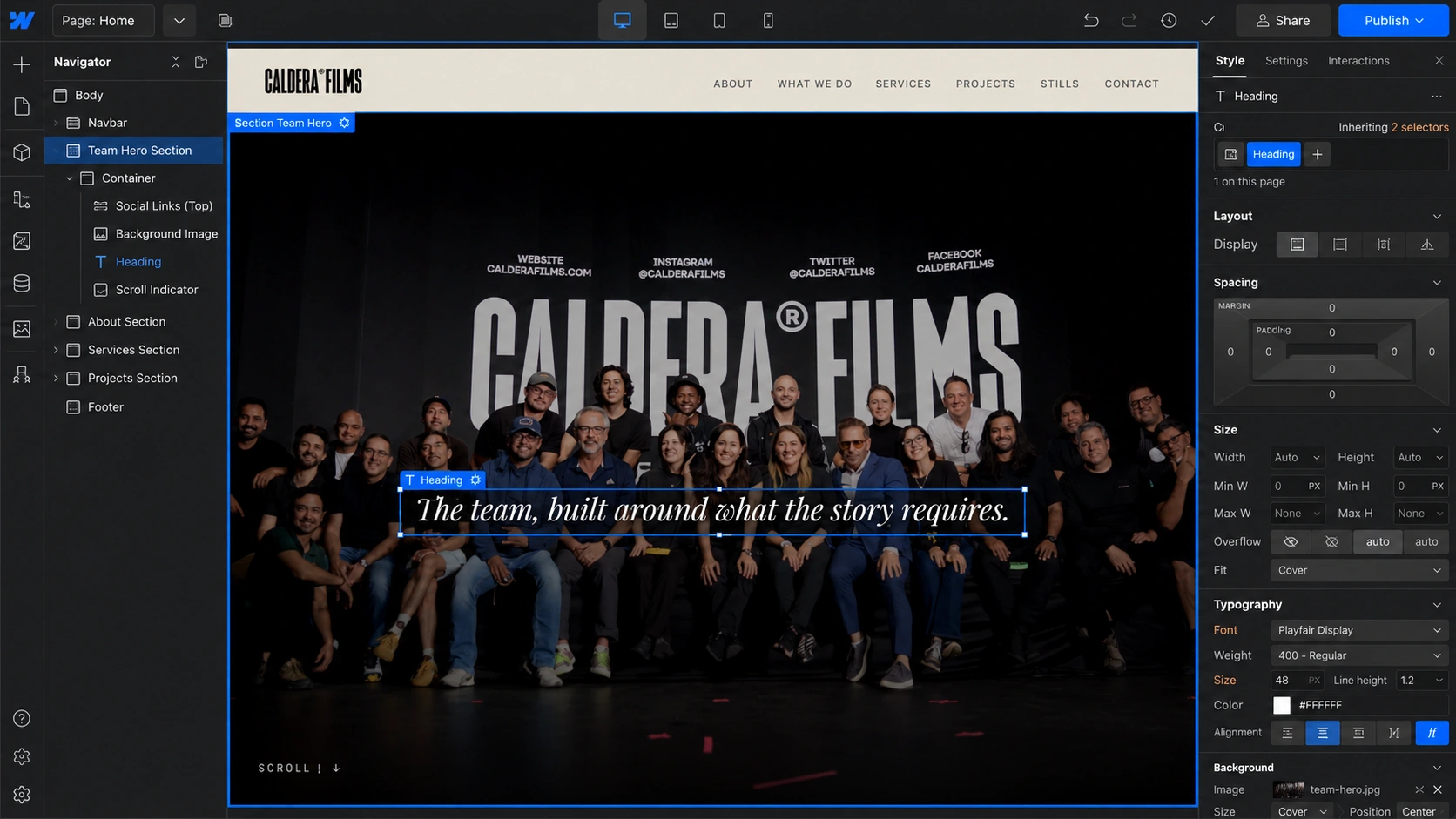
Director Positioning
After establishing the quality of the work, the website introduces the creative leadership behind it.
Caldera Films is led by director and executive producer Enrique Caldera, with the site emphasizing direction, story, performance, atmosphere, and the smaller creative decisions behind each film.
From a UX perspective, this section answers an important question:
Who is actually shaping the work?
This gives prospective clients a more personal connection to the studio.
Production Environment Section
The "Where We Shoot" experience transforms technical production capability into a visual browsing experience.
Visitors can explore approaches including:
LED Volume Stage
Virtual environments and controlled digital production.
On Set
Purpose-built environments shaped around the creative concept.
Real Homes
Authentic spaces suited to lifestyle, interview, and product work.
On Location
Productions built around the story wherever filming needs to happen.
This makes the studio's production flexibility easier to understand without requiring users to read technical equipment lists.
Behind-the-Scenes Storytelling
One of the strongest UX choices is connecting polished final work with how it was produced.
The site includes a "From Frame to Set" experience showing how a finished frame was achieved using an LED volume production setup.
This adds another level of credibility.
Instead of only saying the studio can handle advanced productions, the website shows the relationship between the production environment and final result.
Service Positioning
Rather than presenting an overwhelming service directory on the homepage, core work is framed around recognizable client needs.
The site groups major creative disciplines around outcomes such as:
Making a product desirable
Launching a brand or campaign
Telling a human or founder story
These connect naturally to editorial product films, campaign films, and documentary storytelling.
This makes the service offering easier to understand from a client's perspective.
Global Reach Experience
Caldera works beyond its Miami base, and the website visualizes that reach through an interactive geographic experience.
Visitors can explore production locations and markets where clients are based rather than simply reading a list of cities.
This gives the website another interactive moment while reinforcing the company's ability to manage productions beyond a single local market.
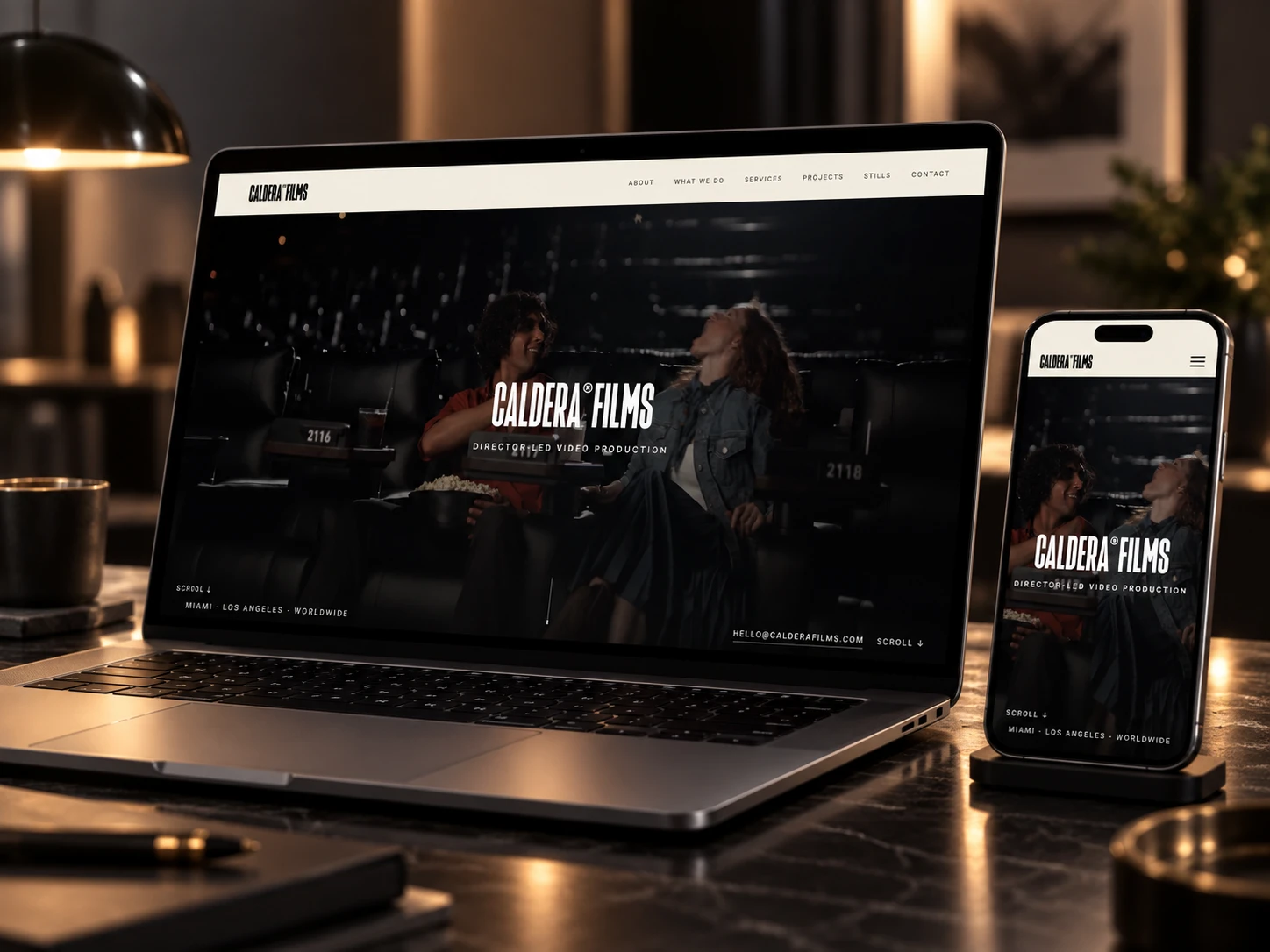
Responsive Experience
The responsive design needed special attention because cinematic interfaces can lose their impact quickly on smaller screens.
I focused on preserving:
Film-first storytelling
Image composition
Video aspect ratios
Typography hierarchy
Project navigation
Touch interactions
Portfolio filtering
CTA visibility
Content pacing
On mobile, larger compositions transition into a more linear sequence while maintaining the same editorial rhythm and visual confidence.
5. Website Architecture
The information architecture was structured around both creative discovery and commercial decision-making.
Homepage
The homepage functions as a cinematic overview of the studio:
Positioning → Selected Films → Showreel → Director → Production Environments → Behind the Scenes → Services → Global Reach → Partners → Inquiry
Projects
The project archive provides a deeper portfolio experience.
Visitors can explore work across categories including:
Commercial
Documentary
Corporate
Product
Events
The portfolio also groups work into themes such as campaigns, human stories, corporate and brand films, product films, and live experiences.
This gives users several ways to discover relevant work.
Individual Project Case Studies
Selected productions receive dedicated case-study pages.
These pages can combine:
Client
Project category
Year
Location
Services
Film
Project overview
Challenge
Approach
Result
Behind-the-scenes imagery
For example, the WebMD project page explains the challenge, production approach, and final patient-story series rather than simply displaying the finished film.
This transforms the portfolio from a gallery into evidence of strategic and production capability.
About
The About page provides deeper context around the company, team, history, geographic reach, and director-led production philosophy.
Caldera identifies itself as founded in Miami in 2018, with expanded teams and production work across multiple markets and continents.
What We Do
The methodology page explains the actual production disciplines behind the work, including:
Direction
Cinematography
Editing and post-production
Creative strategy
Logistics and production
Distribution awareness
This page is particularly valuable for higher-intent prospects who want to understand how the studio operates beyond the finished visuals.
Services
Dedicated service content allows visitors to explore specific production requirements such as brand films, corporate video, documentaries, e-commerce production, and other formats.
Locations
Location-focused pages support clients looking for production capabilities in specific cities and international markets.
This provides both a useful customer journey and a scalable structure for organic search.
Blog / Editorial Content
Editorial content allows Caldera to publish its thinking around filmmaking, branded entertainment, production strategy, cinematography, and creative business.
The website also includes a dedicated branded-entertainment content direction built around films that audiences actively choose to watch rather than conventional interruptions.
Contact / Start a Project
The enquiry experience is designed for serious production conversations.
Instead of asking only for a name and email, the form can capture useful project context including:
Company or brand
Project type
Production location
Budget range
Project details
The page also explains what happens after submission, including the discovery conversation and project-scoping process.
This helps set expectations before the first conversation begins.
6. Website Development
Once the UX structure and cinematic design system were established, I translated the experience into a responsive, media-focused build.
Because the site depends heavily on film, imagery, portfolio content, and interaction, development needed to balance visual quality with performance.
Key considerations included:
Responsive website development
Reusable project components
CMS-driven portfolio structure
Project-category filtering
Individual case-study templates
Video embeds
Responsive film containers
Showreel integration
Interactive carousels
Hover and reveal interactions
Project-preview states
Location/map interactions
Contact and project enquiry forms
Blog/editorial CMS structure
Responsive navigation
Structured metadata
SEO-conscious heading hierarchy
Lazy loading for media
Image optimization
Performance-conscious animation
Accessibility-aware interaction states
Cross-browser testing
Cross-device testing
The goal was to make the site feel visually rich without allowing media-heavy pages to become unnecessarily cumbersome.
7. Design & Development Process
Research → Content Strategy → UX Structure → Wireframes → UI Design → Design System → Development → CMS → Responsive Optimization → Testing → Launch
Research
I started by understanding the studio's positioning, production disciplines, target clients, portfolio range, visual identity, and the information decision-makers need before contacting a production company.
A key consideration was understanding that users would judge Caldera primarily through its work.
The website therefore needed to support the portfolio rather than compete with it.
Content Strategy
I categorized the content into several layers:
Show the work → Explain the perspective → Demonstrate capability → Build trust → Generate inquiry
This prevented operational information from interrupting the cinematic experience too early.
UX Structure
The customer journey was mapped around questions such as:
What kind of work do they make? → Is the quality right for my brand? → Who is behind it? → Can they execute my production? → Have they done relevant work? → How do I start a project?
This became the foundation for the navigation and page hierarchy.
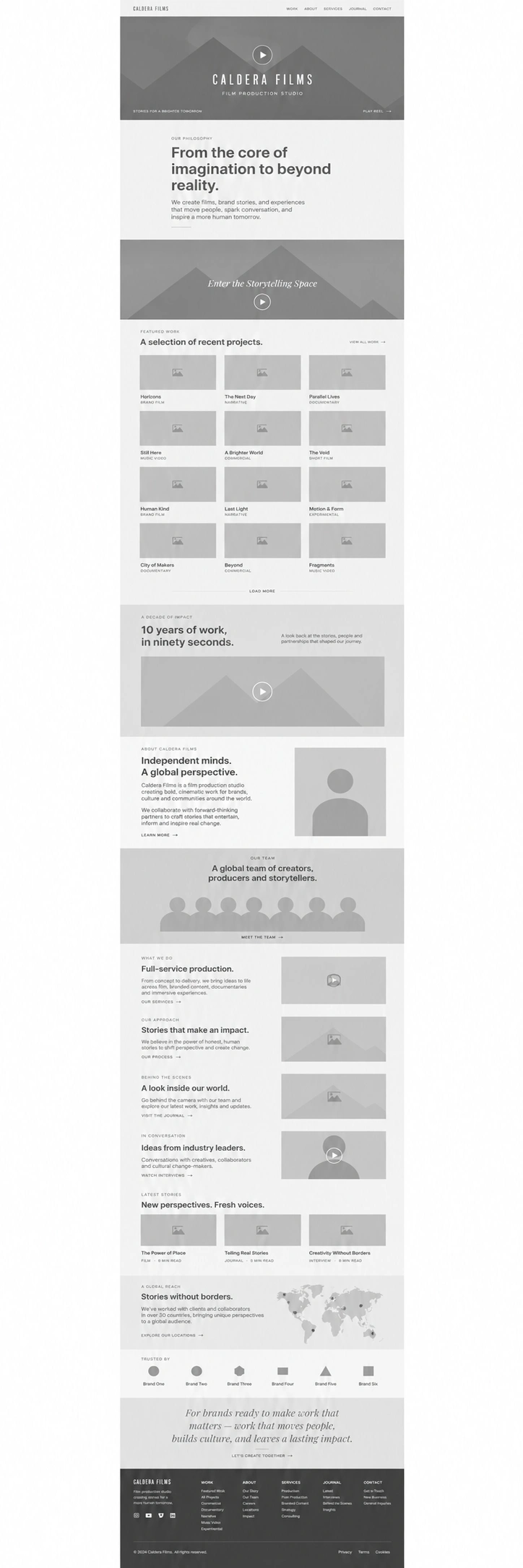
Wireframes
The wireframing stage established:
Hero structure
Project hierarchy
Reel positioning
Director section
Production capabilities
Service content
Case-study structure
Global production information
Inquiry CTAs
At this stage, the focus was entirely on pacing and storytelling.
UI Design
The wireframes were transformed into a cinematic editorial interface.
The design intentionally avoids unnecessary cards and UI decoration where large-format media can communicate more effectively.
Film stills, video, typography, whitespace, and subtle motion form the main visual system.
Design System
Reusable styles were established for:
Display typography
Supporting typography
Section numbering
Buttons
Links
Project metadata
Portfolio cards
Video containers
Case-study modules
Forms
Navigation
Editorial content
Spacing
Responsive behavior
This maintains consistency even though individual projects can have very different visual identities.
Development
The final layouts were translated into reusable responsive components.
Special attention was given to motion, media loading, project transitions, video behavior, and portfolio content management.
CMS Architecture
A structured CMS approach allows individual productions to maintain consistent information while supporting different categories and visual assets.
This makes it possible to add future films without rebuilding the portfolio layout each time.
Responsive Optimization
Desktop compositions were carefully adapted instead of simply scaled down.
Video, project imagery, large headlines, carousels, map elements, and metadata were reorganized for smaller screens while preserving their hierarchy.
Testing
Before launch, I reviewed:
Portfolio navigation
Project filtering
Video playback
Showreel behavior
Case-study pages
Forms
CTAs
Responsive media
Interactions
Navigation
External links
Cross-browser consistency
Page performance
Launch
The final stage focused on refining animation timing, media loading, responsive layouts, accessibility, SEO foundations, and the overall consistency of the cinematic experience.
8. Key Features
Cinematic production-company website
Film-first portfolio experience
Selected project showcase
Full project archive
Portfolio category filtering
Individual film case studies
Video and showreel integration
Director-led brand positioning
Production capability presentation
LED volume production showcase
Behind-the-scenes storytelling
Interactive project carousels
Global production map experience
Brand and client credibility sections
Service and methodology pages
Location-focused landing pages
Editorial/blog CMS
Reusable portfolio components
CMS-driven project architecture
Project enquiry form
Responsive media system
Custom interactions and transitions
SEO-conscious structure
Performance-focused implementation
Mobile-responsive experience
9. Final Result
The final Caldera Films website works less like a traditional production-company brochure and more like a digital screening room built around the work itself.
Visitors can experience selected films immediately, watch the studio reel, understand the director-led philosophy, explore how productions are built, browse work by category, and move into detailed project case studies when they want deeper context.

The site also gives higher-intent clients the practical information they need, production capabilities, services, locations, process, and enquiry pathways, without allowing those details to dilute the cinematic presentation.
By combining film-led storytelling, editorial typography, strong information hierarchy, carefully controlled motion, portfolio CMS architecture, and clear project-conversion pathways, the website presents Caldera as both a creative filmmaking partner and an experienced production operation.
The result is a premium, immersive portfolio experience that lets the films create the first impression while the UX, case studies, process, and production credibility give prospective clients a reason to start the conversation.
Like this project
Posted Sep 24, 2026
Created a cinematic website for Caldera Films showcasing their production capabilities and portfolio.
Likes
3
Views
1
Clients
Caldera Films