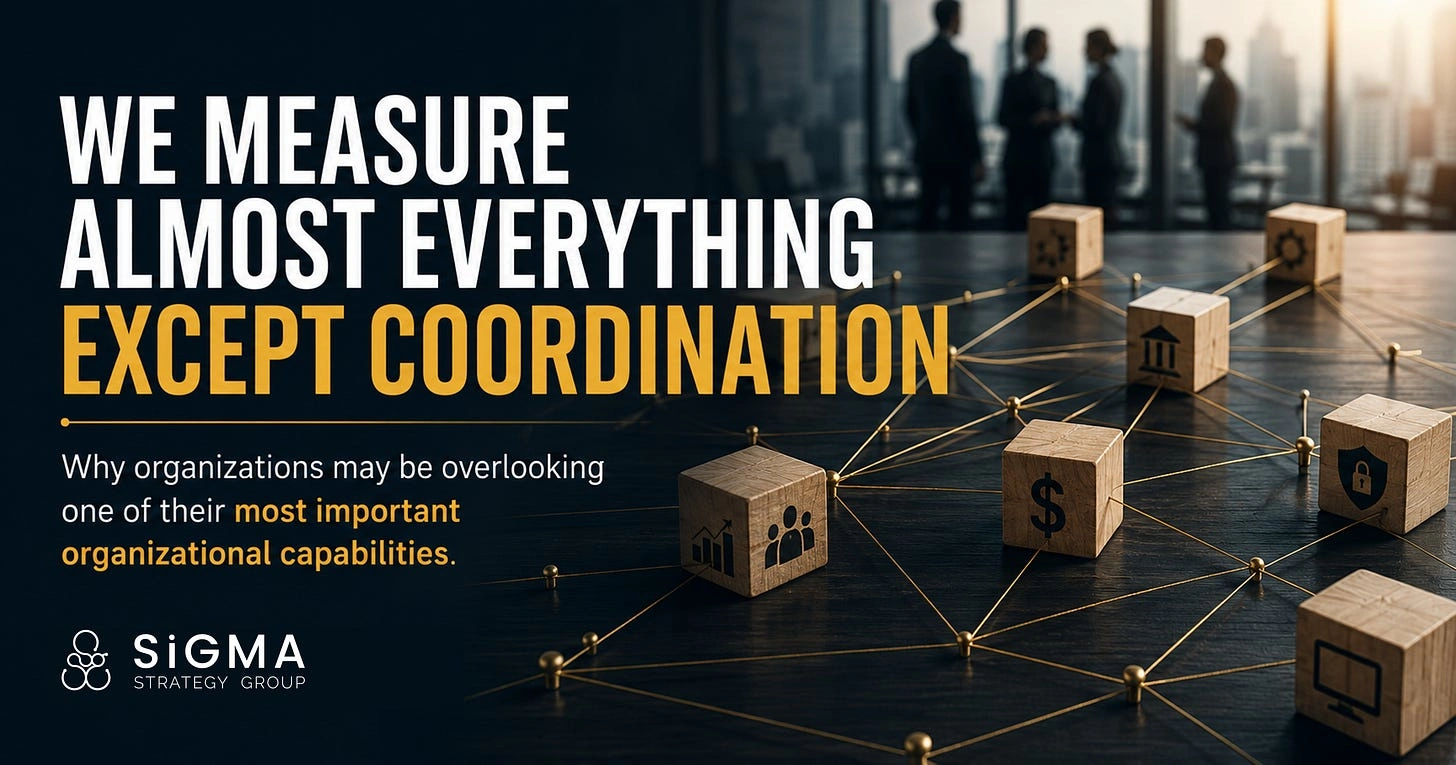
We Measure Almost Everything Except Coordination

Sandra Olivarez

Organizations today generate more data than ever before. Executive dashboards monitor financial performance in real time. HR teams track hiring, retention, engagement, and turnover. Operations leaders measure productivity, quality, and delivery, while technology teams monitor cybersecurity, system performance, and uptime. Across the enterprise, organizations invest enormous time and resources measuring performance because they understand a simple principle:
What gets measured gets attention.
And what gets attention tends to improve.
Yet one capability rarely appears on the dashboard.
Not because it isn’t important.
Because most organizations have never thought to look for it.
Coordination.
Not communication.
Not collaboration.
Coordination.
The ability to intentionally align people, decisions, information, incentives, governance, and execution across increasingly complex systems.
It may influence nearly every strategic initiative inside an organization.
Yet very few organizations can answer a surprisingly simple question:
How good are we at it?
Why Coordination Has Been So Difficult to See
Unlike financial performance or employee engagement, coordination has rarely been viewed as something that exists independently.
Most organizations experience coordination through its symptoms.
Projects move more slowly than expected.
Different teams unknowingly solve the same problem.
Partners struggle to stay aligned.
Employers receive multiple requests from different organizations.
Leaders spend increasing amounts of time resolving issues that seem unrelated on the surface.
Each challenge appears isolated.
Rarely do organizations step back and ask whether they share a common cause.
Perhaps that’s because coordination has traditionally been viewed as something people simply do—not as an organizational capability that can strengthen, weaken, or mature over time.
We Often Assume Coordination Exists
Most organizations never intentionally build coordination. They assume it exists because governance structures are in place, leadership meetings occur every week, project plans are documented, technology platforms are connected, and collaboration tools are widely available.
On paper, everything appears coordinated.
Yet a different reality often emerges.
A workforce team launches an employer outreach campaign without realizing another department is already engaging the same companies.
A digital transformation project introduces a new platform while operational processes remain unchanged.
A steering committee approves a decision without understanding how it affects work happening elsewhere in the organization.
None of these decisions are irrational.
Each makes sense from the perspective of the people making it.
Collectively, however, they create friction that no one intended.
Those aren’t communication failures.
They’re coordination failures.
We Measure the Results. Not the Capability.
Imagine asking an executive:
“How strong is your leadership capability?”
Most organizations could point to leadership assessments, succession planning, performance reviews, coaching programs, and development investments.
Now ask a different question.
“How strong is your organization’s coordination capability?”
Most organizations couldn’t answer.
Not because coordination isn’t important.
Because they’ve never tried to understand it as a capability.
Instead, organizations measure outcomes such as time-to-fill, retention, project completion, technology adoption, employer satisfaction, operational performance, and customer experience. Those metrics provide valuable insight into performance, but they primarily tell us what happened. They rarely explain why it happened or whether the organization possesses the capabilities needed to consistently produce better outcomes.
Imagine measuring a patient’s temperature every hour without ever trying to identify the infection causing the fever.
The temperature matters.
But treating the fever without understanding the underlying condition rarely solves the problem.
Organizational metrics often work the same way.
Many of the outcomes we measure may actually be influenced by an organizational capability we’ve never attempted to understand.
The Cost of Not Seeing It
When organizations can’t see a capability, they naturally compensate for it.
A transformation initiative falls behind schedule.
Leadership adds more meetings.
Additional reporting requirements are introduced.
A new governance committee is created.
Another technology platform is purchased.
Months later, execution still feels slow.
The assumption is often that the organization needs more oversight.
Rarely does anyone stop to ask whether the underlying challenge is coordination itself.
The symptoms receive attention.
The capability producing those symptoms often does not.
Perhaps We’ve Been Measuring the Wrong Things
Organizations have spent decades becoming better at measuring outcomes.
Perhaps the next competitive advantage won’t come from measuring more outcomes.
Perhaps it will come from understanding the organizational capabilities that produce those outcomes in the first place.
Coordination may be one of them.
Not because it replaces strategy.
Or leadership.
Or technology.
But because increasingly, all of those depend upon an organization’s ability to align people, decisions, systems, and execution across growing complexity.
Like leadership, culture, or operational maturity, coordination appears to exist on a spectrum.
Some organizations consistently align dozens of teams, partners, technologies, funding streams, and decisions toward shared outcomes.
Others struggle to align even a handful of departments working toward the same objective.
That difference isn’t luck.
It may represent a capability that has simply remained invisible.
Seeing Before Improving
Organizations don’t improve cybersecurity without first understanding their security posture.
They don’t improve financial performance without measuring financial health.
They don’t improve employee engagement without assessing employee experience.
Perhaps coordination deserves the same treatment.
Because before organizations can improve coordination...
they may first need a way to see it.
Organizations don’t improve what they cannot see.
And what remains invisible often remains unmanaged.
A Different Question
Perhaps the next evolution in organizational assessment is not measuring more outcomes.
Perhaps it is understanding one of the capabilities influencing many of those outcomes in the first place.
The question is no longer simply:
Are we coordinating?
The more important question may be:
Do we have enough coordination capacity for the complexity we’re trying to manage?
Sigma Note
At Sigma Strategy Group, we believe organizations are entering an era where coordination itself is becoming a measurable organizational capability.
Over the coming weeks, we’ll begin exploring what that capability consists of—and why understanding it may become just as important as understanding financial health, operational maturity, or digital readiness.
Next in this series
The Seven Capabilities of Coordination Capacity
Like this project
Posted Sep 16, 2026
Executive thought leadership reframing coordination as a measurable organizational capability and exposing the risks of leaving it invisible.