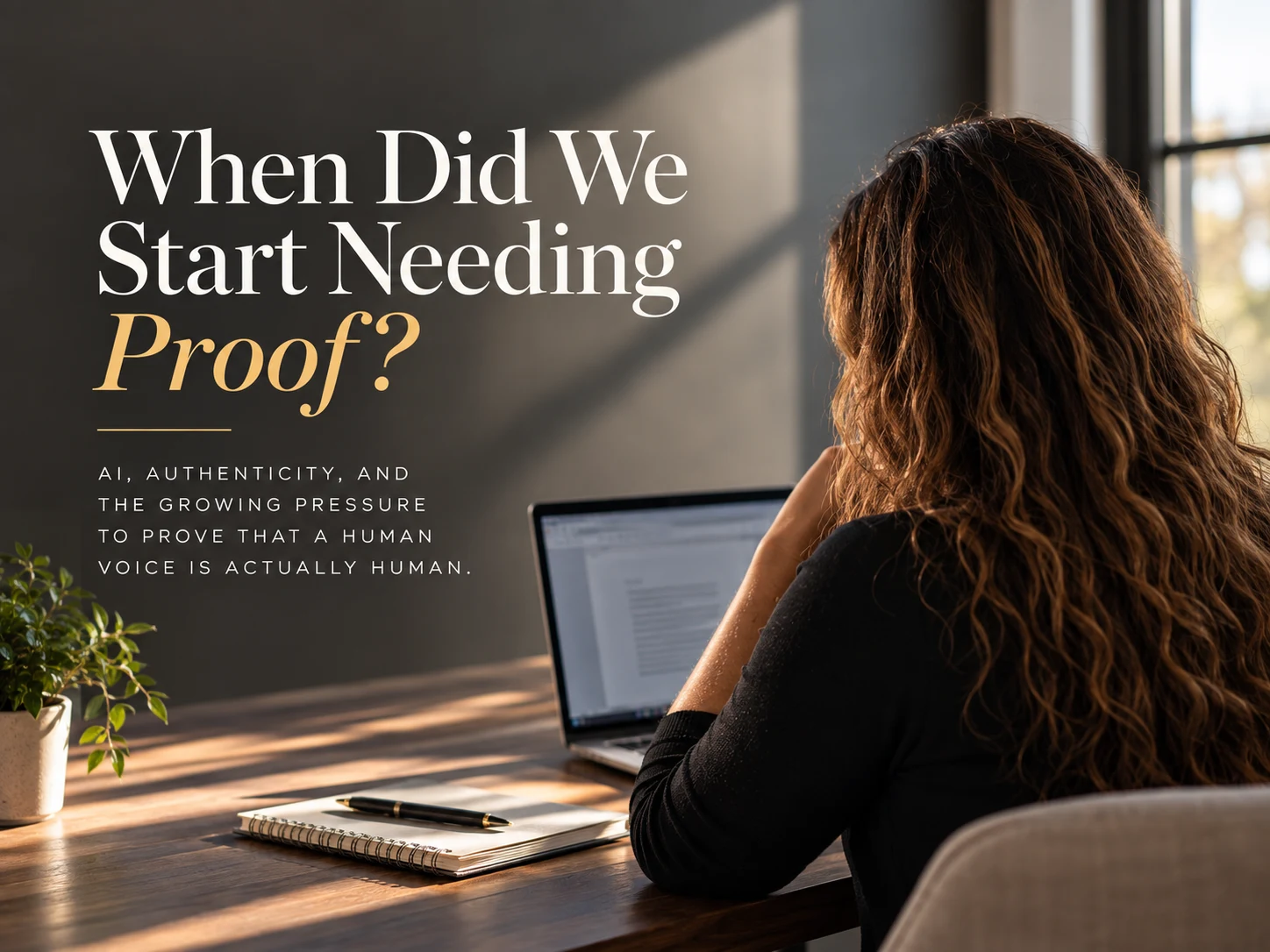
When Did We Start Needing Proof?

Sandra Olivarez


I spent years learning how to find my own voice.
Then one website told me it wasn’t mine.
It wasn’t just any website. It was an AI detection tool designed to estimate whether something had been written by a person or generated by artificial intelligence. According to its report, what I had written was almost entirely AI-generated.
The strange part? I had written every word myself.
At first, I laughed.
Then I found myself unexpectedly frustrated.
Not because I expected an AI detection tool to know me, but because I suddenly felt like I needed to prove something I never imagined needing to prove before…
That I was a human.
Curiosity got the better of me, so I decided to run an experiment.
I opened a blank Word page and wrote something completely on my own. No brainstorming. No editing tools. No AI. Just me and a blank Word page.
I even left in a few extra words and awkward phrases that I knew I would normally edit out. I wanted it to be as untouched as possible.
When I ran it through the detector, it still concluded that most of it had been generated by artificial intelligence.
That was the moment everything shifted for me.
I started wondering what it was actually measuring.
The more I thought about it, the more I realized this wasn’t really a story about AI.
It was a story about authenticity, or trust, or maybe something even bigger than that.
I’ve been learning to write for most of my adult life.
I wrote research papers in college. I spent years writing reports, proposals, executive briefings, white papers, presentations, and more emails than I could ever count throughout my career in Corporate America. I’ve revised documents late into the night, rewritten paragraphs that weren’t quite clear enough, and learned how to organize complex ideas so other people could understand them.
Of course my writing sounds different than it did twenty-five years ago. I’d actually be disappointed if it didn’t.
Over time, I’d like to think I became a better writer.
Not because a computer taught me how, but because practice did. Experience did. Life did.
Ironically, I’m still learning to sound less like the professional I spent years becoming and more like the person I’ve always been.
That probably sounds strange to anyone who hasn’t spent years in a profession where every email, presentation, proposal, and report carried weight.
Over time, you learn to communicate carefully. You anticipate questions before they’re asked. You remove unnecessary words. You polish ideas until they’re clear enough to withstand scrutiny because your audience expects clarity and your credibility depends on it.
Eventually, that “polished” voice becomes second nature.
The surprising part isn’t learning to write professionally.
It’s realizing, years later, that you’re still getting reacquainted with the person underneath it.
My professional voice wasn’t fake. It was earned.
It reflected the environments I worked in, the responsibilities I carried, and the expectations that came with them.
But writing here has invited a different part of me to the page.
Not a different person.
Just a different voice.
One that’s a little less concerned with sounding impressive and a little more concerned with sounding honest…willing to admit uncertainty instead of feeling obligated to have all the answers. Or even discovered there is just as much value in sharing a question as there is in presenting a conclusion.
Maybe that’s why the AI detector bothered me more than I expected.
Because I’ve worked surprisingly hard to uncover this voice.
Finding my way back to writing personally has been its own kind of journey.
And then I found myself wondering something I hadn’t expected. When did authenticity become something we felt obligated to prove?
We live in a world where photographs can be fabricated, videos can be altered, voices can be cloned, and headlines can be written to manipulate us.
I understand why people have become more cautious.
Honestly, I have too.
But I also wonder what it costs us when our first instinct becomes skepticism instead of curiosity.
When did we stop assuming sincerity until proven otherwise?
When did “real” become something that needed verification?
The irony isn’t lost on me that I spent years trying to make my writing stronger, clearer, more thoughtful, and more polished.
Those were qualities I was taught to pursue.
Now, in some corners of the internet, those same qualities can make people wonder whether a machine must have written them.
That’s a strange thing to wrap my mind around.
Because I don’t think polished writing and authentic writing are opposites.
Some of the most authentic things I’ve ever written have also taken the longest to write.
Not because I was trying to make them sound perfect, but because I was trying to make them sound true.
Sometimes authenticity isn’t found in the first draft, it’s found in the twentieth.
It’s found in deleting the sentence that sounds clever but doesn’t feel honest. Rewriting a paragraph because it explains what happened but still doesn’t capture how it felt. Sitting with an experience long enough that the words finally begin to resemble what was in your heart all along.
That’s not artificial. That’s the work.
Maybe that’s why this experience stayed with me longer than I expected.
I think all of us want to be recognized for who we really are.
There’s something strangely unsettling about putting years of growth, experience, reflection, and practice into words only to have them mistaken for something they aren’t.
It makes you wonder how we recognize authenticity in the first place. Maybe the question isn’t whether something sounds human enough. Maybe it’s whether it feels human.
Did it make someone pause?
Did it help someone put words to something they hadn’t been able to explain?
Did it make them feel understood?
Did it remind them they weren’t the only one carrying whatever they’re carrying?
Because that’s always been the reason I write. Not to prove the words came from me. But to help someone else feel a little less alone.
Maybe that’s something no detector will ever be able to measure.
And honestly...
I think I’m okay with that.
Like this project
Posted Sep 16, 2026
Reflective thought leadership on AI detection, authenticity, trust, and the growing pressure to prove that a human voice is actually human.
Likes
0
Views
0
Clients
Substack