Analyzing Workforce Monoculture Risks

Sandra Olivarez

For decades, economists have warned about the dangers of concentration.
Whether in agriculture, financial markets, supply chains, or technology ecosystems, systems become increasingly vulnerable when they rely too heavily on a single supplier, a single source of truth, or a single way of making decisions.
Competition creates resilience.
Diversity of thought and experience creates adaptability.
Alternative pathways create opportunities that might otherwise be missed.
Yet while we readily recognize these dynamics in markets and industries, we rarely discuss them in workforce systems.
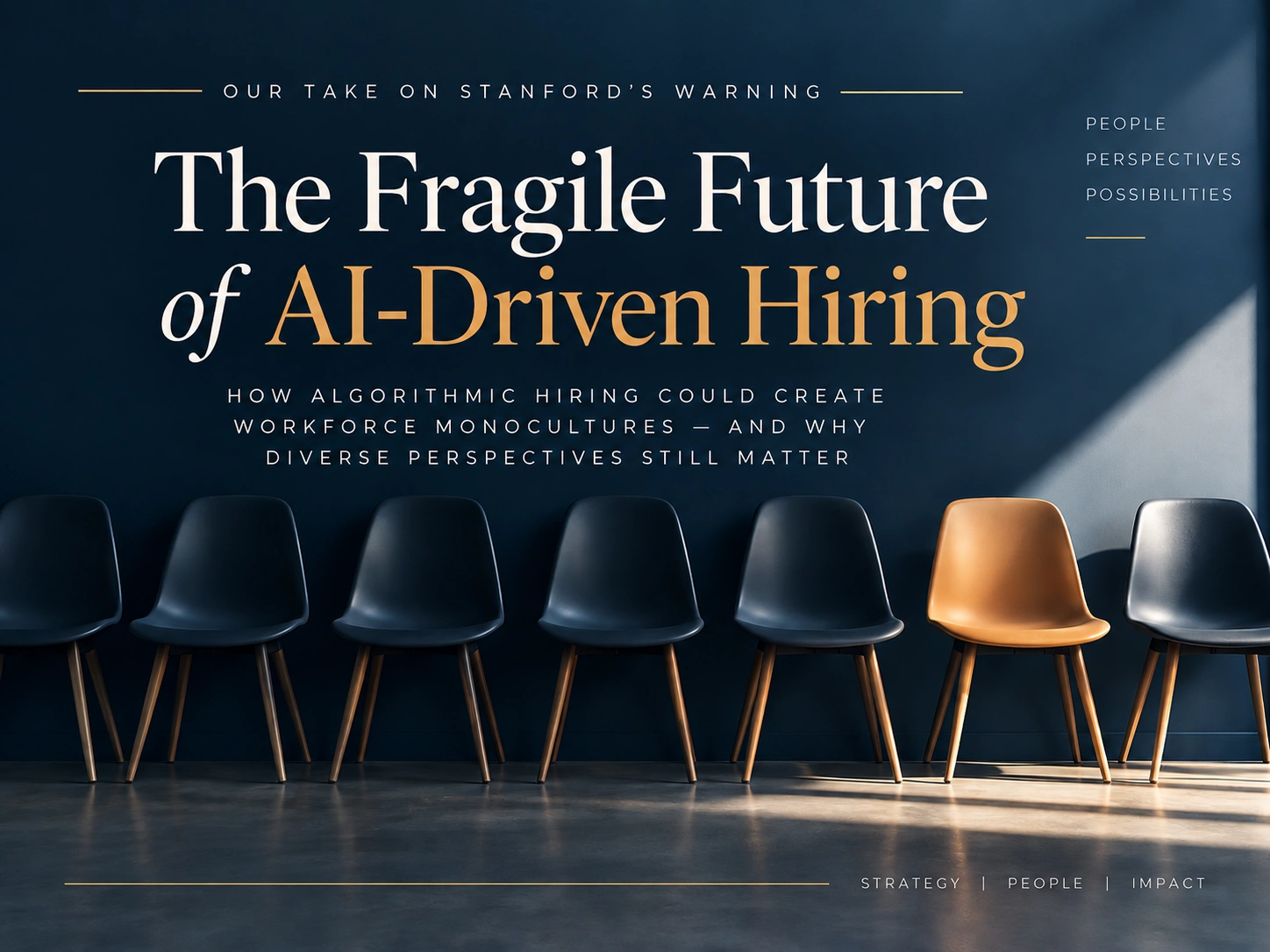
A recent Stanford study on algorithmic monocultures in hiring suggests we may need to start.
Much of the conversation surrounding the study will understandably focus on bias. That conversation matters. But beneath the findings lies a broader question with implications that extend well beyond hiring technology.
What happens when entire labor markets begin evaluating talent through increasingly similar lenses?
What Stanford Found
Researchers at Stanford examined more than four million job applications submitted by over three million applicants across 156 employers.
What makes the study particularly significant is not simply the volume of applications analyzed. It is what the findings may reveal about the growing concentration of hiring technology throughout the labor market.
Today, most large employers use some form of automated screening, filtering, matching, or recommendation technology as part of their hiring process. While organizations often view these tools as independent solutions, many are influenced by a relatively small number of technology providers whose platforms shape talent decisions across thousands of employers.
Stanford’s concern is not that a single organization relies on an algorithm. It’s that increasingly large portions of the labor market may be relying on similar algorithms, similar signals, and increasingly similar ways of evaluating talent.
Their findings suggest applicants can experience highly correlated outcomes across multiple employers—not necessarily because those organizations independently reached the same conclusions, but because increasingly similar systems helped shape those conclusions.
Most leaders understand the risks associated with a single point of failure in a supply chain.
Far fewer have considered the implications of a single point of perspective in a labor market.
The study is important.
But for us, it serves as the beginning of the conversation rather than the conclusion.
The Bigger Risk
The debate surrounding AI in hiring often focuses on whether algorithms are fair.
That matters.
But there is another question worth asking.
What happens when organizations increasingly rely on the same technologies and increasingly similar ways of evaluating talent?
Historically, organizations often reached different conclusions about the same candidate because they valued different experiences, different capabilities, and different indicators of potential.
A military veteran might stand out to one employer and be overlooked by another.
A self-taught technologist might be viewed as unconventional in one organization and highly adaptable in another.
A candidate with an atypical career path might appear risky through one lens and exceptionally valuable through another.
Those differences in judgment created opportunities for organizations to discover talent their competitors overlooked.
The concern is not simply that algorithms may make mistakes.
The concern is that assumptions, blind spots, and decision patterns can become increasingly shared across entire systems.
Workforce Monoculture Risk
The Stanford study prompted us to think about something broader.
Workforce Monoculture Risk is the possibility that organizations become overly dependent on increasingly similar systems, signals, assessments, algorithms, and decision frameworks for identifying talent.
As that risk increases, organizations may unintentionally reduce their exposure to nontraditional career paths, emerging skill sets, transferable experiences, untapped talent pools, and unconventional indicators of potential.
Over time, the result may be workforce systems that are less adaptable, less innovative, and more vulnerable to shared blind spots as organizations increasingly compete for the same talent pools.
Perhaps most importantly, organizations may begin believing they are making independent talent decisions when, in reality, they are drawing conclusions from increasingly similar inputs.
Because organizations rarely gain advantage through uniformity.
They gain advantage through diversity of thought, diversity of experience, and diversity of perspective.
What History Teaches Us About Monocultures
The idea of monoculture is not new.
Agriculture learned this lesson long ago.
Planting a single crop across an entire region creates efficiencies, but it also creates vulnerability. A disease that affects one plant suddenly affects them all.
Supply chains, financial systems, and technology ecosystems have all learned similar lessons.
Monocultures create efficiency—until they don’t.
Then they create systemic risk.
A diverse ecosystem can absorb shocks.
A monoculture amplifies them.
The same principle applies to workforce systems.
Workforce resilience does not emerge from everyone making identical decisions.
It emerges from diversity of pathways, diversity of perspectives, and diversity of opportunity.
The Question Every Executive Should Be Asking
There is a strategic question at the center of this conversation.
One that has very little to do with compliance.
Very little to do with technology.
And everything to do with competitive advantage.
If every organization is purchasing similar technologies, using similar screening criteria, evaluating similar signals, and selecting from similar candidate pools, how exactly do they expect to build a workforce that thinks differently than their competitors?
Organizations consistently tell us they want innovation, adaptability, fresh perspectives, and new ideas.
Yet innovation rarely emerges from systems designed to maximize sameness.
Innovation often comes from people whose experiences do not perfectly match established patterns.
People who took unconventional paths.
People who learned differently.
People who developed skills in unexpected ways.
People who see opportunities and challenges through a different lens.
The challenge facing workforce leaders is not simply identifying qualified talent.
The challenge is identifying talent capable of helping the organization navigate a future that does not yet exist.
That requires variation, curiosity, and enough diversity of thought, experience, and perspectives in talent systems to ensure organizations are not unintentionally filtering out the very people who may help them solve tomorrow’s problems.
Why Workforce Ecosystems Matter
This is one reason Sigma Strategy Group consistently advocates for workforce ecosystems rather than isolated workforce solutions.
No single employer, institution, technology provider, platform, or hiring channel has complete visibility into talent.
Every system has blind spots.
Every network has limits.
Every screening mechanism captures some signals while missing others.
Educational institutions, industry associations, community organizations, workforce intermediaries, and employers all see talent through their own unique lenses.
Each contributes different information, relationships, trust, and insight.
When organizations rely exclusively on a single pathway, they limit what they can see.
When they leverage diverse pathways, they increase the likelihood of discovering talent that might otherwise remain invisible.
Talent Visibility Is Becoming a Strategic Capability
Most workforce systems are designed to improve efficiency.
Fewer are designed to improve visibility.
Yet visibility may become one of the most important workforce capabilities of the future.
Organizations cannot develop potential they cannot see.
They cannot create opportunities for people they cannot identify.
They cannot build diverse pipelines from talent pools that remain invisible.
This challenge extends far beyond hiring.
The same dynamic exists in internal mobility, workforce planning, skills development, succession planning, learning ecosystems, and talent marketplaces.
Every workforce system is ultimately constrained by what it can see.
The organizations that gain a competitive advantage in the future may not be those that process talent more efficiently.
They may be those that develop greater visibility into human potential.
Every participant in a workforce ecosystem sees a different slice of human potential.
Together, they create a more complete view than any one organization could achieve alone.
The goal is not simply to expand applicant volume. The goal is to expand talent visibility.
The Invisible Cost of Workforce Monocultures
One of the challenges with workforce monocultures is that their costs are often difficult to see.
Organizations can measure the positions they fill, the time it takes to hire, and the performance of the people who join their workforce.
What they cannot easily measure is the talent that never entered the system in the first place.
That is what makes this risk fundamentally different from many of the others organizations routinely manage.
When a supply chain breaks down, leaders see the disruption.
When a technology platform fails, they see the outage.
When a workforce system fails to recognize potential, there is often no obvious signal that anything was missed at all.
Candidates whose experiences do not align with established patterns, employees whose capabilities never surface through internal mobility processes, career changers pursuing new pathways, or veterans whose skills are difficult to translate into traditional qualifications can quietly disappear from view before their potential is ever fully recognized.
And because those opportunities disappear from view, organizations rarely have an opportunity to understand what they may have lost.
The challenge is not simply identifying talent more efficiently.
It is maintaining visibility into forms of talent, potential, and experience that may not perfectly align with what workforce systems already know how to recognize.
Because competitive advantage often comes not from processing talent faster than everyone else.
It comes from discovering talent others failed to see.
The Human Side of the Equation
For organizations, workforce systems are often discussed in terms of efficiency, quality, scalability, and outcomes.
For individuals, workforce systems are experienced very differently.
They are experienced through hope and opportunity, but also through rejection, discouragement, and uncertainty.
A candidate who is repeatedly screened out rarely experiences that as a systems problem.
They experience it as a personal one.
Over time, repeated rejection can create self-doubt, frustration, and a belief that opportunity is becoming increasingly inaccessible.
The concern is not simply whether organizations overlook talent.
It is whether workforce systems unintentionally teach talented people that opportunity is inaccessible.
Because workforce systems are not merely evaluating human potential.
They are shaping how people perceive it.
Many careers are shaped by a conversation, a mentor, a sponsor, or a leader who sees potential before it is obvious.
One question worth considering is how much potential never receives that opportunity because individuals are screened out before those human connections can ever occur.
Looking Beyond Screening Out
Most workforce systems were built to identify who qualifies today.
Technology creates an opportunity to ask a different question.
Who could qualify tomorrow?
What skills are missing?
What experiences matter most?
What development opportunities could close the gap?
What pathways could create access?
The future of workforce technology may ultimately be less about exclusion and more about helping individuals understand how to navigate toward opportunity.
Technology has the potential to do more than evaluate readiness.
It has the potential to illuminate pathways.
That is a conversation worth having.
Beyond Efficiency
The Stanford study raises important questions about algorithmic monocultures in hiring.
But from our perspective, the larger significance of the research extends beyond hiring technology itself.
This study may be exposing a structural weakness in how workforce systems are evolving.
As organizations increasingly rely on the same technologies and increasingly similar ways of evaluating talent, there is a risk that workforce systems become more efficient while gradually narrowing what they are able to see.
The consequence is not simply missed candidates.
It may be reduced visibility into unconventional talent, emerging potential, and the very differences that often drive innovation, adaptability, and competitive advantage.
Historically, organizations gained advantage because they saw things differently. They valued different experiences, recognized different strengths, and discovered potential others overlooked.
The concern is not that technology will help organizations identify the same talent.
The concern is that increasingly similar systems may make it harder to discover different talent.
And that may be the bigger workforce risk hidden within the Stanford findings.
About Sigma Strategy Group
Sigma Strategy Group explores the intersection of workforce strategy, organizational systems, and human potential. We help leaders understand the hidden dynamics that influence workforce outcomes—from governance and incentives to talent pathways, coordination, and emerging technologies. Our goal is simple: help organizations build workforce systems that are not only efficient, but resilient.
Like this project
Posted Sep 16, 2026
Research-informed thought leadership on Stanford’s AI hiring study, examining workforce monoculture, perspective diversity, and strategic risk.