Building a Framework for Coordination Capacity

Sandra Olivarez

Over the past several weeks, we have explored a growing challenge facing organizations and workforce ecosystems: as strategies become more interconnected, execution increasingly depends on coordination across people, organizations, systems, decisions, and resources.
That raises the next question:
What does it actually take to coordinate well?
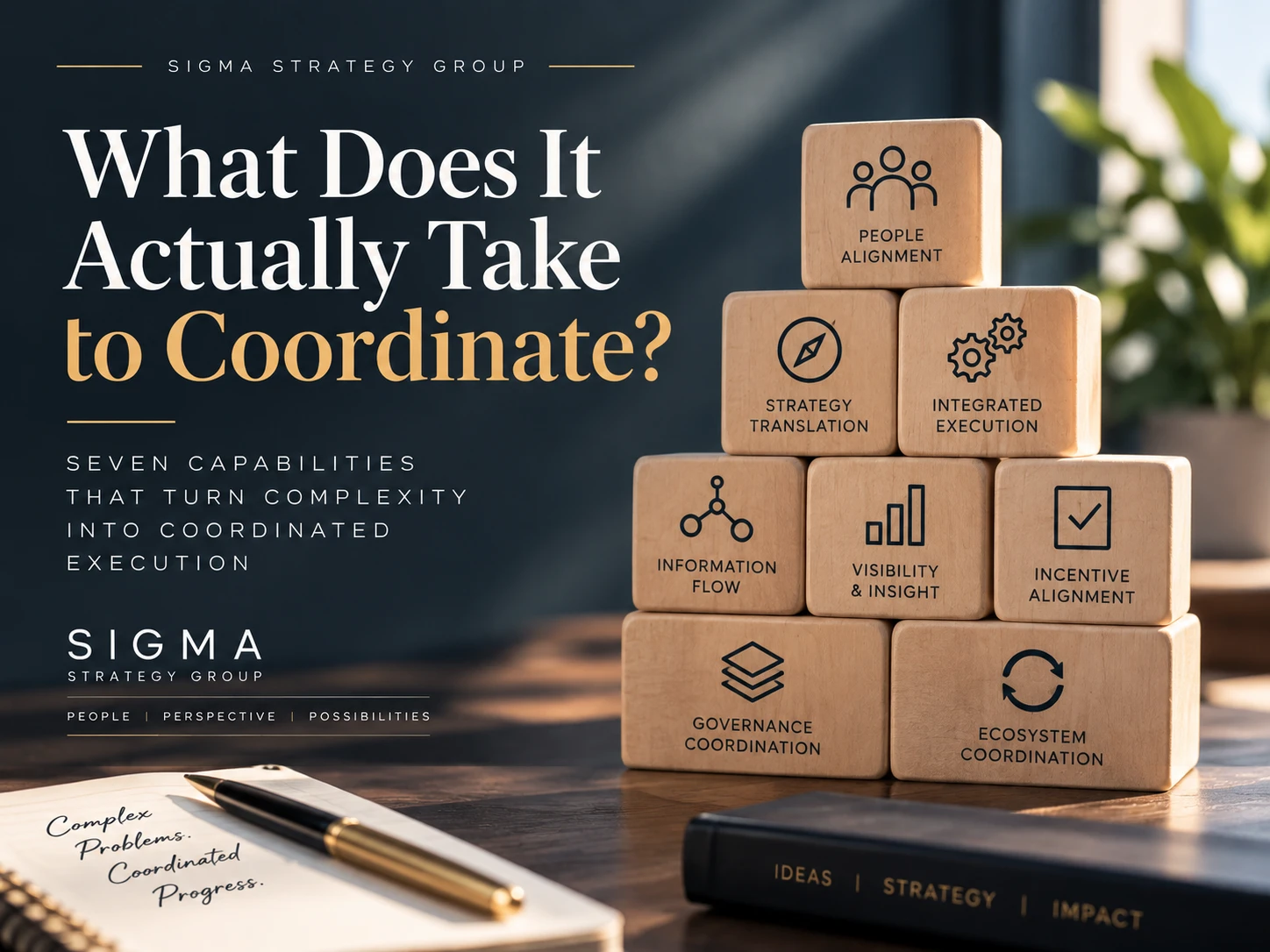
At Sigma Strategy Group, our work has led us to think about Coordination Capacity not as a single competency, but as a system of seven interconnected capabilities.
This distinction matters because organizations rarely struggle with coordination in exactly the same way.
One organization may have strong relationships among its partners but limited visibility into what is happening across the system. Another may have sophisticated data and clearly defined governance, yet incentives continue to pull participating organizations toward competing priorities. A third may have widespread agreement about the strategy but struggle to translate that agreement into integrated execution.
All three may appear to have a coordination problem.
But they do not have the same coordination problem.
Understanding that difference is foundational to the Coordination Capacity Framework.
Consider One Workforce Strategy
Imagine a state launches an ambitious initiative to create pathways into high-demand occupations.
The conditions appear promising. Employers need talent. Community colleges and training providers are ready to respond. Workforce agencies have programs and funding available. State leaders support the effort, and community organizations understand many of the barriers workers face.
Everyone agrees on the broad objective.
But agreement is only the beginning.
For the strategy to work, leaders need to understand which programs and pathways already exist, which employers they serve, where resources are being invested, and where meaningful gaps remain. Employers, colleges, workforce agencies, and other partners need enough alignment among their incentives that success for one does not unintentionally undermine success for another.
Someone needs to know who can make decisions when priorities conflict. Participating organizations need to understand their roles within the larger ecosystem. Employer demand needs to inform program design before investments are made. Workers and employers need to be able to navigate the opportunities being created. Eventually, all of those pieces have to translate into coordinated execution.
Those requirements are related, but they are not interchangeable.
Within the Coordination Capacity Framework, we describe them as seven capabilities: Visibility, Incentive Alignment, Governance Coordination, Ecosystem Coordination, Strategy Sequencing, Navigation, and Integrated Execution.
1. Visibility: Can the System See Itself?
Most complex systems contain enormous amounts of information. That does not mean anyone can actually see the system.
A state may know how many people completed a training program. A community college may know enrollment and credential attainment. A workforce board may know which participants received services, while an employer knows which positions remain difficult to fill.
Each organization possesses information. The challenge is whether anyone can see across it.
Organizational research provides useful context for why shared understanding matters. In a meta-analysis of 23 independent studies, Leslie DeChurch and Jessica Mesmer-Magnus found that shared mental models were positively related to team performance across different methods of measurement. Their work reinforces an important distinction for complex systems: information distributed among participants is not necessarily the same as a shared understanding of the work.
Visibility, as we define it within the framework, is the ability to understand what exists across the system: who is doing what, where resources are flowing, which populations and employers are being served, where efforts overlap, and where gaps remain.
Without that visibility, organizations can make perfectly rational decisions based on incomplete pictures. A new program may be created to address a need another organization is already addressing. Employers may be approached repeatedly by different partners. Funding may flow toward areas already receiving significant investment while another need remains largely invisible.
The problem isn’t necessarily a lack of data.
It is the inability to turn fragmented information into a shared view of the system.
2. Incentive Alignment: Are We Actually Rewarded for the Same Outcomes?
Partners can genuinely agree on a strategy and still behave in ways that make it harder to execute.
A community college may be measured on enrollment and completion. A workforce organization may be accountable for placement outcomes. An employer may prioritize speed, productivity, and retention. A state agency may operate under statutory requirements attached to funding, while a nonprofit may be accountable to a grant with its own target population and reporting expectations.
None of those priorities is inherently wrong, but they are not automatically aligned.
Research into interorganizational incentives illustrates the significance of this dynamic. A 2023 mixed-method case study of a large hydropower project found that interorganizational incentives helped promote goal alignment and cooperative relationships and improve project performance. The setting is very different from a workforce ecosystem, but the underlying lesson is relevant: organizations participating in the same initiative may share broad goals while still responding to different priorities and incentives.
A partnership can therefore have a shared vision while its participants continue making individually rational decisions that collectively pull the system in different directions.
Coordination requires more than agreement. It requires understanding whether incentives, performance measures, funding structures, and organizational priorities reinforce the outcomes the system says it wants.
Shared goals matter. The incentives surrounding them influence whether those goals translate into aligned action.
3. Governance Coordination: Who Can Actually Decide?
Complex initiatives rarely lack governance. Sometimes they have plenty of it.
There may be steering committees, advisory boards, agency leadership teams, employer councils, project offices, funding authorities, and internal approval processes. Each may have legitimate responsibility for part of the work.
The difficulty emerges when a decision crosses those boundaries.
Imagine an initiative that requires changes to funding, technology, program design, and employer engagement at the same time. One group can approve the funding change. Another owns the technology. A third oversees the program. Employers influence requirements but hold no formal authority.
Each part of the decision has an owner.
But who owns the decision that crosses all of them?
Governance Coordination, within the framework, examines whether authority, accountability, escalation paths, and decision rights remain clear when work crosses organizational boundaries.
Without that clarity, governance designed to create accountability can unintentionally create delay.
4. Ecosystem Coordination: Can Independent Organizations Act as Part of a System?
A collection of organizations does not automatically become an ecosystem simply because they participate in the same initiative.
A statewide workforce effort might include employers, community colleges, K–12 systems, workforce boards, economic development organizations, nonprofits, philanthropy, technology providers, and government agencies. Each may bring tremendous value. The question is whether those contributions function as parts of a larger system.
Research on organizational interdependence helps explain why this matters. A Journal of Applied Psychology meta-analysis examining 107 independent samples and 7,563 teams found that different forms of interdependence affect team functioning and performance through different mechanisms. Although teams and multi-organization ecosystems are not interchangeable, the research reinforces a useful principle: when work and outcomes depend on multiple participants, the structure of those dependencies matters.
Within a workforce ecosystem, that raises practical questions. Do partners understand their respective roles? Can they see where their work intersects? Are handoffs intentional? Can relevant information move between organizations? Are duplicated efforts recognized? Can the system adapt when one partner’s decisions affect another?
Ecosystem Coordination does not require every organization to surrender its independence. It requires enough shared structure and awareness for independent organizations to contribute to a larger system while continuing to fulfill their own responsibilities.
Participation creates a network. Coordination helps determine how effectively that network functions as a system.
5. Strategy Sequencing: Are We Doing the Right Things in the Right Order?
A strategy can contain all the right components and still struggle because they happen in the wrong sequence.
A workforce initiative may build a training program before validating employer demand. A digital transformation may purchase technology before redesigning the processes the technology is intended to support. An apprenticeship initiative may recruit participants before employers have developed the internal capacity to support apprentices.
Each activity may eventually be necessary. The problem is the order.
In complex systems, one action often creates conditions required for another to succeed. When those dependencies are poorly understood, organizations can invest significant resources in work that is technically appropriate but operationally premature.
Strategy Sequencing examines whether critical dependencies are understood and whether actions are coordinated in an order that supports successful execution.
Sometimes the difference between a good strategy that works and one that struggles is what happened first.
6. Navigation: Can People Actually Move Through the System?
A system can contain tremendous opportunity and still be difficult to navigate.
Imagine an employer trying to build a new talent pipeline. Workforce boards may offer hiring assistance, community colleges may provide customized training, apprenticeship intermediaries may support program development, economic development organizations may offer incentives, state agencies may administer funding, and nonprofits may provide services that address barriers to employment.
From inside the ecosystem, that abundance may look like capacity.
From the employer’s perspective, it may look like six phone numbers and no obvious place to start.
Workers experience a related challenge. Programs, credentials, funding sources, eligibility requirements, career pathways, and support services may all exist, yet individuals may still have difficulty understanding how those pieces connect.
Recent research from Harvard’s Project on Workforce provides particularly relevant evidence. Its 2026 Pivots Without Pathways report draws on a two-year mixed-methods study of how low-wage workers and community college students access, interpret, and use education and career information. The researchers describe a fragmented labor market in which people are making increasingly complex career decisions, often with limited guidance and under conditions of uncertainty.
Navigation, within the framework, is therefore about more than whether opportunities exist. It considers whether people and organizations can understand where to enter a system, which options are relevant, how to move between them, and what should happen next.
Opportunity has limited value when the people it is intended to serve cannot find their way through it.
7. Integrated Execution: Can All of This Work Together in Practice?
Eventually, coordination has to produce action.
A system may have strong relationships, useful data, aligned leaders, thoughtful governance, and a compelling strategy.
But can it execute?
Integrated Execution is where the other capabilities meet reality. Information has to reach the people who need it in time to influence decisions. Partners need to adjust when conditions change. Funding, technology, operations, and people need to move together rather than through disconnected implementation tracks. Strategic decisions must translate into coordinated behavior across the organizations responsible for delivering the work.
Execution does not happen inside a strategy document. It happens across hundreds of decisions, handoffs, dependencies, and actions, often made by people who work in different departments or entirely different organizations.
Integrated Execution is where coordination becomes action.
The Capabilities Work Together
The seven capabilities are distinct, but they are not independent.
Consider an ecosystem with excellent Visibility. Leaders can see programs, investments, participants, employer demand, and outcomes across the system. But if funding and performance measures reward participating organizations for competing behaviors, better Visibility alone will not create alignment.
Another system may have strong Incentive Alignment but unclear Governance Coordination, leaving partners committed to the same outcomes while decisions repeatedly stall. A third may have effective Governance Coordination and strong Ecosystem Coordination, yet poor Navigation makes the system unnecessarily difficult for employers and workers to use.
This is why simply asking whether an organization is “good at coordination” may not tell us very much.
The more useful question may be: Where is coordination strong, where is it weak, and how are those differences affecting the system as a whole?
Coordination Capacity therefore cannot be understood through communication, collaboration, governance, technology, or any single organizational practice alone. Each may contribute to it, but none represents the whole.
From Coordination to Coordination Capacity
The distinction between coordination and Coordination Capacity may seem subtle, but it changes the conversation.
Coordination describes something organizations do.
Coordination Capacity describes the capability that supports their ability to do it consistently.
Within our framework, that means examining how Visibility, Incentive Alignment, Governance Coordination, Ecosystem Coordination, Strategy Sequencing, Navigation, and Integrated Execution interact as complexity increases.
Those capabilities may not develop evenly. An organization may be strong in one area while remaining reactive in another. Two organizations pursuing similar strategies may therefore encounter very different execution challenges and require very different responses.
That may help explain why adding another meeting, technology platform, or governance structure does not necessarily solve what appears to be a coordination problem. The intervention may simply be aimed at the wrong capability.
Before deciding what to add, organizations may first need to understand what is actually limiting their ability to coordinate.
A Different Way to See the System
Organizations have invested heavily in strategy, leadership, technology, talent, partnerships, and transformation. Those investments remain important, but as work becomes increasingly interconnected, the ability to coordinate them may itself become an important source of organizational capacity.
The question is no longer simply whether the right pieces exist.
It is whether the organization has the capacity to make those pieces work together.
And once we recognize that Coordination Capacity consists of multiple capabilities, another question emerges:
What happens when some of those capabilities are significantly stronger than others?
That is where understanding Coordination Capacity begins to move beyond identifying its components and toward understanding maturity.
Sigma Note
At Sigma Strategy Group, our Coordination Capacity Framework examines seven interconnected capabilities: Visibility, Incentive Alignment, Governance Coordination, Ecosystem Coordination, Strategy Sequencing, Navigation, and Integrated Execution.
These capabilities provide a structured way to examine why complex strategies may succeed, stall, or produce uneven results across organizations and ecosystems.
Our next article will explore why strength in one coordination capability may not compensate for weakness in another, and what uneven capability can reveal about an organization’s overall capacity to execute.
Next in the series
Why Strong Coordination in One Area Isn’t Enough
Like this project
Posted Sep 16, 2026
Original thought leadership translating organizational complexity into a seven-capability framework for understanding and improving coordinated execution.
Likes
0
Views
0