
Overview
Rosita is a short motion film for an AI creative platform. It tells one human story through the product's own interface: Lucía turns her grandmother's hot sauce into a real brand, one prompt at a time. Every product asset in the film was generated with AI, and the film itself was directed by me and built frame by frame in Remotion with Claude.
The idea
The best brand films don't list features: they tell a story through the product. So instead of a feature reel, Rosita is a short story where the product's interface is the narrator.
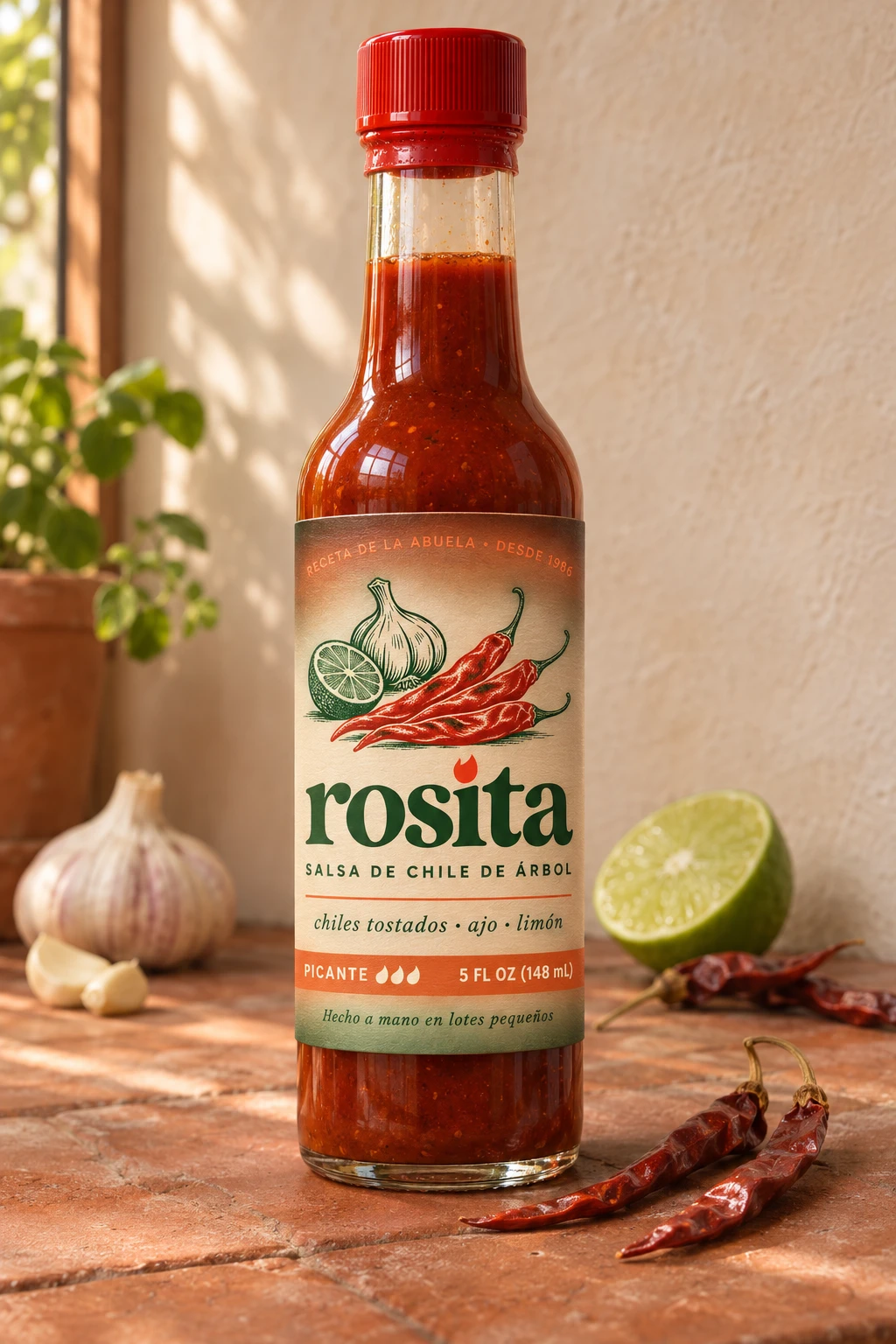
Rosita's sauce.
The brief. A creative test for an AI creative platform: a 30-second motion piece that shows the product authentically and is "highly engaging." The platform works like a creative partner you can talk to. It connects to Shopify and Meta Ads, and it makes images, audio, video and websites.
The research. I studied the platform's site and voice, and measured the live app for its exact colors, sizes and type. I also studied product-story films such as Google's "Parisian Love" and "Loretta", Apple's "Designed by Apple in California" and Waymo's "Singapore, meet Waymo".
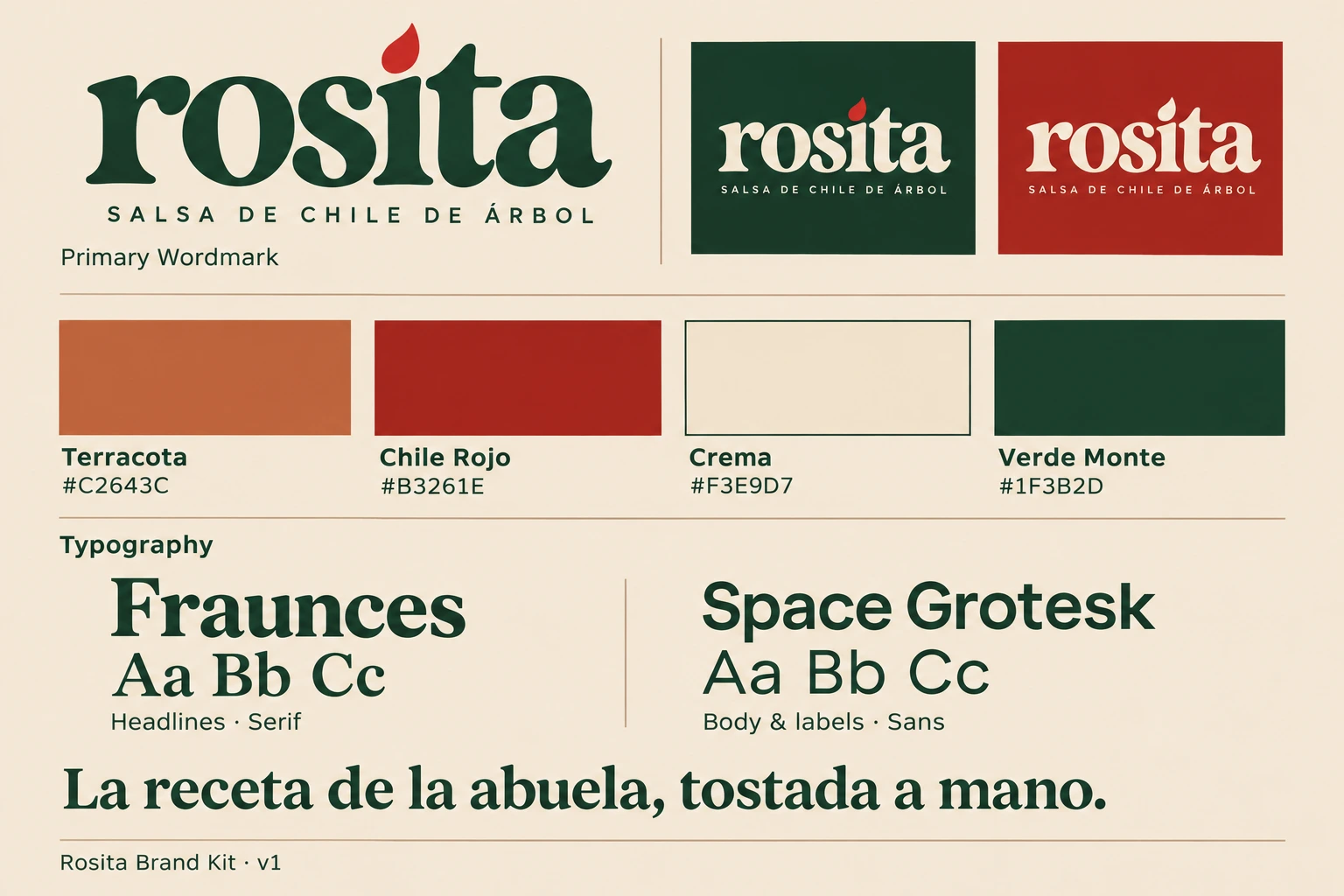
The concept. Lucía wants to sell her grandmother's hot sauce: 40 years, one recipe, no budget. She talks to the AI like a partner, and a brand comes to life: a name and a look, a Shopify store, a photoshoot without a shoot, a launch film, a soundtrack, a website, and an ad refresh the AI suggests on its own. It ends on Order #100 and one line: "she's going to cry."
Why it works.
Every capability in the brief appears as a moment in one story, not as a list.
It sells "partner," not "tool": the AI plans, makes, and notices things before she asks.
It ends on an emotion, not a spec.
The music you hear is the track the AI composed for Rosita inside the story. It plays muffled "from the other room" until Lucía asks for it, then opens up and fills the film.
The film
What we show
One continuous camera move through the app, with no cuts. Each beat is one message and one thing the AI makes.
Final work
Made with AI
Every product asset in the film was generated in the platform with my credits, from three prompts, and appears untouched. The film is made with the product it sells.
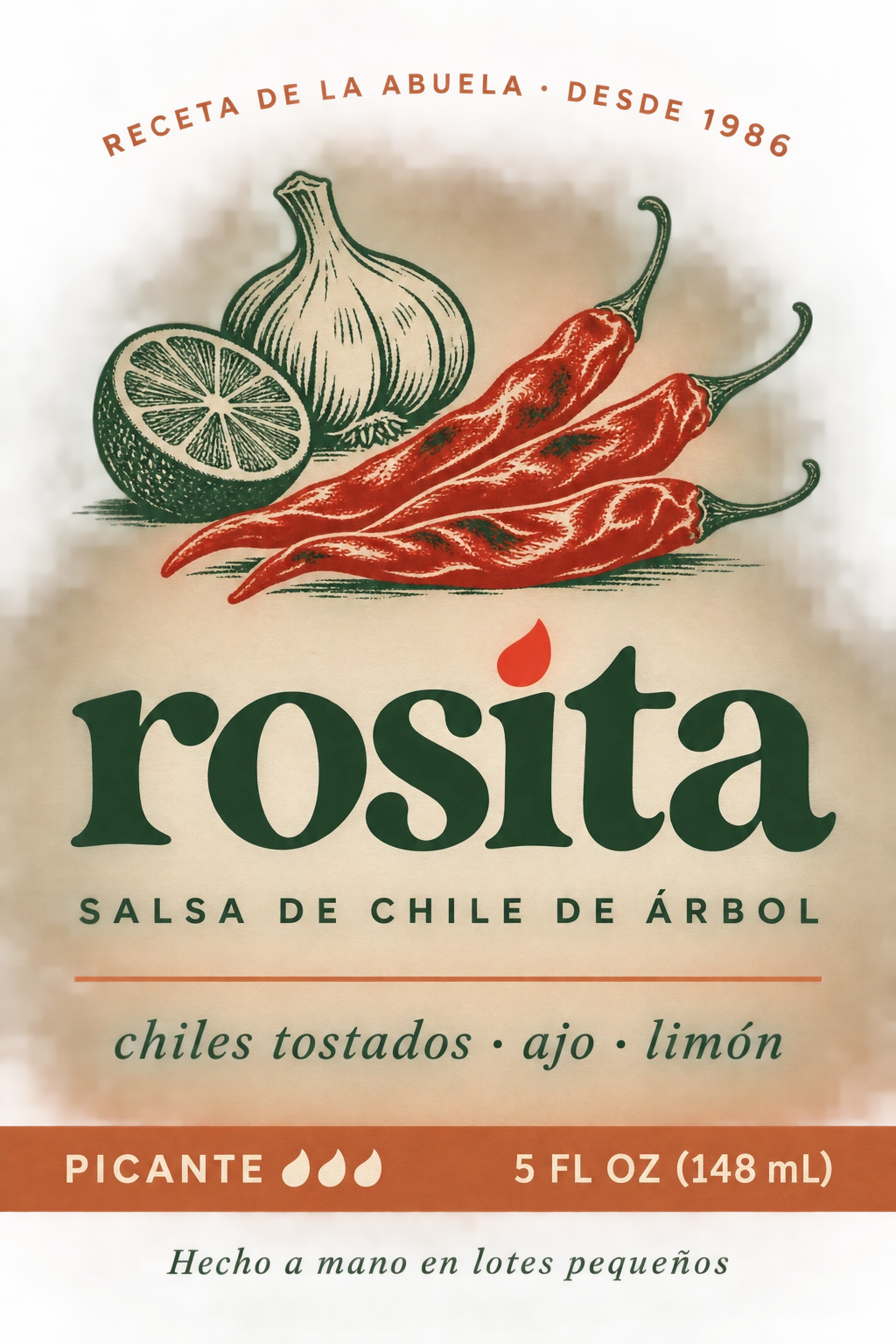
Prompt 1, brand kit. "Create a brand kit for 'Rosita', a small-batch hot sauce made from my grandmother's 40-year-old recipe (roasted chiles de árbol, garlic, lime). Warm, handmade, Mexican kitchen soul but premium and modern, not cliché. Wordmark, a label for a 5 oz woodland bottle with a red cap, palette (terracotta, chile red, cream, deep green), type pairing, bottle mockup."
Prompt 2, photography. "Product photography for launch, with no studio and no budget for a shoot. Use the exact bottle and label. Four photorealistic 4:5 images: golden-hour kitchen table with street tacos; a hand shaking Rosita onto tacos al pastor; overhead flatlay with dried chiles, garlic and lime on terracotta; the bottle held by an elderly woman's weathered hands in her kitchen."
Prompt 3, launch kit. "A ~6 s 16:9 cinematic launch film from the kitchen photo (slow push-in, steam, warm flickering light); an original 30-second instrumental at exactly 120 BPM (nylon guitar, hand percussion, shaker, a trumpet entering halfway, heartfelt finish, grandma's kitchen on a Sunday morning); a one-page HTML shop website; three 4:5 Meta static ads with different hooks, plus a fresh replacement for ad 2."
For the launch kit, the platform chose Seedance for video and Lyria for music, measured the tempo itself, re-rendered the film until the light actually moved, and cut the track to land exactly at 30 s.
Behind the film
Directed with Claude:
I directed the film with one master prompt to Claude, my AI production partner. It covers strategy, research, skills, every shot, motion, sound and quality checks. It is not "make me a video"; it's how I direct.
Research before concept. Claude read the platform's site and measured the live app from its code, not from screenshots: background #0A0A0A, bubbles #262626, a 256 px sidebar, a 440 × 868 chat panel, Inter for the product.
Story and shot list. A shot-by-shot table with exact timings, camera zoom and every line of dialogue.
Build in Remotion. The film is code (React): every animation is driven by the frame number, so it is frame-accurate, editable and re-renderable. The app is rebuilt at its real size (1440 × 900) inside a virtual camera.
One timeline for picture and sound. A single timing file drives both, so every keystroke, send and notification sound lands on its exact frame.
Sound design in code. Effects synthesized with Python and mixed over the AI-composed track, normalized to −14 LUFS.
Quality checks. Full-size stills at about 12 key moments, a sync check between sound and picture, loudness and peak checks, and a brand check: the platform's real UI, no invented features. Craft details Premium and calm, like the product: no bounce, no overshoot, no hard cuts inside the app. Motion • Arrivals ease out fast and settle slowly; exits take about 60 % of the time of entrances. • Every arrival stacks three moves: fade, a 14–24 px rise and a 4–18 px blur, plus a slight scale on cards. • Generated content reads as "rendering," not as a cut: skeleton card, shimmer sweep, then the image resolves from blur. • Chat physics: new messages push the stack up; the AI's replies stream in. • Secondary motion (shimmer, waveform, sync bars, counters) keeps the frame alive while the camera holds. Type and legibility • Inter for the product UI, as in the real app; Helvetica-style headlines with tight tracking for the end card. • UI text never appears smaller than about 20 px on a 1080p frame. Sound • The track plays filtered "from the other room," then opens to full range on a downbeat at 16.21 s, right as Lucía asks for it. • The film ends as the app blurs away and the music fades with it. • Synthesized effects: a soft key tick per typed character, a pop on each send, a shimmer while the AI works, shutter ticks on the photos, a two-note chime for Order #100. Takeaways AI made every asset; the craft was in the direction. The AI produced a complete brand in three prompts, but the story, the pacing and the sync between picture and sound are what make it a film. • Story beats features. Seven capabilities fit in under 30 seconds because each one is a moment in Lucía's story. • The interface can be the narrator. No voiceover, no captions: the chat tells the story. • Direct the AI like a crew. A detailed brief with research, references, a shot list and quality checks gets better work than "make me a video." • Sound is half the film. Locking every cut and reveal to the track's downbeats makes 30 seconds feel inevitable.
0 likes · 1 view · Nov 13, 2026
A grandma’s hot sauce becomes a brand, one prompt at a time. A short motion film where the AI app’s interface tells the story
