
Reflection: This case demonstrates AI product thinking: defining what the AI should and shouldn't do is the core design work. The most important decisions were boundaries — role calibration before judgment, evidence before conclusions, and a preview that earns trust before purchase. It also reflects how I think about human + AI products: the AI does the structured analysis; the human keeps the judgment.
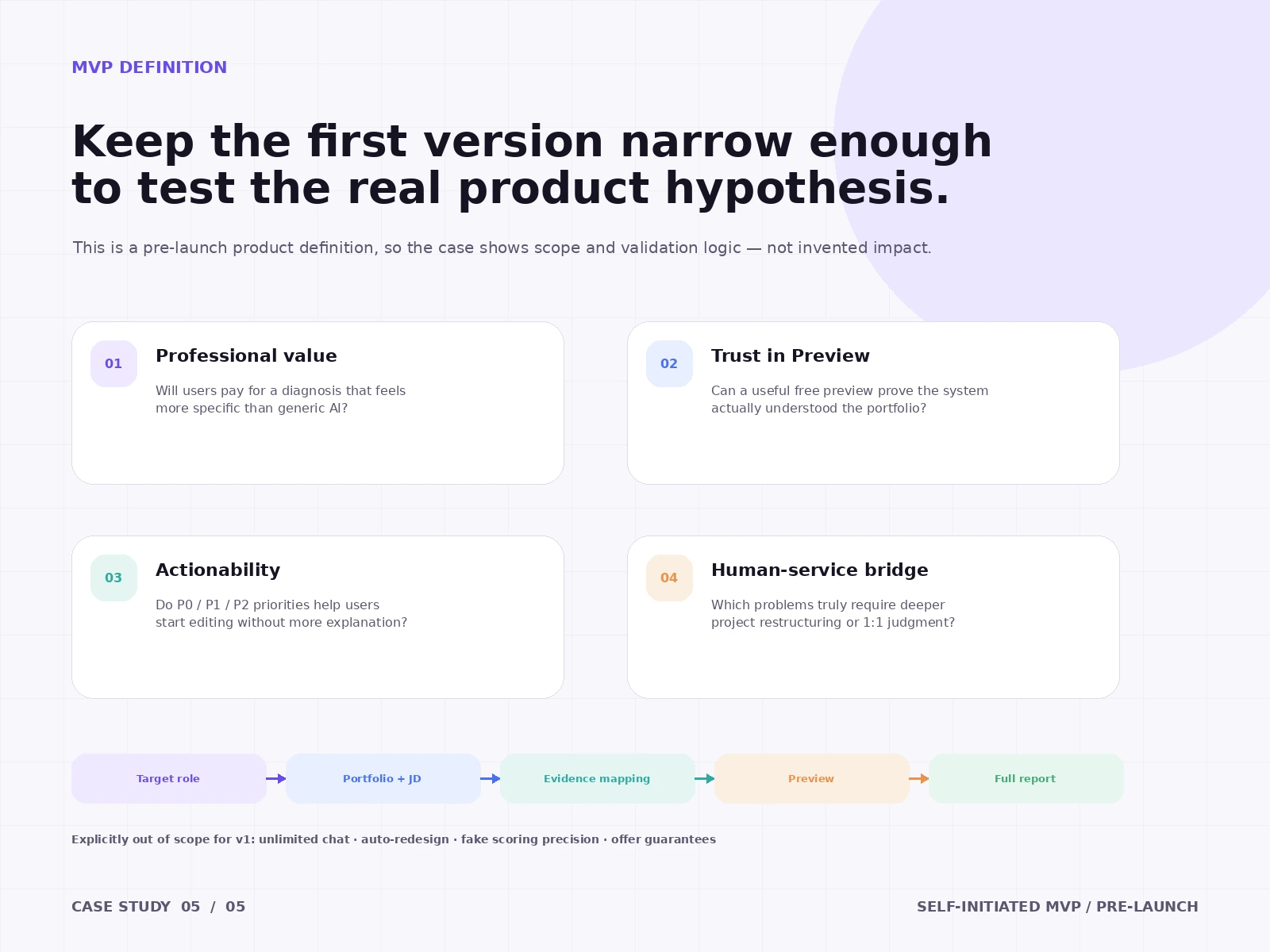
Current Status: Pre-launch MVP definition. Validation is organized around four questions, not metrics: Professional value — will users pay for a diagnosis that feels more specific than generic AI? Trust in preview — can a useful free preview prove the system understood the portfolio? Actionability — do P0/P1/P2 priorities help users start editing without more explanation? Human-service bridge — which problems truly need deeper project restructuring or 1:1 judgment?
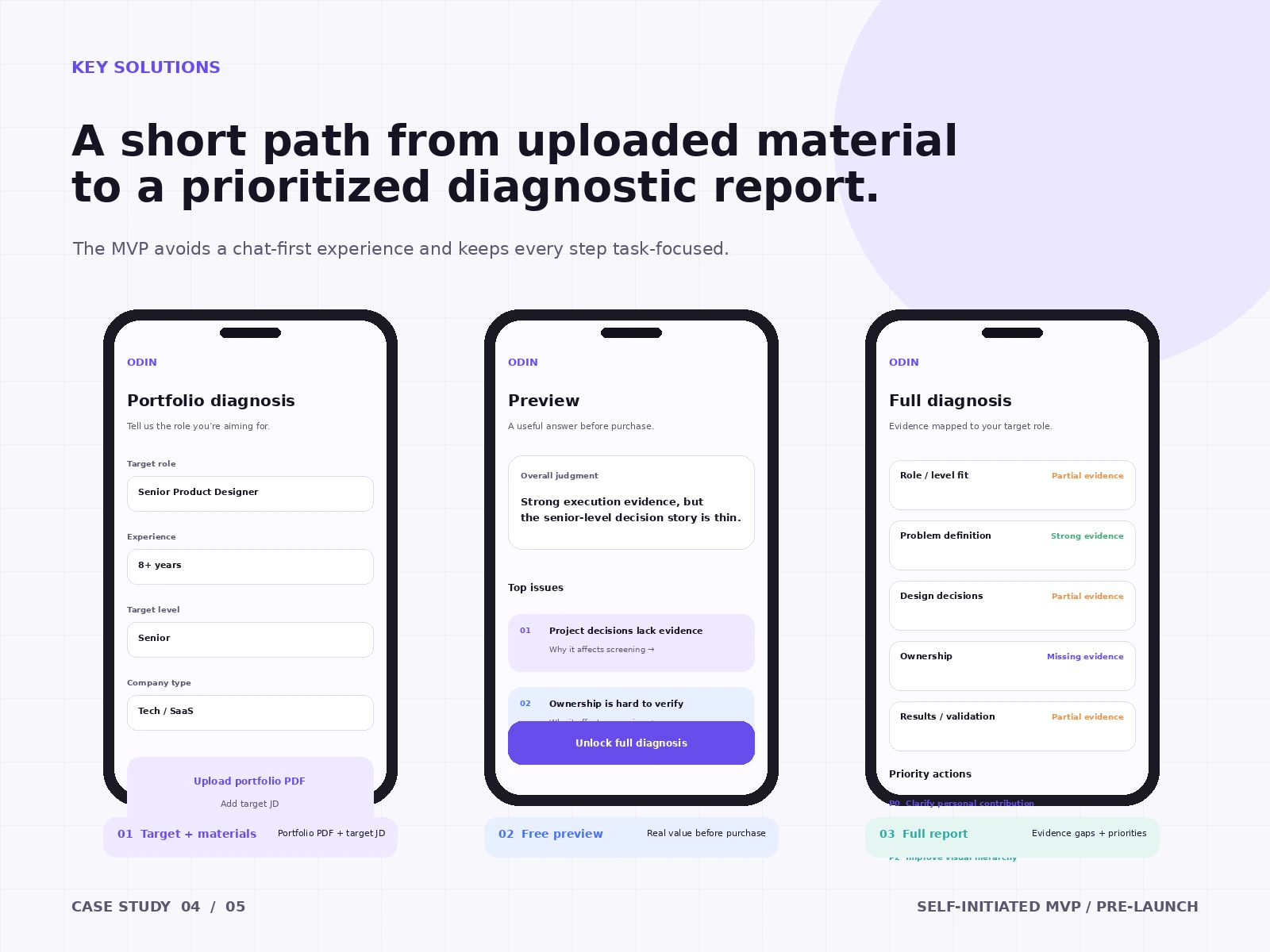
Solution: A mobile-first diagnostic experience: role and material intake, an evidence-mapped preview with top issues, and a full report of evidence gaps with P0/P1/P2 priorities — every step traceable to uploaded material.
Key Decisions: A short, task-focused path — not a chat-first experience: Target + materials (portfolio PDF + target JD) → Free preview → Full report. The free preview gives a real, useful answer before purchase (overall judgment + top issues), so the product proves it understood the portfolio before asking for money. The full report maps evidence to the target role with prioritized actions (e.g., P0 clarify personal contribution, P1 rebuild decision evidence, P2 improve visual hierarchy). Explicitly out of scope for v1: unlimited chat, auto-redesign, fake scoring precision, offer guarantees. Saying no to these keeps the MVP honest and testable.
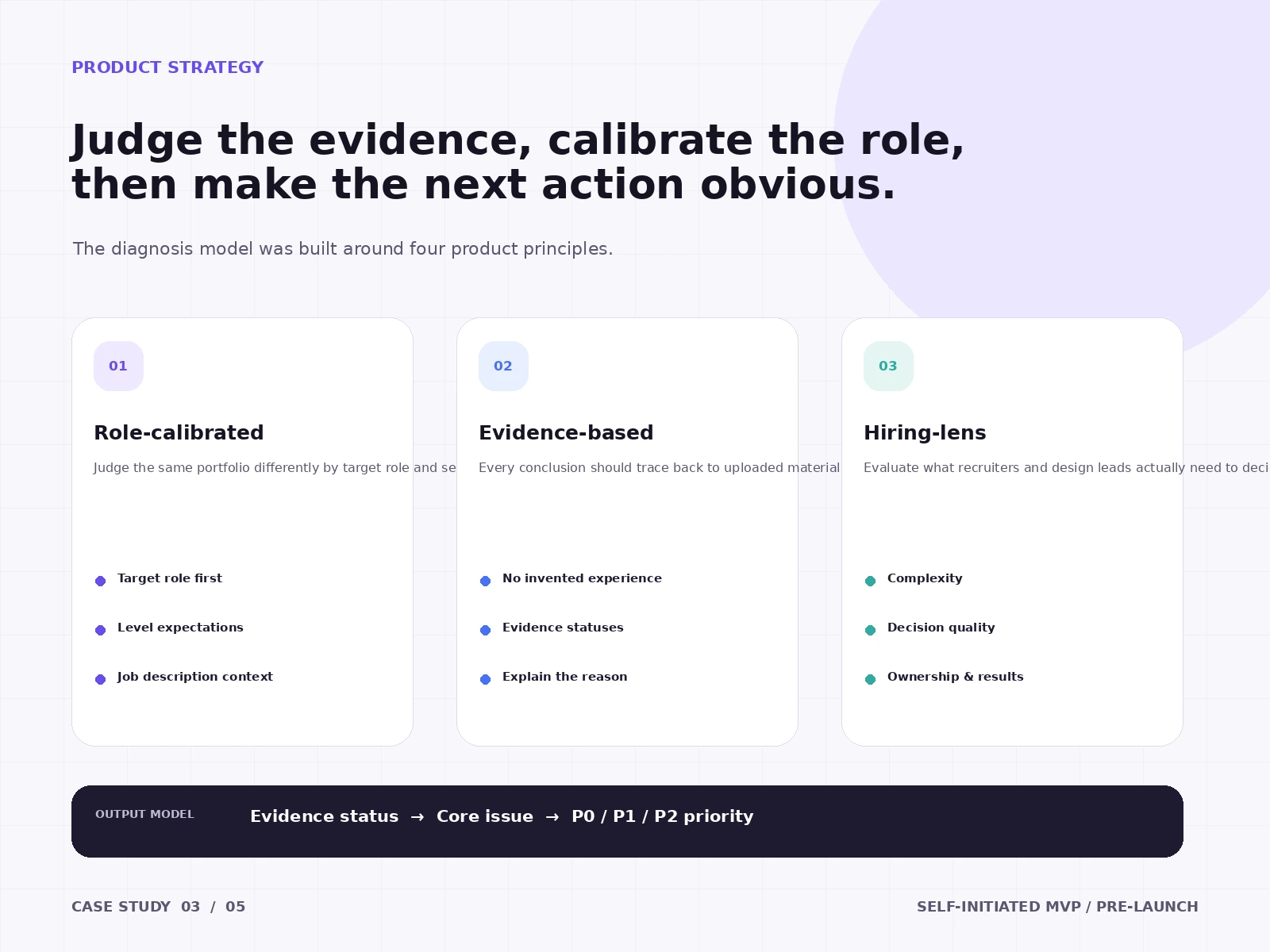
Design Strategy: The diagnosis model was built around four product principles: (1) Role-calibrated — target role first, level expectations, job-description context. (2) Evidence-based — no invented experience, explicit evidence statuses (strong / partial / missing), every conclusion explains its reason. (3) Hiring-lens — evaluate complexity, decision quality, and ownership & results the way recruiters and design leads actually screen. Output model: Evidence status → Core issue → P0 / P1 / P2 priority.
Key Insights: Designers don't need another opinion — they need a hiring lens. The same portfolio reads differently for a senior product role versus a visual design role, so role calibration has to come before any judgment. And trust requires traceability: every conclusion must point back to something the user actually uploaded — no invented experience, no fake scoring precision.
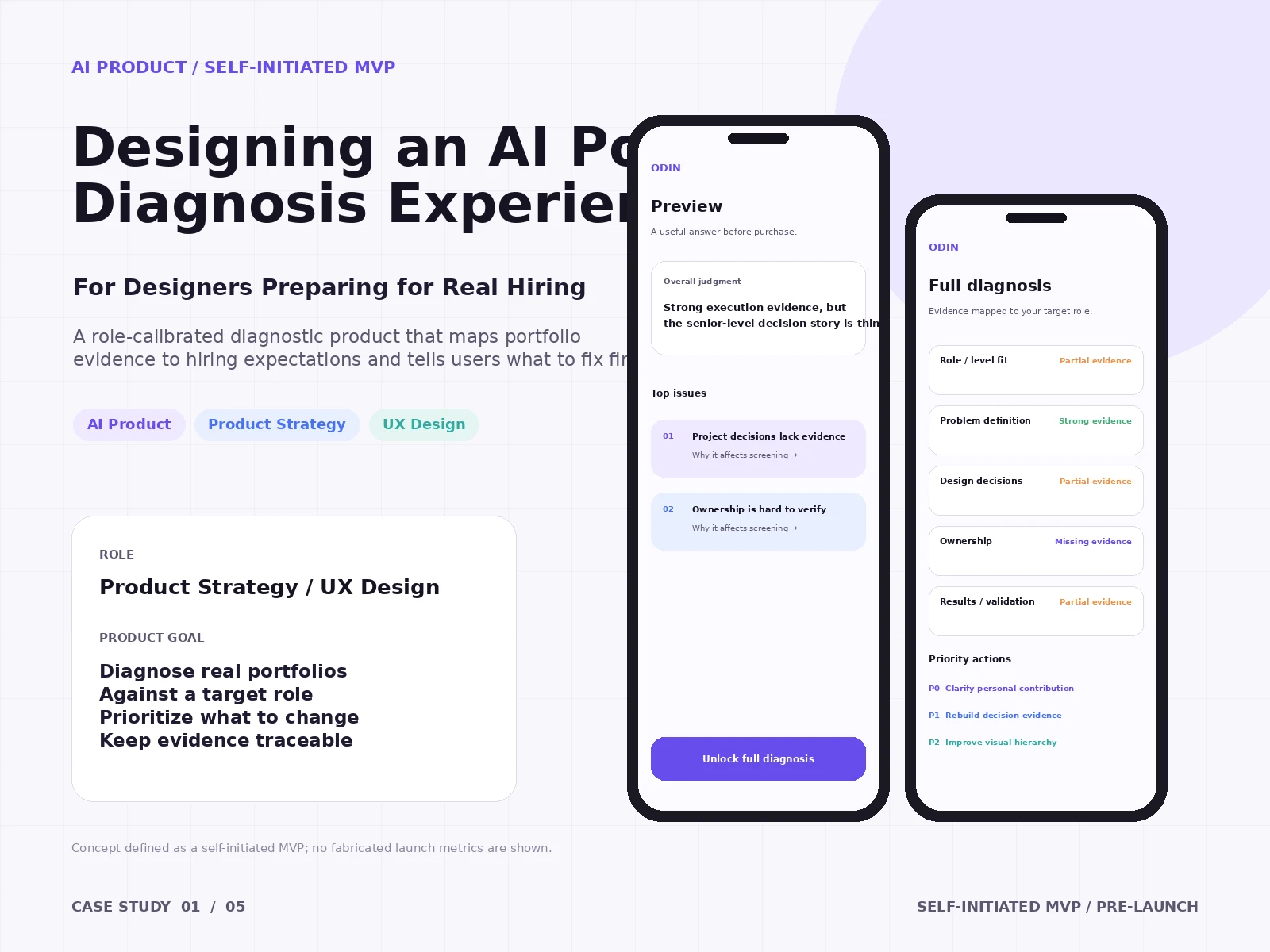
My Role: Product Strategy / UX Design. I defined the product: diagnose real portfolios against a target role, prioritize what to change, and keep every conclusion traceable to uploaded evidence.
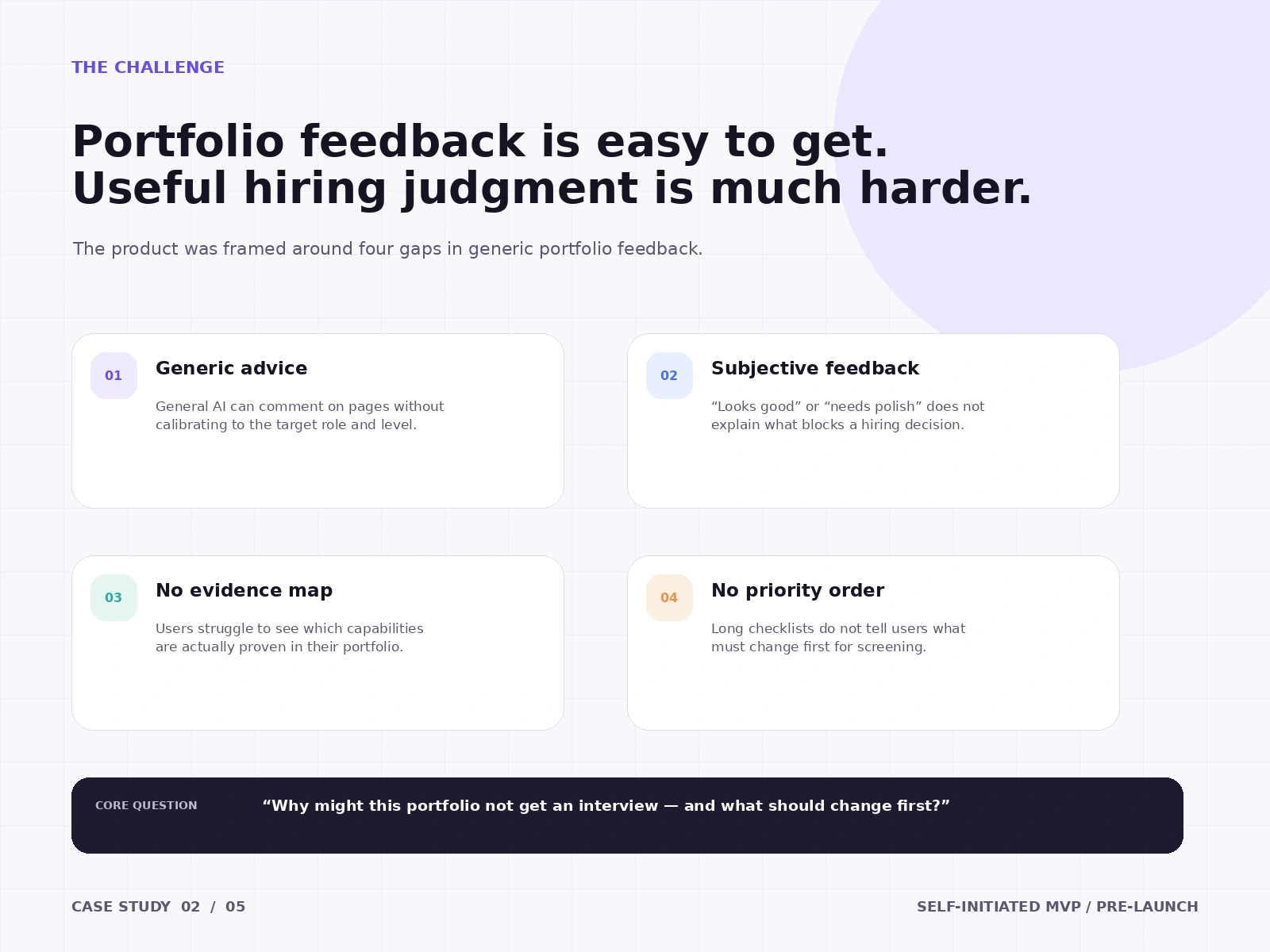
Challenge: Portfolio feedback is easy to get; useful hiring judgment is much harder. The product was framed around four gaps in generic portfolio feedback: generic advice — general AI comments on pages without calibrating to the target role and level; subjective feedback — "looks good" doesn't explain what blocks a hiring decision; no evidence map — users can't see which capabilities are actually proven in their portfolio; and no priority order — long checklists don't say what must change first for screening. The core question: "Why might this portfolio not get an interview — and what should change first?"
Context: A self-initiated product concept, currently in pre-launch MVP definition. This is not a shipped product with validated user metrics — the case shows product definition, scope decisions, and validation logic. No user counts, conversion, revenue, or satisfaction figures are claimed.
0 likes · 1 view · Oct 7, 2026
Self-initiated pre-launch MVP for AI portfolio diagnosis, mapping portfolio evidence to hiring expectations with role-calibrated recommendations.
