Three UK — From journeys to a connected platform

Marian Cozma

Three UK - From journeys to a connected platform
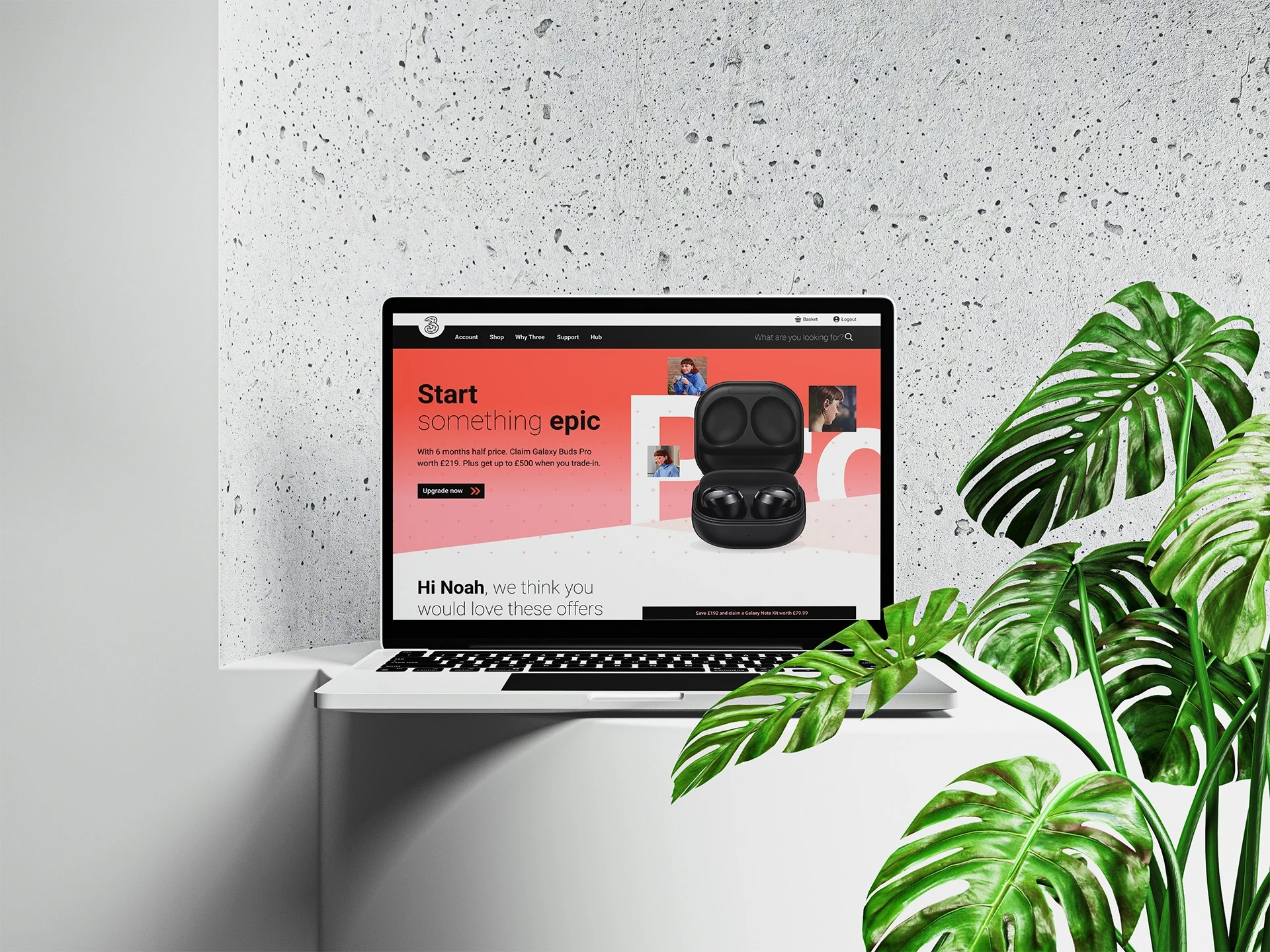
Three's website, account and app experiences felt disconnected, and everyday tasks like logging in and upgrading were harder than they should be. A two-week design proof showed a better direction and secured the wider commission. I then audited 1,200+ pages and turned them into reusable responsive templates for the new platform.
The problem
Customers moved between the website, account, and app, and the experience didn't tie together.
Pages had been designed one at a time, so a large estate had no shared structure.
The new platform had to support 1,200+ pages without treating each one as a separate design problem.
What I did
Phase 1: two-week proof
Combined stakeholder conversations, competitor journey reviews and interviews with store staff and customers.
Ran a rapid UX workshop to agree which problems the proof should solve.
Turned the findings into three priority journeys: upgrading as an existing customer, joining as a new customer, and buying again.
Reworked the information architecture, including how logged-in and logged-out experiences should differ, and designed responsive wireframes with a UI designer.
Phase 2: scaling the platform
Audited 1,200+ pages and grouped them into recurring page families.
Documented each template's goals, sections, components and content rules.
Created responsive template wireframes that the design, content and development teams built from.
Key decisions
Start with problems customers already had: the proof tackled everyday friction, not a visual refresh.
Keep the next decision in view: devices, plans and offers appear in a clear order, and logged-in customers see their usage, billing and upgrade options.
Templates, not pages: reusable structures and content rules, so new pages don't need new design.
Outcome
The proof secured the wider commission.
The audit became a shared set of responsive templates and content rules.
The UX and template work went into production, with design support through development. Post-launch metrics aren't available.
My role: Phase 1: led UX alongside a UI designer, working with business, product and technology teams. Phase 2: estate audit, UX design and responsive templates with the wider delivery team.
Relevant if your site or product has grown page by page and every new page feels like a new design problem, or you need a fast proof to win internal buy-in.
See my UX Audit or Complex Workflow Design services.
Full case study available by invitation
Like this project
Posted Oct 3, 2026
Customer research, journey design and reusable responsive templates for Three UK’s digital platform. Integrated into production.