Enhancing Customer Experience Through Consistent Interactions

Martha Nwoye


What Handling 80 Customer Interactions a Day Taught Me About Customer Experience
Customer experience is often discussed in terms of big initiatives.
New platforms.
New processes.
New customer journeys.
But some of my most important lessons about CX came from something much less glamorous:
handling customers, one conversation at a time.
For nearly four years, I worked in customer experience within financial services, supporting customers across phone, email, live chat, WhatsApp, X and Instagram.
On busy days, that meant handling approximately 80 customer interactions while maintaining quality, empathy, accuracy and service-level expectations.
The volume taught me something important:
Customer experience is not created by one perfect interaction.
It is created by the consistency of hundreds of small interactions.
The customer doesn’t see the system
From the inside, a support organisation can look complicated.
There are different teams.
Different queues.
Different systems.
Different escalation paths.
A customer’s issue might involve frontline support, branch operations, fraud, digital banking and card services.
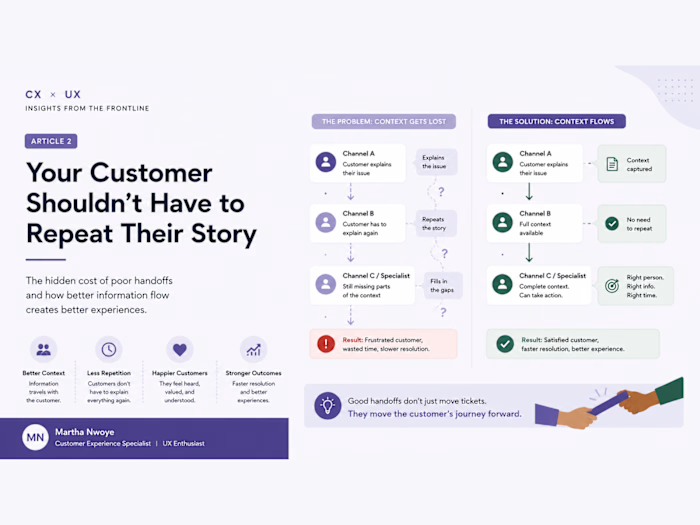
But the customer doesn’t experience those departments separately.
They experience one organisation.
That meant I couldn’t think only about whether I had completed my part of the process.
I had to think about whether the customer’s problem was actually moving toward resolution.
That changed how I approached escalations.
Instead of simply passing an issue to another team, I focused on making sure the next person had the context needed to continue the conversation.
Quality isn’t just about the score
I consistently maintained approximately 98% QA performance, with zero fatal QA errors, while working across a high-volume environment.
That achievement mattered.
But over time, I realised that individual performance was only one part of the picture.
If I could deliver excellent service but couldn’t help someone else develop the same standard, the impact stopped with me.
That became increasingly important as I trained and mentored more than 20 Service Associates.
The question shifted from:
“How well can I perform?”
to:
“How can good performance become repeatable?”
Consistency is a systems problem
Training taught me that people don’t always need more information.
Sometimes they need:
clearer expectations
better processes
easier access to information
examples of good judgment
consistent feedback
This is where my interest in UX and product thinking became stronger.
Because the same principle applies to products.
If users repeatedly struggle with the same task, telling every user to “try harder” isn’t the solution.
You improve the experience.
What frontline CX taught me about UX
Working directly with customers exposed me to something that is difficult to reproduce through hypothetical personas:
real frustration in real time.
I saw customers become confused by processes.
I saw where explanations were repeatedly required.
I saw which issues created unnecessary escalation.
And I saw how small points of friction could become much bigger problems when repeated at scale.
Those conversations became a form of informal user research.
Not every complaint represented a product problem.
But recurring complaints were worth investigating.
My biggest lesson
The biggest lesson I took from high-volume customer experience work is this:
Don’t measure customer experience only by how well you resolve problems. Pay attention to why customers keep encountering them.
A good support team can resolve problems.
A great customer experience organisation also looks for opportunities to prevent avoidable problems from happening again.
That’s the mindset I want to carry forward into CX and UX work.
Listen to customers.
Look for patterns.
Understand the system.
Improve the experience.
Like this project
Posted Sep 3, 2026
An insight-led article exploring how high-volume frontline customer interactions shaped my approach to consistency, customer trust, and improvement at scale.