Enhancing Customer Experience Through Effective Handoffs

Martha Nwoye


Your Customer Shouldn’t Have to Repeat Their Story
Imagine contacting a company about a problem.
You explain everything.
The issue gets escalated.
A new person joins the conversation.
And the first thing they ask is:
“Can you explain what happened?”
You explain it again.
Then perhaps again.
At that point, the problem isn’t only the original issue anymore.
The support experience itself has become part of the problem.
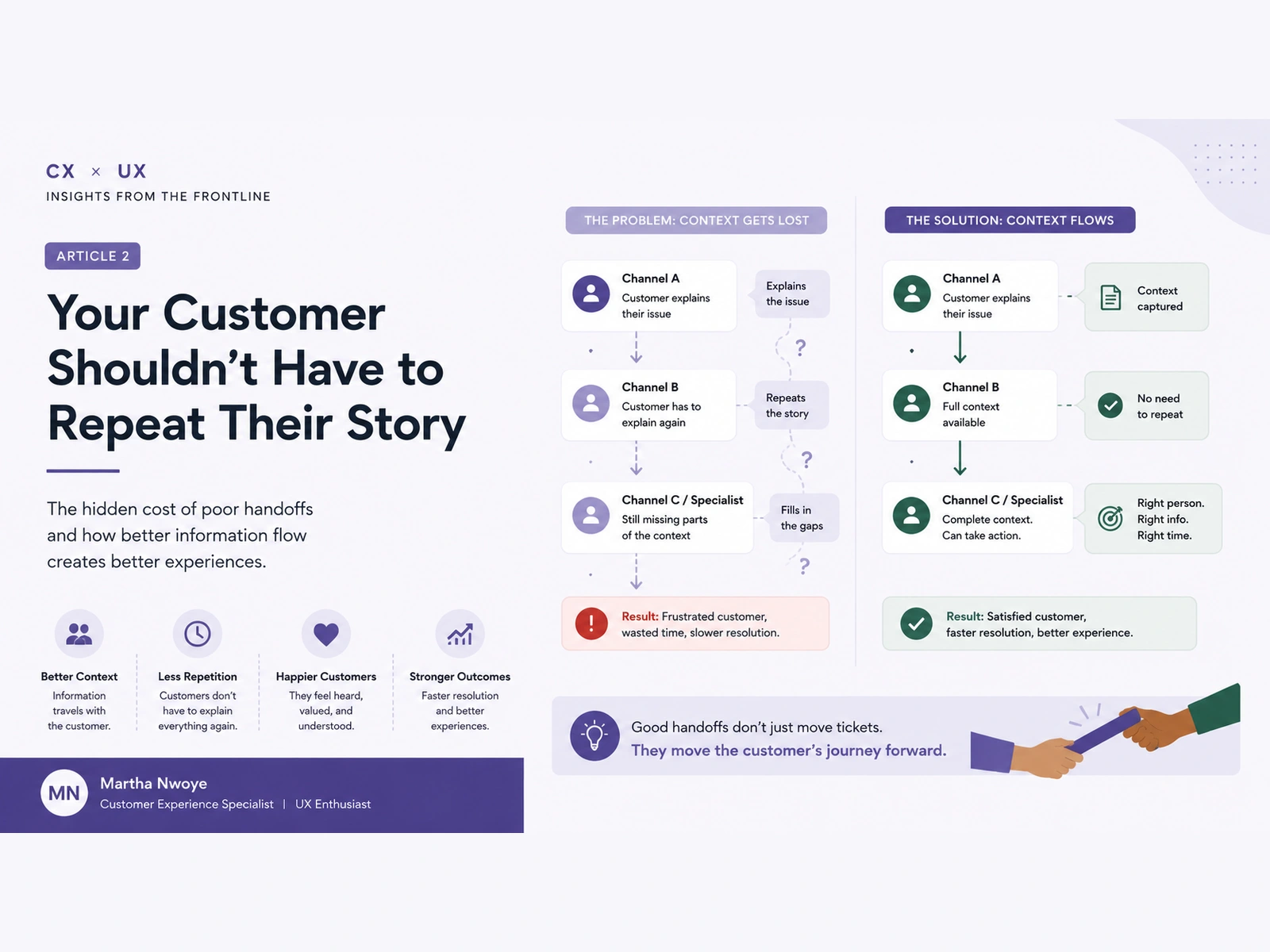
One customer. Multiple channels.
In multi-channel support environments, customers can move between:
Chat → Phone → Email → Specialist Team
Internally, those might be separate teams and workflows.
To the customer, however, it is one continuous journey.
That’s where I noticed an important disconnect.
The organisation could see several interactions.
The customer experienced one conversation.
Where the experience breaks
When an issue moves between teams, important context can disappear.
What happened?
What has already been tried?
What was promised?
How frustrated is the customer?
What needs to happen next?
If those details aren’t transferred clearly, the receiving agent has to reconstruct the story.
And who usually ends up doing that?
The customer.
The hidden cost of a poor handoff
Repeated explanations create more than inconvenience.
They can create:
Frustration
The customer feels unheard.
Delay
Agents spend time rebuilding information.
Uncertainty
The customer isn’t sure whether anyone owns the problem.
Loss of trust
The organisation starts to feel fragmented.
This is why I don’t see handoffs as purely operational.
They are experience-design moments.
The better question
Instead of asking:
“How can agents communicate better?”
I think we should ask:
“What information does the next person need to continue the customer’s journey?”
That leads to a different solution.
Rather than relying on memory or inconsistent notes, the handoff can be designed around a small set of essential information:
Issue
What is the customer trying to resolve?
Action taken
What has already happened?
Customer sentiment
What is the current emotional context?
Next action
What needs to happen now?
That small structure can make a complex handoff much easier to understand.
Not every case needs the same handoff
A simple case shouldn’t require a complicated process.
For routine issues, structured notes may be enough.
For complex or high-priority cases, a short live handoff between agents can prevent important context from being lost.
The principle is:
Add structure where it reduces friction, not where it creates bureaucracy.
The customer should never become the bridge
One of the biggest things CX work taught me is that customers shouldn’t have to compensate for internal complexity.
If two departments need to communicate, the customer shouldn’t have to carry information between them.
If three systems don’t share context, the customer shouldn’t have to remember everything.
If a process is complicated internally, the customer shouldn’t have to experience that complexity.
Internal complexity should be absorbed by the organisation, not passed to the customer.
Why this changed how I think about UX
UX is often associated with screens and interfaces.
But experiences don’t stop at the interface.
They include:
handoffs
processes
communication
information flow
service recovery
human interactions
A beautifully designed interface can still produce a frustrating experience if everything behind it is fragmented.
That’s why service design and UX thinking have become increasingly connected in how I approach customer problems.
The takeaway
The next time a customer has to repeat themselves, don’t only ask whether the agent handled the conversation correctly.
Ask:
Why did the customer have to repeat it in the first place?
Sometimes the problem isn’t the person handling the case.
It’s the system that failed to carry the customer’s story forward.
Like this project
Posted Sep 3, 2026
Exploring how better support handoffs, context sharing, and information flow reduce customer friction, build trust, and create seamless experiences.