ADEO

Irina Zubareva


Intro
Product Digital Platform (ADEO)
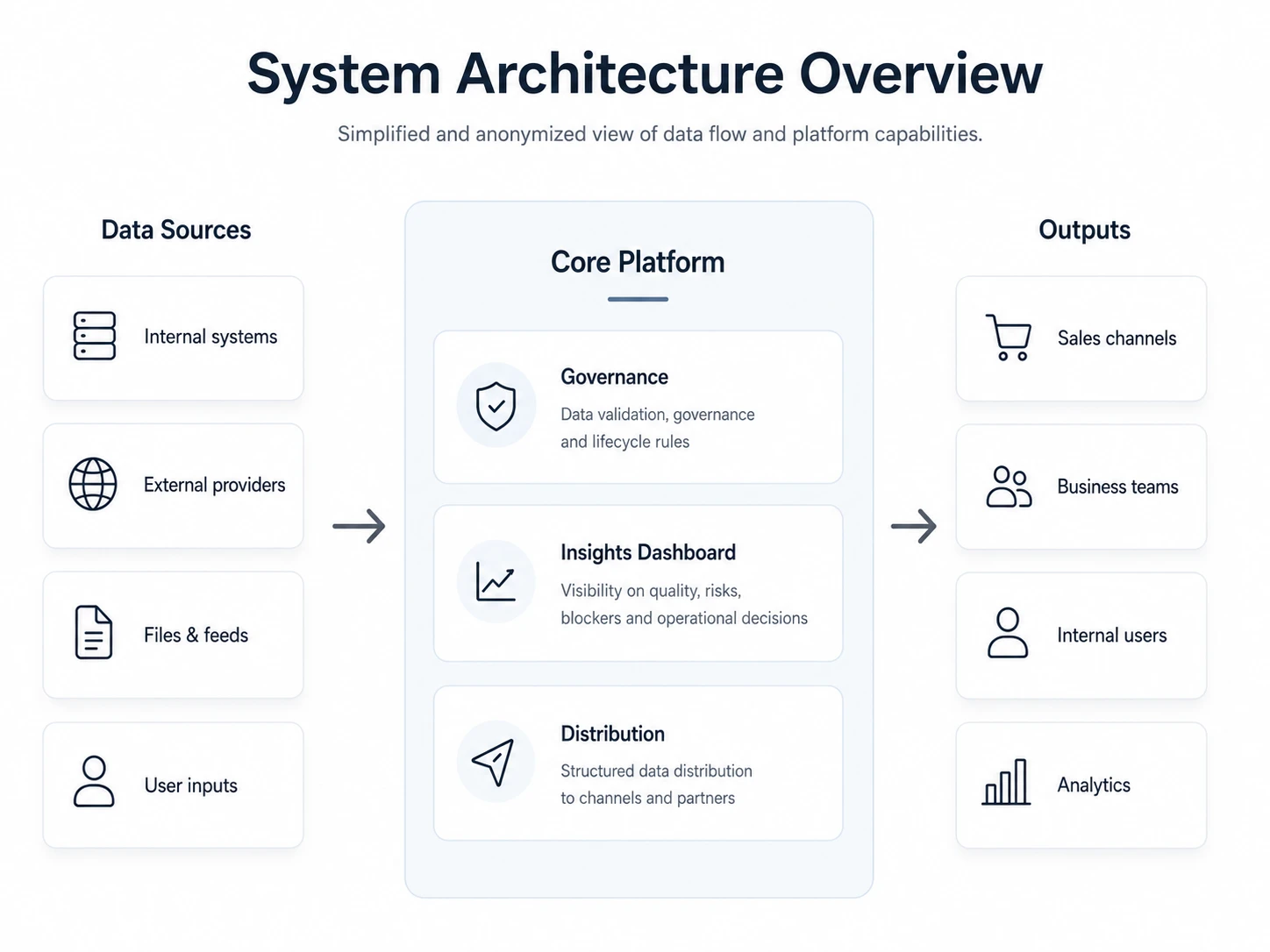
I worked on a product data ecosystem used across multiple Business Units in a large retail environment. The platform supported the complete product lifecycle — from product data creation and enrichment to governance, operational monitoring, and distribution across channels.
Rather than isolated products, the ecosystem was composed of connected initiatives solving different stages of the same workflow.
The goal was to improve data quality, reduce operational friction, and accelerate time-to-market at scale.
Platform Architecture
The platform relied on three connected capabilities:
1. Product Data Governance (MIM)
Creating and validating structured product information while maintaining consistency and business rules.
2. Product Visibility & Decision-Making (PLD V2)
Transformed a reporting dashboard into an operational decision platform. Providing operational visibility into product quality, lifecycle states, risks and issues requiring action.
3. Product Distribution & Syndication (SP)
Transforming and distributing product data efficiently across channels and partner ecosystems.
Together these initiatives formed an end-to-end workflow:
Create (MIM) → Validate (MIM) → Monitor (PLD) → Distribute (SP)
My Role
I worked as a Product Designer across multiple initiatives, from discovery through delivery.
My focus was on translating complex operational problems into scalable workflows and improving how teams interact with large volumes of product data.
My work included:
Designing end-to-end workflows across multiple products
Structuring information architecture and operational logic
Defining and improving product workflows
Aligning business, product and engineering teams
Supporting prioritization and decision-making
Contributing to design quality through reviews and shared practices
Note
Case 1: "I help teams make better decisions."
→ Product listing dashboard
Case 2: "I scale complex systems with AI."
→ Syndication Platform
Case 3: "I remove operational bottlenecks."
→ Model information management
PLD. Product Listing Dashboard V2
Turning Product Monitoring Into Actionable Decision-Making
Transformed a reporting dashboard into an operational decision platform helping teams identify, prioritize and resolve product issues faster across multiple Business Units.
My role
I worked across the project from discovery through delivery
My responsibilities included:
Conducting discovery with Business Units and stakeholders
Structuring workflows and information architecture
Defining interaction logic and prioritization frameworks
Aligning business, product and engineering teams
Designing operational dashboards and user journeys
Collaborating closely with engineers through implementation
The challenge
Teams were managing large volumes of products across different lifecycle stages and countries.
The existing experience provided visibility but not action.
Users could poorly identify:
missing product information
quality issues
publication blockers
lifecycle status
And they struggled to answer:
What requires attention first?
Why is it happening?
What should I do next?
Approach
I focused on three principles:
Prioritize
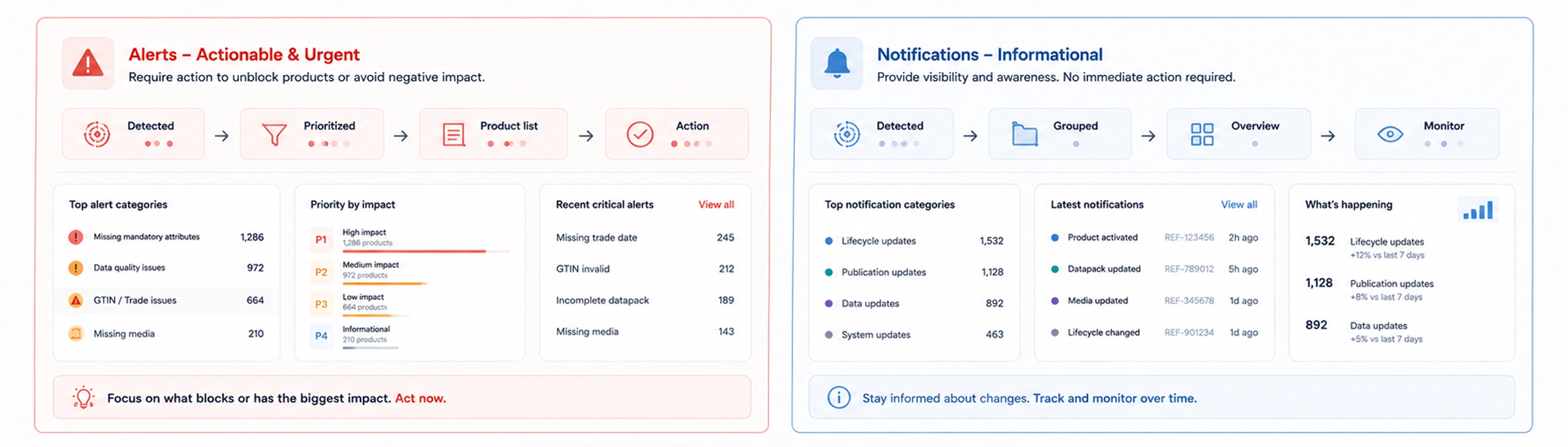
Separate urgent problems from informational notifications.
Reduce effort
Move users directly from insight to action.
Increase visibility
Provide clear lifecycle and risk visibility.
Key decision
Shifted from generic metrics to a problem-driven experience:
Alerts (actionable & urgent)
Notifications (informational)
Lifecycle visibility
Contextual product lists
Direct actions
Impact
Faster issue identification
Reduced manual investigation
Better prioritization
Faster decision-making
SP. Syndication platform
Scaling Product Data with AI-Powered Enrichment
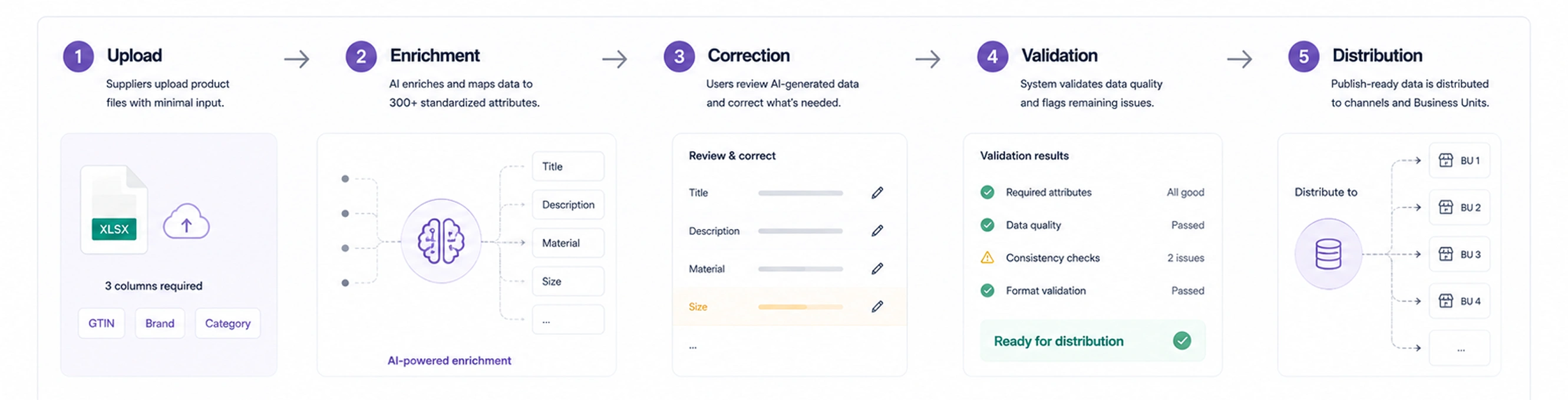
Simplified product onboarding by transforming 3 input columns into structured, publish-ready datasets across multiple Business Units.
My role
I worked across the project from discovery through delivery, focusing on simplifying complex product onboarding and making AI-generated data usable and scalable.
My responsibilities included:
Structuring workflows for product enrichment and review
Defining data organization and attribute logic
Identifying correction patterns and user pain points
Designing review and validation experiences
Aligning business, product and engineering teams
Collaborating closely with engineers through implementation
Challenge
Suppliers had to complete large Excel files with many required attributes.
This created:
Low data completeness
Repetitive manual work
Long onboarding cycles
Slow time-to-market
Approach
I focused on three principles:
Reduce manual effort
Minimize data entry requirements.
Improve data quality
Increase completeness before publication.
Create scalable workflows
Support multiple Business Units with a shared structure.
Key decision
Shifted from:
Manual completion → AI-assisted enrichment
Flow:
3 columns uploaded
↓
AI enriches product data
↓
User reviews and adjusts
↓
Structured product listing
Instead of creating information manually, users validate and improve generated data.
Impact
Time-to-market reduced 45 → 15 days
Data completeness reached ~95%
Reduced manual workload
Improved consistency across 4 Business Units
MIM. Model information management
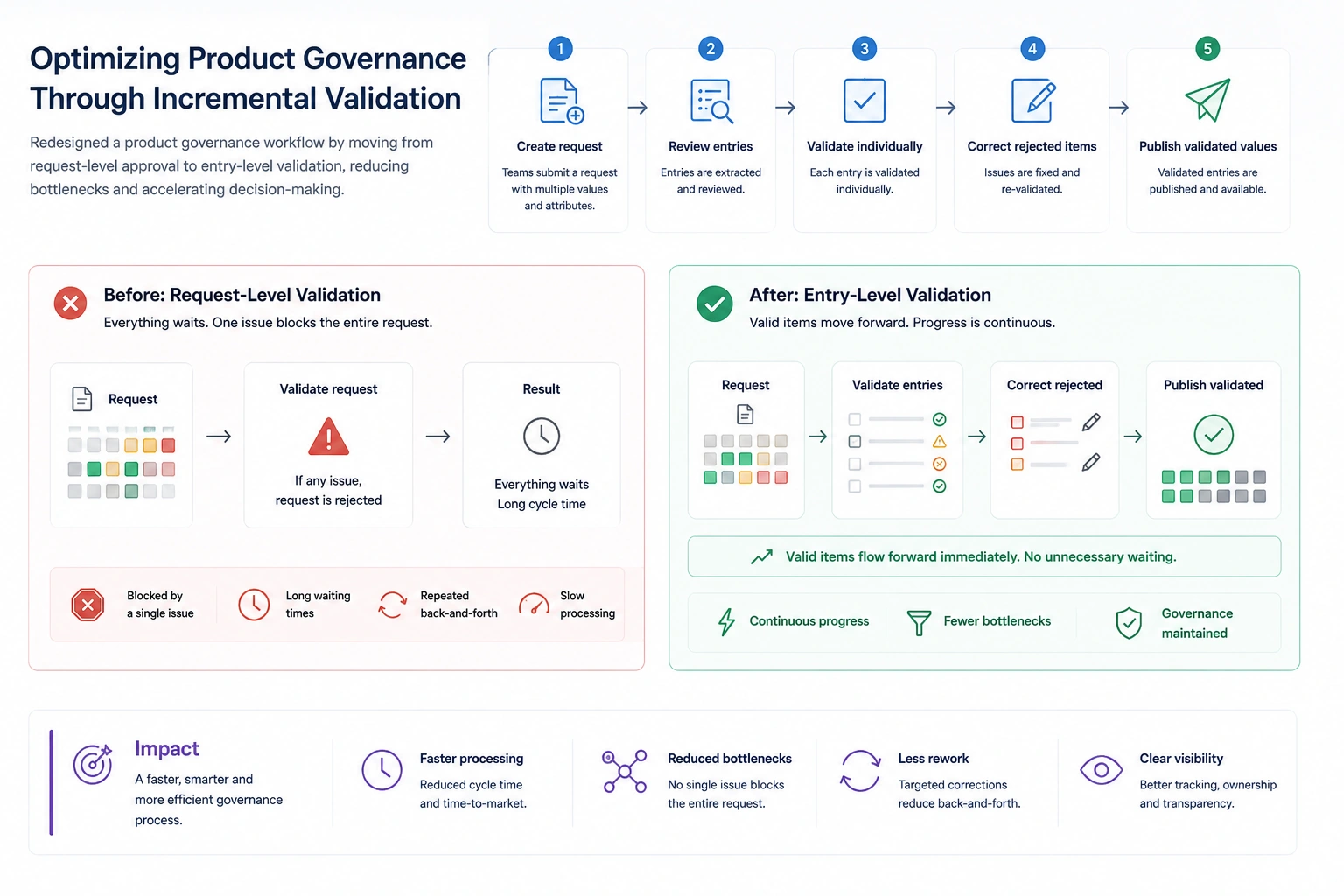
Optimizing Product Governance Through Incremental Validation
Redesigned a product governance workflow by moving from request-level approval to entry-level validation, reducing bottlenecks and accelerating decision-making.
Role
Workflow & Governance Design
I worked across the project from discovery through delivery, focusing on simplifying complex governance workflows and improving how product information moves through the validation process.
My responsibilities included:
Mapping and restructuring end-to-end workflows
Defining roles, permissions and validation logic
Identifying bottlenecks and process inefficiencies
Designing scalable review and approval experiences
Aligning business, product and engineering stakeholders
Collaborating closely with engineers through implementation
Challenge
Teams managed requests containing multiple product values and attributes.
The existing process created delays:
Entire requests were blocked by a single issue
Long waiting times
Repeated back-and-forth
Slow processing
Approach
I focused on three principles:
Reduce bottlenecks
Prevent one issue from blocking everything.
Enable progress
Allow validated information to move forward immediately.
Preserve governance
Improve speed without reducing control.
Key decision
Shifted from:
Request validation
↓
Everything waits
To:
Entry-level validation
↓
Valid items move immediately
Flow:
Create request
→ Review entries
→ Validate individually
→ Correct rejected items
→ Publish validated values
Impact
Faster processing time
Reduced workflow bottlenecks
Less unnecessary rework
Clearer ownership and visibility
Like this project
Posted Apr 21, 2026
As a platform for open and connected businesses, ADEO offers sustainable and innovative solutions to improve living conditions around the world.
Likes
1
Views
78