Explainable AI for Dental Radiographs

Aashray Iyer


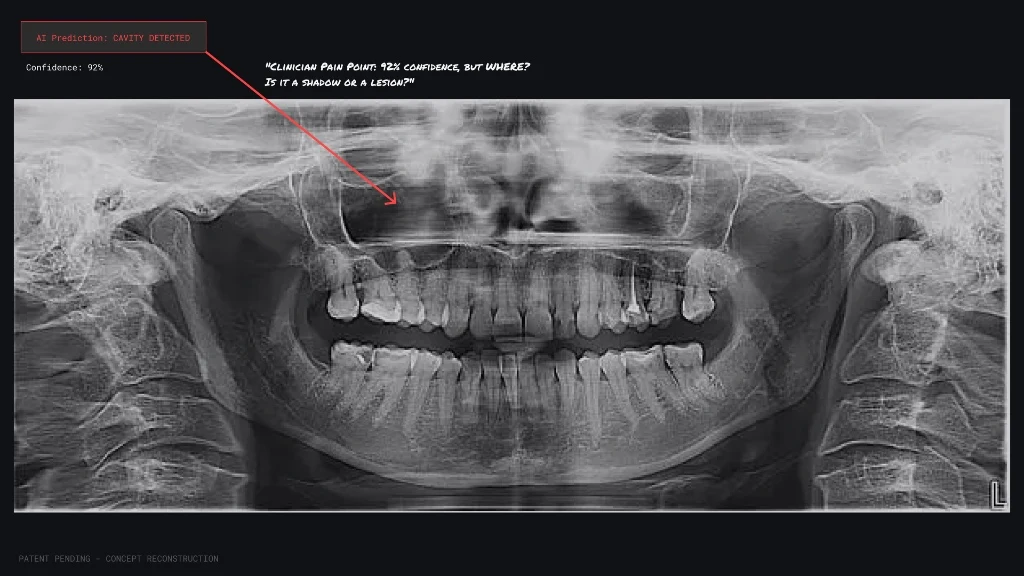
In medical diagnostics, high algorithmic accuracy does not guarantee clinical adoption. While working on dental radiograph analysis, we developed an ML model that achieved a 92% F1-score in detecting cavities.
Through contextual shadowing of dentists, I observed a critical "Trust Gap." Clinicians were hesitant to rely on the system because it functioned as a "Black Box". A simple text alert saying "Cavity Detected" forced doctors to re-examine the entire X-ray manually to verify the claim, negating the efficiency gains of the AI.
The Accuracy Paradox
Clinician Pain Point: "92% confidence, but where?"
Without visual evidence, binary alerts were treated as noise rather than assistance. The lack of interpretability forced practitioners to ignore the AI and trust their own eyes completely, rendering the model useless in a real-world workflow.
Visualizing Uncertainty
My core research question was: How might we visualize algorithmic uncertainty to transition AI from a "Replacement" to a "Partner"?
I hypothesized that by exposing the "Confidence Gradient", visually showing where the AI was sure and where it was guessing, we could reduce the cognitive load required for verification.
Attentional Heatmaps & Explainability
Attentional Heatmaps: Instead of binary bounding boxes, I utilized semi-transparent overlays (using Color Dodge blending) to highlight regions of interest. This mimics the way a radiologist scans an image, drawing the eye to anomalies without obscuring the bone structure.
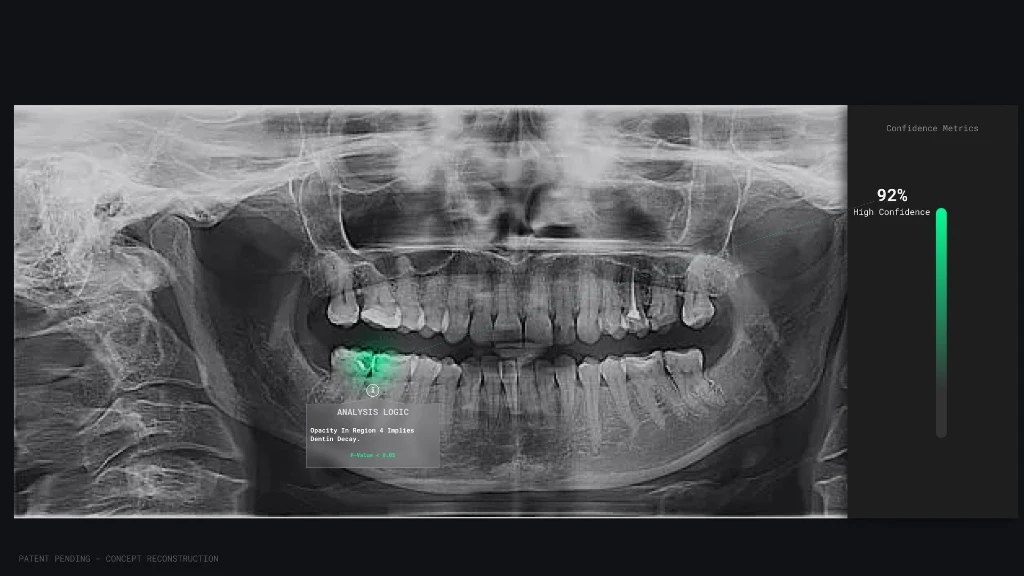
Explainability Layer: I designed a "Confidence Sidebar" that deconstructs the prediction. By interacting with the heatmap, clinicians can see the specific feature vectors (e.g., "Opacity in Region 4") that triggered the alert, providing the "Why" behind the "What".
Bridging the Gap Between Algorithm and Adoption
The introduction of the XAI interface transformed the model from a theoretical success into a clinical tool.
The Impact.
By guiding the clinician's attention immediately to low-confidence zones via the heatmap, the system streamlined the verification process.
The interface allowed doctors to quickly dismiss false positives (like shadows) and focus on true positives, effectively bridging the gap between algorithmic output and human decision-making.
The novel application of this Explainability Layer resulted in an official patent filing (Indian Patent Application No. 202541039070).
Like this project
Posted May 18, 2026
Developed an explainable AI model for dental radiograph analysis with a focus on reducing clinician cognitive load.
Likes
0
Views
2