
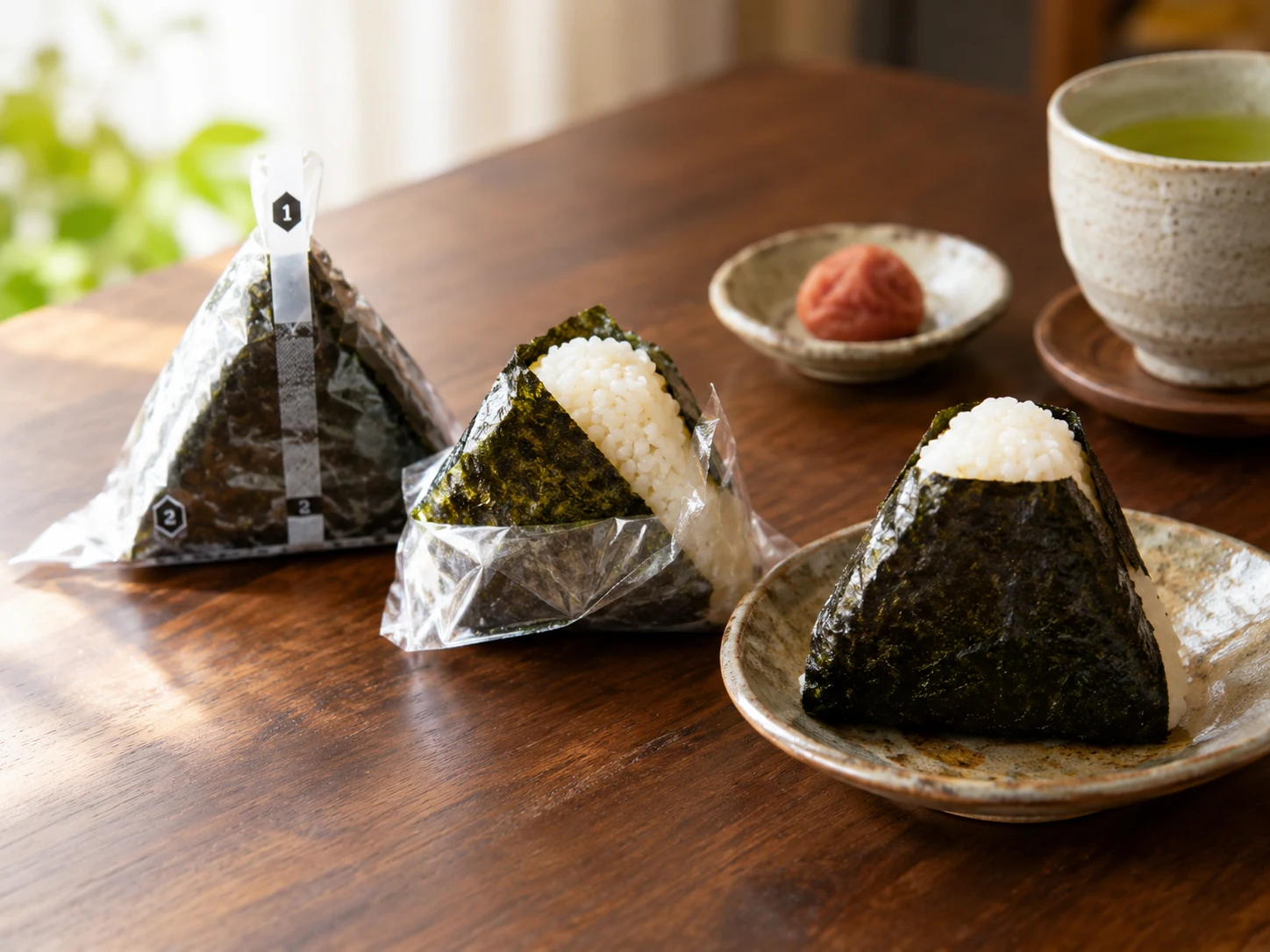
Self-produced English writing sample — not commissioned client work. One researched topic becomes a blog article and a matching 55-second short-video script.
BLOG ARTICLE
Onigiri: The Rice Ball That Has Traveled With Japan for Two Thousand Years
Walk into any Japanese convenience store and you will find a shelf of neat triangles: white rice, a strip of dark seaweed, and a label naming the filling inside. Onigiri look simple, almost too simple to write about. But this hand-held rice ball carries a long history, a regional map of shapes and names, and a small piece of packaging design that visitors often discover by accident.
An old idea, shaped by hand
The idea of forming rice into a portable lump is very old. Archaeologists have found triangular pieces of carbonized rice at the Sugitani Chanobatake site in Ishikawa Prefecture, dating to the Yayoi period. According to the Onigiri Society, that rice was probably steamed in a wrapping rather than pressed by hand after cooking, so it is better described as an ancestor than as the first onigiri.
The earliest written reference comes from the Hitachi no Kuni Fudoki, a regional record compiled around the year 721. It mentions rice formed by hand, called nigiri-ii. Over the centuries, the name shifted to nigiri-meshi and then onigiri. Another name, omusubi, came into wide use in the Edo period, and both words are used today.
Triangles, bales, and discs
The triangle is now the default, partly because it is stable and suits mass production. Historically, however, shapes varied by region. Kyoto and Osaka favored a small cylinder shaped like a rice bale (tawara), while Edo — today's Tokyo — leaned toward round or triangular balls. Some areas made wide, flat discs.
What's inside
Traditional fillings were chosen partly because they kept well: pickled plum (umeboshi), grilled salmon, salted kelp, bonito flakes, and miso. Modern shelves add tuna with mayonnaise, fried chicken, boiled egg, and even roast beef. Okinawa has its own take, a pork-and-egg rice ball that works more like a sandwich.
The film that keeps seaweed crisp
For many first-time visitors, the most memorable part of a convenience-store onigiri is the wrapper. The seaweed is kept separate from the rice by a thin plastic film, so it stays crisp until you eat it. You pull a numbered tab down the middle, then slide each side away. Get the order wrong and you may end up with torn seaweed — a small, shared rite of passage for travelers in Japan.
More than a snack
Onigiri also carry emotional weight. After the Great Hanshin-Awaji Earthquake in 1995, volunteers handed out rice balls to people who had lost their homes, and January 17 was later named Omusubi Day. In 2024, the word "onigiri" was added to the Oxford English Dictionary — a sign of how far the humble rice ball has traveled.
For a food channel, onigiri offer an easy entry point: a familiar shape, a satisfying unwrapping moment, and a history that rewards a closer look.
MATCHING SHORT-VIDEO SCRIPT (about 55 seconds)
Title A: Onigiri: Japan's 2,000-Year-Old Grab-and-Go Food
Title B: How to Open a Japanese Convenience-Store Rice Ball
0–6 sec — Voiceover: "This is one of the most-eaten foods in Japan — and you've probably opened it wrong." On screen: Hand holding a wrapped triangle onigiri.
6–18 sec — Voiceover: "Onigiri means a rice ball shaped by hand. Rice formed by hand appears in a regional record from around the year 721." On screen: Old-style illustration; "c. 721: nigiri-ii".
18–30 sec — Voiceover: "Shapes changed by region: bales in Kyoto and Osaka, rounds and triangles in Edo — today's Tokyo." On screen: Three shapes side by side.
30–44 sec — Voiceover: "At convenience stores, a film keeps the seaweed crisp. Pull tab one down the middle, then slide each side off." On screen: Close-up of tab 1, then sides 2 and 3.
44–55 sec — Voiceover: "Simple food, long history. In 2024, 'onigiri' even entered the Oxford English Dictionary. Sources in the caption." On screen: Finished onigiri; "Sources in caption".
Suggested caption: Onigiri are hand-shaped rice balls with a long history in Japan. Here's where they came from and how to open the convenience-store kind without tearing the seaweed.
Sources: Nippon.com, "Onigiri: The Evolving Face of Japan's Beloved Rice Ball" (Feb 3, 2026): https://www.nippon.com/en/japan-topics/g02574/onigiri-the-evolving-face-of-japan%E2%80%99s-beloved-rice-ball.html
Wikipedia, "Onigiri" (background only): https://en.wikipedia.org/wiki/Onigiri
0 likes · 0 views · Oct 12, 2026
Self-produced English article (about 520 words) and matching 55-second script on onigiri, with sources. No client commission.
