
Self-produced English writing sample — not commissioned client work. One researched topic becomes a blog article and a matching 58-second short-video script.
BLOG ARTICLE
Natto Beyond the “Longevity Food” Headline
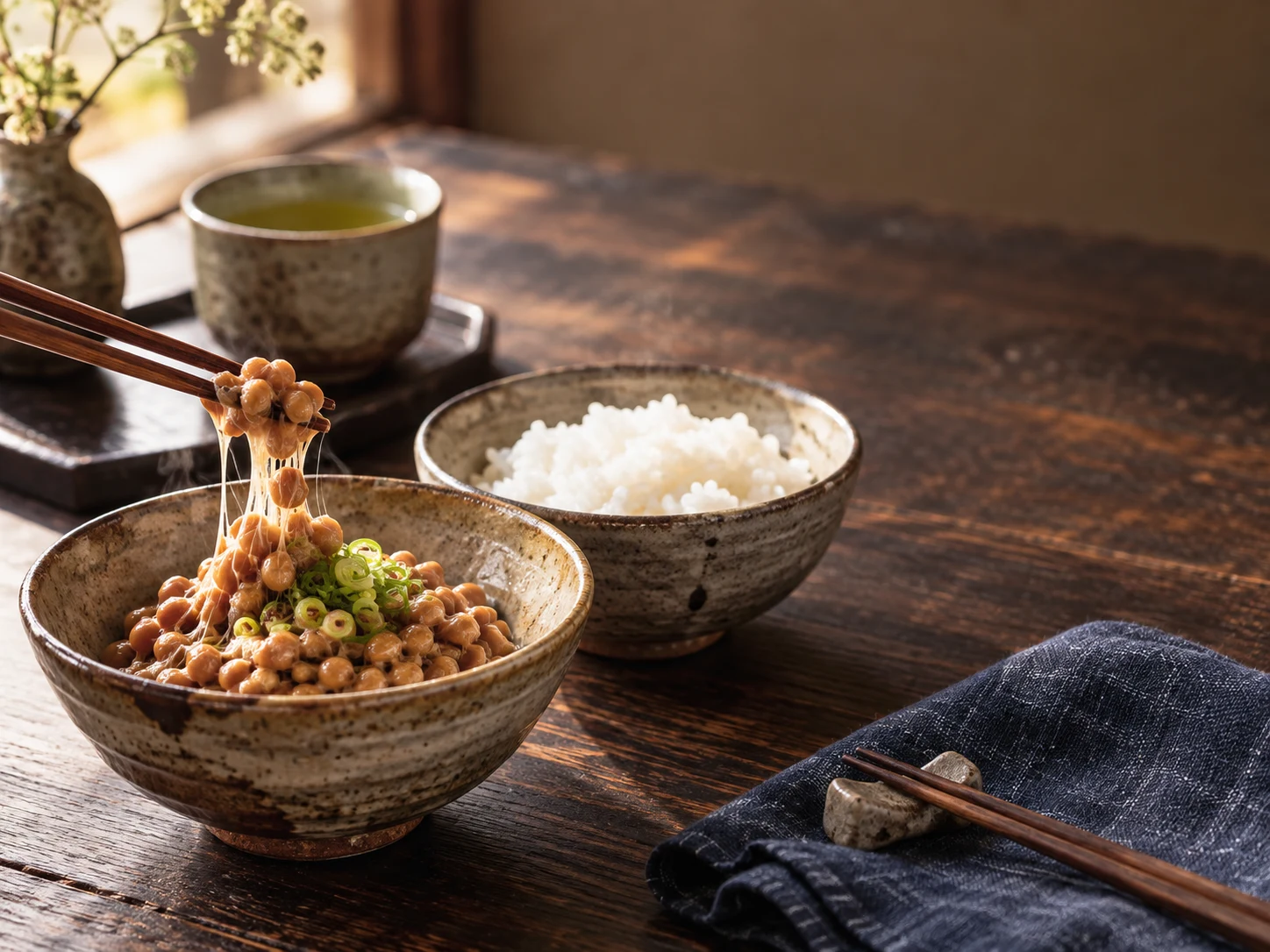
Natto can be a surprise on a first encounter: fermented soybeans with a strong aroma and a stringy texture. In Japan, it is also an ordinary food. Small packs sit in supermarkets, and many people eat it with rice. Those two views—novelty abroad and familiarity at home—make natto an interesting subject for an international food channel. They also make it easy to oversell.
What is natto?
The familiar sticky variety, itohiki natto, is made by fermenting cooked soybeans with Bacillus subtilis var. natto. Japan's agriculture ministry distinguishes it from shiokara natto, a different, salt-preserved fermented bean product. The distinction matters because the word “natto” does not always describe the same production method or seasoning.
Mito in Ibaraki Prefecture is particularly associated with natto. An agriculture ministry account describes small-bean natto as a local specialty and notes that the food was eaten in households and later sold to travelers. That is a cultural story, not evidence that Mito residents—or anyone else—live longer because they eat it.
Natto is commonly served over rice, sometimes with a sauce or other toppings. For a first taste, its flavor and texture are better explained honestly than hidden behind a health slogan. A food channel can show how the beans are stirred, what accompanies them, and how people actually include them in a meal. This gives a viewer a useful picture even if natto is unavailable where they live.
What does research say?
A Japanese prospective study followed 92,915 adults for an average of 14.8 years. It examined reported intakes of several soy foods. Higher intake of fermented soy products—natto and miso together—was associated with lower all-cause mortality in both men and women. In contrast, the study did not find a significant association between total soy-product intake and all-cause mortality. It also reported an association between natto intake and lower cardiovascular-disease mortality.
These results deserve a careful reading. The researchers observed what participants said they ate and what happened later; they did not randomly assign people to eat natto. Other differences between participants may have influenced the results, even after statistical adjustments. The authors themselves warned that residual confounding could weaken the apparent association. The study cannot show that adding natto to a particular person's diet will prevent disease or extend life.
Nor should the fermented-soy finding be quietly rewritten as “natto alone caused lower overall mortality.” The all-cause comparison grouped natto with miso. Preserving that detail is more useful to a curious audience than a dramatic but inaccurate headline.
How to tell the story responsibly
Natto works well as an entry point into Japanese food culture: a fermented soybean dish with regional history and a recognizable place at the table. It can also introduce the difference between a food association and a treatment claim. Viewers leave with something concrete—what natto is, how it is served, and what a large study did and did not find—without a promise that one ingredient is a shortcut to longevity. It invites curiosity without promising a personal health result.
MATCHING SHORT-VIDEO SCRIPT (about 58 seconds)
Title A: What Is Natto? The Japanese Food Behind the Headlines
Title B: Natto and Longevity: What the Study Actually Found
0–7 sec — Voiceover: “Natto is often called a Japanese longevity food. But what is it, and what does the research really show?” On screen: Natto pack and stirred beans; “Longevity food?”
7–19 sec — Voiceover: “The familiar sticky kind is soybeans fermented with Bacillus subtilis var. natto. It is often eaten with rice.” On screen: Beans, fermentation, rice; “itohiki natto.”
19–33 sec — Voiceover: “In a study of over 92,000 adults in Japan, more fermented soy—including natto and miso—was linked with lower overall mortality.” On screen: “Fermented soy: association in an observational study.”
33–46 sec — Voiceover: “But the researchers did not prove natto makes people live longer. The overall result grouped natto and miso, and other factors may matter.” On screen: “Association ≠ cause”; natto and miso.
46–58 sec — Voiceover: “The real story is already interesting: a regional food, an everyday way of eating it, and a study worth reading carefully.” On screen: Mito on a simple map; rice bowl; “Sources in caption.”
Suggested caption: Natto is a traditional fermented soybean food. A Japanese cohort study linked higher fermented-soy intake with lower mortality but did not establish causation or isolate natto as the cause of its overall finding.
Sources: Japan's Ministry of Agriculture, Forestry and Fisheries, processed bean products and Natto (Ibaraki); Katagiri et al., BMJ 2020. Links: https://www.maff.go.jp/e/policies/market/dento_syoku/bunrui/mamerui-kakou.html ; https://www.maff.go.jp/e/policies/market/dento_syoku/menu/natto_ibaraki.html ; https://pmc.ncbi.nlm.nih.gov/articles/PMC7190045/
This is educational content, not medical advice.
0 likes · 3 views · Sep 30, 2026
Self-produced English article (505 words) and matching 58-second script on natto, with Japanese government and original research sources. No client commission.
