
Self-produced English writing sample — not commissioned client work. One researched topic becomes a blog article and a matching 55-second short-video script.
BLOG ARTICLE
Oyaki: Nagano's Everyday Dumpling, and the Map Hidden Inside It
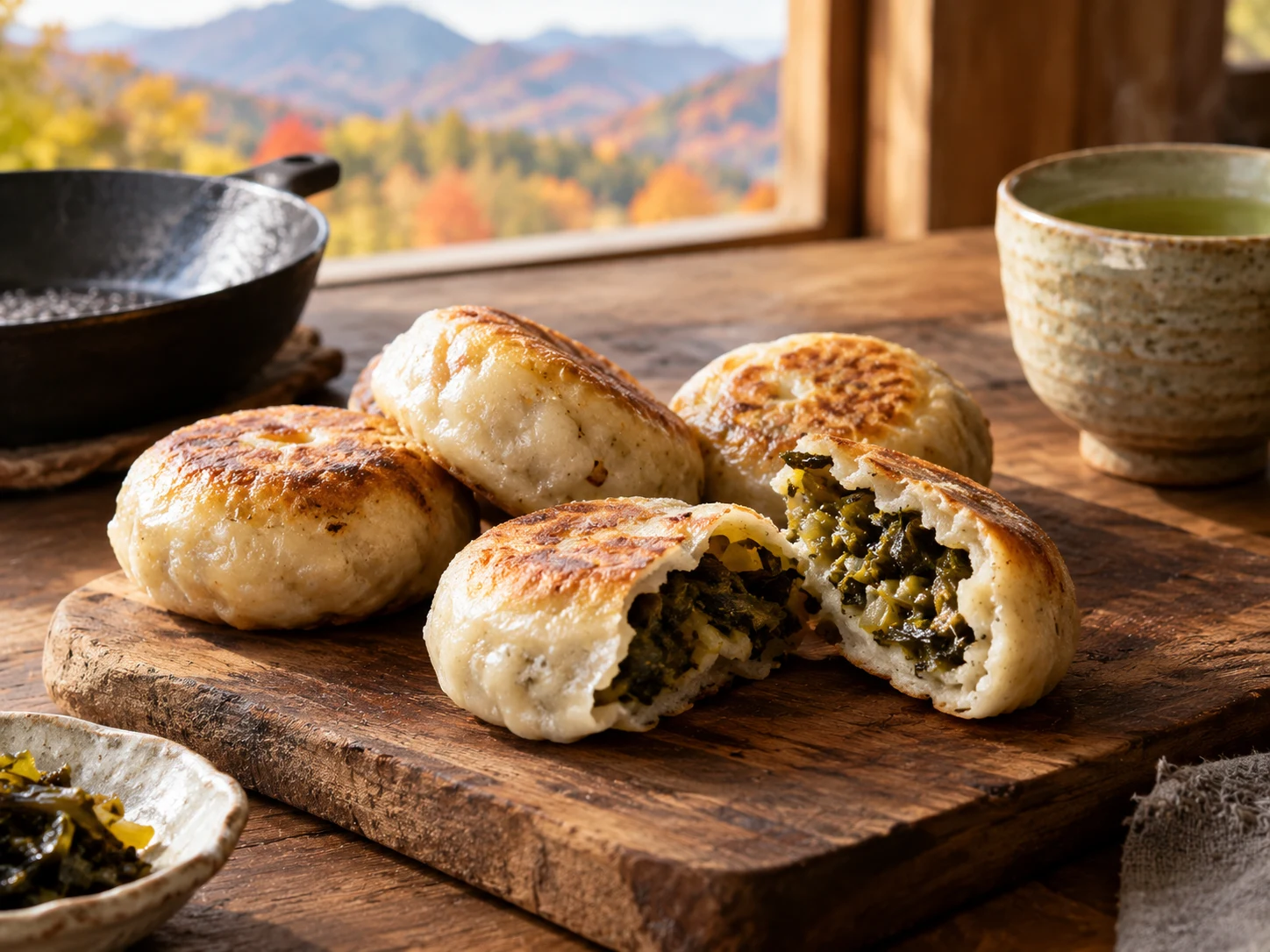
Most visitors to Nagano come for mountains, ski slopes, or Zenko-ji Temple. Fewer leave knowing about the round, palm-sized dumpling that many local households have long treated as ordinary food. It is called oyaki, and it may be one of the best ways to understand how geography shapes what people eat.
What is oyaki?
Oyaki is a dough wrapper around a savory or sweet filling. Today the dough is usually made from wheat flour. According to Japan's Ministry of Agriculture, Forestry and Fisheries (MAFF), other flours were used in the past, depending on what grew locally: rice flour made from broken grains, corn flour mixed with flour from unripe rice, and buckwheat flour in parts of northern Nagano.
The filling follows the seasons. A classic choice is nozawana, a leafy local green that is pickled and then stir-fried with a sweet-and-salty seasoning. MAFF also lists dried daikon radish, wild mountain plants in spring, eggplant in summer, and sweet potato or squash in autumn. Sweet versions with red bean paste are common in shops, too.
One name, many methods
Oyaki can be roasted on a griddle, steamed, or fried — and in some mountain areas, it was traditionally baked in the ashes of a sunken hearth. Ingredients and methods vary so much between towns and even between households that MAFF says you could draw a map of the varieties. Two oyaki bought in different valleys may look and taste quite different.
Why flour, in rice country?
Japan is famous for rice, but Nagano's mountainous terrain and cool climate made wheat and other grains important in many places. MAFF notes that it was once customary to eat one flour-based meal out of the three each day. The habit has left a trace in modern data: Nagano City was Japan's top buyer of wheat flour per household in the national Household Budget Survey for 2016–2018.
A dish protected as culture
In 1983, Nagano Prefecture added oyaki — along with pickled nozawana and hand-cut soba — to its list of selected intangible folk cultural properties. According to MAFF, no other prefecture had designated a food as a cultural property at that time.
Ordinary and special at once
Oyaki is everyday food, often eaten as a simple meal or snack. But it also appears when guests visit or people gather, because kneading the dough is considered auspicious. That combination — humble, local, and quietly ceremonial — is what makes it a strong story for an international audience. It is not a dish you can fully understand from one recipe. It is a dish you understand by asking, "How does your family make it?"
MATCHING SHORT-VIDEO SCRIPT (about 55 seconds)
Title A: Oyaki: The Dumpling Nagano Protects as Culture
Title B: Why Japan's Mountain Region Eats Flour, Not Just Rice
0–6 sec — Voiceover: "In Japan's mountains, there's a dumpling so local that it's officially protected as culture." On screen: Steaming oyaki, mountains behind.
6–18 sec — Voiceover: "This is oyaki from Nagano: a flour dough wrapped around a filling, often a pickled local green called nozawana." On screen: Cut oyaki showing green filling; "nozawana".
18–30 sec — Voiceover: "Fillings change with the seasons — wild plants in spring, eggplant in summer, squash in autumn." On screen: Three fillings, seasonal labels.
30–43 sec — Voiceover: "Why flour? The mountain climate made other grains important, and one flour-based meal a day was once customary." On screen: Map of Nagano; "1 of 3 meals".
43–55 sec — Voiceover: "In 1983, Nagano listed oyaki as an intangible folk cultural property. Every valley — and every family — makes it a little differently." On screen: "Since 1983"; several oyaki; "Sources in caption".
Suggested caption: Oyaki is a stuffed dumpling from Nagano, Japan, with fillings that follow the seasons. Since 1983 it has been on the prefecture's list of intangible folk cultural properties.
Sources: MAFF, "Our Regional Cuisines: Nagano": https://www.maff.go.jp/e/policies/market/k_ryouri/areastory/1360/index.html
Wikipedia, "Oyaki" (background only): https://en.wikipedia.org/wiki/Oyaki
0 likes · 3 views · Oct 12, 2026
Self-produced English article (about 500 words) and matching 55-second script on oyaki from Nagano, with Japanese government sources. No client commission.
