
Self-produced English writing sample — not commissioned client work. One researched topic becomes a blog article and a matching 55-second short-video script.
BLOG ARTICLE
Yakizakana Teishoku: Why a Plate of Grilled Fish Is Japan's Quiet Breakfast Classic
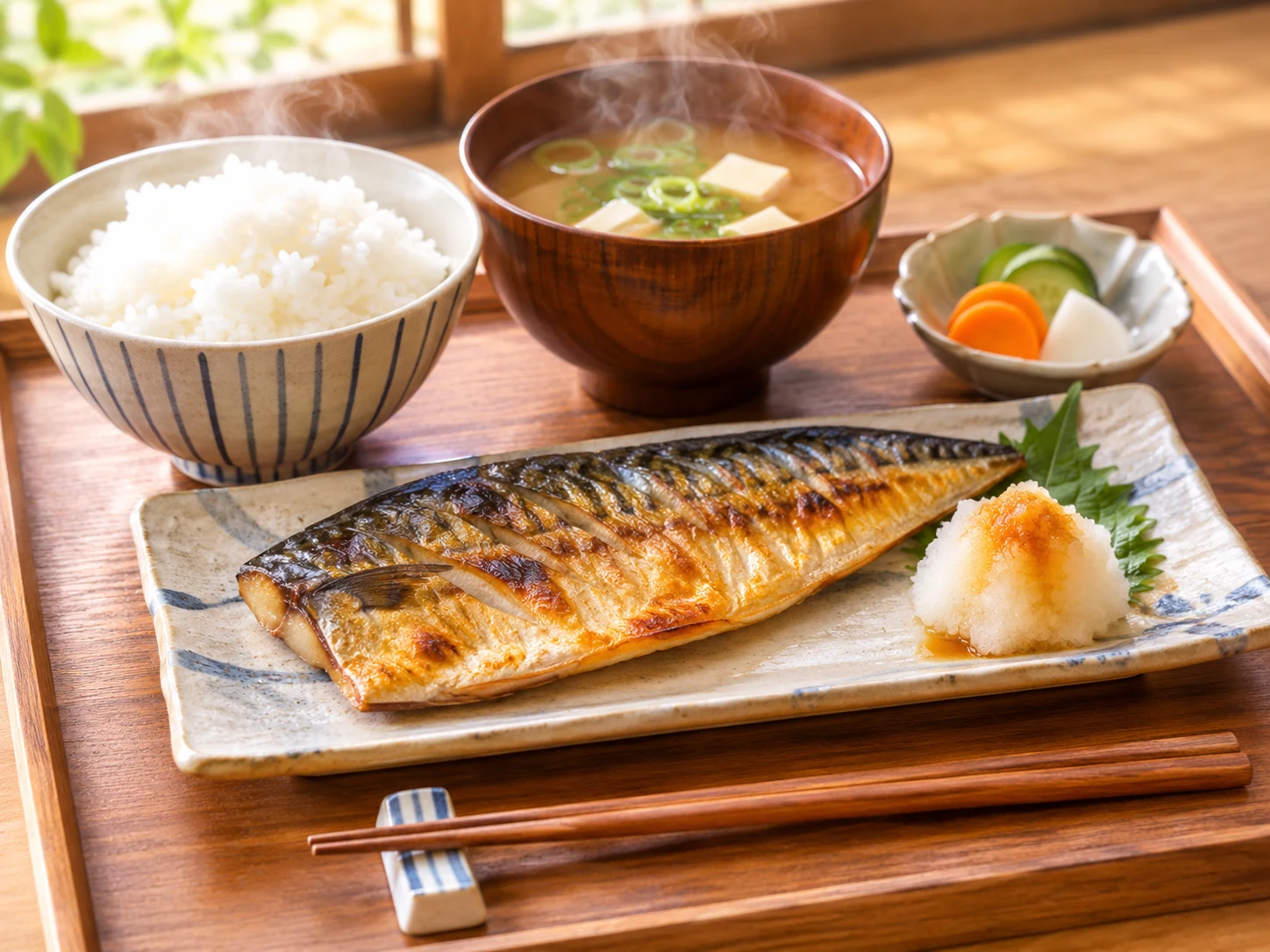
Ask where to eat breakfast in Japan and, sooner or later, someone will point you to a tray that looks almost plain: a piece of salt-grilled fish, a bowl of white rice, miso soup, a few pickles, and a small mound of grated daikon radish. This is yakizakana teishoku, the grilled fish set meal. It rarely appears on lists of Japan's most famous foods, yet it may be the closest thing to everyday home cooking a visitor can order.
One soup, three dishes
A teishoku is a set meal built around one main dish. Its logic comes from ichiju sansai, "one soup, three dishes": a soup, a main dish (often fish) and two smaller sides. Rice and pickles are always served as well, but they are not counted among the three. In December 2013, washoku, the traditional dietary culture of the Japanese, was added to UNESCO's list of Intangible Cultural Heritage, and this balanced tray is one of its clearest everyday forms.
Salted, sometimes dried, then grilled
The fish is usually prepared as shioyaki: salted, then grilled. Common choices include salmon, mackerel (saba), horse mackerel (aji) and, in autumn, Pacific saury (sanma), whose kanji 秋刀魚 can be read as "autumn sword fish." Breakfast salmon is typically shiozake, salted salmon sold in light, medium or strong grades.
Many fish on the menu are himono, or dried fish. The fish is split open, soaked in brine and then dried. A lightly dried version called ichiya-boshi, "dried overnight," keeps more moisture and has a softer texture. Hokke, the Okhotsk atka mackerel caught mainly off Hokkaido, spoils so quickly that it is almost always sold already split and dried.
Then there is saba no bunka-boshi, "culture-dried mackerel." The name is said to come from a Tokyo seafood processor that, around 1950, began wrapping dried fish in cellophane. The packaging looked modern — "cultured" — and the name stuck.
The daikon on the side
The small pile of grated raw daikon is not a garnish to push aside. It is the traditional partner for grilled fish. Japanese agricultural groups say it refreshes the palate, and it is traditionally believed to help digestion. Add a few drops of soy sauce and eat it together with the fish.
How to eat it without flipping
A whole grilled fish comes with a small etiquette lesson. Eat the top side first. Then, rather than turning the fish over, lift the backbone away — head and all — and set it at the back of the plate before eating the lower fillet. Flipping the fish is considered poor manners.
Affordable, but less common at home
At chain restaurants, a grilled fish set usually costs roughly 600 to 1,200 yen, which makes it one of the more affordable sit-down meals in Japan. Ironically, Japanese households eat less fish than they used to: by one official measure, meat overtook fish in per-capita consumption in 2011. For many visitors, a grilled fish set has become a way to taste the kind of breakfast that once filled Japanese homes.
For a food channel, the topic offers simple visuals — a sizzling fish, a full tray, a backbone lifting off in one piece — and small stories that most viewers have never heard.
MATCHING SHORT-VIDEO SCRIPT (about 55 seconds)
Title A: Japan's Grilled Fish Breakfast, Explained in 55 Seconds
Title B: Don't Flip the Fish: How to Eat a Japanese Grilled Fish Set
0–6 sec — Voiceover: "In Japan, flipping your fish over is bad manners. So how do you eat the other side?" On screen: Whole grilled fish on a plate; chopsticks hovering.
6–18 sec — Voiceover: "This is yakizakana teishoku — a grilled fish set. One soup, three dishes, plus rice and pickles. It's the classic Japanese breakfast tray." On screen: Full tray from above; labels: fish / miso soup / rice / pickles.
18–30 sec — Voiceover: "The fish is salted, then grilled. Many are dried first. One mackerel is even called 'culture-dried' — said to come from cellophane wrapping that looked modern around 1950." On screen: Split dried mackerel; "bunka-boshi = culture-dried".
30–44 sec — Voiceover: "Now the trick: eat the top side, then lift the backbone off in one piece and set it aside. The bottom fillet is ready." On screen: Close-up of the backbone lifting off with chopsticks.
44–55 sec — Voiceover: "Add grated daikon with a drop of soy sauce. Simple, balanced, and usually under 1,200 yen. Sources in the caption." On screen: Daikon with soy sauce; "Sources in caption".
Suggested caption: A grilled fish set is one of Japan's most everyday meals. Here's what's on the tray, why one mackerel is called "culture-dried," and how to eat the fish without flipping it.
Sources: JETRO, "What is Ichiju-Sansai?": https://japan-food.jetro.go.jp/en/japanesecuisine/125.html
Nippon.com, "Washoku Designated UNESCO Intangible Cultural Heritage": https://www.nippon.com/en/behind/l00052/washoku-designated-unesco-intangible-cultural-heritage.html
MAFF, Traditional Foods – Dried foods: https://www.maff.go.jp/e/policies/market/dento_syoku/bunrui/kanbutu.html
MAFF, aff magazine (Sept 2017, sanma and how to eat grilled fish; Japanese): https://www.maff.go.jp/j/pr/aff/1709/characterinformation.html
JA Group, daikon (Japanese): https://life.ja-group.jp/food/shun/detail?id=4
Nippon.com, fish and meat consumption (FY2021 Fisheries White Paper; Japanese): https://www.nippon.com/ja/japan-data/h01349/
0 likes · 1 view · Nov 9, 2026
Self-produced English article (about 540 words) and matching 55-second script on Japan's grilled fish set meal, with sources. No client commission.
Timeline
Sep 25, 2023 - Oct 2, 2023
