
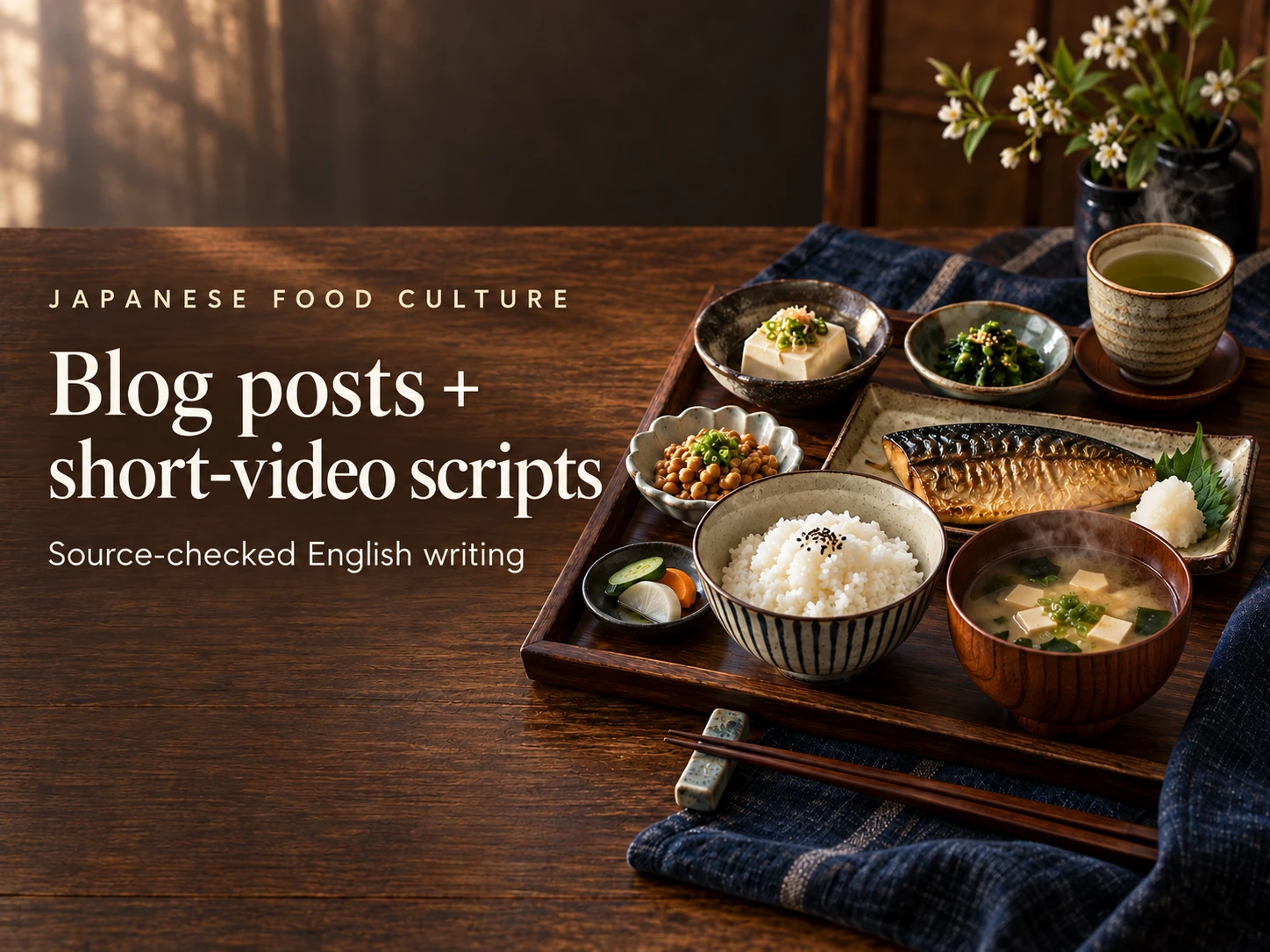
Self-produced English writing sample — not commissioned client work. One research topic becomes a blog article and a matching 45–60 second short-video script.
BLOG ARTICLE
Japan’s Long Life Is Bigger Than One “Superfood”
Could miso soup, green tea, or natto explain why people in Japan live so long? These foods attract attention abroad, but the question is too large for one ingredient to answer.
Japan does have a high life expectancy. The OECD's Health at a Glance 2025 country note reports 84.1 years, three years above the OECD average. That makes Japan a useful place to explore everyday food habits. It does not establish that Japan ranks first worldwide or that Japanese food, by itself, caused the difference. The same OECD edition reports 84.3 years for Switzerland.
Look at the meal, not a miracle ingredient
Japan’s official Food Guide Spinning Top organizes meals into grain dishes, vegetable dishes, fish and meat dishes (including eggs and soy products), milk products, and fruit. It also depicts physical activity, water or tea, and moderation with snacks and drinks. The guide is a picture of balance, not a claim that every person in Japan eats the same way. A familiar meal might be rice, a vegetable side, and fish or tofu. People outside Japan can adapt that structure using foods available where they live; no imported “longevity ingredient” is required.
“Japanese food” is not one unchanging menu. A home-cooked meal, a quick lunch, and a restaurant dinner may look quite different. The government guide describes a recommended pattern; it is not a record of what every resident eats. We can use a dish to illustrate the guide without claiming that the dish itself explains a population statistic.
What a Japanese study found
Researchers followed 79,594 adults in Japan for a median of 15 years and compared how closely their reported diets matched the Food Guide. People in the highest adherence group had a lower observed risk of death during follow-up than those in the lowest group. The adjusted hazard ratio was 0.85. That finding is interesting, but the study was observational. It found an association, not proof that following the guide made people live longer. Diets are difficult to measure perfectly, and outcomes can be affected by factors beyond food. The result is a reason to study the overall pattern, not a promise that copying one meal will add years to anyone's life. Self-reported food intake also brings measurement limits, so the size of the association should be read carefully.
A useful way to borrow the idea
Start with a meal you already eat. Is it mostly a single grain or noodle dish? Could you add a vegetable side and a source of protein, such as fish, eggs, tofu, or beans? Across the day, consider variety rather than repeating one supposedly special food. Japan’s agriculture ministry also advises care with excessive oil and salt in main dishes.
Japanese food culture is worth exploring because it offers concrete ways to think about meal composition. Its strongest lesson for a general audience is less dramatic than a “secret”: examine the whole pattern, read health studies at the level they actually support, and leave room for individual needs and local foods.
MATCHING SHORT-VIDEO SCRIPT (about 58 seconds)
0–7 sec — Voiceover: “Is miso or natto the secret to Japan’s long life? One food can’t explain a country’s lifespan.” On screen: “One secret food?”
7–18 sec — Voiceover: “Japan’s life expectancy was 84.1 years in an OECD report—three years above the OECD average. But that doesn’t prove a food caused it.” On screen: “Japan: 84.1 years | OECD 2025.”
18–34 sec — Voiceover: “Japan’s official food guide looks at the whole day: grains, vegetables, protein-rich dishes, dairy, and fruit, alongside activity and moderation.” On screen: simple five-group meal diagram.
34–47 sec — Voiceover: “A large Japanese study linked closer adherence to the guide with lower mortality. It was observational, so the result isn’t proof of cause and effect.” On screen: “Association ≠ proof.”
47–58 sec — Voiceover: “The practical takeaway? Build a balanced meal with foods you can get locally. Skip the miracle-food promise.” On screen: grain + vegetable + protein; “Sources in caption.”
Sources: OECD Health at a Glance 2025 (Japan and Switzerland); Japan’s Ministry of Agriculture, Forestry and Fisheries, Japanese Food Guide Spinning Top and interpretation; Kurotani et al., BMJ 2016, PMID 27005903. Source links: https://www.oecd.org/en/publications/health-at-a-glance-2025_15a55280-en/japan_319bfc39-en.html ; https://www.maff.go.jp/e/policies/tech_res/attach/pdf/shokuiku-1.pdf ; https://pubmed.ncbi.nlm.nih.gov/27005903/
This is educational content, not medical advice.
0 likes · 1 view · Sep 29, 2026
Self-produced research and writing sample: a source-checked English article paired with a 58-second video script. No client commission or results claimed.
