Built with Framer
Mandex - PPE Compliance Platform Landing Page

Anush | Foundrline


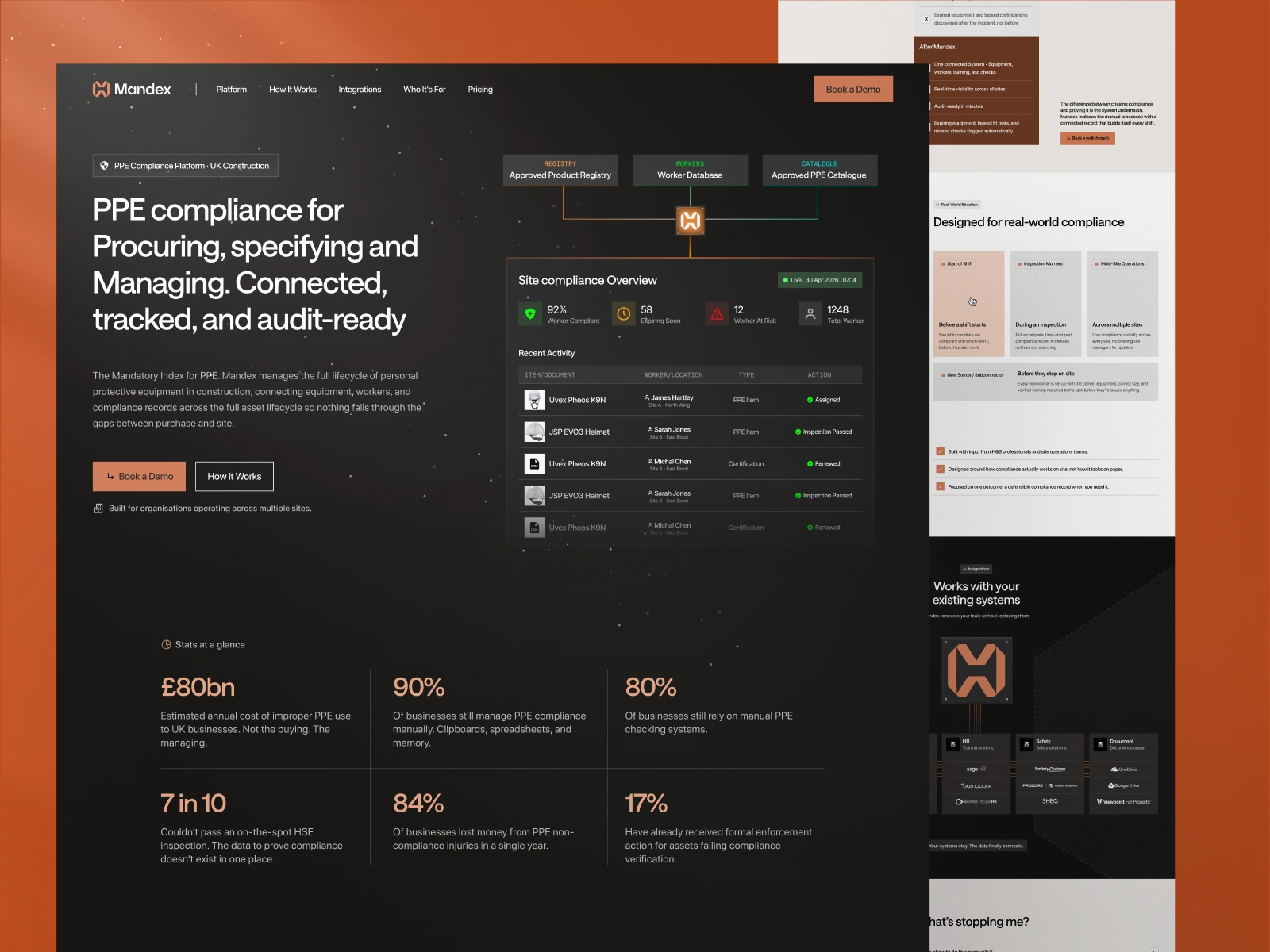
Mandex
Concept Positioning, Landing Page Strategy & Investor Pitch Support
Turned a complex PPE compliance concept into a landing page that made an early-stage idea feel credible.
Client
B2B SaaS Concept (Compliance / Safety Ops, Pre-MVP)
Audience
Primary: Investors
Secondary: Future H&S buyers, Site Leads, Operations Teams
Scope
Product Framing, Messaging Strategy, UX, UI Design, Framer Development
Timeline
~2–3 weeks
Challenge
Translate an idea-stage product into a clear, investable story people could understand in one pass.
Outcome
Created a narrative-driven concept landing page designed to support investor pitching, early validation, and future sales conversations.
The Challenge
Mandex wasn’t an existing product looking for a redesign.
It was an idea preparing to raise belief.
The challenge wasn’t improving a product website.
It was helping make a concept feel real.
The idea connects:
Workers
PPE
Training records
Compliance visibility
But the problem it solves runs deeper:
Organizations often don’t fail compliance because PPE is missing.
They fail because people, equipment, and compliance data aren’t connected.
The founder understood that.
The pitch narrative didn’t communicate it clearly enough yet.
And that creates friction when speaking to investors:
The concept takes too long to grasp
The opportunity feels more complicated than compelling
Conversations begin with explanation instead of conviction
For an early-stage venture, that can stall momentum.
This wasn’t a design problem.
It was a framing problem.
Where Things Were Breaking
The original communication had a common early-stage problem:
Everything was technically sound.
Nothing felt immediately investable.
It read like:
A collection of features
Not a system opportunity
Not a clear market narrative
Which meant:
The founder had to do too much explaining
The concept felt fragmented
The pitch asset wasn’t doing enough persuasion on its own
And for pre-product ventures, the story often is the product initially.

Strategic Reframing
This was approached as a product narrative and investor communication challenge.
The objective became:
Make the concept understandable in under 10 seconds
Frame the opportunity through real-world risk
Show system logic without overwhelming
Give the founder an asset that could support investor conversations
Not just something visually polished.
Something pitchable.
The Shift In Approach
1. Start from the situation, not the software
Rather than introduce a product concept,
we opened with the problem tension:
“If HSE walked onto your site today, could you prove compliance?”
That instantly:
Creates urgency
Makes the market problem tangible
Grounds the concept in real-world stakes
Makes the opportunity feel bigger than a software feature set
That matters to investors.
They don’t just evaluate software.
They evaluate problem gravity.
2. Turn the pitch into a narrative
Instead of stacking product claims,
we structured a progression:
What’s at risk
Where compliance breaks down
Why current systems fail
What a connected model changes
Why the opportunity matters
That moved the story from “tool concept”
into “market problem with solution logic.”
3. Reduce the concept into a mental model
Early-stage ideas often lose people through complexity.
So the concept was reduced into a simple system model:
People
Equipment
Compliance status
Once that clicked,
the broader platform idea became intuitive.
Complexity didn’t disappear.
It became legible.
4. Ground the concept in real workflows
Rather than talk abstractly,
we framed the idea inside operational moments:
Before shifts start
During inspections
Across multiple sites
Under compliance pressure
Because that’s how both buyers and investors evaluate credibility:
Can I see this operating in the real world?
What Was Delivered
Included:
Investor-oriented landing page strategy
Messaging architecture and narrative positioning
Information hierarchy and page structure
UI design focused on clarity over decoration
Framer concept build (modular and scalable)
This wasn’t just a landing page.
It was a pitch asset.
Before → After
Before
Idea required heavy founder explanation
Opportunity felt harder to grasp
Product concept appeared fragmented
Pitch relied too much on verbal storytelling
After
Core concept makes sense in one pass
System logic feels coherent
Opportunity feels more investable
Landing page supports the pitch instead of depending on it
Why This Mattered Commercially
The shift wasn’t just communication polish.
It helped:
Reduce explanation burden in investor conversations
Increase perceived credibility of the concept
Create a stronger first impression for early validation
Turn the page into an asset for fundraising and future sales
Early Impact
Pre-launch project.
No vanity metrics.
But meaningful outcomes included:
Founder could communicate the idea with far less friction
The concept resonated faster in discussion
Conversations started from understanding rather than confusion
For an early-stage venture, that matters.
Strategic Takeaways
1. Complex products are often framing problems
Most “complexity” is really poor narrative structure.
Once the mental model clicked,
the concept stopped feeling complicated.
2. In risk products, clarity creates confidence
People aren’t asking:
Is this clever?
They’re asking:
Will this hold up when something goes wrong?
That changes how you design and position everything.
3. Early-stage landing pages often function as pitch infrastructure
At this stage,
your website isn’t just marketing.
It can help carry belief.
That changes what it needs to do.
4. Real-world pressure beats polished messaging
The biggest shift didn’t come from UI.
It came from framing the concept inside real moments of operational pressure.
That made the story believable.
If your product is strong internally but hard to explain externally
That’s often not a product problem.
It’s a framing problem.
That’s usually where I help.
Book a call
Like this project
Posted Apr 29, 2026
Strategy, messaging, design, and development for a PPE compliance platform—turning a complex system into a clear, conversion-ready page.


![Sales AI Agent [B2B] | Web Dev + UI Design+ Illustration](https://media.contra.com/image/upload/c_fill,w_700/cqztxlaskk3j8gyikos1.avif)