Built with Framer
Senior Phone | Inventing a Product Category From Zero

Anush | Foundrline
Verified


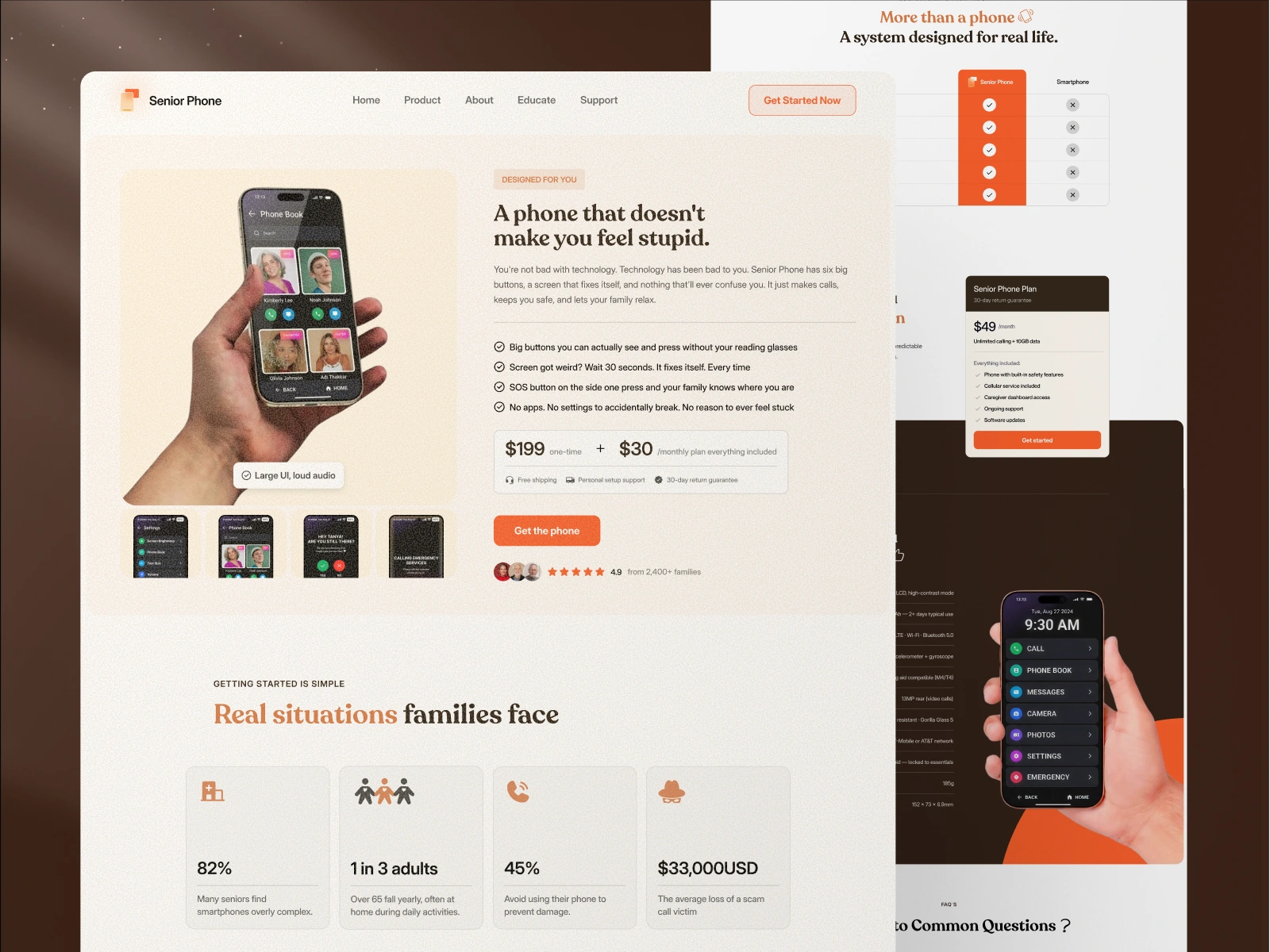
Product Concept, Brand & Conversion Experience for a New Consumer Tech Category
Snapshot
Helped turn an unformed idea into a premium direct-to-consumer product concept, brand, and conversion-ready product experience.
Client
Senior Phone (Early-stage consumer tech venture)
Audience
Seniors, Caregivers, Adult Children
Scope
Product Concept Strategy
Brand Design
Positioning & Copywriting
Product Narrative Architecture
Custom Visual Systems
Motion & Animation
PDP UX/UI Design
Web Development
Timeline
~4–6 weeks
Challenge
Create an entirely new product concept and digital buying experience for a device category that didn’t yet exist in a compelling way.
Outcome
Built the product concept, premium brand, and full-funnel PDP experience from scratch — turning an idea into a believable, purchasable system.
The Challenge
This wasn’t a redesign.
There wasn’t an existing product detail page to optimize.
There wasn’t even a defined product story.
There was mostly a concept:
What if a phone was designed around seniors — not adapted for them?
That sounds simple.
It isn’t.
Because this wasn’t just inventing a device.
It meant defining:
What the product is
Why it should exist
How it differs from smartphones
Why families should trust it
How to make people want to buy something unfamiliar
That’s product creation.
Not page design.
And the challenge was bigger because the audience carried emotional stakes:
Safety.
Independence.
Caregiving anxiety.
Technology frustration.
The product needed to feel both credible and deeply human.

Where The Risk Was
Because this category was being shaped from scratch, the risks weren’t usability issues.
They were adoption risks.
Without the right framing the concept could feel:
Like a simplified smartphone
Like “tech for seniors” cliché
Like an assistive device rather than a desirable product
Like a niche gadget rather than a system solution
And that would have limited belief.
The challenge was making the product feel like a category.
Not a compromise.
Strategic Reframing
The biggest move was shifting the idea from:
a senior-friendly phone
into
a communication and safety system designed for real life.
That changed everything.
Now it wasn’t selling hardware.
It was selling confidence.
The objective became:
Create a product people could emotionally understand
Build premium trust around a new concept
Make the device feel simple without feeling simplistic
Turn the PDP into both education and conversion engine
Position the offer as a system, not a phone
This was product storytelling and venture creation.
The Shift In Approach
1. Built the product narrative from scratch
Rather than lead with specs,
the story was built around human tension:
Feeling stupid using technology
Fear of emergencies
Caregiver anxiety
Losing independence
The messaging didn’t sell features.
It sold relief.
That was foundational.
2. Positioned the product as a system, not a device
Critical move.
Not:
phone for seniors
But:
a system designed for real life.
That allowed the story to include:
Device
Safety layer
Support layer
Caregiver reassurance
Service model
Much stronger.
3. Designed the PDP as education + persuasion
This wasn’t a normal ecommerce PDP.
It needed to do three jobs:
Explain a new category
Build emotional trust
Drive conversion
So the page was structured as narrative progression:
Problem recognition
Product introduction
Social proof
Feature understanding
Comparison framing
Offer construction
Objection handling
Conversion
Essentially:
direct response meets product storytelling.
4. Built the brand from zero
Brand work was foundational.
Designed to feel:
Warm
Trustworthy
Premium
Calm
Human-centered
Not medical.
Not “senior product.”
A real consumer brand.
Important distinction.
5. Used custom visuals to make the product feel real
Because much of the product vision was being shaped,
custom visuals became part of invention.
Included:
Product storytelling visuals
Lifestyle scenarios
Feature explanation graphics
Comparison frameworks
Custom interface presentations
Not decoration.
Belief-building assets.
6. Used motion and animation to support comprehension
Animation was used to communicate:
Simplicity
Flow
Feature understanding
Product sophistication
Motion made unfamiliar ideas easier to absorb.
7. Built conversion into the product story
Pricing, offer framing, social proof, FAQs, comparison logic—
all integrated into one conversion system.
Not added afterward.
Designed in from the start.
What Was Built From Scratch
Included end-to-end:
Product concept framing
Brand identity direction
Positioning strategy
Full copywriting and messaging system
Custom visual system
Motion and animation language
Product detail page UX/UI
Web development implementation
Conversion architecture
This wasn’t a webpage.
It was product category creation expressed digitally.
Before → After
Before
Idea existed, product story didn’t
No clear category framing
No conversion narrative
No cohesive brand system
After
New product concept made tangible
Premium consumer brand established
Full-funnel PDP built for education and purchase
Product positioned as a system, not a device
Why This Mattered Commercially
This work helped create:
A believable new category narrative
Stronger trust for unfamiliar product adoption
A conversion-ready direct-to-consumer experience
A scalable brand and digital foundation
For early-stage product ventures,
that is often foundational.
Early Impact
Pre-launch concept work.
No vanity metrics.
But meaningful outcomes included:
Product vision became concrete
Messaging resonated emotionally
Category concept became easier to grasp
PDP became both sales asset and trust engine
Strategic Takeaways
1. New product categories often need emotional framing before feature framing
Especially in consumer adoption.
2. Product pages can function as category education
Sometimes PDPs don’t just sell.
They teach the market.
This was one of those cases.
3. In trust-sensitive products, design is reassurance
Not just aesthetics.
4. Sometimes the “website project” is really product invention
This was that kind of project.
If your product idea is strong but still feels hard to make people believe in
That’s often not a product problem.
It’s a framing problem.
That’s often where I help.
Discuss a similar challenge
Like this project
Posted Apr 28, 2026
Built a new product concept, brand and conversion-ready PDP experience through strategy, visuals, copywriting, UX and development.
Likes
1
Views
29
Timeline
Oct 29, 2024 - Dec 12, 2025
Clients
Thumbstop Collective