FLOLO — AI Productivity Web App (Solo Build)

Marcellus Borland


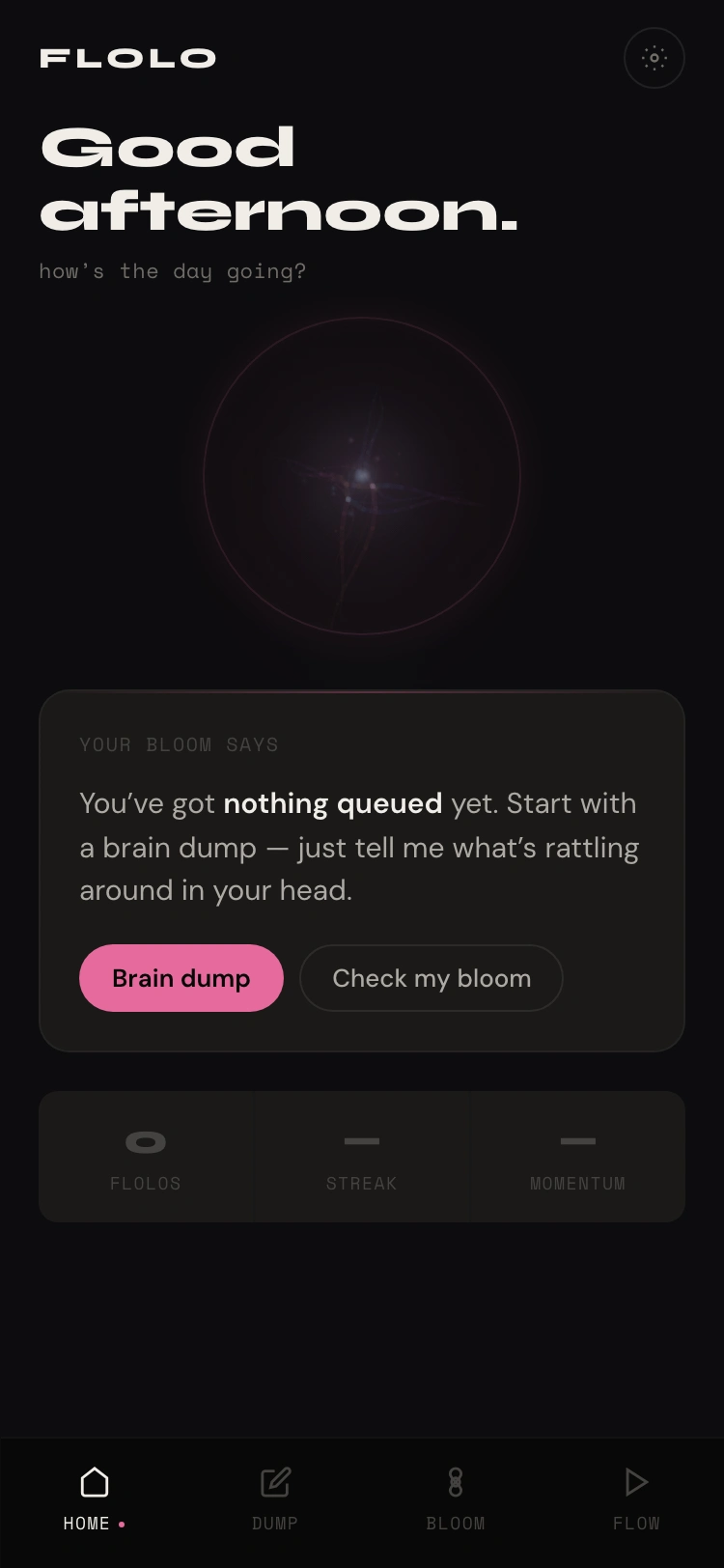
Landing page to sign-up. The full entry flow to FLOLO.
Brain dump. Get one clear focus.
FLOLO is a mindful productivity app where the AI does not suggest — it decides. Brain-dump everything on your mind, and the app returns one task to focus on right now. I built it solo end to end: UX, prompt chain, schedule logic, habit system, and the bloom that grows as work gets done.
At a glance
Product — AI productivity web app
Audience — Founders, creatives, and solo operators overwhelmed by traditional task lists
Role — Solo founder, designer, prompt engineer, developer
Shipped — Live at flolo.app
Stack — Figma · Claude · Next.js · Vercel · Supabase
Why it matters — Proves an AI product can refuse to show a list and still feel like a productivity tool. The ritual is the product.
What I owned
Product strategy and positioning
UX and UI built directly in Claude Code — no Figma mockup step
Brand identity and landing page
Prompt chain for task parsing + schedule reasoning
Next.js front end and Supabase back end
The bloom reward system — concept, visual, and habit integration
Beta testing and prompt tuning against real user behavior
The tension
Every user I interviewed said the same thing. They opened their task app, saw 40 items, and closed it. The list itself was the problem. The fix was not better sorting — it was refusing to show a list at all.
The decision
Instead of surfacing tasks, FLOLO hides them. The AI parses the brain-dump, reads the schedule, checks the user's energy state, and returns one sentence. "Right now, do X." Everything else stays invisible until the next check-in.
Messy brain-dump → one clear task. The core mechanic.
Dump — user brain-dumps messy thoughts into one field
Parse — the AI extracts tasks from unstructured text
Match — schedule and energy state filter what fits right now
Decide — the AI picks one task, not a menu
Reward — completion grows the bloom, reinforcing the ritual
The bloom
Most reward systems feel tacked on. The bloom is load-bearing. It persists and grows across sessions, and users told me that visual progression is what brought them back. That reframed FLOLO: not just a productivity tool, but a ritual people return to.
The bloom grows with completed tasks. The ritual made visible.
The bloom engine
The bloom is not decoration. It is a live, data-driven generative element that reads completion counts, energy state, and habit momentum in real time and generates its form from that state. I vibe-coded it end to end in Claude Code — no Figma step. To my knowledge it is one of the first artistic, state-reactive visuals shipped to production this way, pushing Claude Code past "code completer" into "design partner for generative art."
The system
Brain-dump parser — Claude extracts tasks from messy text
Schedule-aware layer — real calendar load shapes what fits now
Energy-state selector — the AI matches task weight to user state
Habit layer — streaks and momentum reinforce the ritual
Bloom system — visual reward that grows across completed tasks
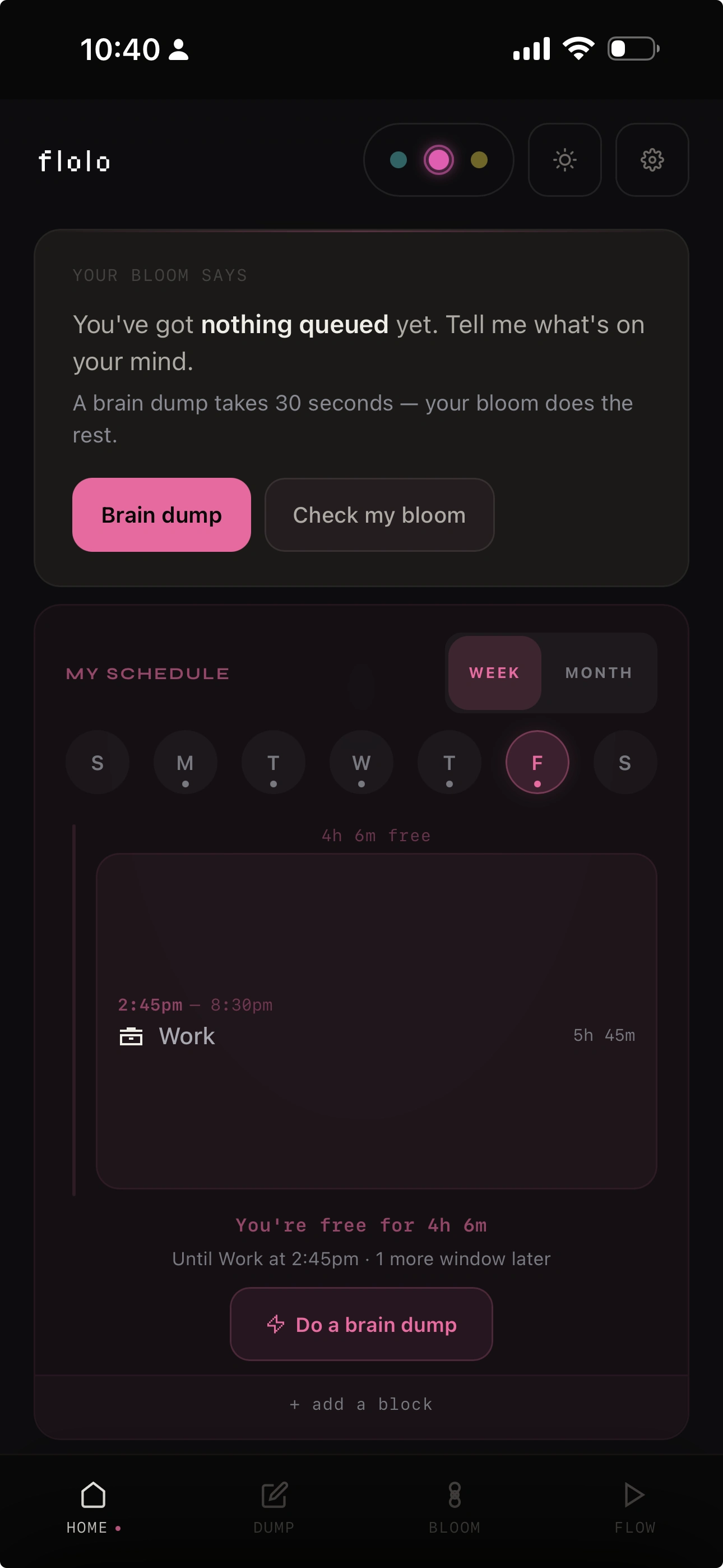
The schedule is context for the AI, not a planner.
The prompt chain
Every production prompt went through five beta loops with real users. The biggest shift was moving from "suggest a task" to "choose the task." Users didn't want options — they wanted a decision. The chain checks three signals (priority in the dump, schedule pressure, energy state) before returning a single sentence.
How it was built
I vibe-coded FLOLO end to end. Claude Code and ChatGPT were the brains — every component, every flow, every interaction shipped from prompt to production with no Figma mockup step. I built a Perplexity-powered knowledge base to source user and problem research up front, then fed that context into every design and feature decision. Research → decide → ship. No handoff phase.
My Associates in Graphic Design and ongoing BFA in Electronic Design Media at CCNY are why none of this looks vibe-coded. Formal design training keeps the aesthetic tight when the build process moves fast.
What this project proves
I treat UX and prompt design as one system
I design product rituals, not just feature sets
I build visual reward systems that carry real product weight
I ship production AI products solo — end to end, prompt to deploy
I own the stack from research to Supabase — vibe-coded, no handoff
Stack
Research — Perplexity (user + problem knowledge base)
AI brains — Claude Code · ChatGPT · Claude
Build — Next.js · Vercel · Supabase
Brand — Pixel logo, cyan/pink palette, soft-neutral UI
Like this project
Posted Apr 23, 2026
AI productivity web app shipped solo. Parses a messy brain-dump into one prioritized focus task. Full loop: PRD, UX, prompts, release. Claude + Supabase.
Likes
1
Views
16