LedgerRise Seed Pitch Deck

Miftah Fahmi



LedgerRise cover

LedgerRise title slide
LedgerRise: $2.5M Seed Pitch Deck
AI-powered cash intelligence for SMBs that can't afford to run blind.
Overview
This 15-slide Seed deck positions LedgerRise as the predictive finance layer for modern SMBs, built around a $2.5M fundraising scenario and an $8M pre-money valuation model. The product story addresses a clear SMB finance problem: cash visibility, forecasting confidence, and the operational risk of making decisions without forward-looking data.
The narrative moves from problem urgency, through product logic and traction modeling, and lands on a confident fundraising ask. Metrics such as ARR, customer count, CAC, LTV, and forecast accuracy are used as operating assumptions to show how the business story could be presented with investor-level clarity. The deck is designed to feel credible at first glance and defensible on second read.
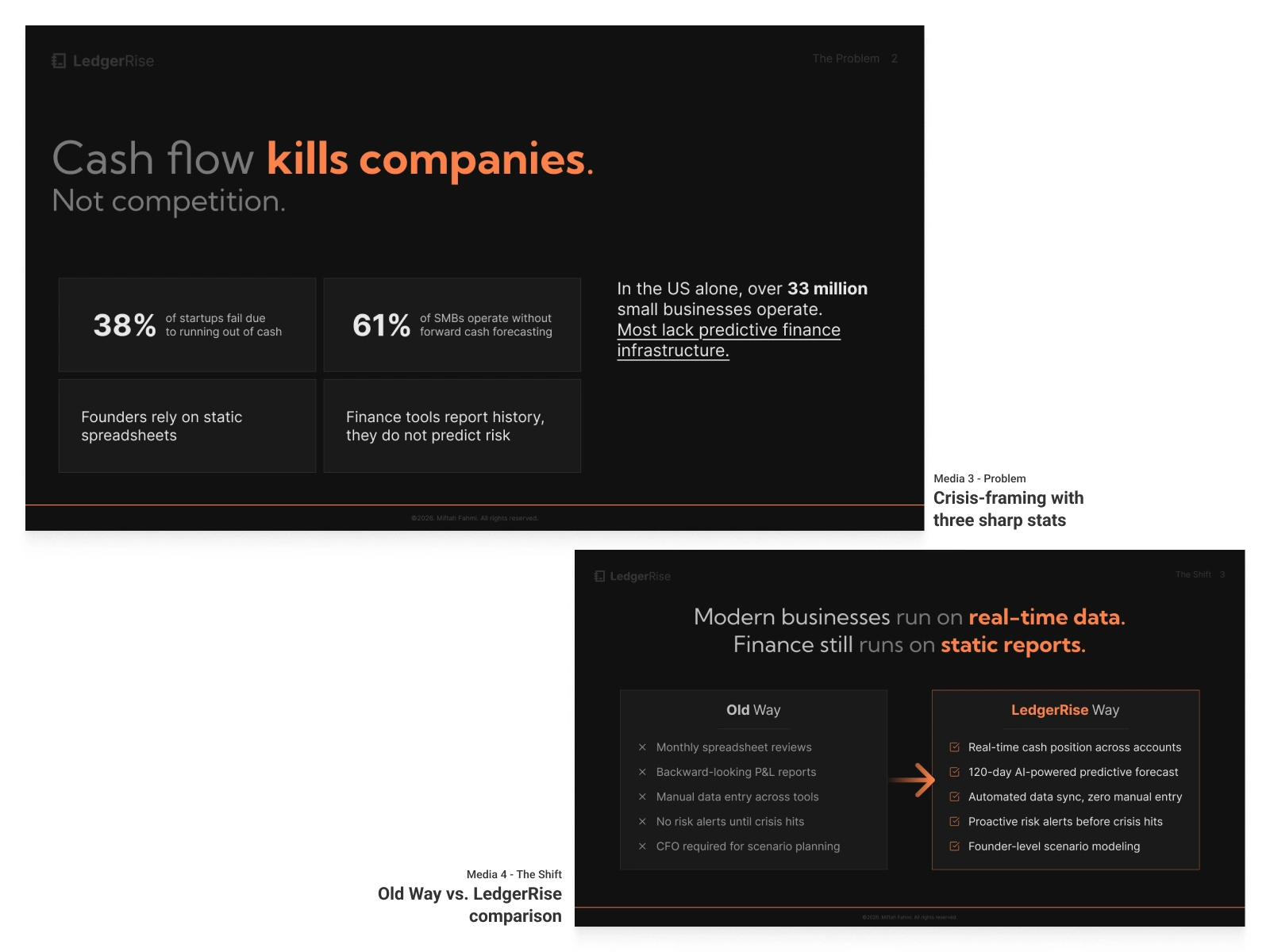
Problem and shift slides
The Challenge
Translating an AI forecasting product into a story a non-technical investor immediately understands
Positioning LedgerRise as a complement to QuickBooks and Xero, not a competitor, without diluting the product's standalone value
Presenting traction assumptions ($87,450 MRR, $42 CAC, $684 LTV) without letting the numbers overshadow the narrative arc
Designing a dark-themed deck that reads as premium fintech, not just "dark mode," across every slide type including data-heavy comparison tables and projection charts
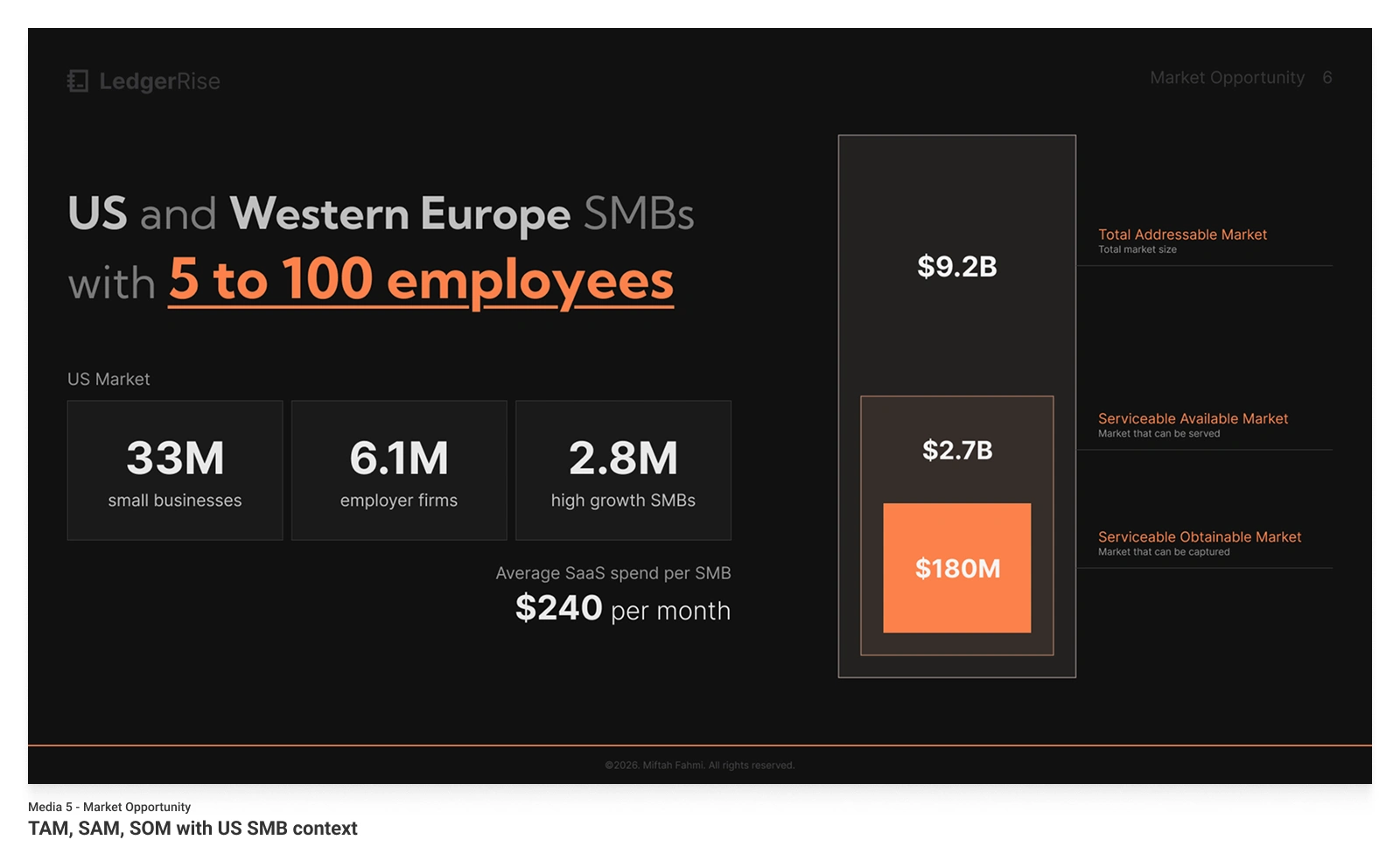
Market opportunity slide
Approach
The deck is structured to build investor conviction in sequence: market urgency first, product logic second, traction as proof third. Every section earns the next.
Design decisions that drove the execution:
Dark theme with orange accent system. The color language signals fintech credibility. Orange carries emphasis without shouting. Every CTA element, key stat, and headline accent uses the same orange, so the investor's eye always lands in the right place.
Headline-first hierarchy. Each slide opens with a conclusion, not a topic. "Cash flow kills companies. Not competition." tells the investor the point before they read a single body copy word.
Comparison table reframed as positioning, not competition. The competitive slide leads with "LedgerRise owns the forecasting layer." The table then proves it rather than defending it.
Traction slide built as a metrics grid. Eight key metrics displayed as equal-weight tiles, with a quarterly revenue chart that visually confirms the growth story. No clutter, no commentary needed.
Product presented as a system, not a feature list. The three product modules (Predict Engine, Control Center, Scenario Lab) are each given their own visual system, showing product depth without overwhelming the slide.
Ask slide designed to close, not just request. Fund allocation uses a horizontal bar chart. Milestones are displayed as a five-item list with bold lead numbers. The layout communicates exactly how the capital would be allocated.
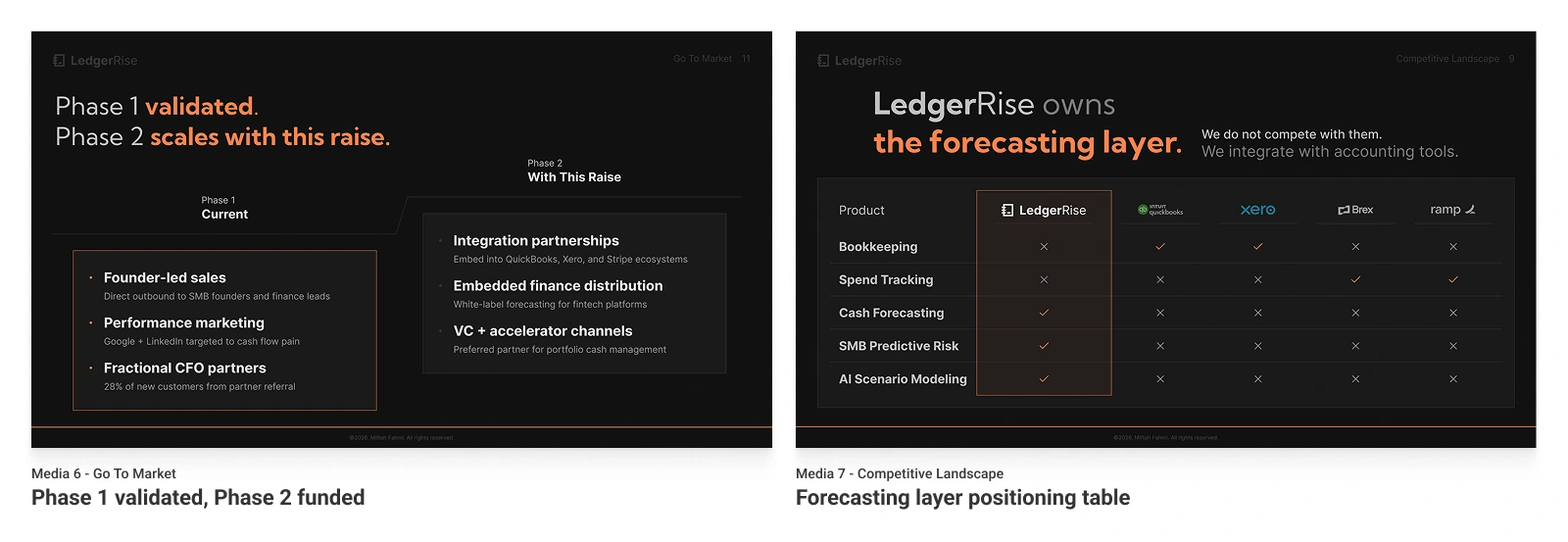
Go to market and competitive landscape slides
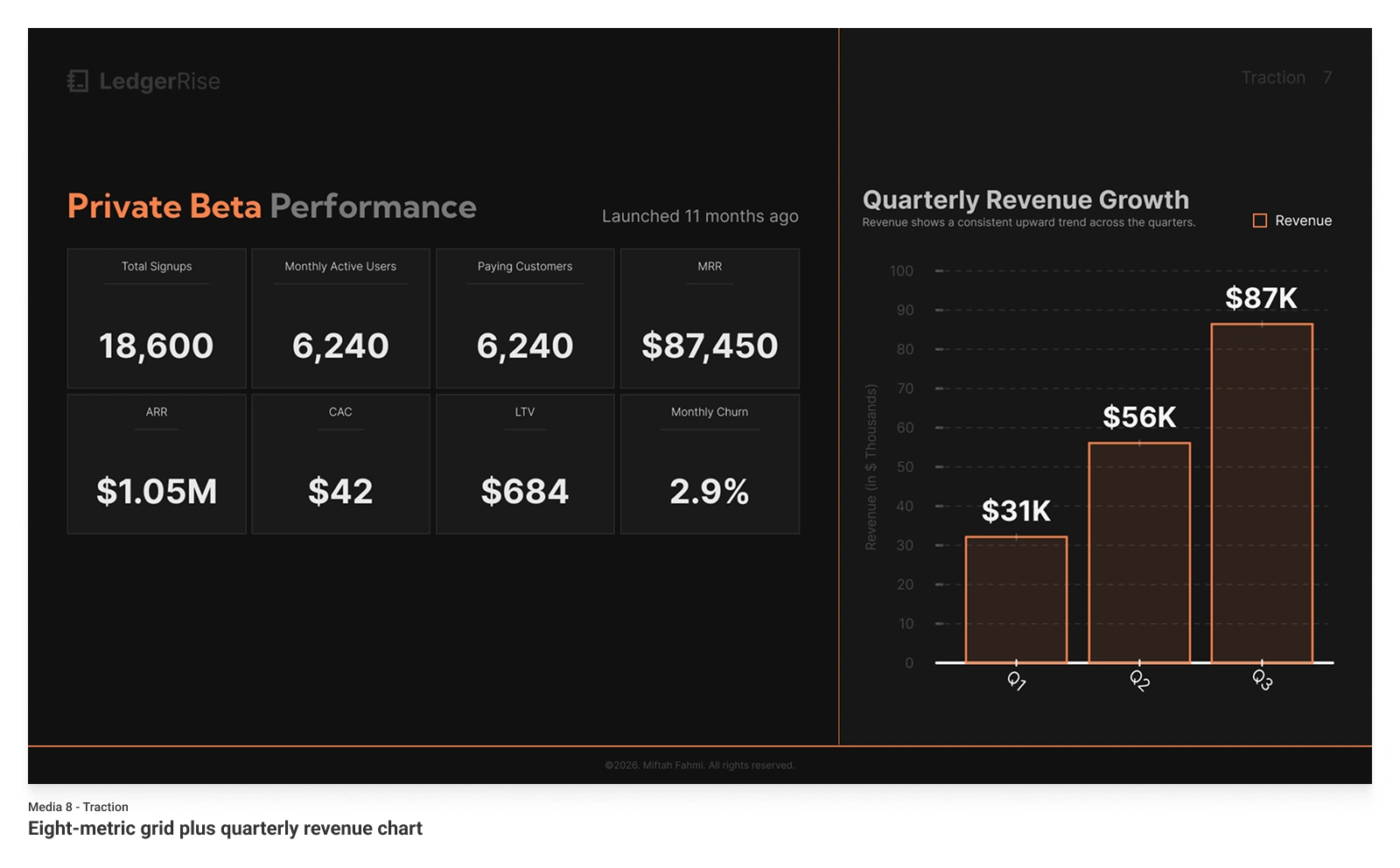
Traction slide
Results
This deck packages modeled ARR, forecast accuracy, and customer traction into a narrative that feels grounded rather than speculative. It gives seed investors the problem urgency, product clarity, and business logic needed to evaluate the opportunity.
Positions LedgerRise as a net-new category: the SMB predictive finance layer, distinct from accounting tools
Translates AI model performance assumptions (forecast accuracy and transaction volume) into investor-legible proof points
Presents CAC and LTV as a clear efficiency ratio without making the investor do the math
Frames the $2.5M ask against specific 24-month operating targets, including customer growth, revenue expansion, and churn control
Builds a complete narrative from market problem through technology moat, with no gaps in investor logic
This style of work is directly relevant for founders raising Seed rounds in FinTech, SaaS, or any AI-native product where the technical story needs to be made simple without being dumbed down.
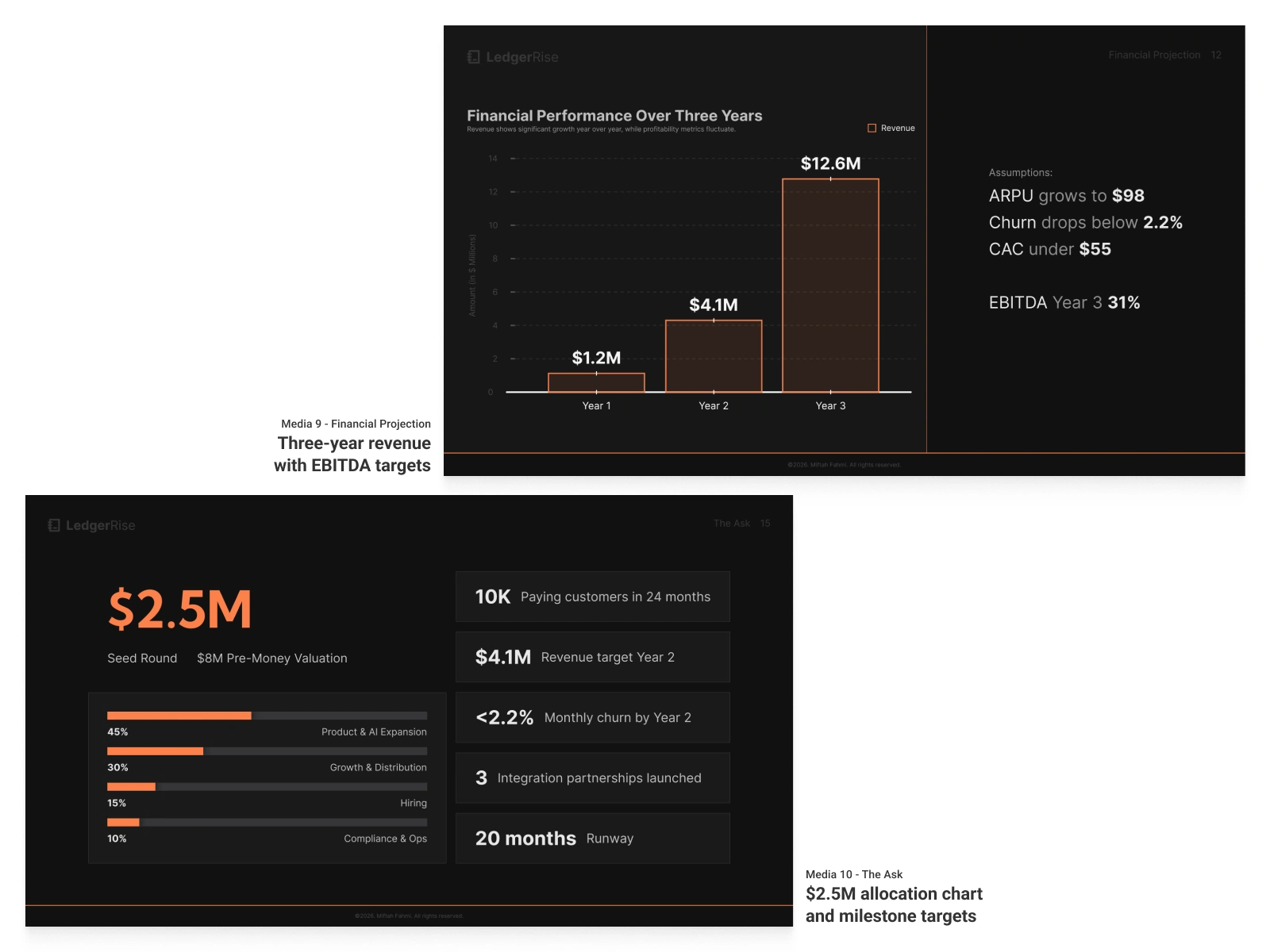
Financial projection and ask slides
View the Full Slide Deck
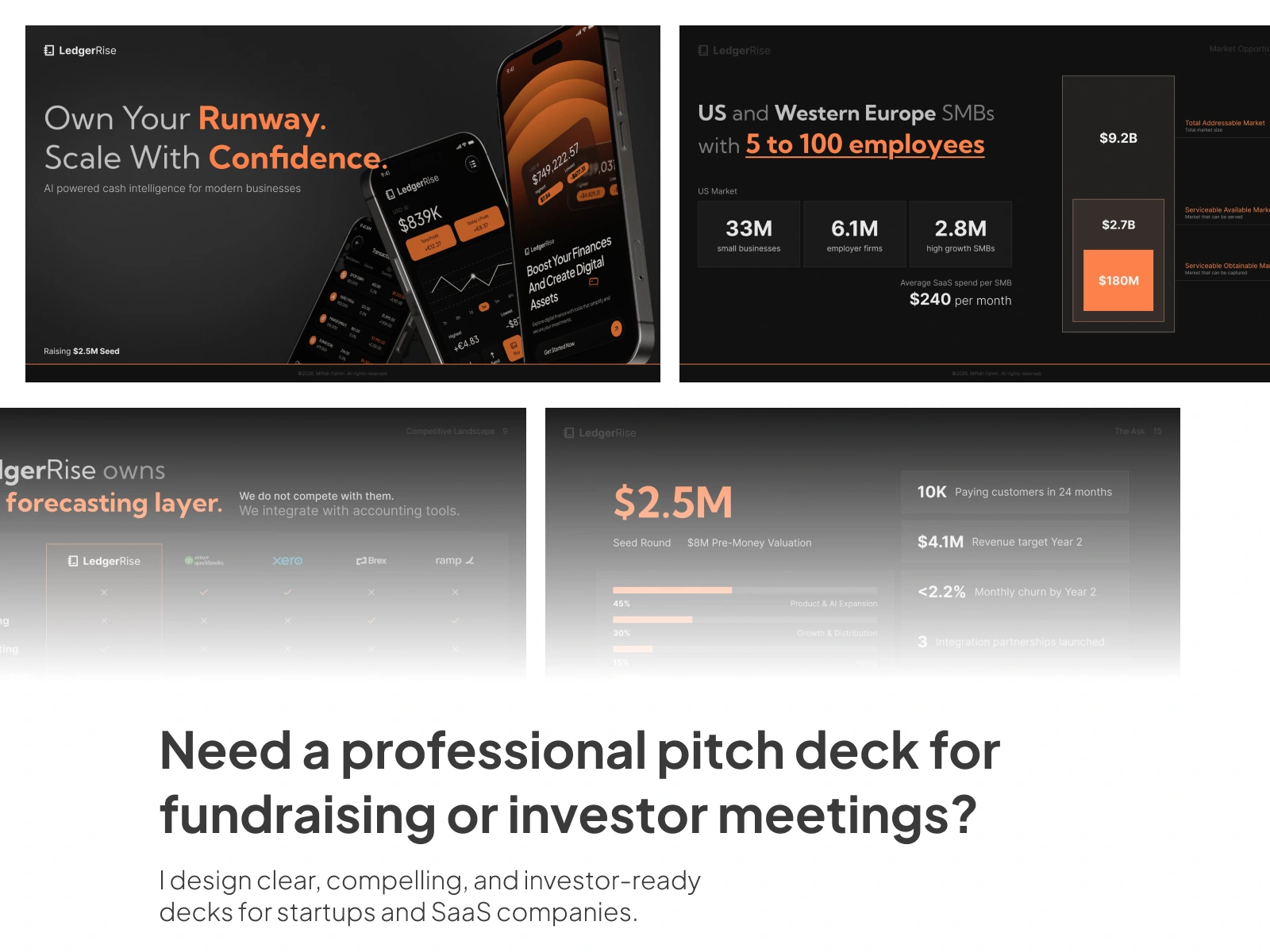
Selected slides and closing note
Like this project
Posted Mar 14, 2026
A self-directed fintech pitch deck case study exploring investor narrative, data visualization, and funding-story structure for an AI cash intelligence platform