HireWise: UX/UI Design for AI Job Search Assistant

Ashiat Abdulkadir


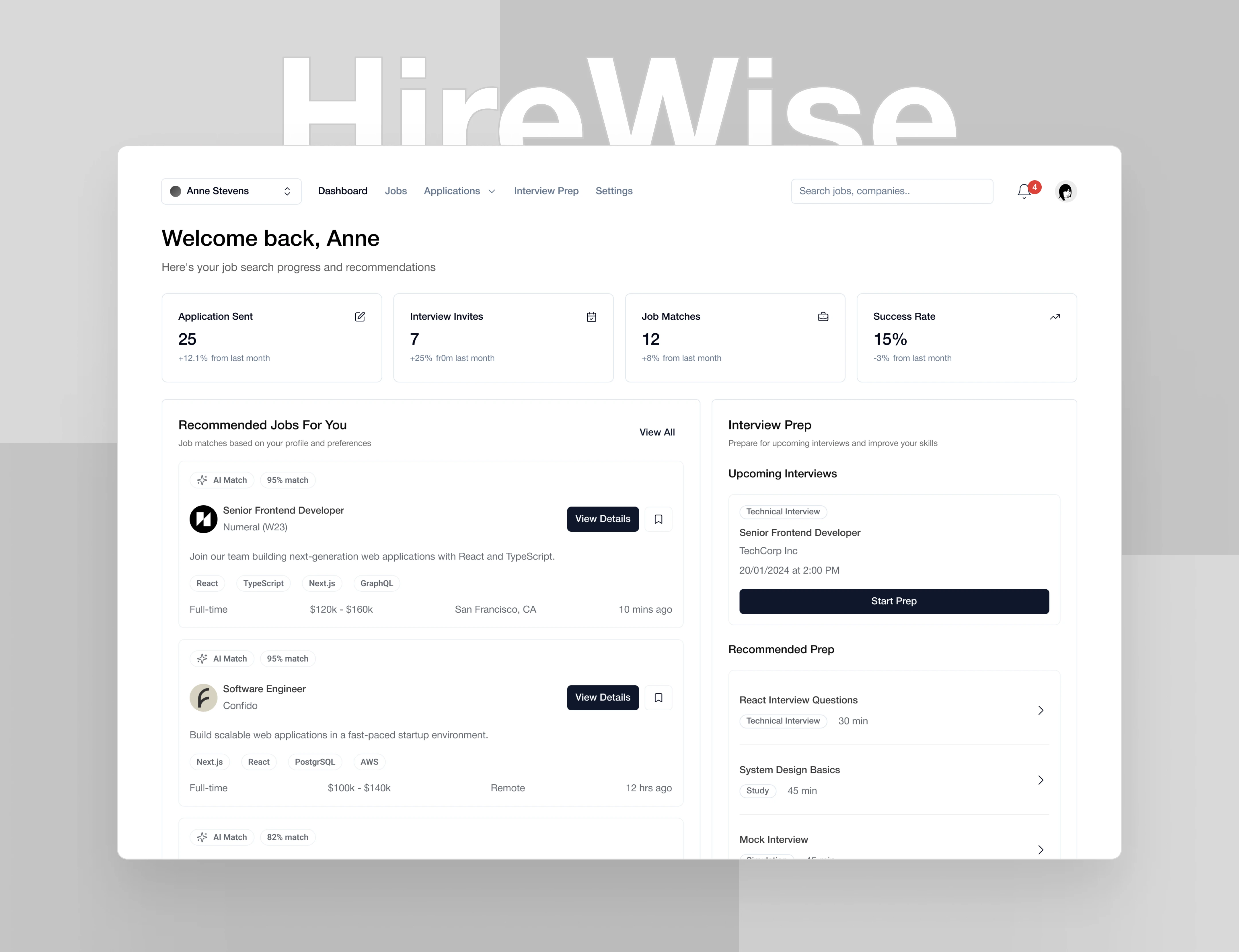
HireWise: AI-Powered Job Search Assistant
The Challenge
Job seekers today face an overwhelming, fragmented experience across platforms like LinkedIn and Indeed. They struggle with irrelevant listings, generic applications, zero feedback, and the growing threat of fake job postings. The process is not just inefficient, it's emotionally draining.
The Solution
HireWise is an AI-powered job search assistant designed to personalize discovery, automate tailored applications, track progress, and deliver interview preparation, all while protecting users from exploitative job postings.
My Role
End-to-end UX/UI Designer (Research, Information Architecture, Wireframing, Prototyping, Visual Design)
Timeline
8 weeks (Concept to High-Fidelity Prototype)
Tools
Figma, FigJam, Notion, ChatGPT (for research synthesis)
Problem Statement
Job seekers spend countless hours navigating bloated platforms, tailoring applications without guidance, and facing rejection without feedback all while increasingly encountering fake job postings designed to harvest data rather than hire candidates.
This broken experience disproportionately affects:
Young professionals (0-5 years experience)
Career switchers
International job seekers
Recent graduates
Research & Discovery
Research Methods
Secondary Research: Analysis of Reddit threads (r/jobs, r/recruitinghell), LinkedIn comments, Glassdoor forums, and Twitter discussions
Competitive Analysis: LinkedIn, Indeed, Teal, Huntr, Jobscan, Big Interview
User Quote Mining: Extracted authentic pain points from job-seeking communities
Key Insights
1. Information Overload
"Scrolling through job boards feels like drinking from a firehose. I'm getting listings for jobs I'm not qualified for or not interested in."
— Reddit user, r/jobs
Finding: Users spend more time filtering than applying, leading to decision fatigue and reduced application quality.
2. The Tailoring Paradox
"I spend hours tweaking my resume and cover letter for each application, but I never know if it's actually improving my chances."
— LinkedIn comment
Finding: Job seekers invest significant time customizing applications but lack any validation mechanism or guidance on effectiveness.
3. The Tracking Gap
"I apply to so many jobs that I lose track of where I am in each process. No app seems to do this well."
— Twitter user
Finding: Manual spreadsheets are abandoned halfway through job hunts. Users miss follow-ups and interview opportunities.
4. The Trust Crisis (New Reality)
"JD says '3+ years required' but the salary is entry-level. I waste time reading these."
— Reddit, r/recruiting hell
Finding: Fake job postings and engagement farming by recruiters create distrust and waste users' limited time and emotional energy.
5. Emotional Burnout
"It's demoralizing to be ghosted after hours of preparation. I don't know what I did wrong."
— Reddit, r/jobs
Finding: The job search is isolating. Users crave encouragement, progress visibility, and signs they're improving.
Pain Point Summary Table
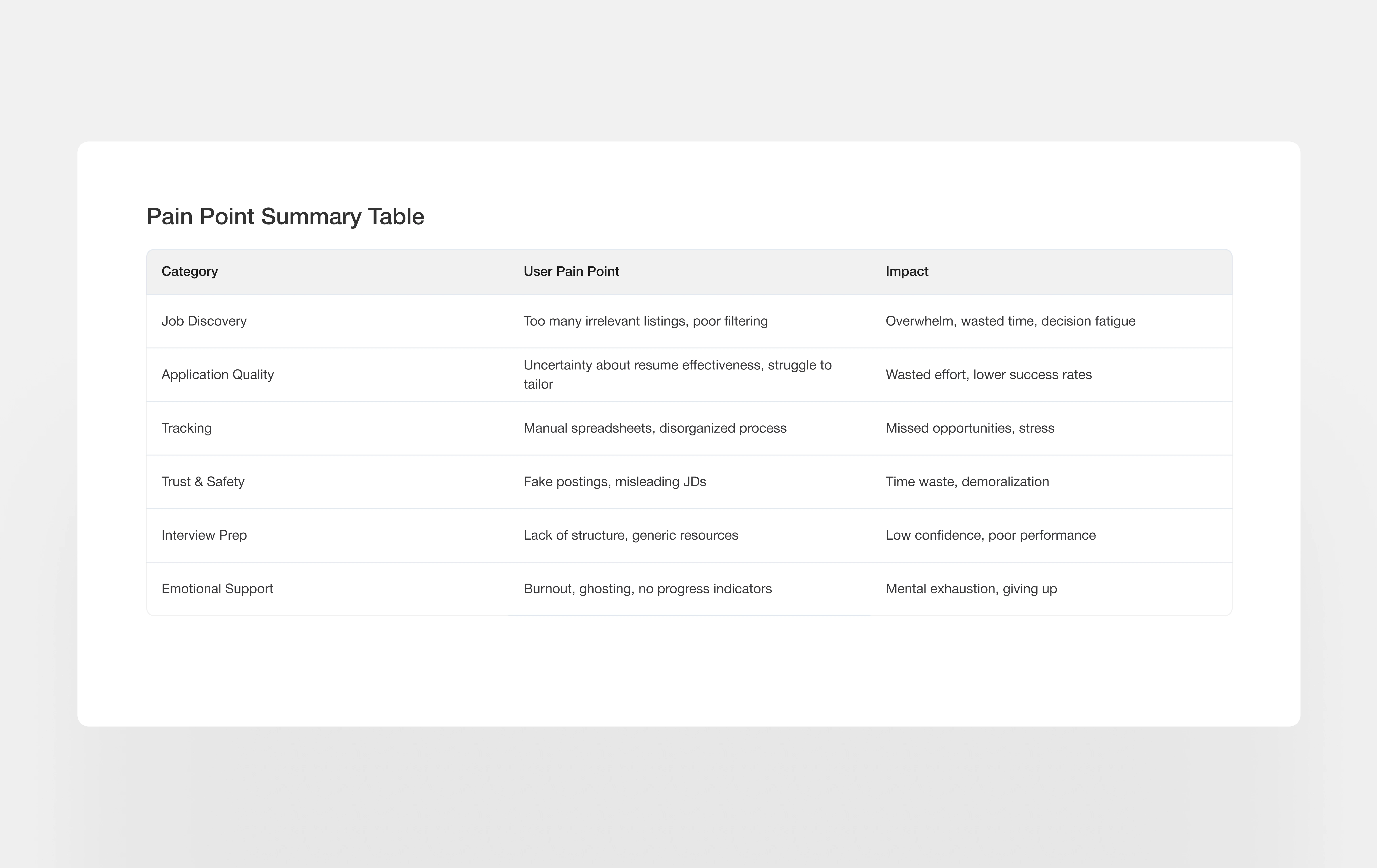
Pain Point Table
User Personas
Persona 1: Vanessa Okoro
Junior UI/UX Designer | Age 24 | Lagos, Nigeria
Background
Recent design bootcamp graduate with a 6-month internship, applying for remote junior design roles globally.
Goals
Land first full-time remote UI/UX role
Build career at a startup
Improve application strategy
Pain Points
Doesn't know how to tailor resume per job
Feels invisible on platforms
Constantly ghosted with no feedback
Manual Notion tracking she forgets to update
Quote: "I've applied to 50 jobs and got 2 responses. I must be doing something wrong but I have no idea what."
Persona 2: Daniel Chen
Mid-Level Software Engineer | Age 31 | Toronto, Canada
Background
7 years in backend development, recently upskilled in AI/ML, wants to pivot into AI-focused product roles.
Goals
Transition into AI engineering
Communicate transferable skills effectively
Understand fit for AI industry jobs
Pain Points
Unsure how to rebrand for new industry
Vague JDs don't explain actual AI involvement
Confused about whether he's qualified
Quote: "I know I have relevant skills, but job descriptions are so vague I can't tell if I'm wasting my time applying."
Persona 3: Aisha Noor
Freelance Marketing Strategist | Age 28 | Nairobi, Kenya
Background
4 years freelancing for e-commerce brands, strong portfolio but no traditional employment history, seeking remote full-time role in Europe/US.
Goals
Secure stable remote income
Understand visa eligibility
Position freelance work professionally
Pain Points
Unsure which companies sponsor remote workers
ATS filters her out due to freelance status
Cover letter writing feels repetitive
Quote: "I've built entire campaigns from scratch, but on paper I look like I've never had a 'real job.'"
User Journey Mapping
Before & After: Vanessa (Junior Designer)
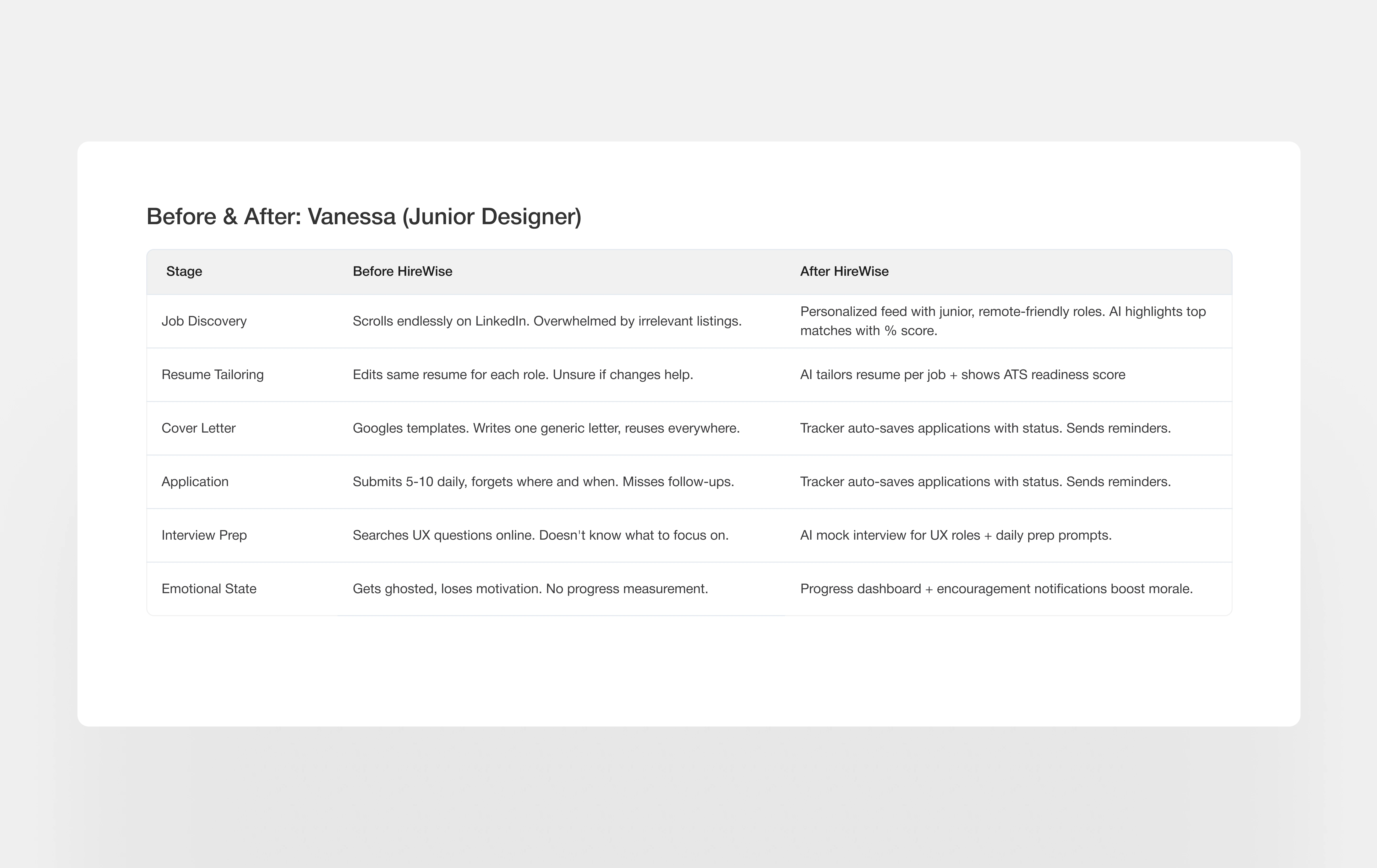
User Journey Mapping
Feature Prioritization
MoSCoW Method
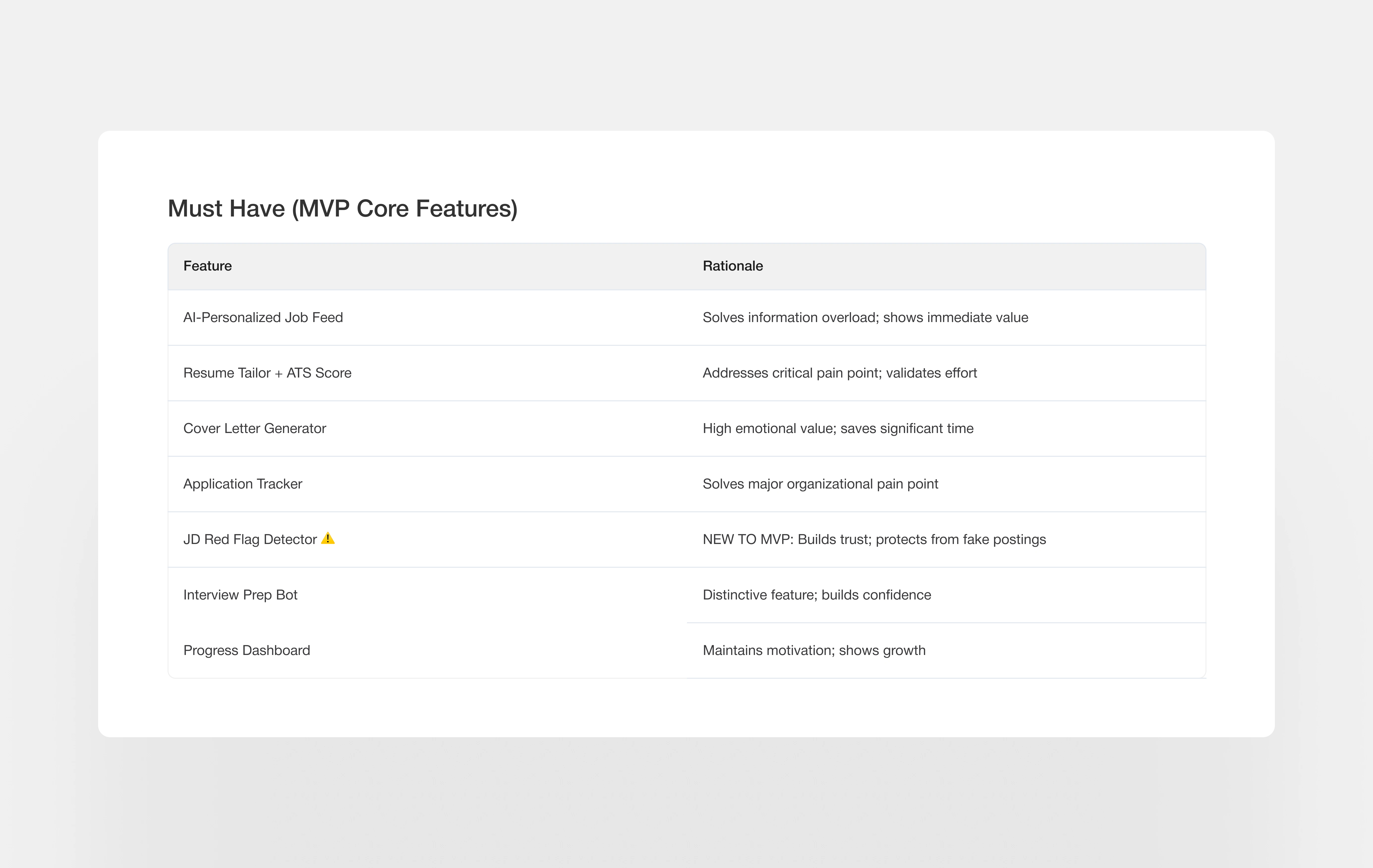
Feature Prioritization
Should Have (Phase 2)
JD Analyzer & AI Summary
Email/LinkedIn Auto Import
Encouragement Bot
Success Stories Feed
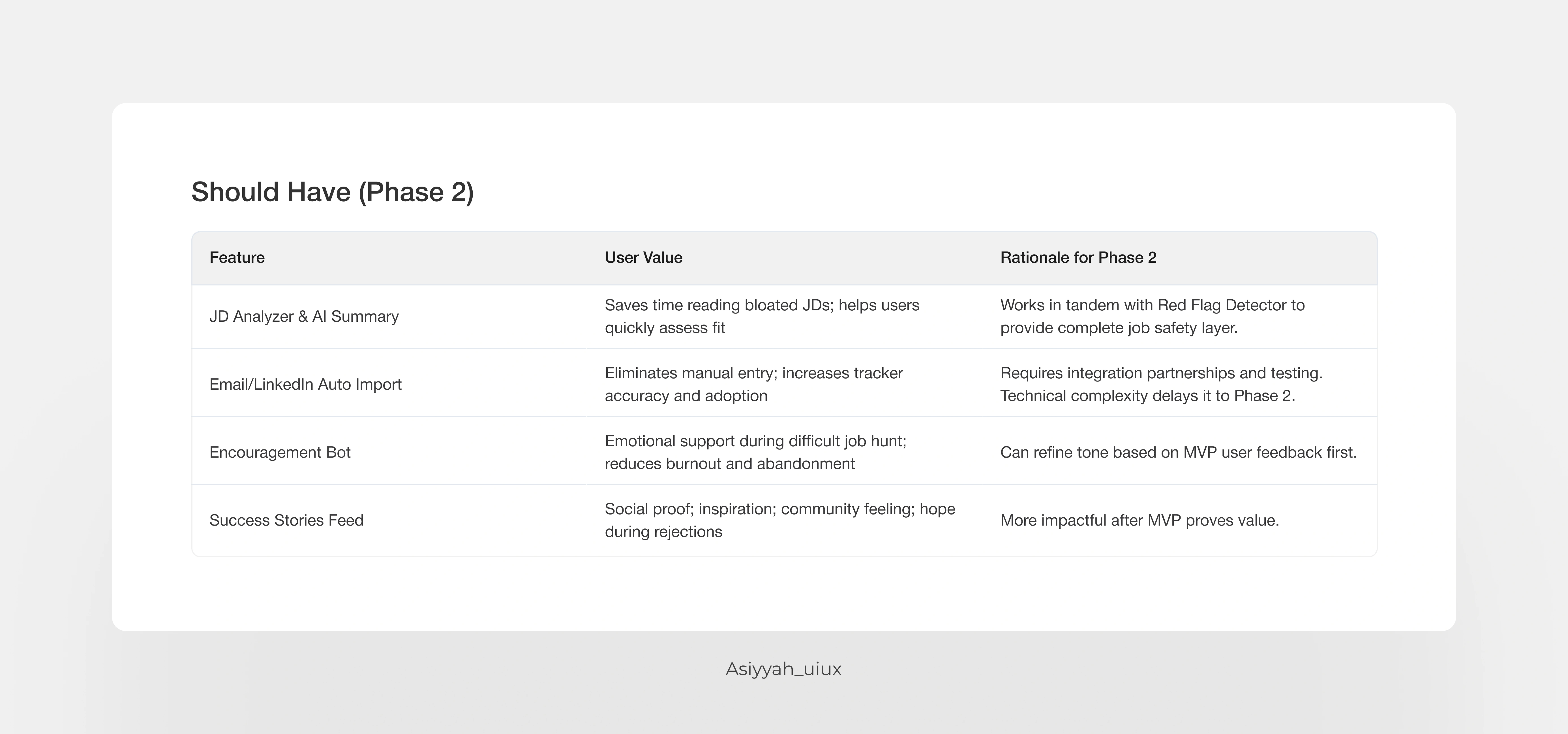
Feature Prioritization
Could Have (Future Enhancements)
Community Check-In Space
Interview Readiness Score
Voice-based Interview Practice
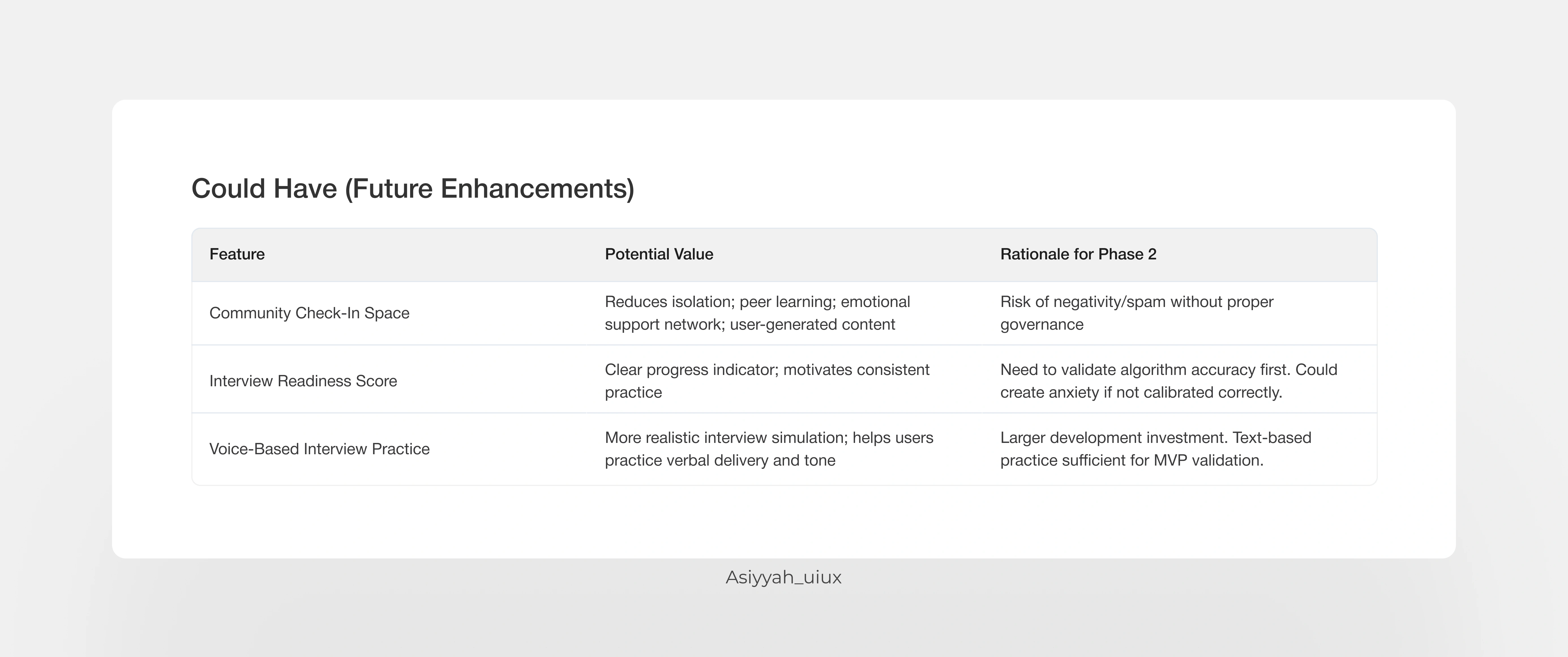
Feature Prioritization
Won't Have (Out of Scope)
Tax Integration for Freelancers
Real-Time Recruiter Chat
Full Applicant Tracking System
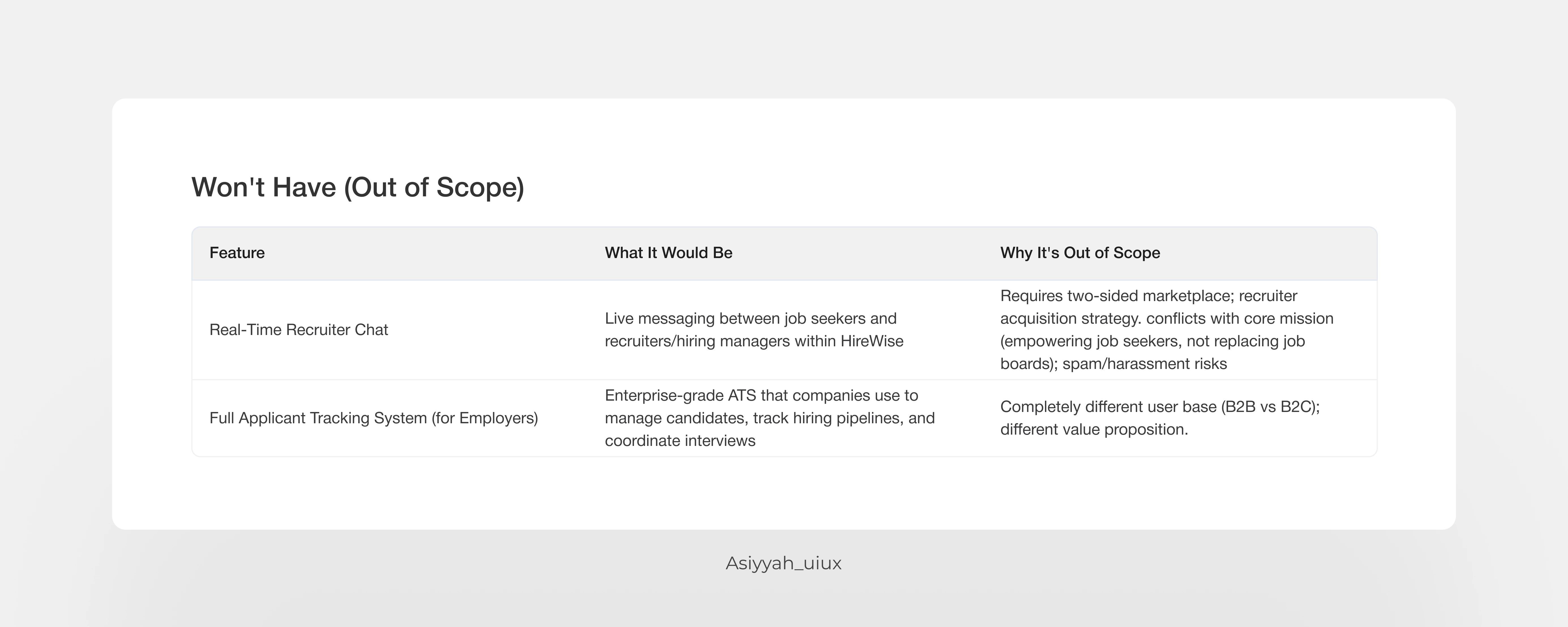
Feature Prioritization
🏗️ Information Architecture
Sitemap Structure
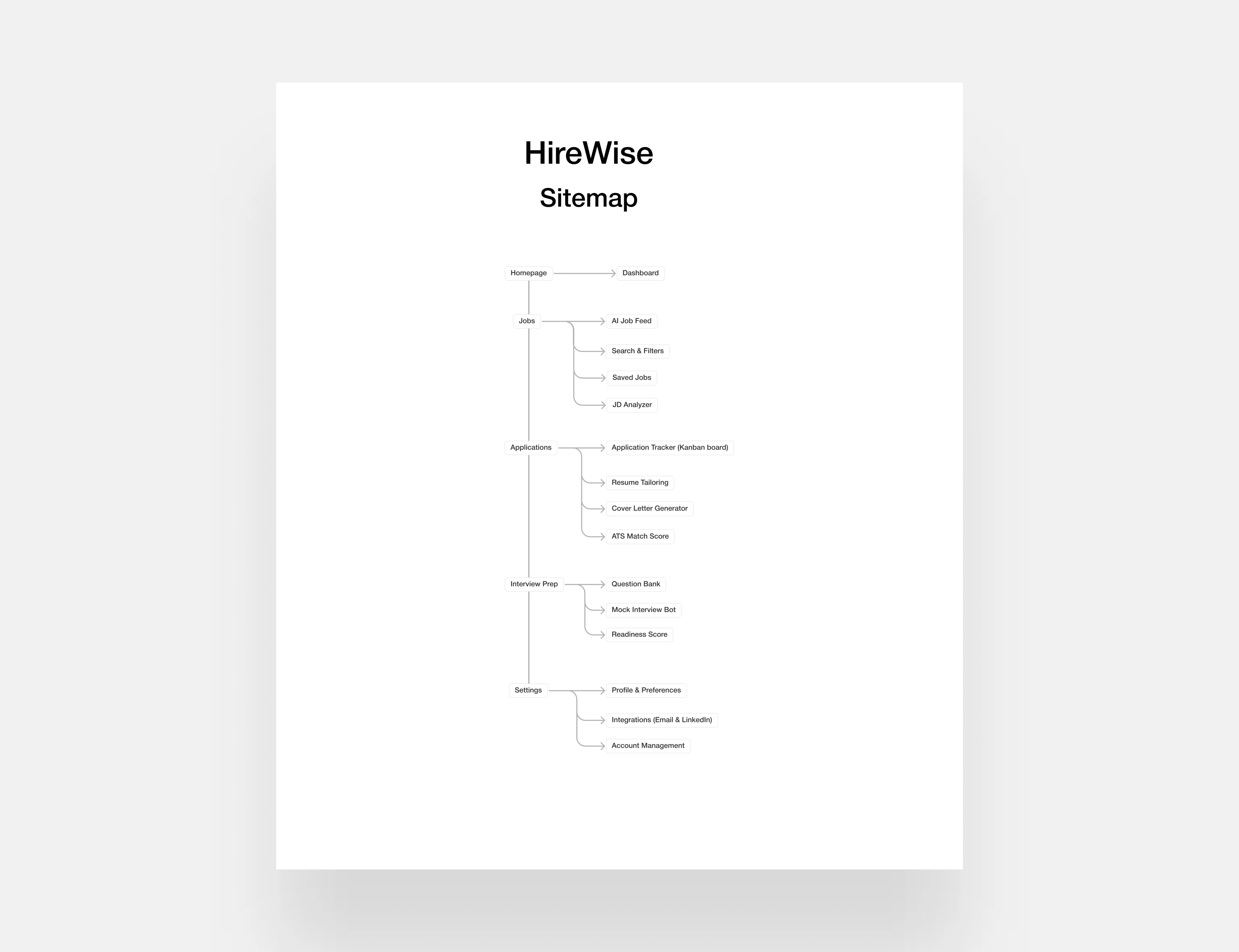
Sitemap
🎨 Key Feature Designs
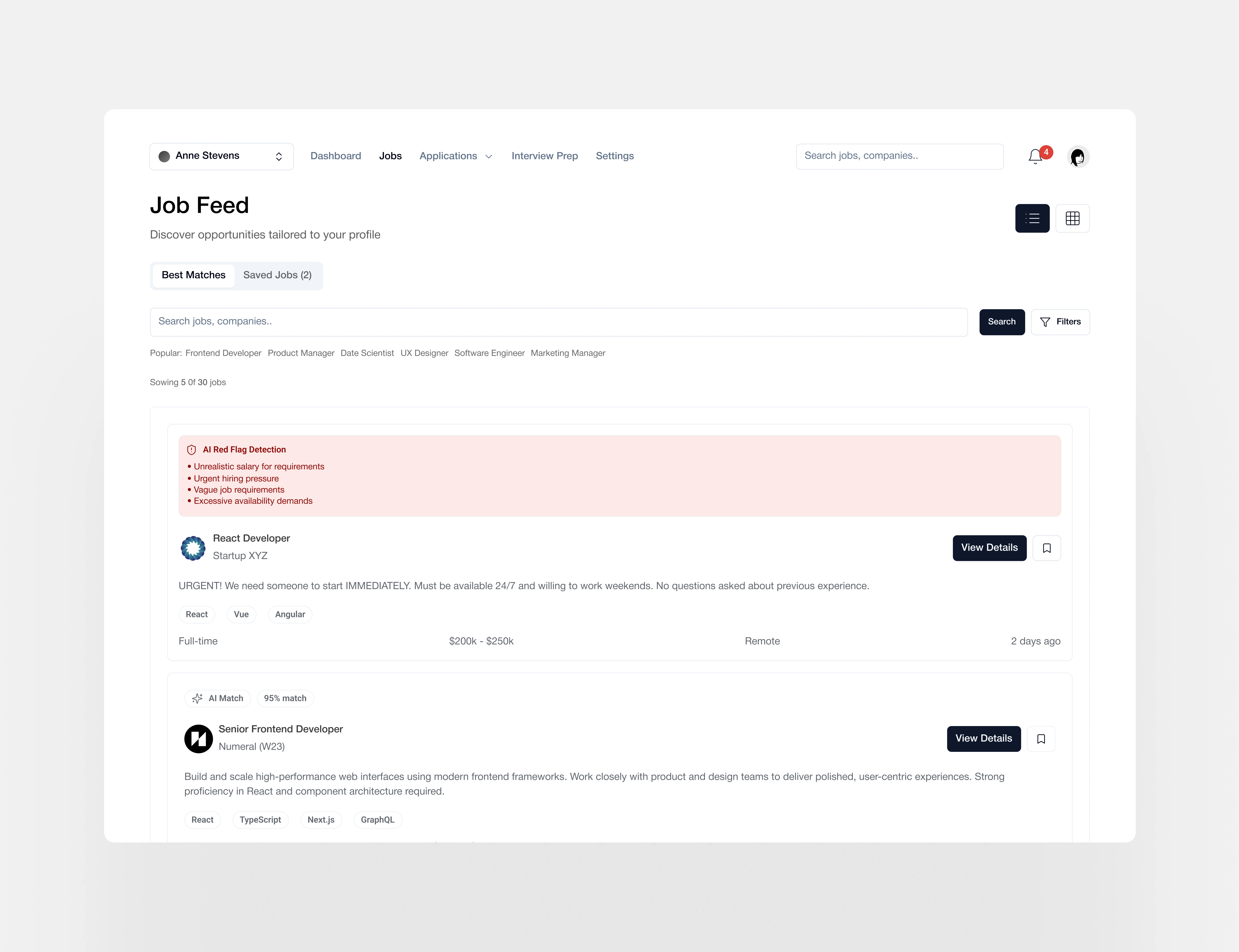
Feature 1: JD Red Flag Detector (Safety-First Innovation)
Problem: Fake job postings and engagement-farming recruiters waste job seekers' time and emotional energy.
Solution: AI-powered analysis flags suspicious job descriptions before users invest time applying.
Red Flags Detected:
Salary ranges that don't match experience requirements
Vague job descriptions with no specific responsibilities
Excessive experience requirements for entry-level pay
Missing company information or unverified employers
Requests for personal information upfront
Unpaid "test projects" or work samples
Design Decisions:
Warning badges appear directly on job cards in feed
Expandable "Why is this flagged?" section provides transparency
Color-coded system: 🟢 Verified Safe | 🟡 Minor Concerns | 🔴 High Risk
Users can still proceed but must acknowledge warnings
Option to report additional red flags to improve AI
Impact: Builds trust immediately; differentiates HireWise from aggregators; protects users' time and mental health.
JD Red Flag Detector
Feature 2: AI-Powered Interview Prep Module
Problem: Job seekers struggle with unstructured interview preparation. They don't know which questions are relevant for their specific role, lack practice opportunities, and receive no feedback on their responses.
Solution: A comprehensive, role-specific interview preparation system with AI-powered practice and structured feedback.
Module Components
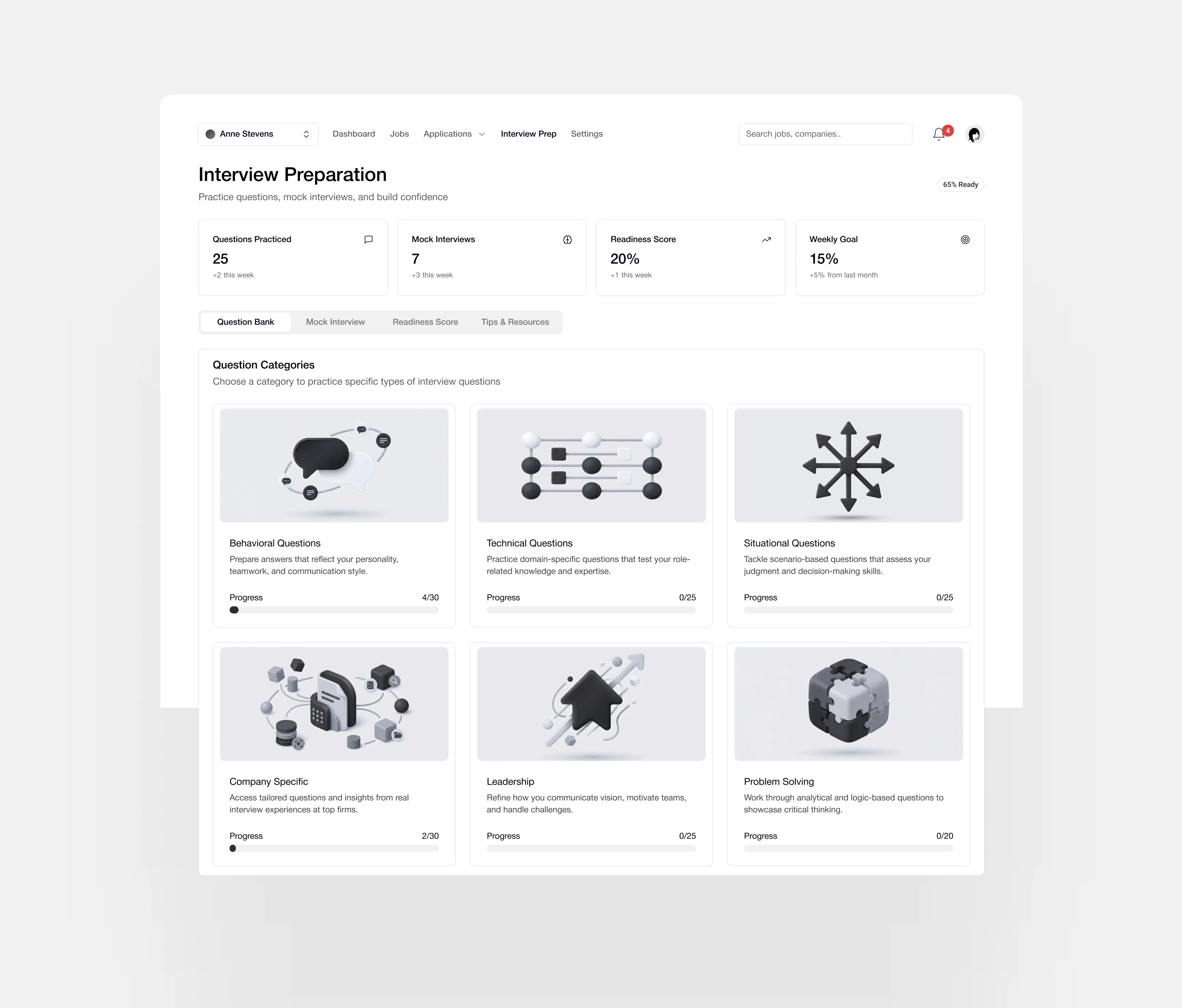
1. Role-Based Question Bank
Design Decisions:
Questions automatically curated based on job title, seniority level, and industry
Categories: Behavioral, Technical, Case Studies, Company-Specific
Question Bank
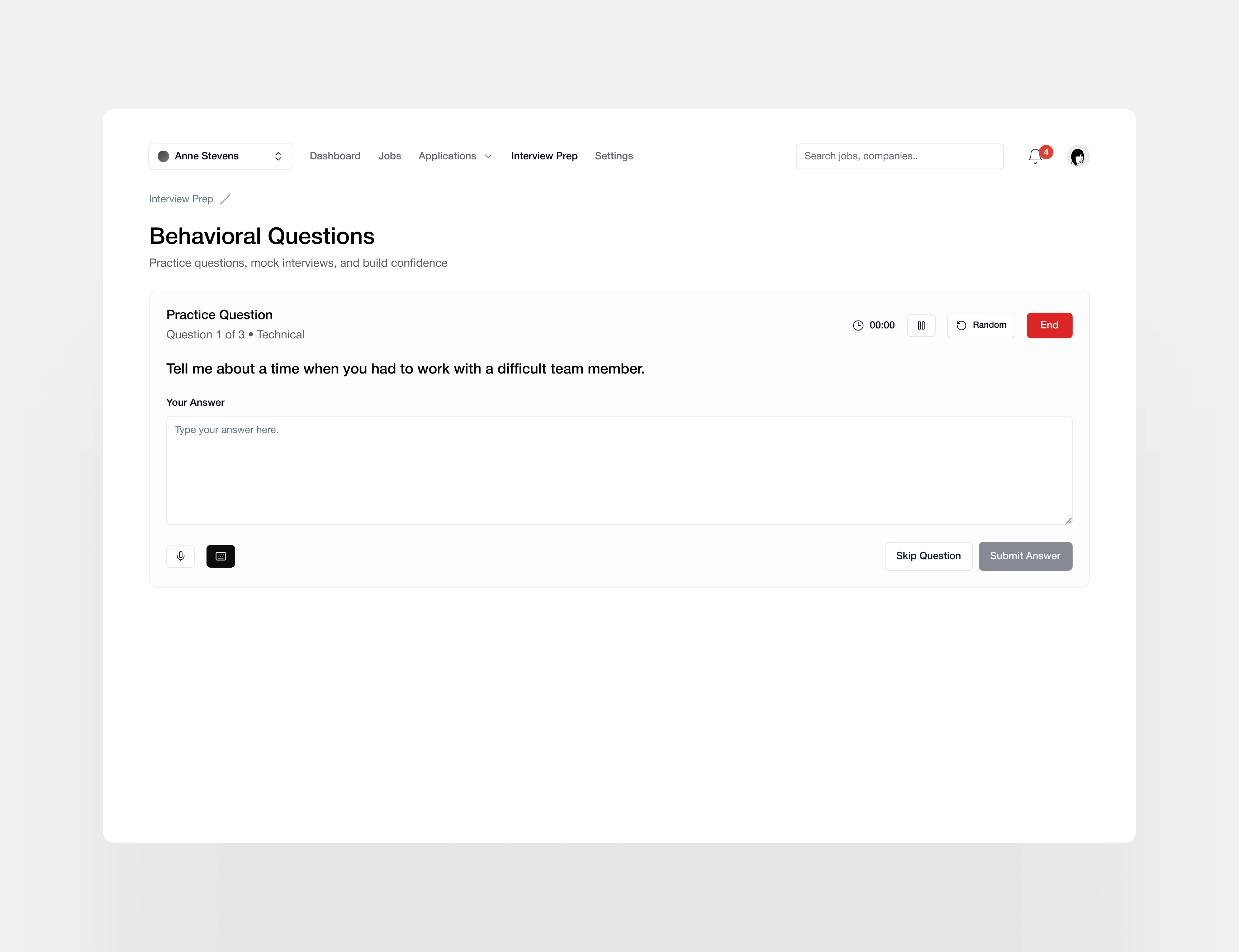
2. AI Mock Interview
Interface Design:
Clean, distraction-free chat interface
Timer display (simulates real interview pressure)
Voice-to-text option for practicing verbal responses
Pause/resume functionality
Mock Interview
Feature 3: Interview Feedback & Skill Reinforcement
Problem: Users completing mock interviews receive generic scores without actionable learning takeaways.
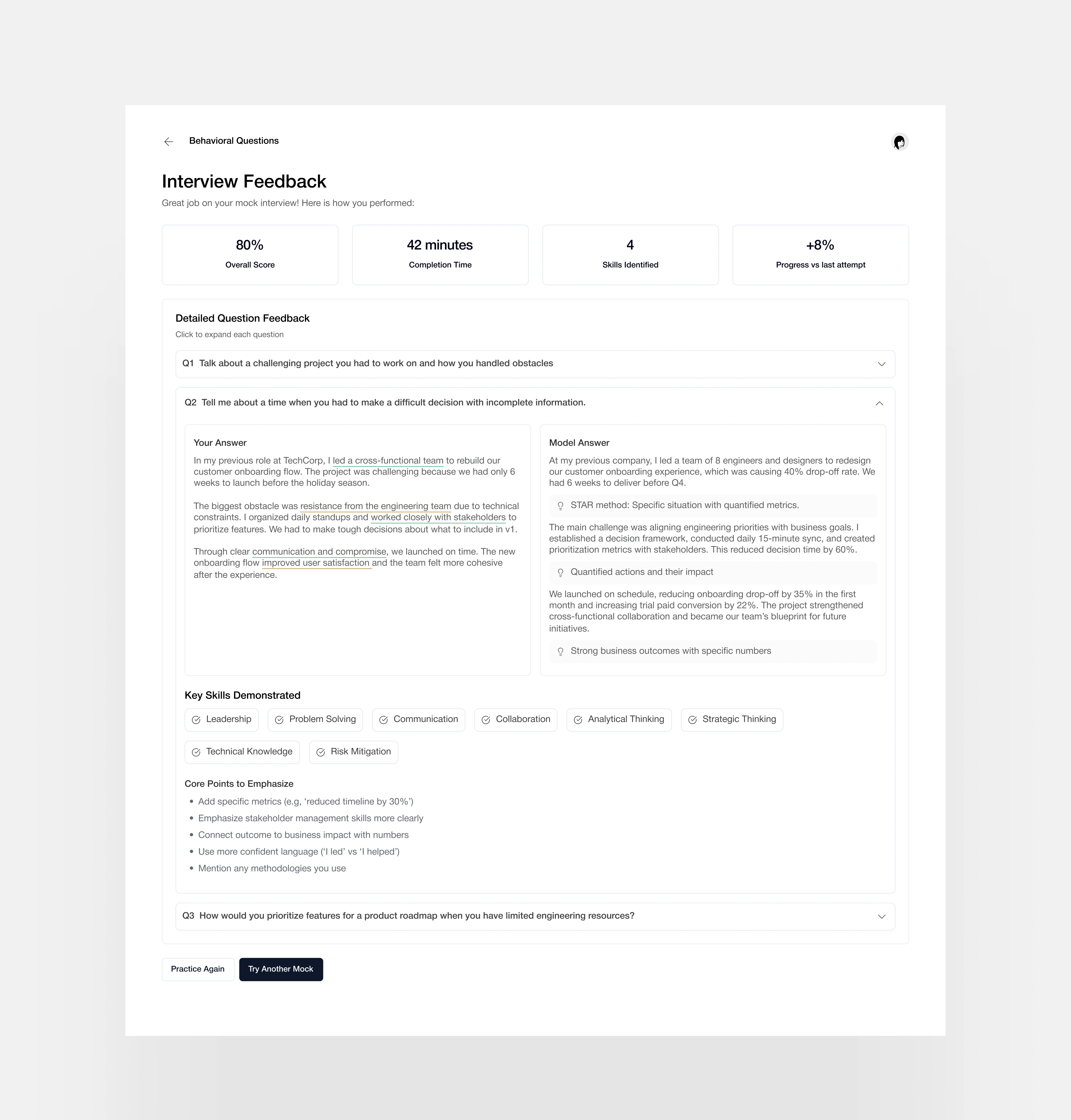
Solution: Structured, personalized feedback screen after each practice session.
Components:
Performance Summary Card
Overall score, completion time, performance rating
Progress tracking ("15% improvement since last attempt")
Question-by-Question Feedback
User's answer displayed
AI evaluation with specific suggestions
Model answer for comparison
Key talking points to strengthen response
Skill Reinforcement Widget
Highlights emphasized skills (Leadership, Problem-Solving, etc.)
Maps answers to job requirements
Next Steps CTA
"Try another mock" / "Review similar questions" / "Save notes"
Design Principles:
Growth-focused language: "Here's how to make your answer stronger"
Color-coded highlights: 🟢 Strengths | 🟠 Improvement areas
Toggle between "My Answer" and "Model Answer"
Export feedback as PDF for reference
User Story: "As a job seeker, I want detailed feedback on my mock interview answers so I can identify what I did well and where to improve."
Interview Feedback
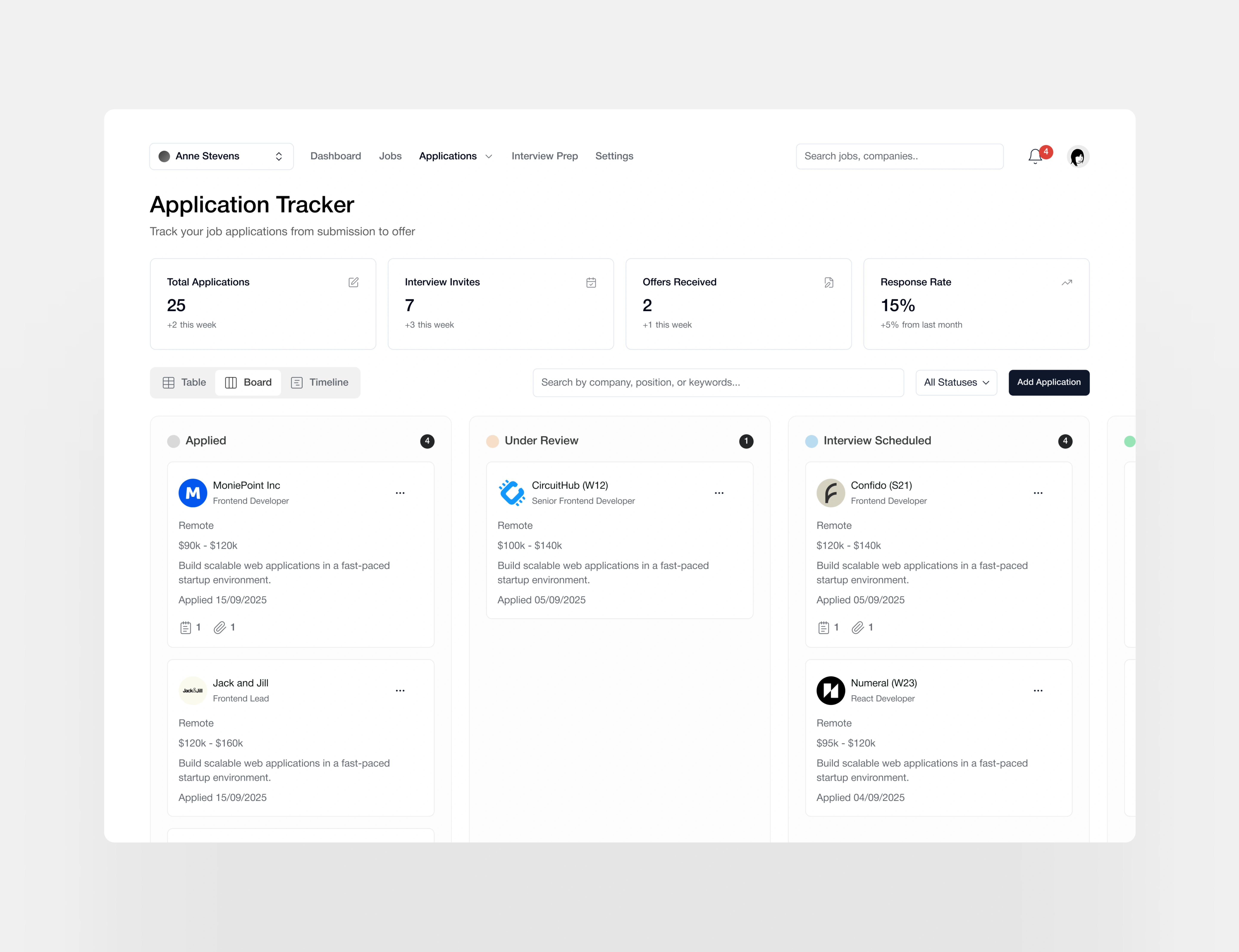
Feature 4: AI-Powered Application Tracker
Problem: Manual spreadsheets are abandoned; users lose track of applications and miss opportunities.
Solution: Visual, automated tracking with intelligent reminders.
Views:
Timeline View: Chronological display of application journey
Kanban View: Cards organized by stage (Applied → Interviewing → Offer)
List View: Sortable table with filters
Smart Features:
Follow-up reminders (e.g., "Check in with Company X - 2 weeks since interview")
Notes and attachments per application
Quick actions: "Send thank-you email" template (To-do later)
Application Tracker
Add Application
Design System Highlights
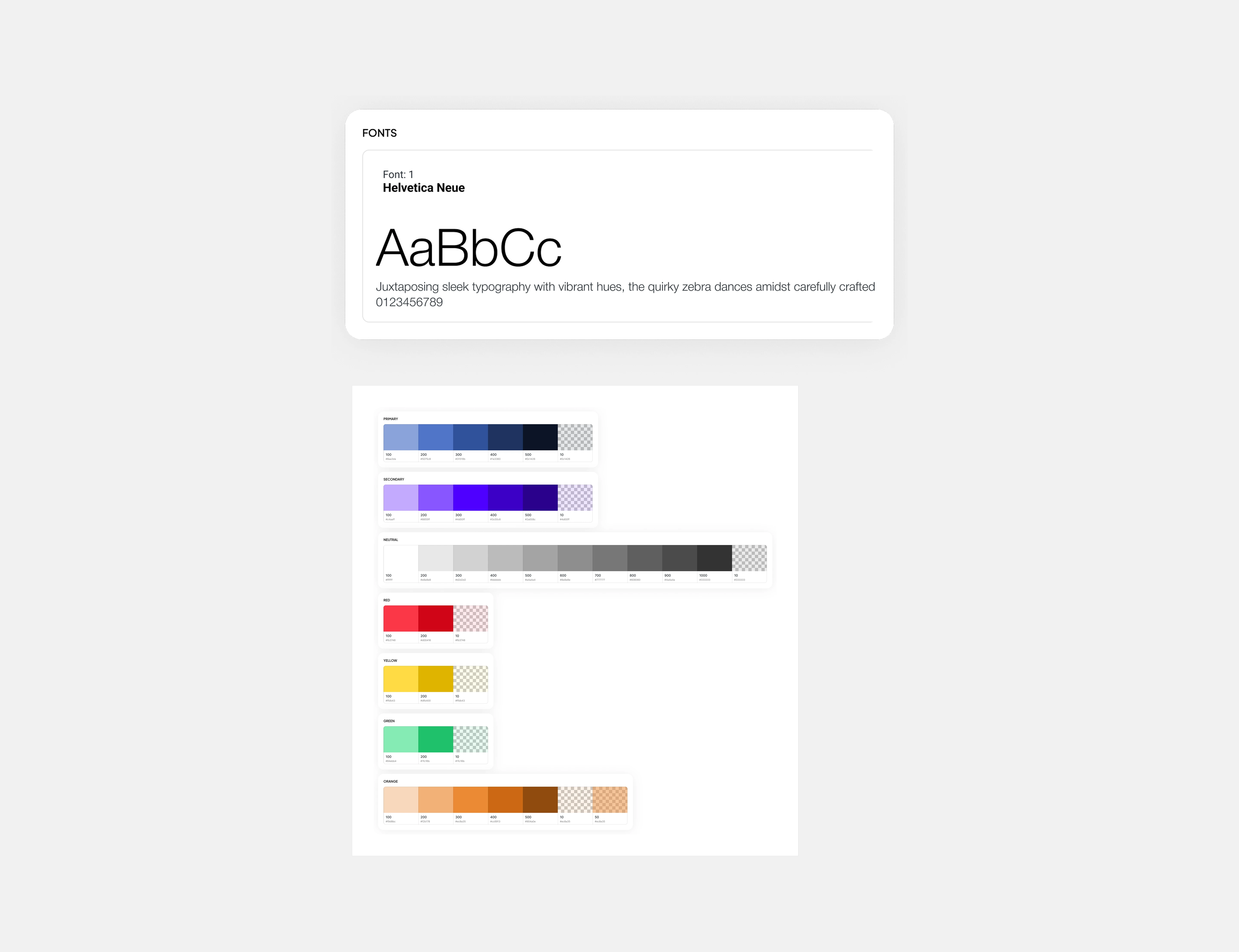
Color Strategy
Primary: Midnight Blue (#0C1426) - Trust, professionalism
Success: Growth Green (#1fC16B) - Positive feedback, achievements
Warning: Caution Amber (#DFB400) - Improvement areas
Danger: Alert Red (#D00416) - High-risk job postings
Neutral: Sophisticated Gray scale - Readability, hierarchy
Typography
Headings & Body: Helvetica Neue - Modern, approachable
Type & Color System
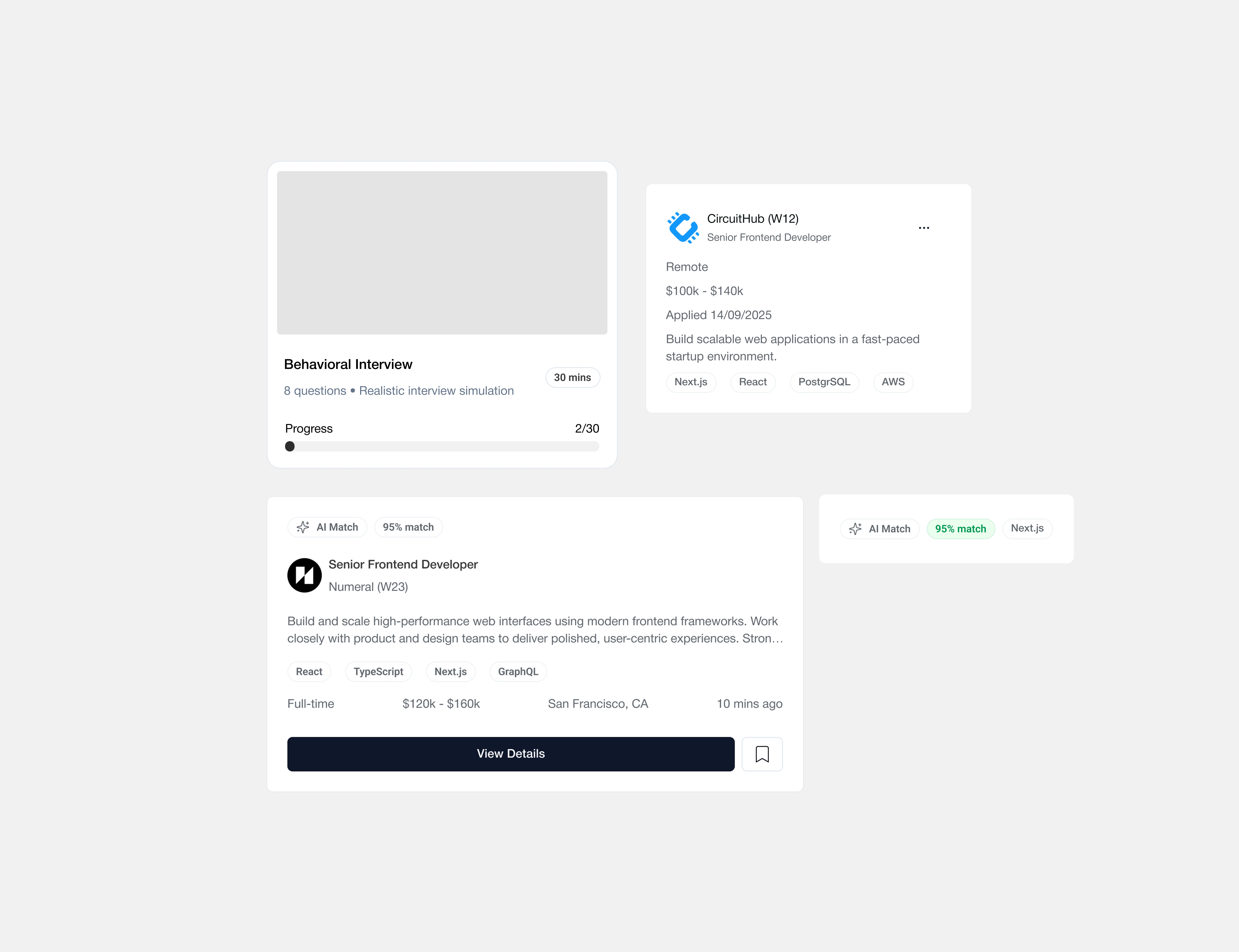
Component Library
Cards with subtle shadows for job listings
Progress bars for mock interviews
Badge system for match percentages
Toast notifications for encouragement and reminders
Components
💡 Design Decisions & Rationale
1. Why JD Red Flag Detector Became MVP
Initial Plan: Placed in "Could Have" category
Shift: After research revealed growing fake job posting problem, elevated to MVP
Rationale:
Builds trust immediately on first use
Differentiates from all competitors
Addresses emotional pain (wasted hope) not just functional pain
Low technical lift for high user value
2. Encouraging Tone Throughout
Design Principle: Growth-focused language replaces deficit language
Examples:
❌ "Your answer was incomplete"
✅ "Here's how to strengthen this point"
❌ "Low ATS score"
✅ "Let's boost your resume's visibility"
Rationale: Job searching is emotionally taxing. Every interaction should build confidence, not erode it.
3. Visual Progress Over Hidden Metrics
Decision: Dashboard shows activity graphs, application counts, and interview conversion rates
Rationale:
Users cited "no sense of progress" as demotivating
Gamification elements (streaks, milestones) maintain engagement
Transparency about metrics builds trust in AI recommendations
📈 Success Metrics
User Engagement
Daily active users returning to practice interviews
Applications tracked per user per week
Red flag reports submitted by community
Effectiveness
Interview conversion rate improvement (target: +25%)
Time saved per application (target: 40% reduction)
User-reported confidence increase
Business
Freemium conversion rate
User retention at 30/60/90 days
Referral rate from satisfied users
Future Enhancements
Phase 2
Voice-based interview practice
Peer comparison insights (anonymized benchmarks)
Email integration for automatic tracking
Success stories community feed
🎓 Key Learnings
1. Safety Features Build Trust Faster Than Convenience
Initially focused on productivity (tailoring, tracking). Research showed users equally value protection from exploitation. Trust is the foundation of engagement.
2. Emotional Design Matters in High-Stress Contexts
Job searching involves rejection, uncertainty, and comparison. Every micro-interaction from loading states to error messages must acknowledge this emotional reality.
3. Fragmentation Is the Real Competitor
Users don't just want better tools; they want fewer tools. Integrating discovery, application, prep, and tracking into one flow reduces cognitive load significantly.
4. AI Should Augment, Not Replace, Human Agency
Users want AI to suggest, optimize, and educate, not make decisions for them. The interface always gives users final control and transparency into AI reasoning.
Conclusion
HireWise reimagines job searching as a guided, protected, and empowering experience rather than a demoralizing grind. By combining AI-powered personalization with safety features, structured tracking, and confidence-building feedback, it addresses both the functional and emotional dimensions of one of life's most stressful processes.
The platform doesn't just make job searching more efficient, it makes it more humane.
📎 Appendix
Research Sources
Reddit: r/jobs, r/careeradvice, r/recruitinghell (200+ posts analyzed)
LinkedIn: 50+ comment threads on job search frustrations
Glassdoor Community: 30+ forum discussions
Twitter: Job-seeking hashtag analysis
Tools & Methodologies
Affinity mapping for pain point clustering
Jobs-to-be-Done framework for feature validation
MoSCoW prioritization for scope management
Figma for all design deliverables
View Full Prototype: Prototype
POW: Figma Link (WIP)
This case study demonstrates end-to-end UX thinking: from authentic user research to strategic feature prioritization to empathetic interaction design. HireWise isn't just a portfolio piece—it's a vision for how AI can make a broken system work for people, not against them.
Like this project
Posted Feb 8, 2026
Designed an AI-powered job search assistant from concept to prototype, focused on creating a clear, intuitive UX for navigating complex job discovery workflows.