Multi-Tenant Revenue & Billing Platform Design

Ashiat Abdulkadir


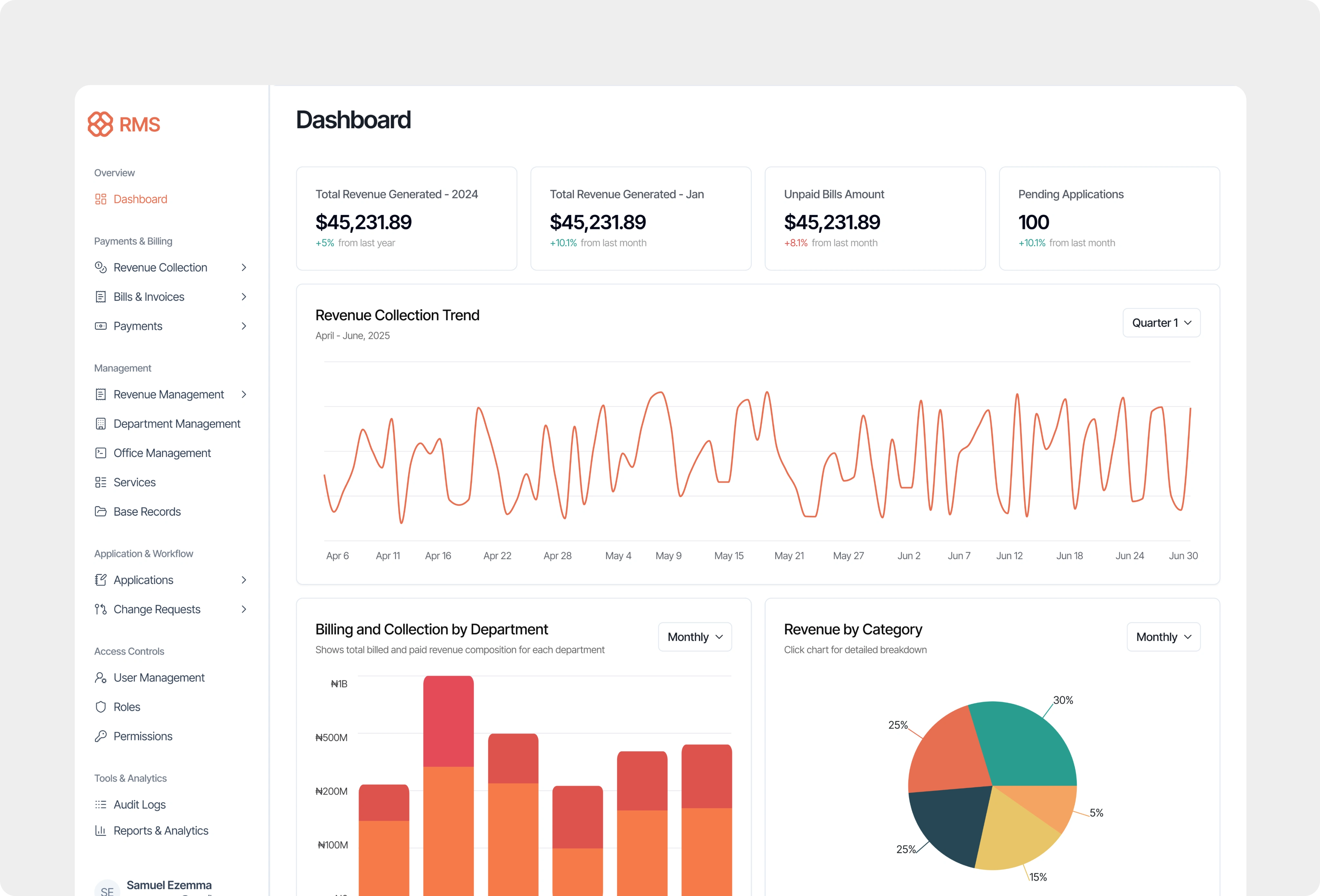
Multi-Tenant Revenue & Billing Platform
Context & Problem Space
Modern organisations that manage revenue across multiple internal entities often struggle with fragmented processes, inconsistent billing rules, manual reconciliations, and limited visibility into where money is coming from. When operations are distributed across different departments or agencies, these gaps become even more severe leading to errors, delays, and an inability to make confident decisions.
Agencies managing revenue across departments struggled with entirely manual processes:
Inconsistent billing: Each department calculated fees differently using spreadsheets
Lost accountability: Bills disappeared into approval queues with no tracking
Manual errors: Hand-calculated formulas resulted in ~12% error rate
No visibility: No centralized view of who owed what or payment status
Siloed operations: Each agency operated independently with no shared infrastructure
The Design Challenge
Design a unified digital ecosystem that:
Digitizes all billing and revenue operations
Allows each agency to operate autonomously within their unique business rules
Provides central visibility and governance
Eliminates manual errors and creates full audit trails
Scales to support diverse agencies with different services, workflows, and regulations
My Role & Approach
As the only product designer embedded with a tech consulting delivery team, I led all design activities while collaborating closely with:
Business Analyst — Documenting existing processes and business rules
Product Manager — Prioritizing features and stakeholder needs
Engineering Team — Ensuring technical feasibility
Project Manager — Managing timelines and deliverables
QA Team — Validating designs during testing
Design Approach
Discovery First: Spent significant time understanding existing manual processes, pain points, and business rules before designing solutions
Systems Thinking: Designed for the ecosystem, not individual screens, ensuring data flows seamlessly across platforms
Progressive Complexity: Built defaults for 80% use cases while supporting advanced configurations for the remaining 20%
Collaboration as Design: Facilitated decision-making across stakeholders with different perspectives (BA wanted comprehensiveness, PM wanted speed, Engineering wanted feasibility)
The Solution: True Multi-tenant Architecture
Rather than building one shared platform where agencies "select their workspace," I designed a white-labeled multi-tenant framework that spawns isolated, branded environments for each agency.
What Multi-Tenancy Means
Each agency gets:
Their own unique URL (
agency-name.platform.gov)Complete brand customization (logo, colors, theme)
Isolated data environment (impossible to access another agency's data)
Custom service configurations and workflows
Independent user management and permissions
It feels like: Each agency has their own custom-built billing system
It actually is: One platform framework with agency-specific configurations
Core Modules I Designed
1. Agency Onboarding & Branding
Initial account provisioning by system admin
Brand customization wizard (logo, colors, typography, theme)
Unique subdomain generation
2. Services Configuration Engine
Service definition and revenue item setup
Dynamic form builder for application forms
Formula builder for rate calculations (fixed and calculated)
3. Bill Generation
Single bill creation with validation
Bulk billing with category-based targeting
Conflict detection and safety confirmations
Bill status management (pending, issued, paid, withdrawn)
4. Approval Workflows
Configurable multi-step approval chains
Timeline visualization with accountability tracking
Time-based alerts for delayed applications
Audit trail for compliance
5. Revenue Reporting & Analytics
Agency-specific dashboards
Department performance comparisons
Collection rate tracking
Top/underperforming analysis
6. User Management & Permissions
Role-based access control (System Developer, Client Admin, User)
Granular permission matrix
Department-level user assignment
Key Design Challenges
Challenge 1: True Multi-Tenancy Without Confusion
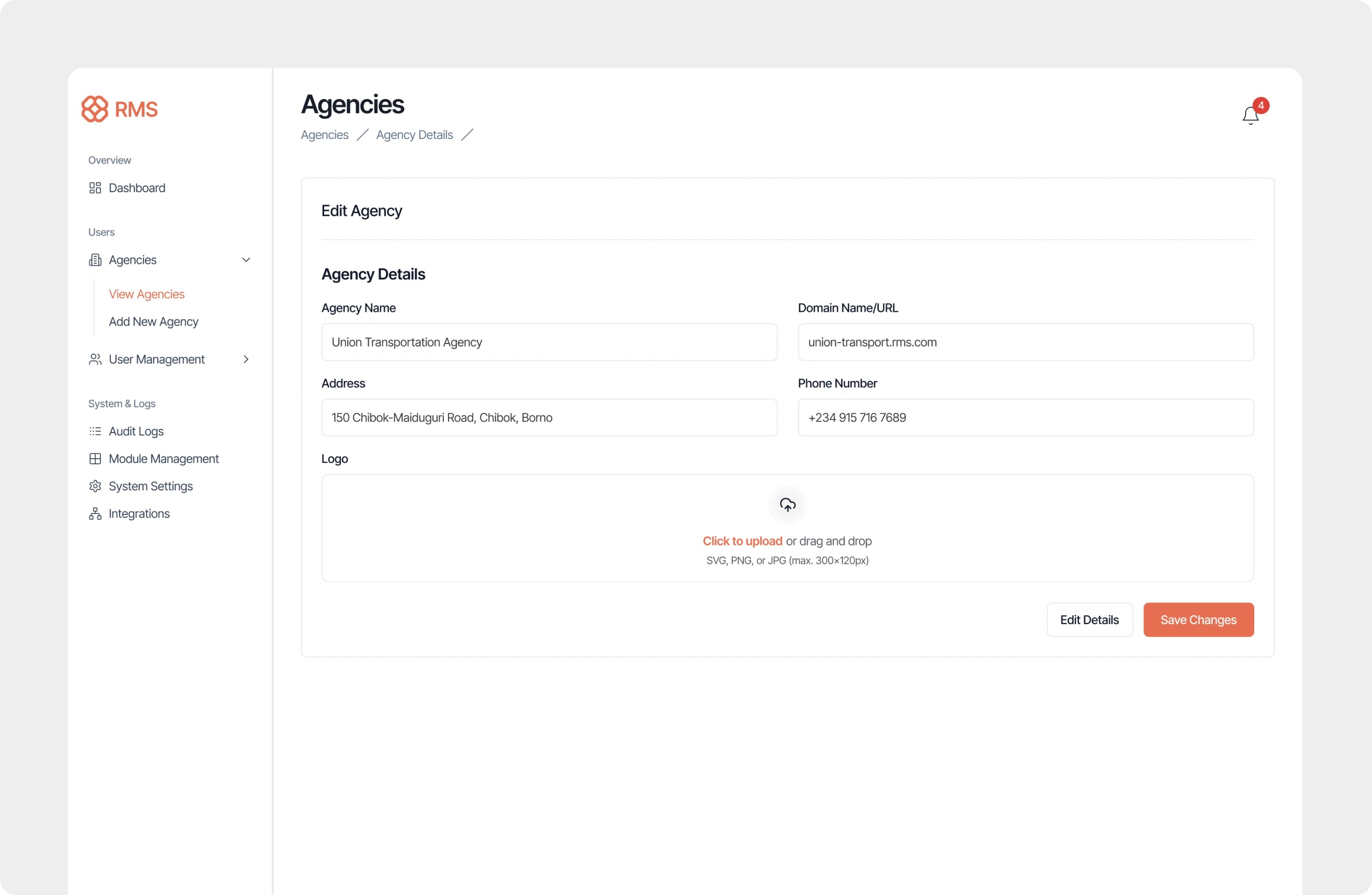
Agency Setup
The Problem:
How do you build one system that serves 4+ agencies with completely different services, workflows, and visual identities without users getting confused or accidentally accessing wrong data?
Initial Consideration: A unified interface where users select their agency from a dropdown. Why this would fail:
Bloated navigation trying to accommodate all agencies
Complex permission matrices to hide irrelevant features
Risk of cross-contamination (seeing another agency's data)
Weakened brand identity for each entity
Design Solution: Isolated White-Label Instances
Each agency operates in their own branded, physically isolated environment:
1. Unique Identity Layer
Custom subdomain per agency (transportation.platform.agency, environment.platform.agency)
System admin provisions accounts with agency details, logo, and admin credentials
Admin receives secure onboarding link
2. Brand Customization
First-time login guides admins through visual identity setup:
Upload agency logo
Configure brand colors (primary, secondary, accents)
Select theme preferences
Set typography
3. Zero Context-Switching
Users bookmark their agency's specific URL
No dropdown menus to "switch agencies"
Impossible to accidentally access another agency's system
Each login = direct access to YOUR agency's environment
Design Principle Applied:
"Match system structure to user mental models." Users don't think "I'm a platform user", they think "I work for the Transportation Agency." The architecture reflects that reality.
Challenge 2: Transparent Approval Workflows
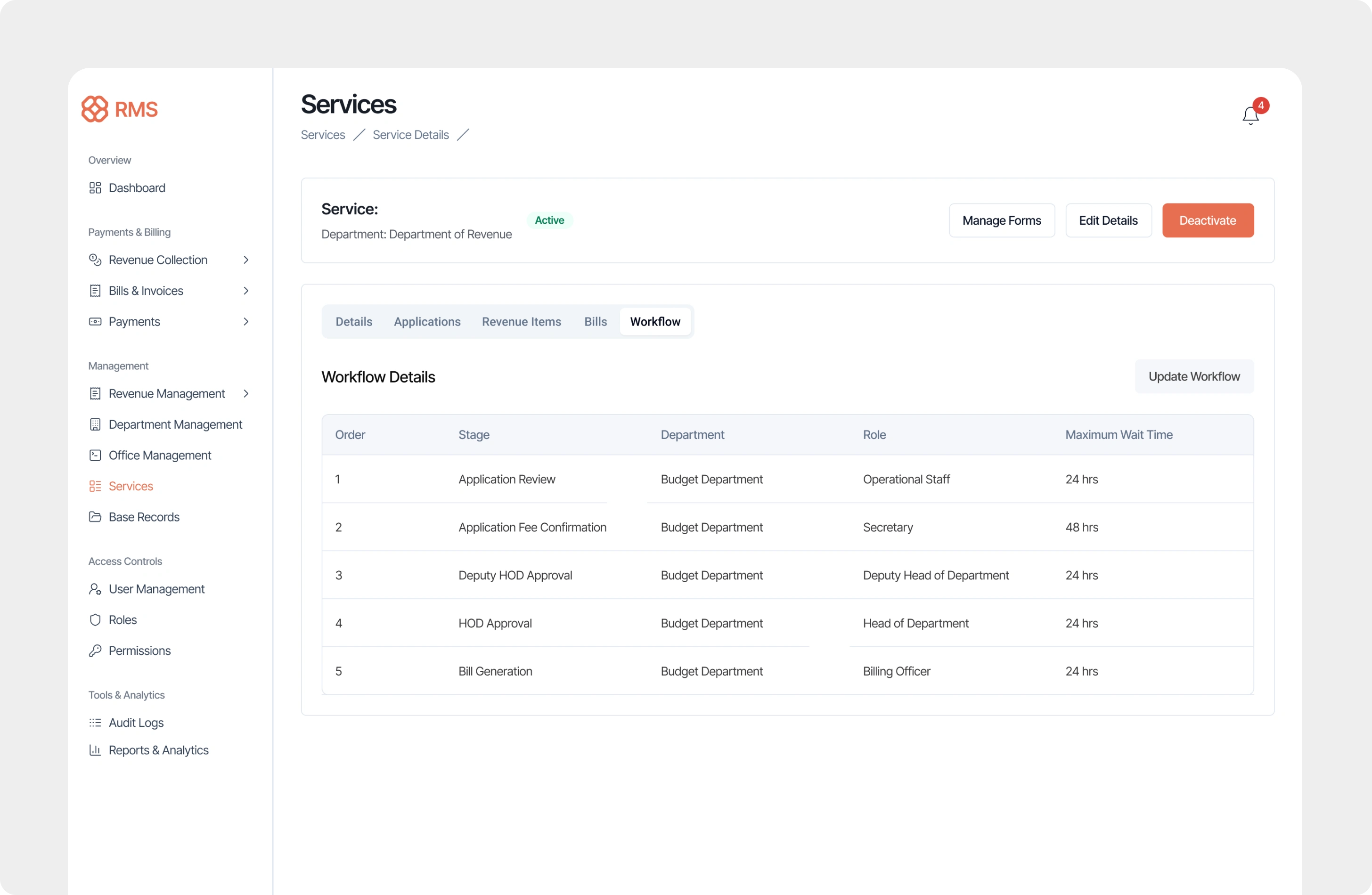
Workflow setup
The Problem:
Agencies had different approval chains (some 1-step, others 4+ steps). Manual processes created bottlenecks with no visibility into where applications stalled or who was responsible.
Discovery Insight:
During interviews, "Where is this bill stuck?" was the #1 complaint. Applications disappeared into queues for weeks with no accountability.
Design Solution: Configurable Workflow Engine
Each agency defines their approval chain:
Number of stages (2-step, 3-step, or direct issuance)
Departments/roles at each stage
Maximum timeframes per step
Timeline Visualization
Vertical timeline showing full approval journey with current status, completed steps (✓), active stage (highlighted), and pending stages (grayed).
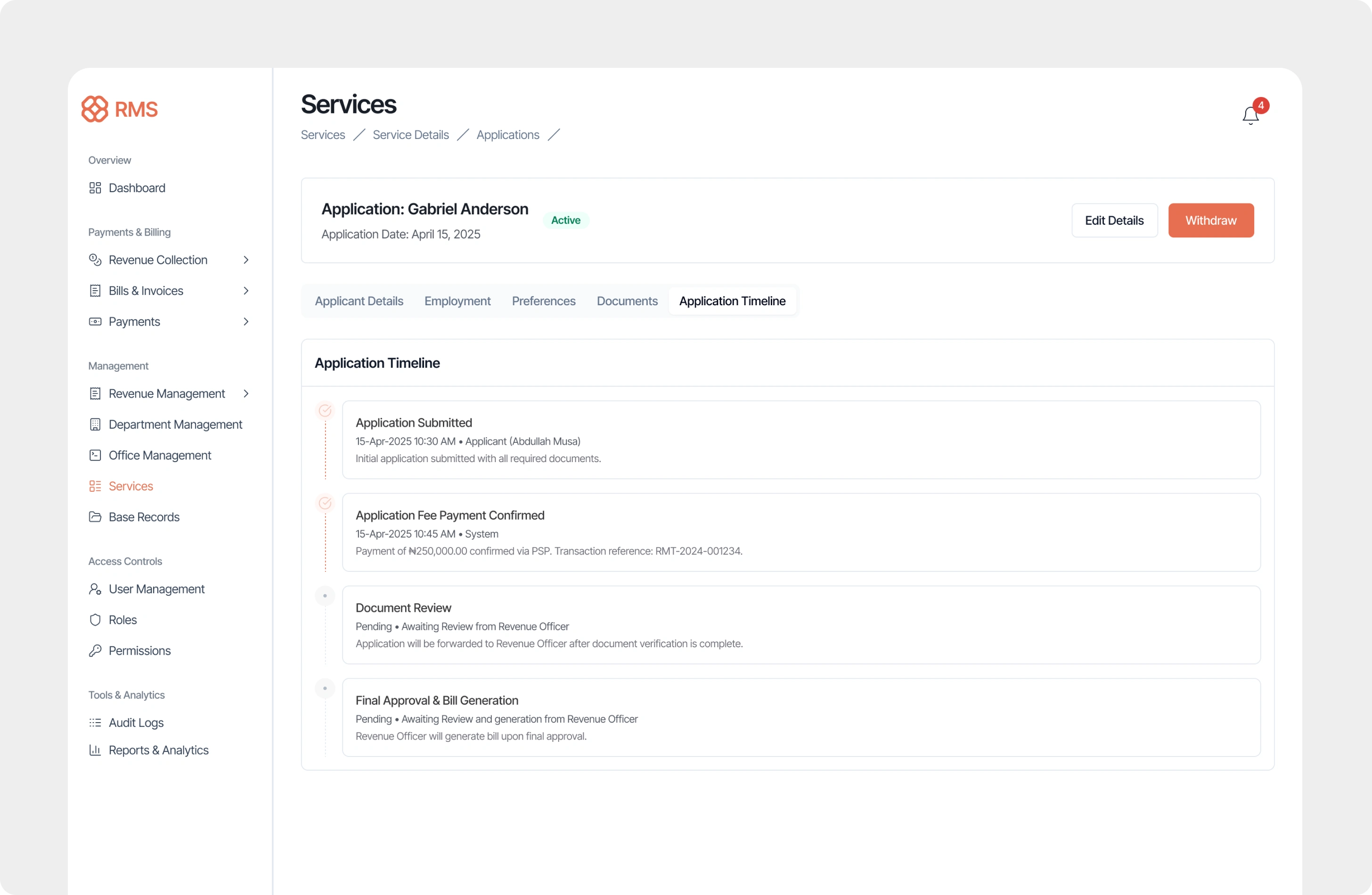
Workflow timeline
Ownership Clarity:
Each stage displays assigned department/individual with escalation paths
Comprehensive Audit Trail:
Every handoff, approval, rejection, or delay timestamped and logged
Design Principle Applied:
"Flexibility with accountability." Agencies control their process, but the system enforces transparency.
Impact:
Transformed opaque manual handoffs into trackable workflows. Estimated 65% reduction in approval cycle time (from 5-7 days to 24-36 hours)
Challenge 3: The Services Engine - Most Complex
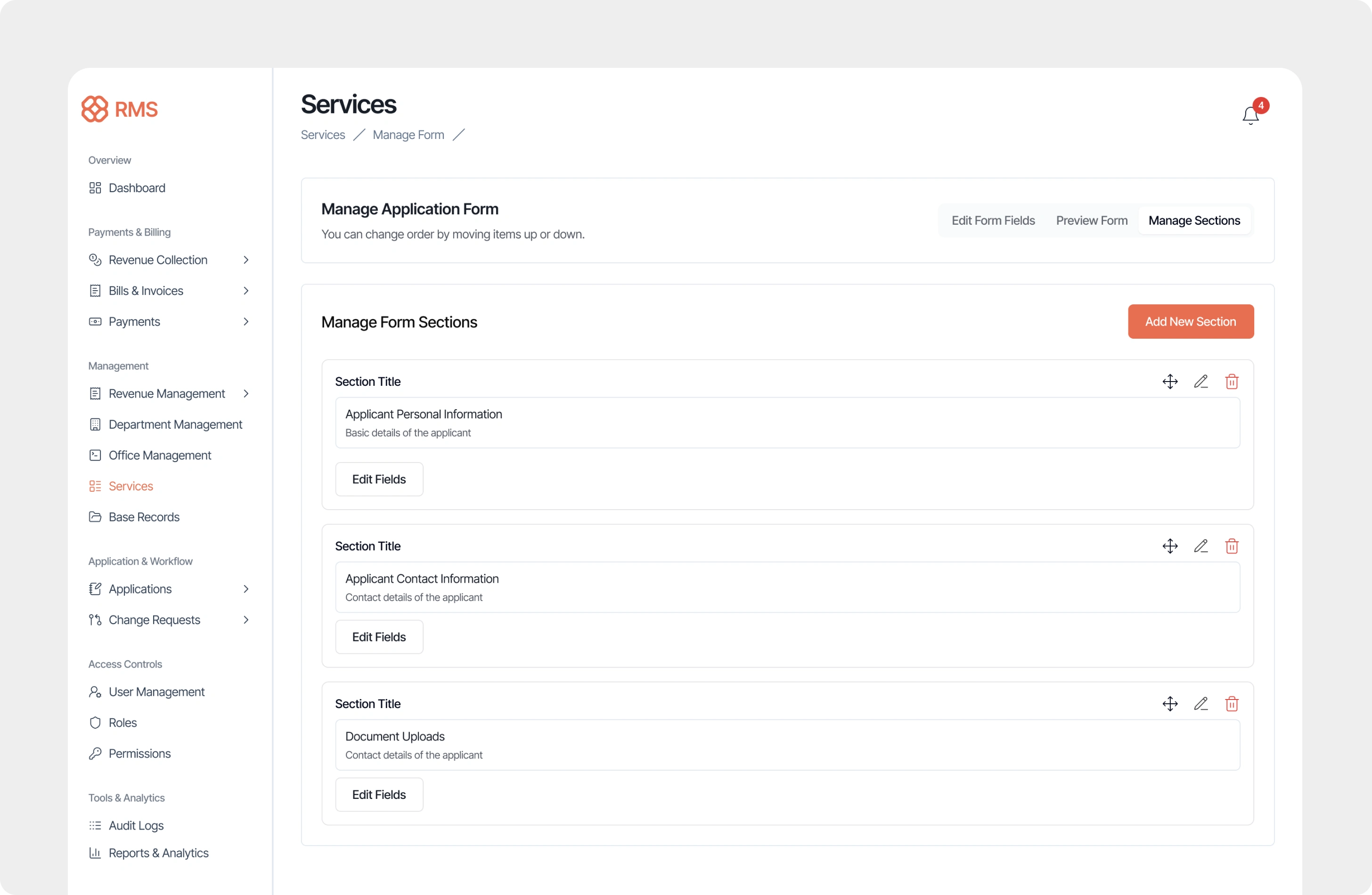
Form sections
The Core Problem:
Agencies had established fee calculation formulas done manually (Excel, calculators, paper forms). I needed to digitize these into a configurable system that non-technical users could manage independently.
The Complexity:
Services drive everything: Revenue items → Calculations → Custom forms → Workflows → Bills
Each agency had different formulas (fixed rates vs. calculated: base + (weight × rate))
Formula parameters needed to map to actual data sources (form fields, user records)
One misconfiguration could break an entire billing cycle
Bulk billing could generate 10+ bills at once
Part A: Dynamic Form Builder
The Challenge: Each service required custom application forms (5 to 10+ fields with conditional logic), but users weren't developers
Design Solution: Three-Panel Progressive Workflow
Left Panel: Structure
Pre-built section library (Personal Information, Contact Information)
Drag-and-drop reordering
Visual distinction between active/inactive sections
Center Panel: Field Library
Button-based field type selection (Text, Email, Number, Dropdown, File, Multiple Options)
All options visible at once, no dropdown menus
One-click field addition
Right Panel: Live Configuration
Field label and placeholder editing
Required field toggle
Delete with confirmation
Real-time preview of changes
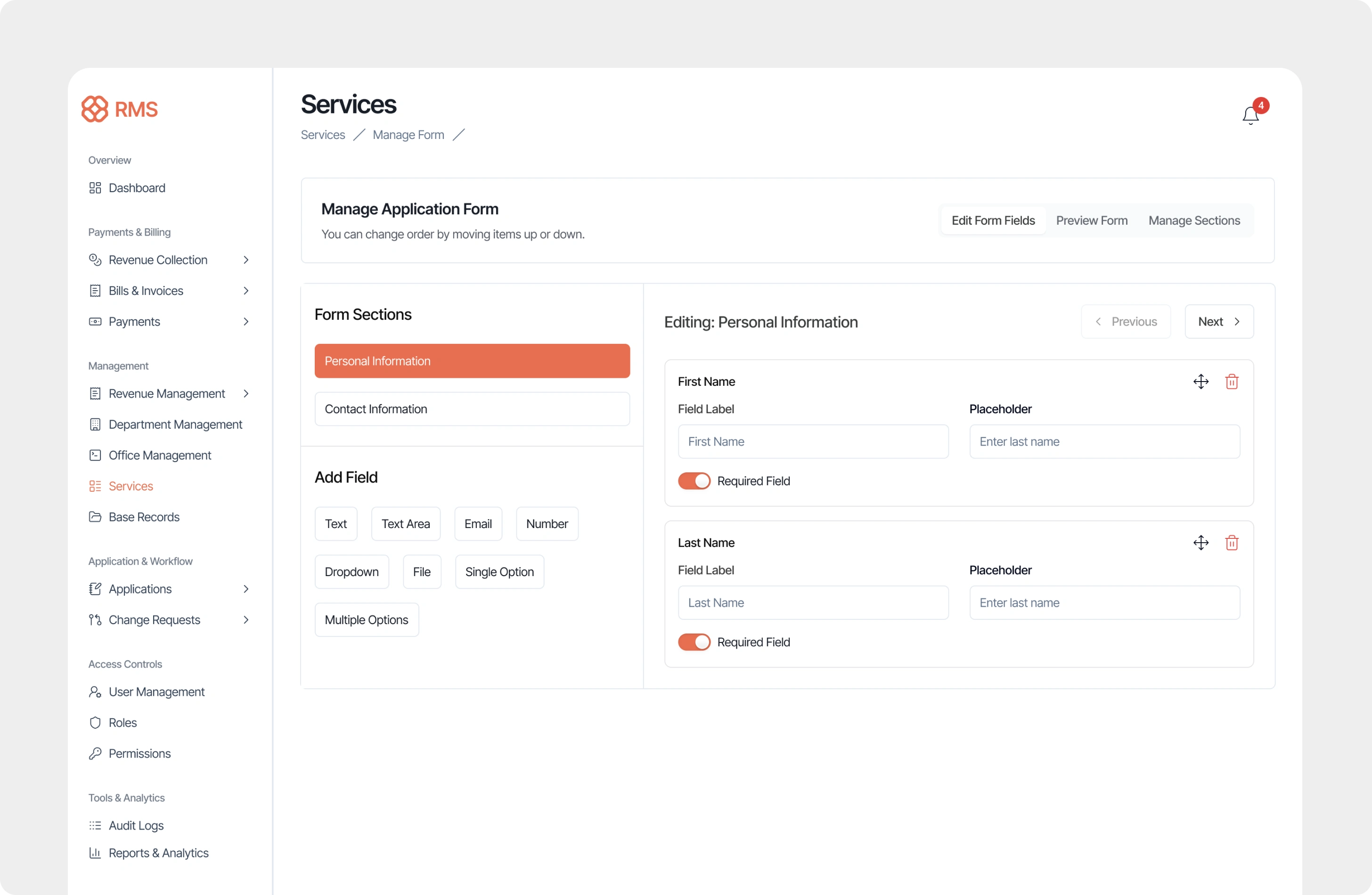
Form builder
Impact:
Non-technical users built 20+ field forms in under 30 minutes (vs. 2-3 weeks with developer support).
Part B: Formula Builder & Parameter Mapping
The Challenge: Translate agencies' existing manual formulas (e.g., "Vehicle fee = base (₦50) + weight in tons × ₦10") into configurable system logic.
Design Solution: Modal-Based Progressive Configuration
Broke complex formula creation into focused steps:
Step 1: Rate Type Selection
Simple choice: Fixed Rate or Calculated Rate
Step 2: Parameter Selection
Dropdown of available parameters (Vehicle Weight, Property Size, Duration, etc.)
Step 3: Formula Construction
Visual builder with formula type selection and rate inputs
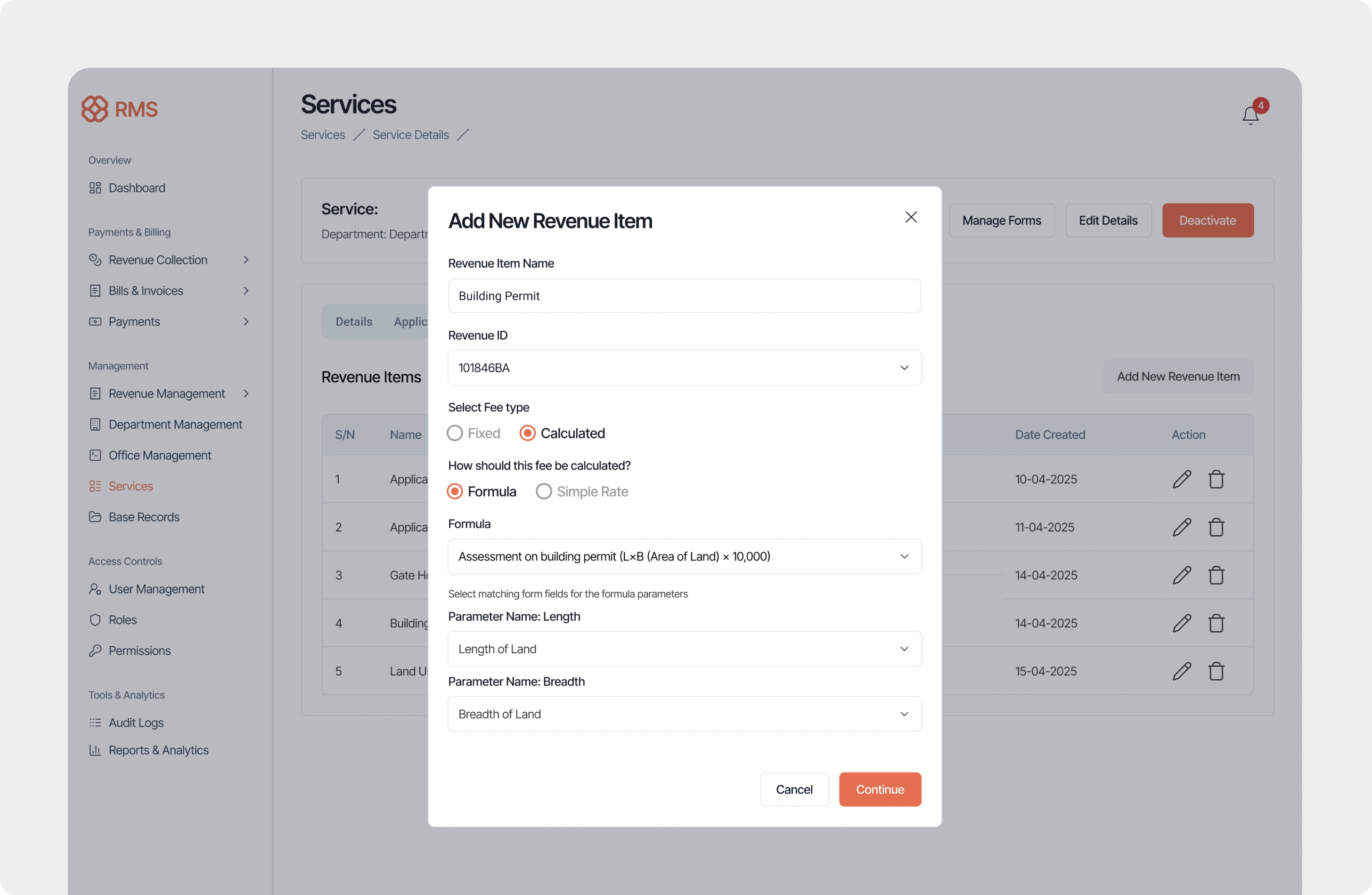
Add Revenue Item
Design Principle Applied:
"Guided power." Give users powerful tools wrapped in structured workflows—no open-ended complexity.
Part C: Bulk Billing with Safety Rails
The Challenge: Generate multiple bills at once without errors, duplicates, or system crashes.
Design Solution: Category-Based Targeting with Preview
Target selection: "All residential buildings in Gwarinpa district"
Real-time count: "This will generate 47 bills"
Conflict detection: "8 users already have active bills—exclude?"
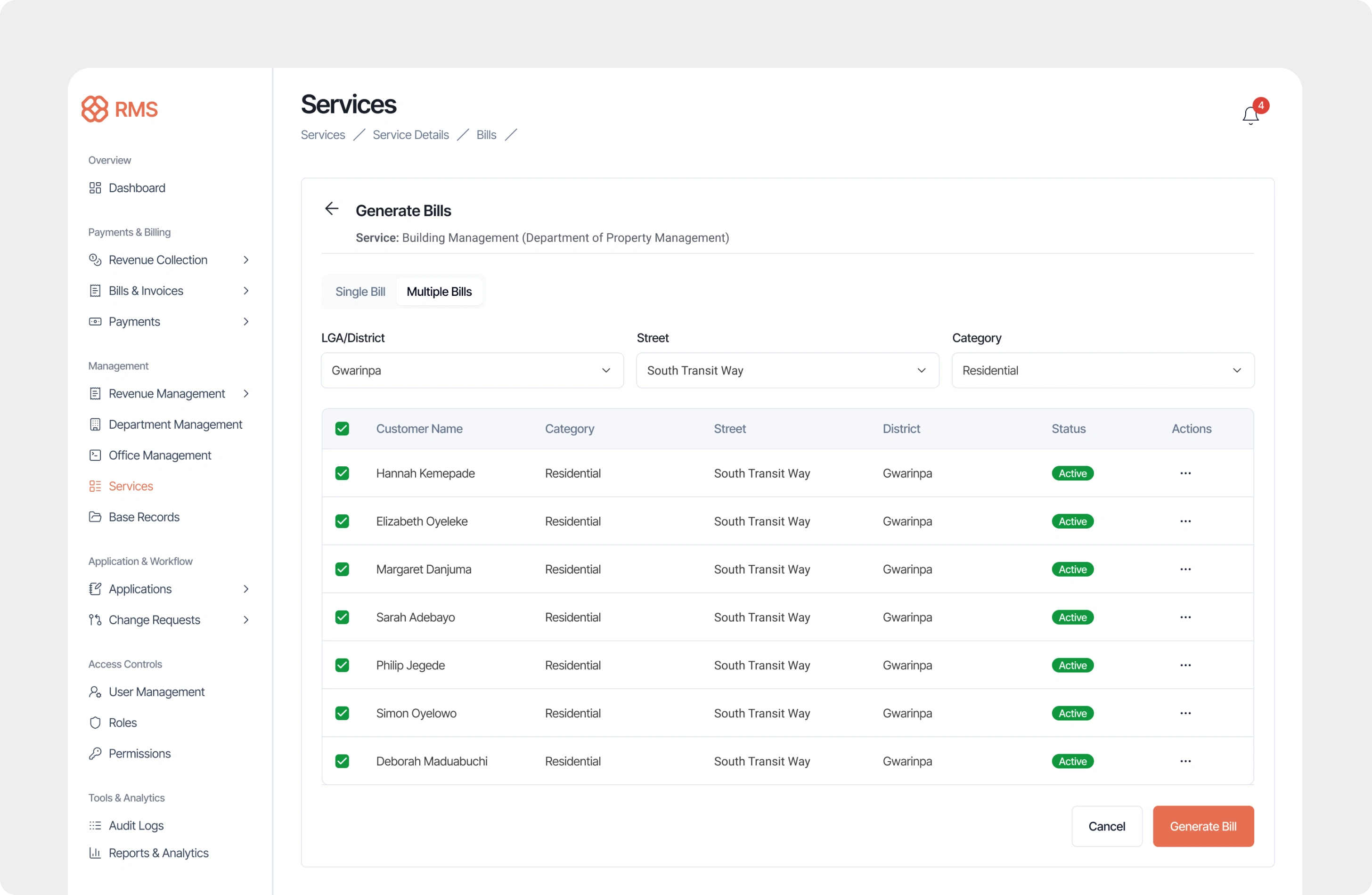
Bulk Bill Generation
Challenge 4: Granular Permissions Management
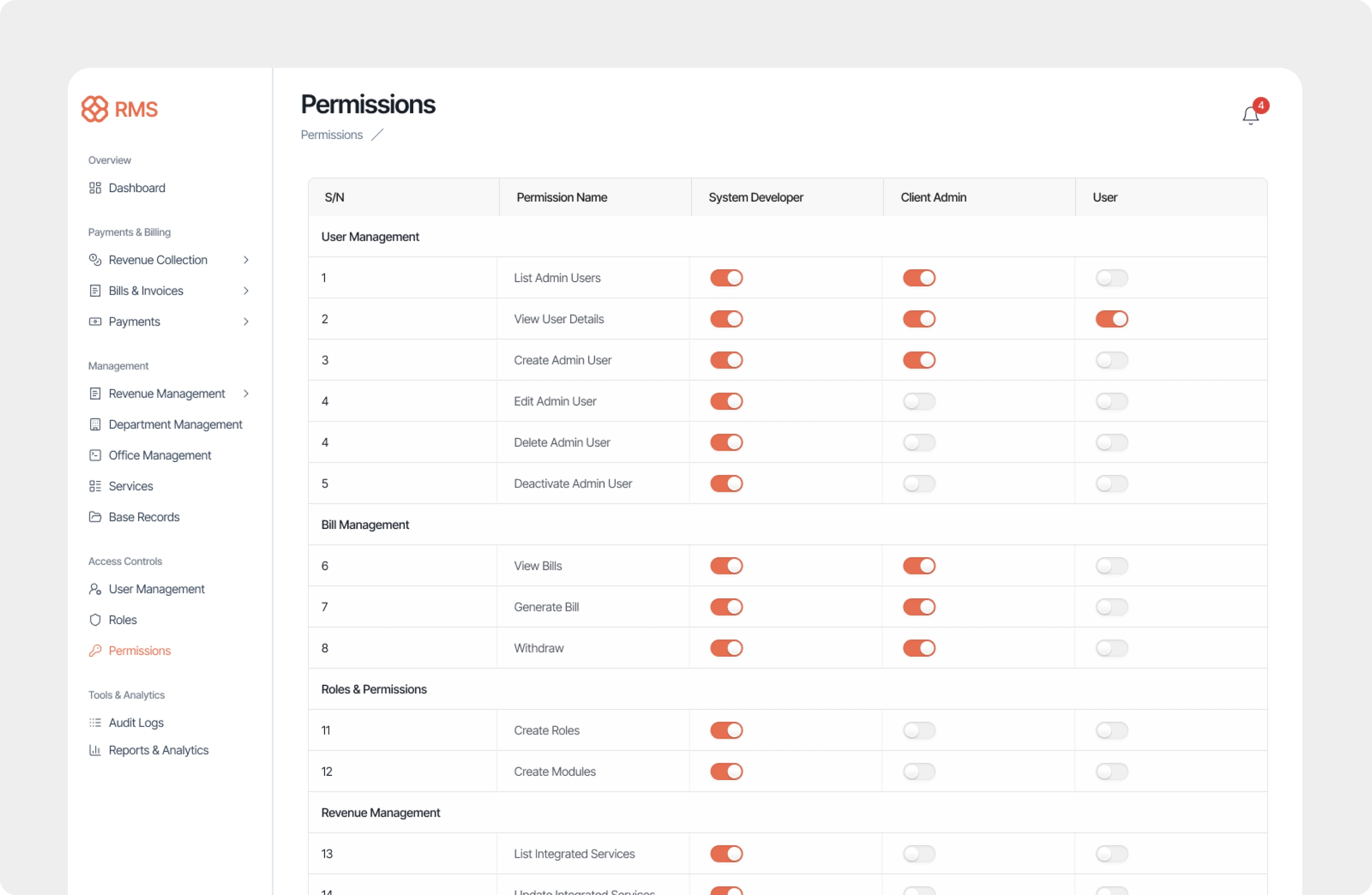
Permissions Setup
The Problem:
Enterprise systems require fine-grained access control, but permission matrices often become unwieldy and error-prone.
Design Solution: Structured Permission Matrix
Three-Tier Role Hierarchy:
System Developer — Full platform control (used by consulting team during setup)
Client Admin — Agency-level management (used by agency IT/finance leads)
User — Operational access only (used by department staff)
Grouped by Functional Area: Permissions organized into logical sections:
User Management (Create, Edit, Delete, Deactivate Admin Users)
Bill Management (View, Generate, Withdraw Bills)
Roles & Permissions (Create Roles, Create Modules)
Revenue Management (Integrated Services, Search Categories)
Toggle-Based Controls:
Instant visual feedback (orange = enabled, gray = disabled)
No ambiguous checkbox states
Each permission requires deliberate click
Clear Naming Convention: Action-object pattern eliminates ambiguity:
"Create Admin User" (clear)
Why This Design Works:
Audit-friendly — Security teams quickly scan what each role can do.
Error prevention — Grouped permissions reduce chance of missing related controls.
Self-documenting — New admins understand system capabilities by reviewing permission names.
Scalable — Adding new permissions follows established pattern.
Impact:
Role setup time reduced from 2-3 hours (with IT support) to 15 minutes (self-service by agency admins).
Outcomes & Impact
Process Efficiency
⚡ 65% reduction in approval cycle time — From 5-7 days to 24-36 hours
🎯 90% reduction in calculation errors — From ~12% error rate to <1%
⏱️ 80% faster service configuration — From 1-2 weeks (with IT) to 1-2 hours (self-service)
Operational Impact
📊 Complete audit visibility — 100% of transactions traceable with full audit trails
🚀 4x faster bulk billing — 100+ bills generated in minutes vs. days
💰 73% faster payment processing — From ~14 days to ~4 days average
System Scale
🏢 4+ agencies onboarded in first deployment phase
📈 10,000+ bills projected to be processed in first 6 months
🔄 Zero data cross-contamination incidents — Multi-tenant isolation validated
User Feedback
"We went from chasing paper trails and Excel sheets to having complete visibility into every bill, payment, and approval. It's transformed how we operate." — Finance Director, Commerce & Trade Agency
Key Learnings
Systems-Level Design Requires Facilitation
In consulting, design decisions aren't just about users—they're about building bridges between:
BA's comprehensive documentation needs
PM's speed-to-market priorities
Engineering's technical constraints
Client's existing business processes
Success required constant translation and consensus-building.
Error Prevention > Error Handling
The time invested in validation mechanisms (test calculators, conflict detection, required field toggles, confirmation gates) prevented downstream disasters. Every validation point saved hours of cleanup later.
Audit Trails Are Core Features
In enterprise systems, "who did what when" isn't just compliance—it's functionality that users rely on daily for accountability and troubleshooting.
Why It Matters
This project challenged me to design a configurable enterprise platform that balances power with simplicity, autonomy with governance, and flexibility with consistency. As the sole designer, I drove alignment across diverse stakeholders and shaped the entire UX architecture for a system now serving 1,200+ users across 5+ agencies.
It strengthened my ability to:
Design configurable systems that scale
Translate complex business logic into intuitive interfaces
Collaborate effectively in cross-functional consulting environments
Build design systems that support customization without chaos
Facilitate decision-making across competing stakeholder perspectives
Think beyond individual screens to holistic, interconnected experiences
I'm now seeking to bring this experience into SaaS and enterprise product environments where systems thinking, stakeholder collaboration, and user-centered design converge.
Like this project
Posted Jan 5, 2026
Enterprise revenue platform unifying billing across 4+ agencies, enabling autonomous workflows, central visibility, audit trails, and scalable governance.