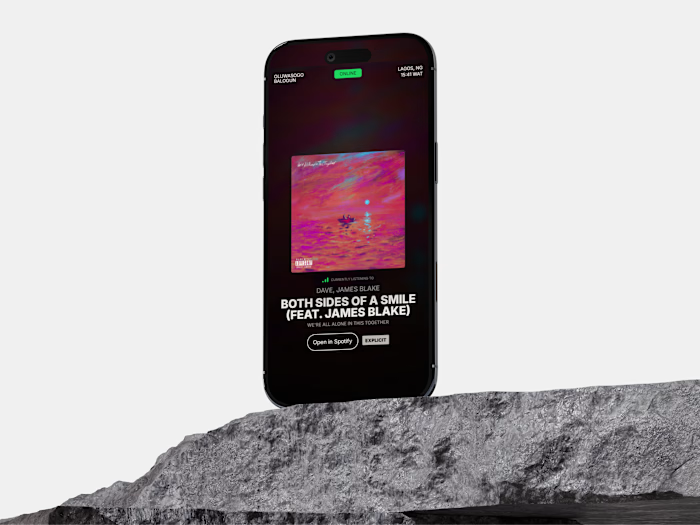
JobTrackr - Job Search Management Platform

Oluwasogo Balogun


JobTrackr
A focused workspace for managing the entire job search.
Product Design · Full-Stack Development · UX/UI · Software Engineering
Job searching rarely happens in one place. Applications live in spreadsheets, interview notes in documents, follow-ups in calendars, job descriptions across browser tabs, and important files somewhere in between.
I designed and built JobTrackr to bring that fragmented process into a single, focused workspace — giving job seekers a clearer picture of where they are, what needs attention, and what comes next.
The challenge
Most application trackers solve one part of the problem: keeping a list of jobs.
But managing an active job search involves much more than maintaining a list. There are interviews to prepare for, follow-ups to remember, documents to organize, status changes to track and eventually offers to compare.
The challenge was to support that complexity without making the product itself feel complicated.
One workspace for the entire process
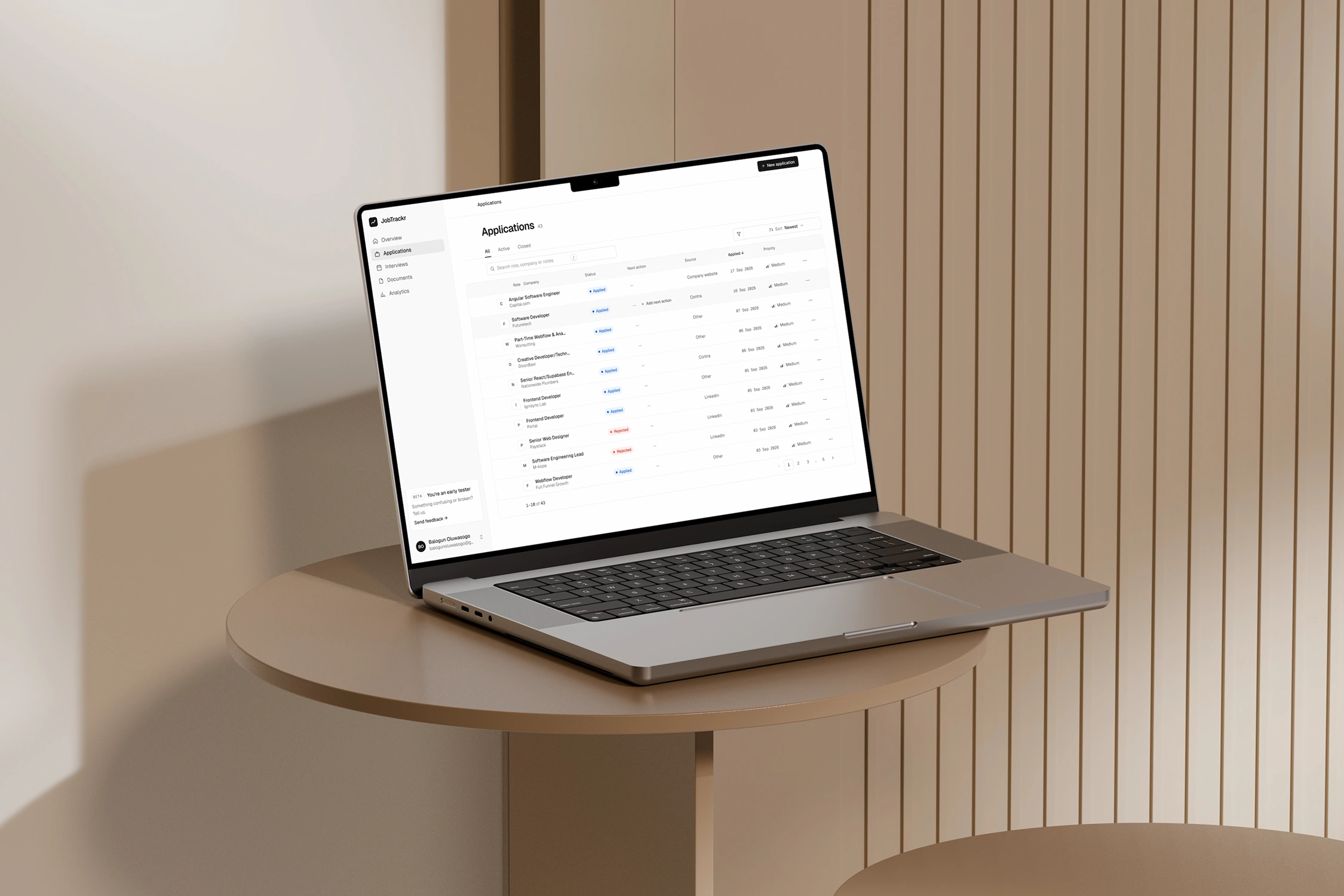
JobTrackr is structured around the lifecycle of an application rather than treating every job as a static record.
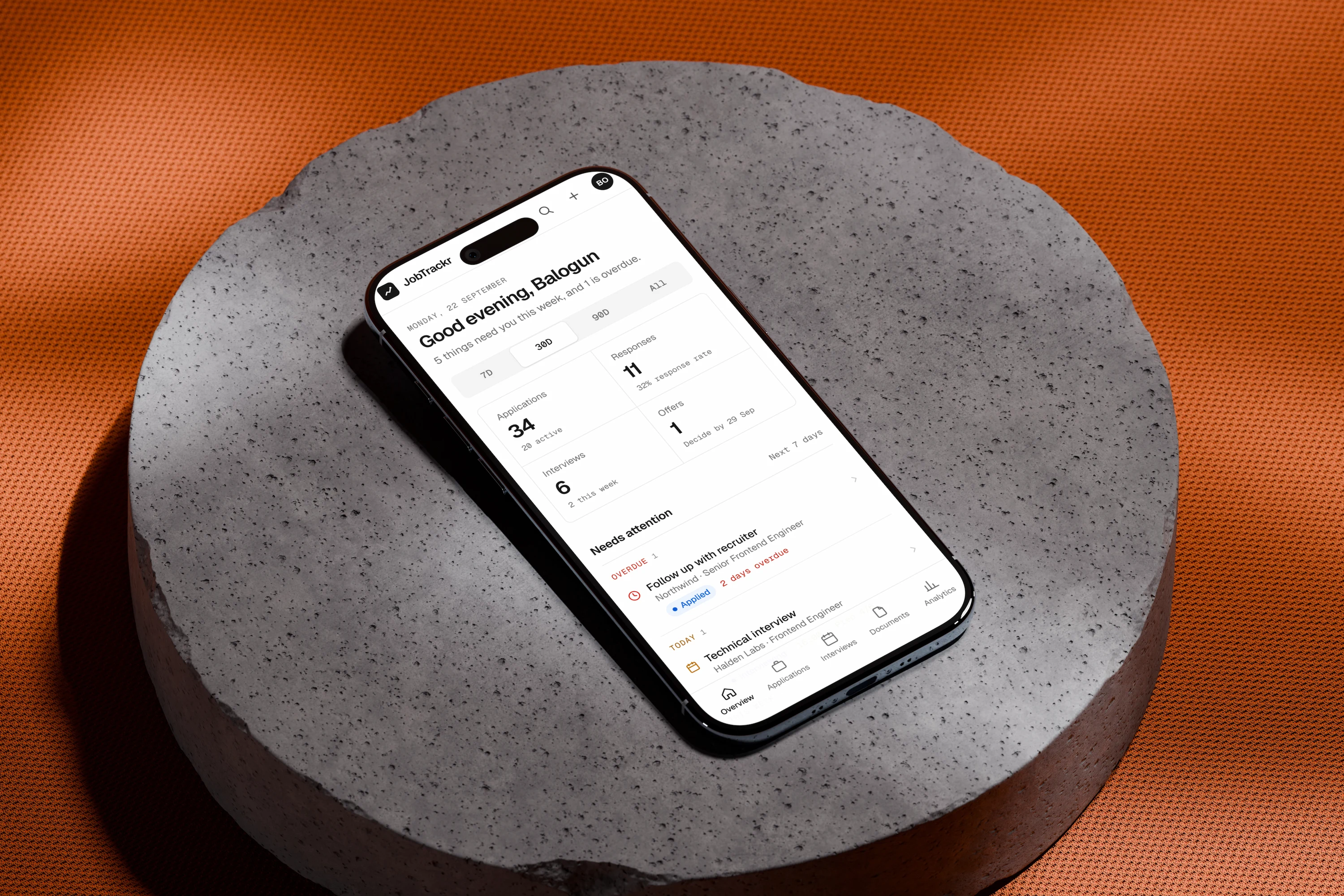
Users can manage their applications, maintain an activity history, schedule next actions, prepare for interviews, attach relevant documents and track offers - while the overview and analytics surfaces provide a broader picture of their search.
A key design principle was making the product answer two questions quickly:
“Where does everything stand?”
and
“What do I need to do next?”
That influenced everything from the dashboard hierarchy to application statuses and the dedicated next-action system.
Designed around real workflows
An application can accumulate a lot of context over time.
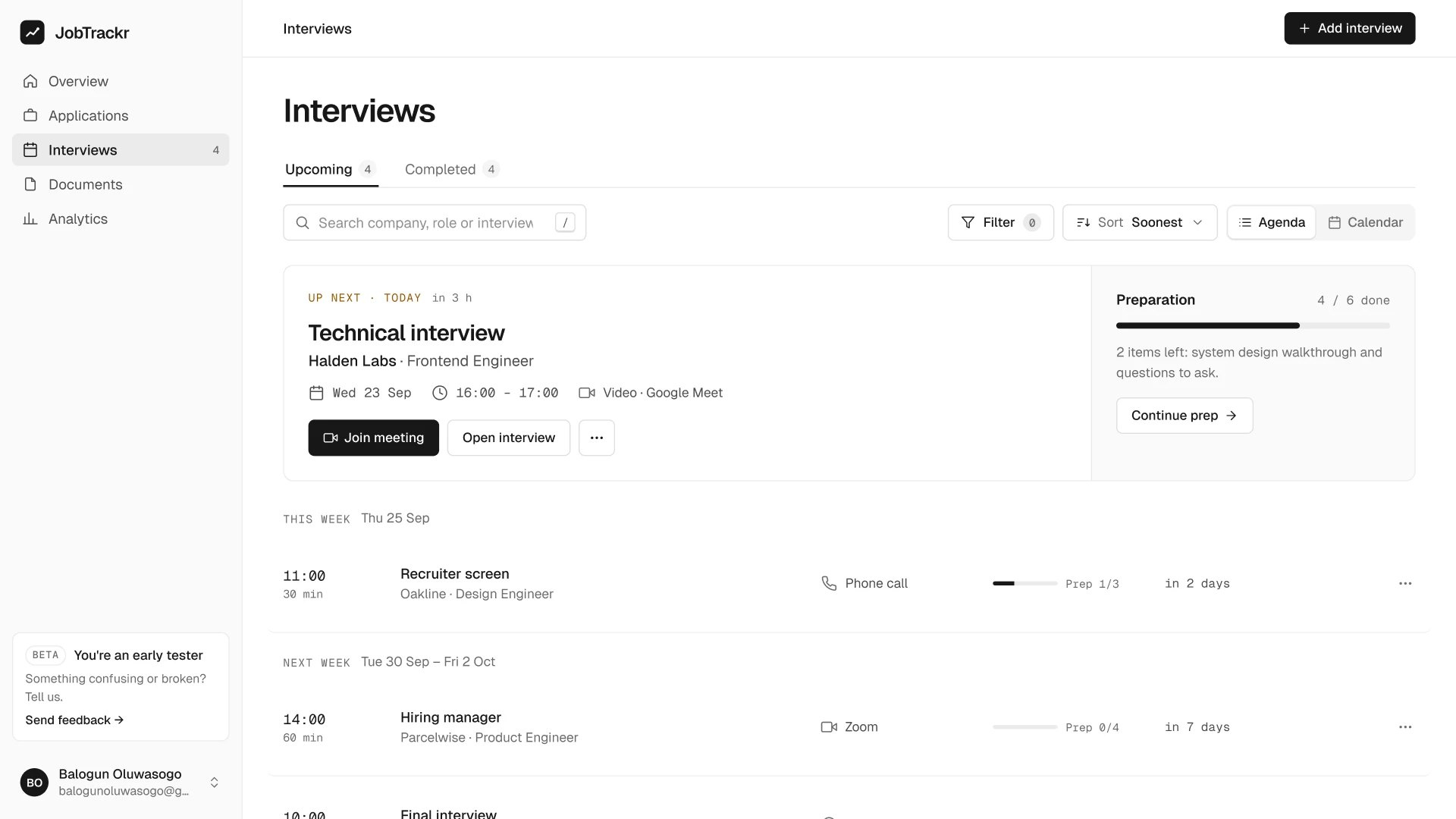
Instead of forcing everything into one oversized form, JobTrackr separates information into focused workflows while keeping it connected to the underlying application.
Interviews have their own preparation space. Documents can be managed centrally and associated with applications. Activities preserve the history of what happened, while next actions keep the user's attention on what hasn't happened yet.

This creates a system that can remain useful from the moment an application is saved through interviews and, eventually, an offer.
Turning activity into perspective
Tracking information isn't particularly useful if users can't make sense of it.
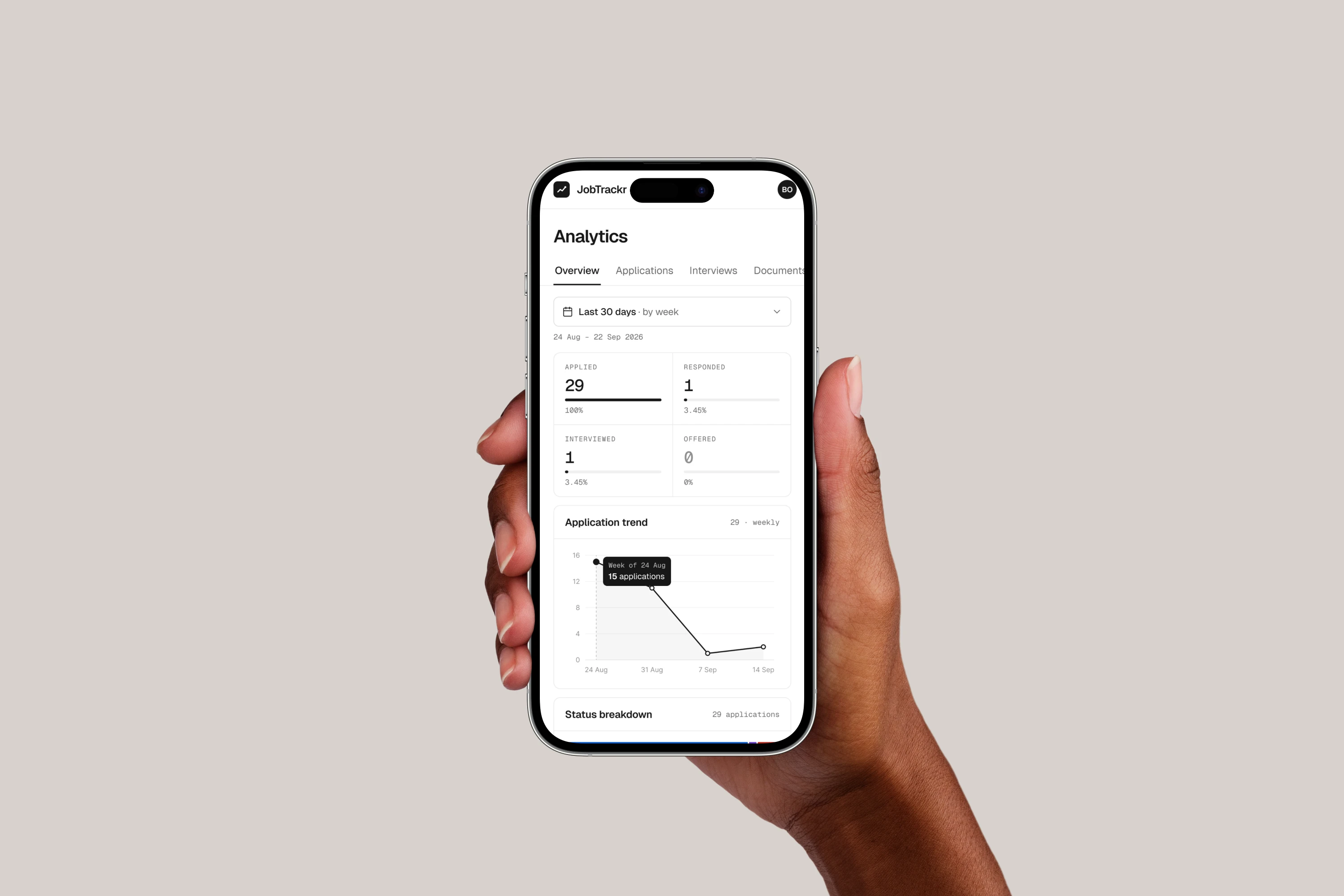
The analytics experience turns application data into a clearer view of the job search - helping users understand application volume, outcomes and progress without turning the product into a dense reporting dashboard.
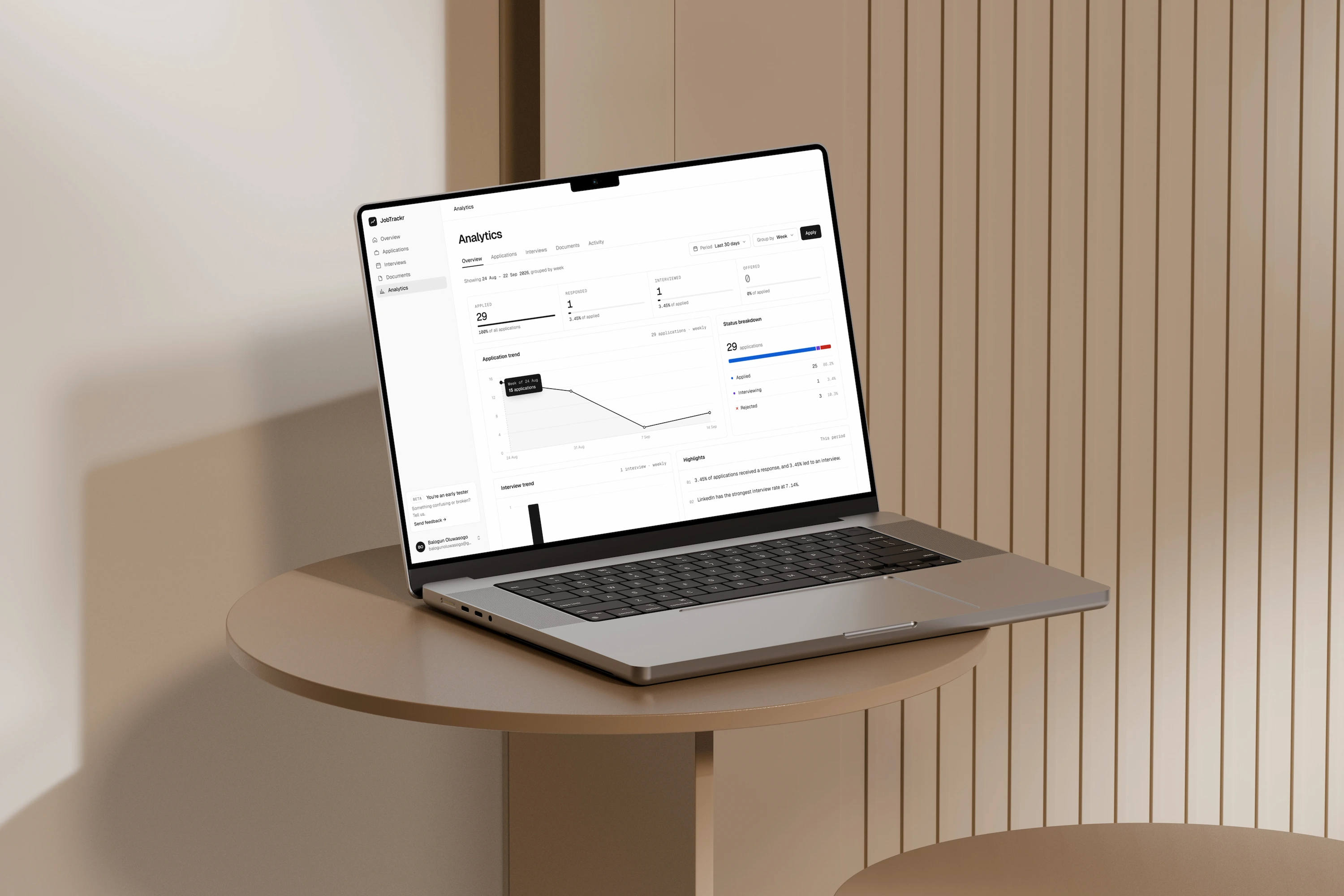
The goal wasn't to add charts for the sake of charts. Each visualization needed to help answer something meaningful about the user's search.
Built end-to-end
JobTrackr wasn't only a design exercise.
I took the product from concept through UX/UI design, frontend engineering, backend architecture, relational database design, authentication, authorization, security and production deployment.
The application uses a Next.js + React frontend with a NestJS API, backed by PostgreSQL through Supabase. Authentication supports email/password and Google sign-in, with user-scoped data protection and row-level security forming part of the security model.
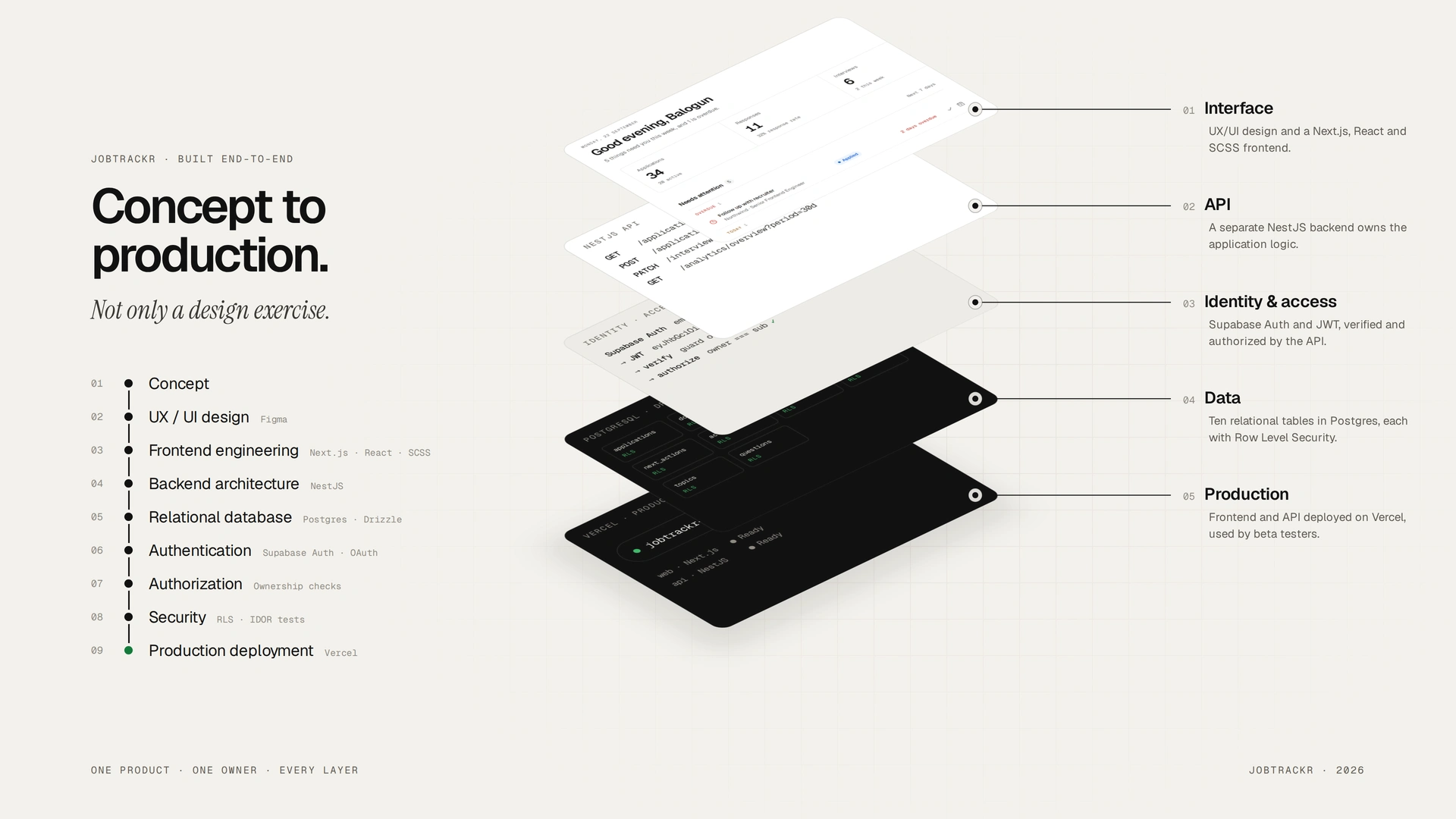
The underlying data model connects applications with activities, next actions, interviews, preparation items, documents and offers while maintaining clear ownership boundaries between users.
Built to be used, not just presented
The final step was putting JobTrackr in front of actual users.
Rather than ending as a portfolio prototype, the application was deployed as a working product with responsive experiences across desktop and mobile.
That distinction mattered to me: the interface needed to survive real data, real accounts and real usage - not just look good in a case-study mockup.
The result
JobTrackr became both a functional product and an exploration of how thoughtful product design and engineering can simplify a workflow that is inherently messy.
It brings applications, interviews, actions, documents, offers and analytics together without losing the sense of focus that motivated the product in the first place.
Next.js · React · TypeScript · NestJS · PostgreSQL · Supabase · SCSS
See it in action.
JobTrackr isn't a prototype. It's a live product built for real job searches.
Like this project
Posted Sep 25, 2026
A full-stack platform designed and built to bring applications, interviews, follow-ups, documents, offers and job-search analytics into one place.