
It started with $100 I didn’t want to waste
I had $100 in Claude credits that were about to expire.
There were about three or four days left to use them, and I figured I might as well build something rather than let them go to waste.
I’d already been thinking about experimenting with Three.js, 3D graphics, and interactive experiences in the browser. I had a few ideas, but nothing I’d committed to building yet.
I’ve also practised Taekwondo since 2015, when I started university. I haven’t been training as consistently in recent years, but it’s something I’ve enjoyed for a long time.
During a short brainstorming session, those two interests came together.
What if I built a 3D Taekwondo game that runs in the browser?
That’s how DOJANG started.
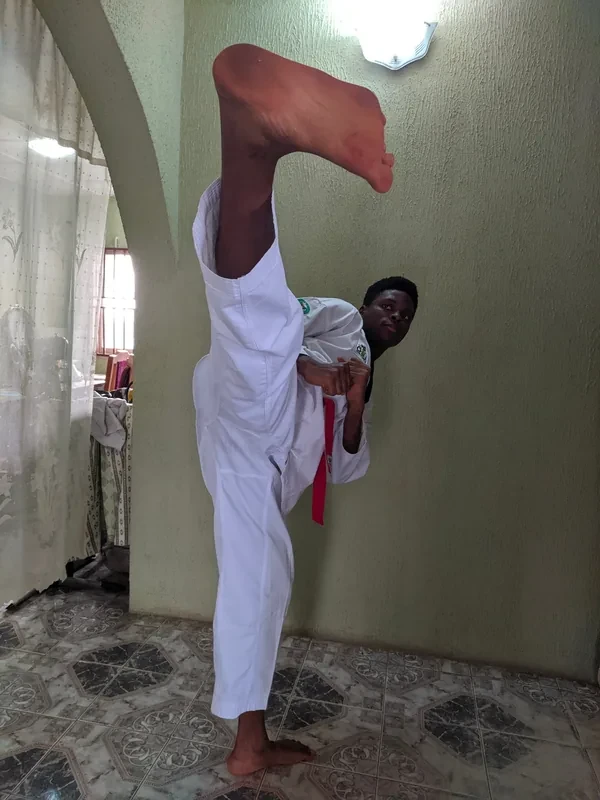
Training at home in 2020
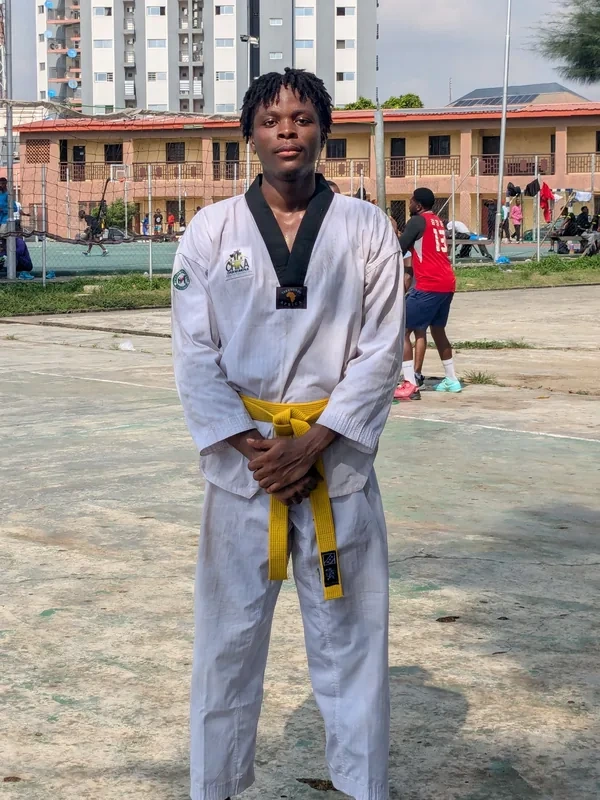
Training in my dobok in November 2025
I wasn’t trying to build the next big fighting game. I wanted to explore an idea, see what was possible, and hopefully have something playable before those credits expired.
Getting the first version working
I approached DOJANG the same way I approach most of my projects: with a plan.
I started by working through the idea with ChatGPT. I had a vision for the game and gathered references of Taekwondo practitioners sparring, training halls, and the general atmosphere I wanted to create.
Once I was happy with the direction, I moved into implementation with Claude.
The first version was surprisingly promising.
I could move fighters around a 3D dojang, control the camera, throw kicks, and actually register hits. The playing area looked good, and the camera angles were already quite nice.
Of course, there were rough edges.
The characters looked somewhat like stick figures, their movements were stiff, and some of the kicks didn’t look quite right. But I wasn’t particularly concerned about those things yet.
I believe in iterating over time. I don’t believe in rushing or 'one-shotting' things. Most things that are good take time to get right.
The important thing was that I had something working.
And now that I could actually play it, I had a much better idea of what needed improving.
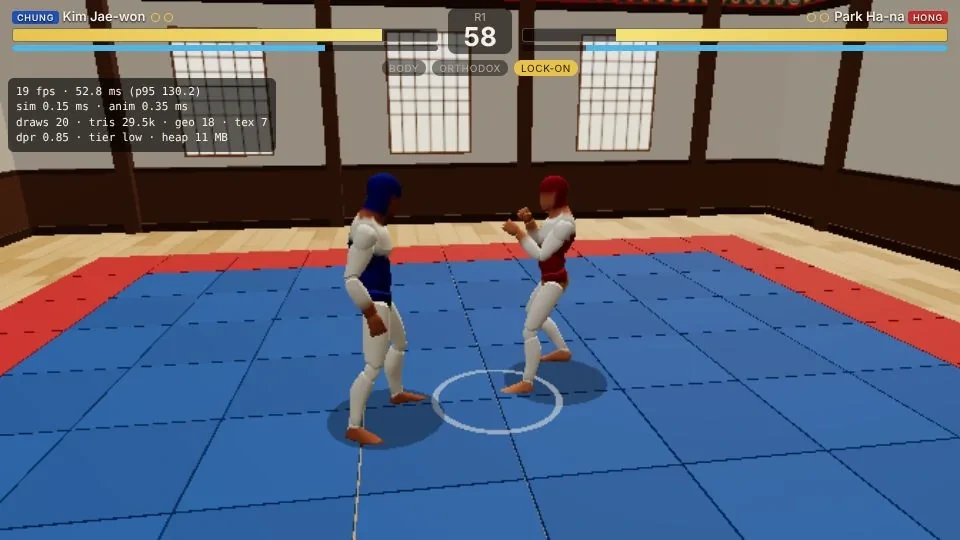
The first version: the fighters squaring up
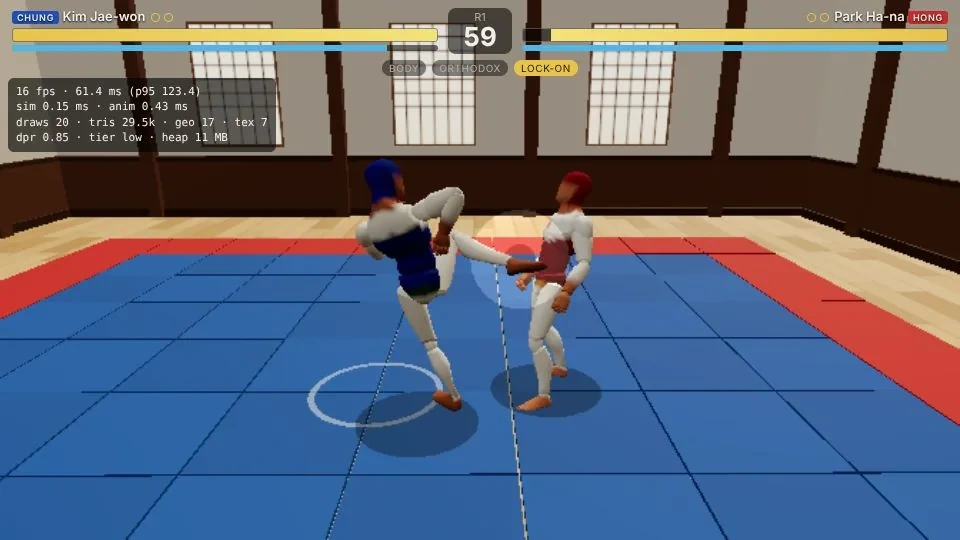
The first version: a roundhouse kick landing
Making the fighters feel like Taekwondo practitioners
One advantage of having practised Taekwondo myself is that I already had a reference for how sparring should look and feel.
Not that I’m an expert, but I’ve spent enough time training to recognise when something feels off.
Take the footwork, for example.
When Taekwondo practitioners spar, there’s a rhythm to their movement. They’re bouncing lightly, adjusting their distance, shifting their weight, stepping in and out, and preparing to react.
Sparring in November 2025
Cut from a longer recording down to the busiest exchanges. I’m the one in the white dobok.
The first version of DOJANG didn’t really capture that.
The fighters could move across the mat and throw kicks, but their movements felt mechanical. Their feet sometimes appeared to slide, and the transitions between standing, moving, kicking, and recovering weren’t particularly convincing.
So I started describing what I wanted to Claude.
I explained the bounce, the footwork, how fighters should move forward and backward, and how they should settle after throwing a kick. I also provided references and asked the agent to look at footage of real Taekwondo sparring.
The distinctions between techniques mattered too. A roundhouse kick shouldn’t look like a side kick. The way a fighter prepares, rotates, extends the leg, and recovers is part of what makes each technique recognisable.
Over several iterations, the fighters became much more convincing.
The game uses procedural animation rather than relying entirely on prerecorded movement. In simple terms, it calculates and adjusts parts of the fighters’ movements as the game runs. That made it possible to refine things like foot placement, balance, and how a fighter recovers after a kick.
I wasn’t personally writing those animation systems. My role was to explain what I wanted, review what the coding agent implemented, play the game, and identify what still needed attention.
First version
Now
The characters themselves went through a similar process.
At one point, they had faces without any real facial features. Just smooth, featureless surfaces where their faces were supposed to be. It looked a little jarring.
I didn’t need photorealistic faces. I just wanted simple details like eyes, noses, and mouths to make the characters feel more natural.
The same applied to their uniforms and protective equipment. Over time, the fighters got their doboks, hogu, headgear, gloves, and foot protectors.
Those details helped bring the characters closer to what I had in mind.
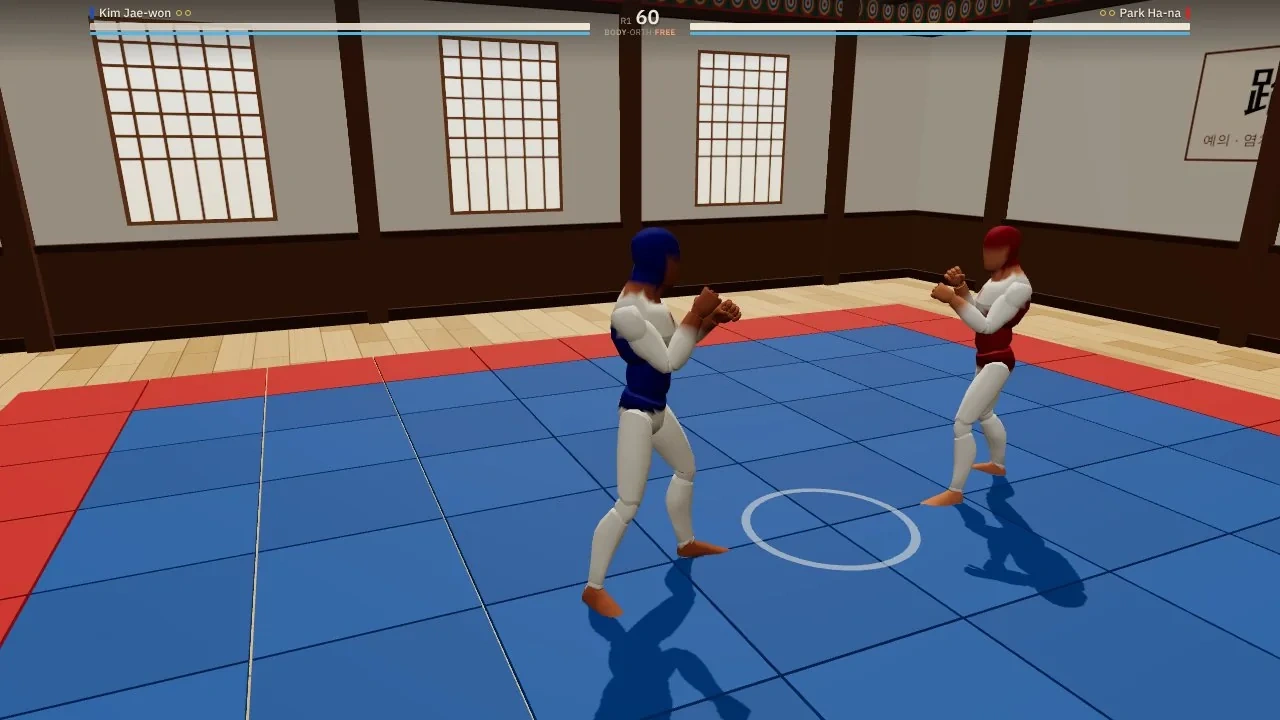
fighters before
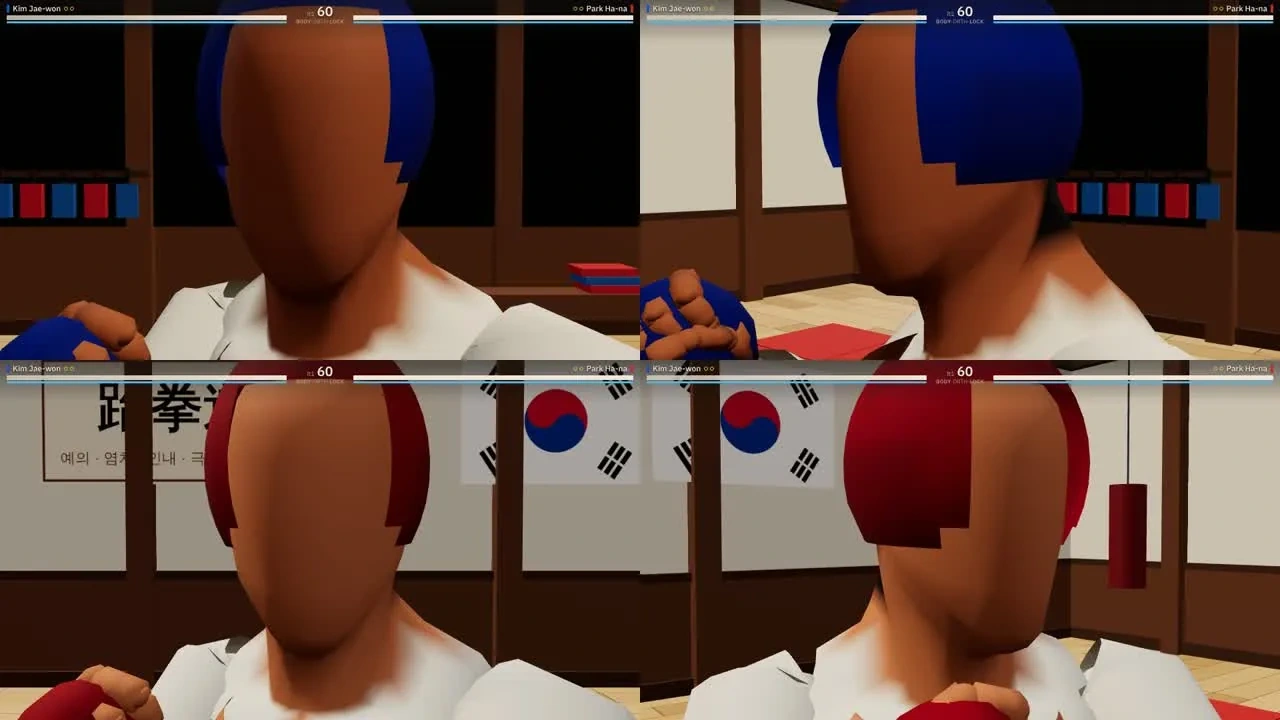
Faces before
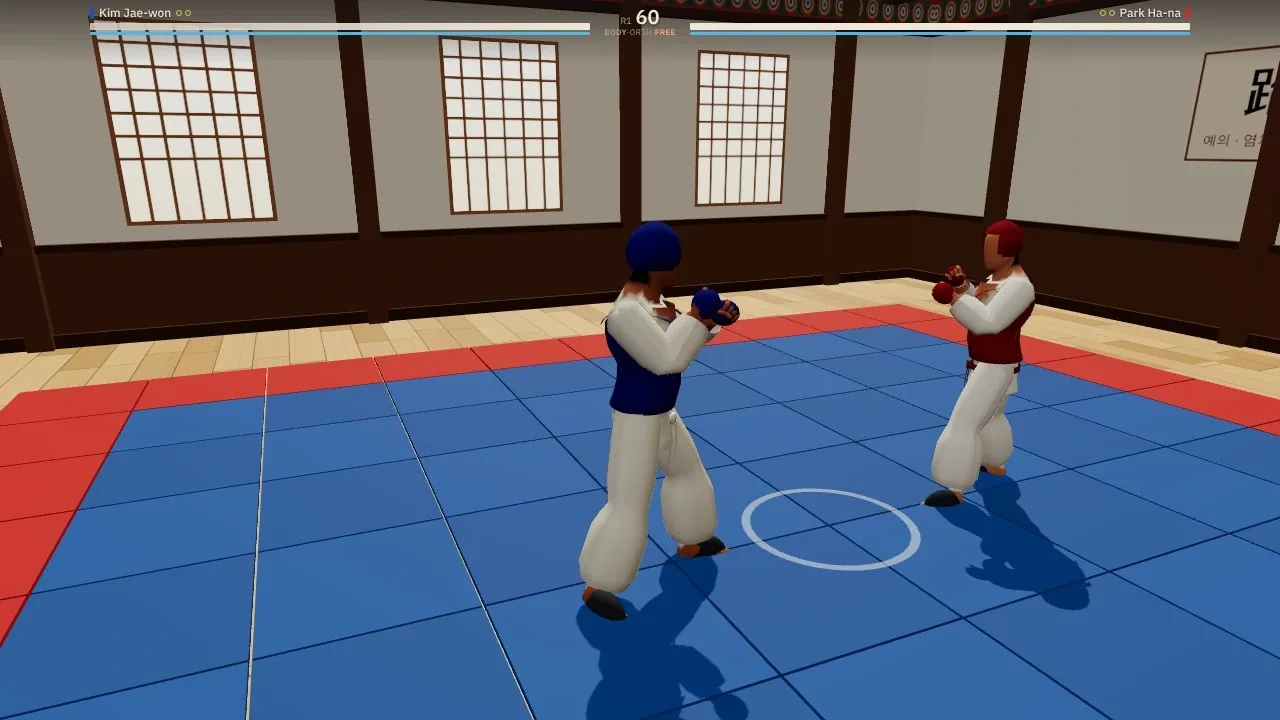
Fighters after
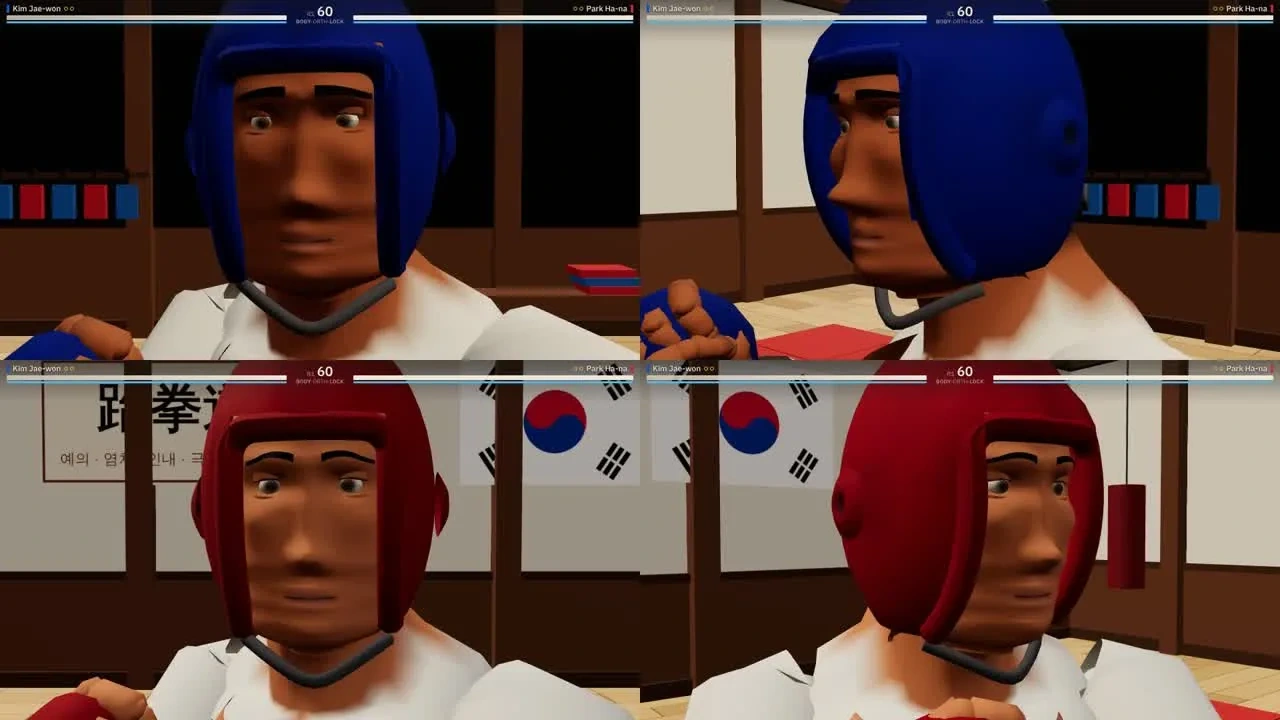
Faces after
I also had to keep my expectations realistic.
I’m not a AAA game studio. I’m just a guy trying to make a Taekwondo game in the browser.
I wanted it to be playable and enjoyable, both for myself and for anyone else who might come across it.
A fighting game still has to feel good on a phone
From the beginning, I wanted DOJANG to work on both desktop and mobile.
On my PC, I could move around using WASD and use the keyboard for different actions. On mobile, I wanted the gameplay experience to feel practically the same, even though the controls would obviously be different.
That turned out to be an interesting design problem.
In the early mobile versions, the buttons took up too much screen space. There were several actions to accommodate: movement, kicks, blocking, dashing, switching stance, controlling the camera, and more.
Putting a separate button on the screen for everything wasn’t working particularly well.
At one point, the controls and interface occupied nearly a third of the screen on a smaller phone. That’s a lot of space to lose when you’re trying to follow two fighters moving around a 3D environment.
After a few rounds of refinement, I settled on a more compact control scheme.
Instead of having every kick permanently visible, there’s a primary Kick button. You can tap it to repeat your selected technique or slide from it to bring up a wheel of other kicks. The remaining actions are arranged around the playing area.
There’s a slight learning curve, especially when you’re using the wheel for the first time. But once you get the hang of it, it’s pretty straightforward.
The changes brought the interface’s screen coverage down from roughly 32% to 18% on an iPhone SE-sized screen.
More importantly, I could still perform the actions available on desktop without having so many buttons covering the fight.
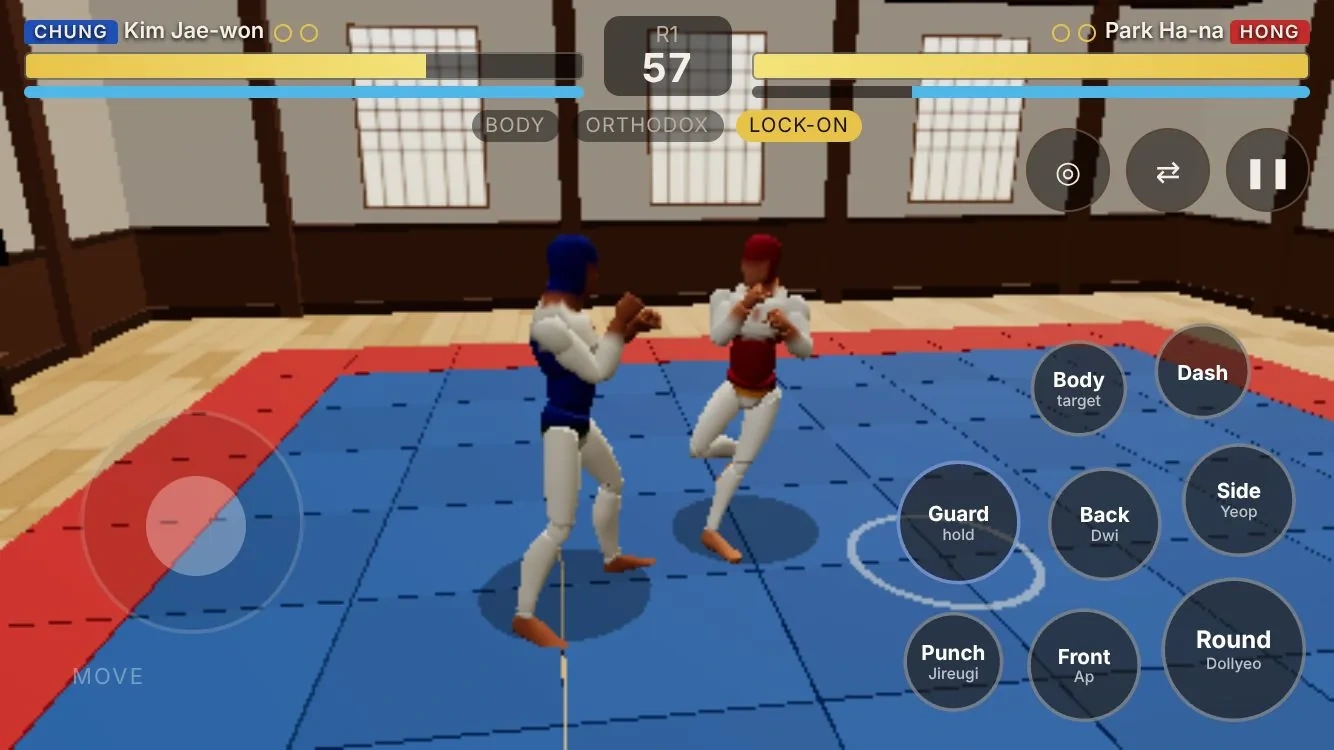
Mobile layout before
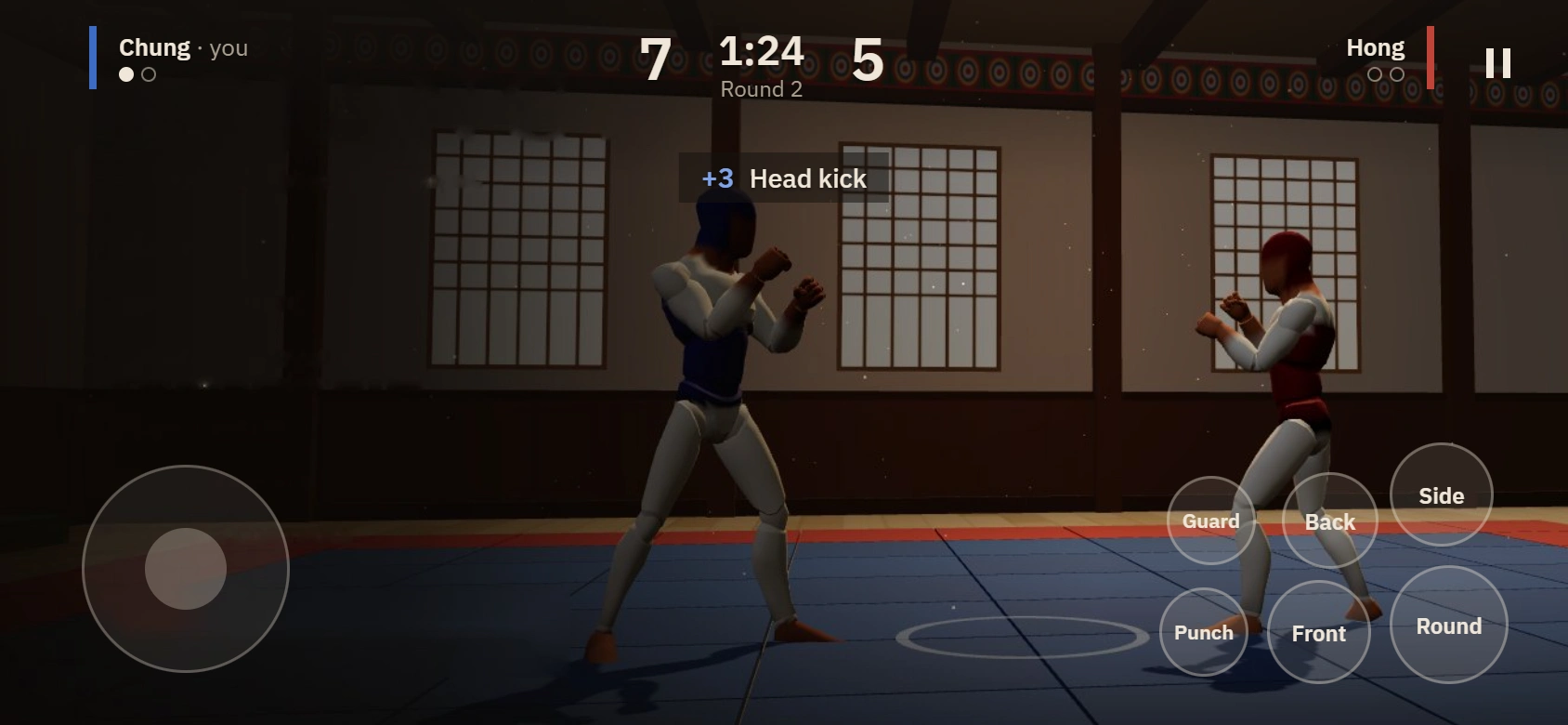
Mobile layout after
I still play DOJANG on both my PC and phone, and I’m happy that the overall experience feels consistent between them.
The controls are different, but I’m still playing the same game.
Getting beaten by my own game
DOJANG has three AI difficulty levels: White Belt, Red Belt, and Black Belt.
Naturally, the Black Belt is the toughest opponent.
While testing the game, I played a few matches against it and got my ass whooped.
That was actually quite satisfying. 😂
I’d spent all this time working on the game, and here I was having to put in some real effort to beat an opponent in something I’d built.
It was one of those moments when DOJANG felt less like an experiment and more like an actual game.
Against the Black Belt AI
A recent match, recorded on 14 November 2026 with a keyboard. It knocked me out in the first round, and I came back to win 2–1.
I also wanted people to be able to play against each other.
Eventually, I added local multiplayer, where two people can play on the same device, and online multiplayer, where you can create a room and invite someone using a link.
One of my favourite moments happened when I tested online multiplayer with a colleague.
We were standing right beside each other. I created a game, sent him the link on WhatsApp, and we started playing.
And it worked.
His actions registered, mine registered, and the match felt responsive. I didn’t notice any obvious synchronization issues during that session.
I was even pointing out some of the things I’d worked on while we were fighting — the movements, the hits, the knockdowns.
It was genuinely fun seeing someone else interact with the game in real time.
Behind that experience is a networking technique called rollback netcode. Rather than making the game wait for every action to travel between players, it keeps the match moving and corrects differences when new information arrives.
For a fighting game, where timing matters so much, that makes a difference.
But at that moment, I wasn’t thinking about the networking implementation. I was just enjoying the match.
An online match
Recorded on 14 November 2026: me on a keyboard, my opponent on a touch screen, joined through a room link. It’s a later match, not the first session with my colleague.
Not everything is where I want it yet
One area I’m still not entirely satisfied with is the sound design.
The first set of effects felt too synthetic and mechanical, particularly the timing of certain sounds.
There have been improvements since then. The game now has sounds for footwork, impacts, blocks, and other actions, using a combination of recorded effects and generated audio.
But I still think there’s room to make it sound more natural.
I spent some time refining it, using real Taekwondo footage as a reference for what different movements and impacts should sound like. Eventually, I decided the improvement was good enough for now.
I can always return to it later.
That’s generally how I approach these things. If something isn’t quite where I want it to be, I’ll work on it, but I also try not to get stuck endlessly polishing one part of a project while everything else waits.
There have also been occasions when I needed to repeat prompts or clarify what I wanted from the coding agent.
That’s something I’m working on as well: communicating requirements more precisely so there’s less room for misinterpretation.
My workflow throughout DOJANG has been fairly straightforward. I describe what I want, the agent implements it through a pull request, I test the result by actually playing the game, and we iterate if needed.
I haven’t been going through the code line by line. Most of my involvement has been in planning, design direction, testing, and deciding what needs to change.
It’s a workflow that’s worked well for me, even if every first attempt doesn’t always get things right.
Still playing, still improving
A few people have played DOJANG now: friends, my brother, colleagues, and some people who came across it online.
Someone on X even shared gameplay and suggested adding a knockdown animation, which I later worked into the game.
I like that. Someone played something I made, noticed something that could make it better, and that suggestion eventually became part of the experience.
The same knockout, before and after
The knockdown fall, added on 9 November 2026. Before it, a knocked-out fighter froze in the pose they were hit in.
DOJANG hasn’t really changed how I approach building things.
I still prefer getting something working first, then improving how it looks, feels, and works over time. It’s the same approach I’ve taken with JobTrackr and my other projects.
What DOJANG has done is give me another opportunity to explore creative development, 3D experiences, and animation — things I’ve been interested in for a while.
There’s still more I’d like to do with it.
But for something that started because I had $100 in credits I didn’t want to waste, I’m pretty happy with how it’s turned out.
And, more importantly, I actually enjoy playing it.
Give DOJANG a try
DOJANG runs in your browser on desktop and mobile. You can spar against the AI, practise your techniques, or challenge a friend.
0 likes · 0 views · Nov 15, 2026
DOJANG — a browser 3D Taekwondo fighting game built with AI assistance, featuring procedural animation, compact mobile controls, local and online multiplayer.

