Baldwin Wallace Study Abroad Website UX Research

Terrell Morton

Timeline: 6 months
Role: UX Researcher, Data Analyst
Goal: Present research-driven guidance on improving BW Study Abroad web conversion
Problem
Leaders wanted insight on what drove students away from singing up for study abroad. Through UX research they sought to understand how they could increase visitors and conversions.
Main themes we sought to explore include: discoverability, navigation, accessibility, and process clarity.
Research Goals & Questions
For our research, we gave participants 9 different tasks, all centered around finding bottlenecks within the study abroad website. The questions focused on different aspects of the Study Abroad booking process.
Derived from these tasks, there were specific questions we sought to answer:
Can students independently locate the BW study abroad website and identify the resources they need for their first steps in the process?
Can students efficiently browse and locate specific programs using the website's current structure and navigation?
Does the website display specific logistical information in a way that's clear and easy to find?
Is the journey to starting an application simple and intuitive enough that students can begin independently?
These questions are a high-level overview of the core usability challenges we set out to investigate, and ultimately shaped the themes and insights that emerged from our research
Methodology
To investigate how effectively students navigate the Baldwin Wallace study abroad website, we conducted individual in-person usability testing sessions with a group of 4-6 volunteer participants recruited from the BW sphere of influence. Participants were selected based on availability and willingness to engage.
Each session ran approximately 20 minutes, during which participants were asked to complete 9 structured tasks using a think-aloud protocol (verbalizing their thoughts, decisions, and frustrations in real-time as they navigated the site).
All sessions were recorded using both screen capture and eye-tracking technology, providing a dual layer of behavioral data.
Following data collection, the team and I analyzed each session to identify recurring patterns, pain points, and moments of friction that informed our key findings.
Synthesis Process
I was tasked with cross-referencing behavioral patterns and pain points across participants to surface the themes that carried the most weight heading into our final presentation, which we documented in a shared Excel spreadsheet.
For each of the 9 tasks, I tracked one of three endpoints:
Users completed the task
Users abandoned the task entirely
Users completed the task without realizing they had done so
This framework gave us a structured, consistent way to measure usability across the site and pinpoint exactly where the experience broke down.
Key Findings
Our analysis presented four recurring themes across participants that highlight gaps in the site and opportunity for growth.
Finding 1: Information Overload on the Main Page
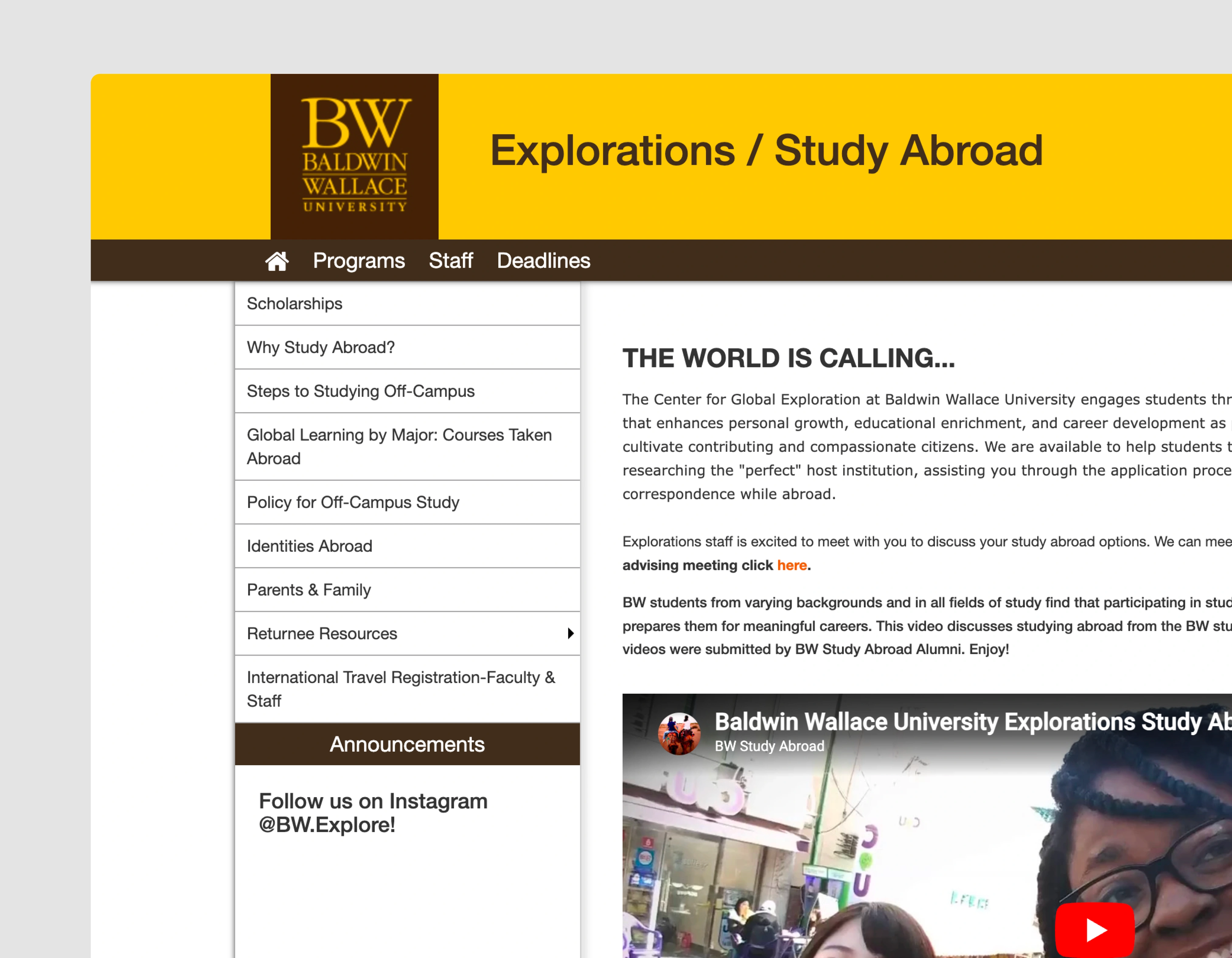
The volume and density of text made it difficult for participants to quickly identify what was most important. Key details were frequently overlooked, not because they were absent, but because they were buried within large blocks of copy.
What the team and I noticed was a repeated pattern of analysis paralysis, user movement became sporadic and random, or sometimes users didn't move at all for an extended period of time. Tendencies like these lead to frustration and increases a sites bounce rate.
Finding 2: Unclear Next Steps & Process Navigation
Participants were frequently unsure how to initiate the study abroad process. The "Steps to Studying Off-Campus" section, rather than providing clarity, created additional confusion about what the logical next step was. Adding to this, the option to schedule an advising appointment was embedded within a paragraph near the bottom of the page, making it easy to miss. Booking with the study abroad team required navigating to the staff page and selecting an individual, a process that was not immediately intuitive to any participant.
Finding 3: Limited Filtering & Program Discovery
Participants assumed they'd be able to filter programs quickly based on their specific needs. The current site supports this, but there is a particular opportunity to improve filtering by visa requirements, as participants had difficulty determining which programs required one.
Design Opportunities
Drawing from our key findings, the following opportunities represent potential areas where the Baldwin Wallace study abroad website could be improved to better support the student experience.
Opportunity 1: Surfacing Critical Information
The landing page could benefit from a restructured layout that prioritizes key information and makes next steps immediately visible upon arrival. Rather than displaying dense blocks of text, the site could introduce clear calls-to-action or buttons that guide students directly through each step of beginning the study abroad process, which could reduce the cognitive load of figuring out where to start.
Opportunity 2: Improving Program Discovery Through Filtering
There is an opportunity to expand filter criteria to better match what students are actually looking for, with the biggest opportunity coming from displaying an explicit "visa required" filter, which would significantly reduce the time and frustration involved in finding a relevant program.
Opportunity 3: Centralizing Scheduling & Advising Access
Rather than embedding scheduling options within paragraphs or requiring students to navigate to a staff page because of unclear instructions, the site could introduce a clear, centralized touchpoint, such as a prominent "Schedule an Appointment" button, which would be accessible from key entry points across the site. This would make advising feel approachable and easy to act on.
Limitations & What We'd Do Differently
Like any research project, ours came with a set of constraints that shaped the scope and reliability of our findings.
Sample Size
Our most significant limitation was the size of our participant pool. With only 4–6 participants, our findings offer valuable directional insight but cannot be considered fully representative of the broader BW student population. A larger and more diverse sample would strengthen the confidence of our conclusions and surface a wider range of navigation behaviors.
Recruitment Timing & Team Coordination
Recruiting participants mid-testing rather than before the study created scheduling conflicts that disrupted team communication and introduced unnecessary confusion into our process. In hindsight, establishing a participant group before beginning any sessions would have allowed for a smoother, more coordinated research timeline and kept the team aligned throughout.
Software Limitations
A significant technical constraint emerged during our data analysis phase. Our post-session recordings lacked audio, meaning we were unable to hear participants' think-aloud responses when reviewing sessions. This limited our ability to fully capture the reasoning behind participant decisions and may have caused us to miss nuanced insights that verbal feedback would have provided. Future studies would benefit from verifying full audio-visual recording functionality before any sessions begin.
Reflections & Takeaways
This project was a meaningful learning experience in multiple ways, both in terms of research ability and team collaboration.
Personal Growth
For me, this was my first experience working within a research team, and it offered valuable insight into how collaboration shapes the research process, from coordinating sessions to synthesizing findings collectively. Alongside that, working with advanced tools like Tobii for eye-tracking and live session monitoring was a significant hands-on learning opportunity that deepened my understanding of how behavioral data is captured in a real UX research setting.
Surprising Findings
One of the most notable moments during analysis was observing the consistency in where participants slowed down or struggled. The fact that multiple participants, independently of one another, spent the most time on the same sections of the site was a compelling signal that those friction points are systemic rather than individual. That consistency gave our findings a level of credibility that was both surprising and validating.
Team Reflection
Despite the scheduling constraints and technical challenges we faced, the team did a good job of gathering meaningful data and synthesizing it into something accessible and actionable for BW study abroad leadership.
Looking Forward
If this research were to continue, a natural next step would be exploring how the study abroad homepage could be redesigned to provide students with the most seamless and intuitive experience possible, turning the opportunities we identified into tangible, testable solutions.
Like this project
Posted May 2, 2026
UX research conducted for Baldwin Wallace's study abroad website to identify pain points and improve user experience.
Likes
0
Views
10
Timeline
Jan 29, 2026 - May 6, 2026