Offline Insight: Webflow Website for a CRM & Data Consultancy

Victor Adebayo

Offline Insight — CRM & Data Consultancy Website
Web Design · UX/UI Design · Webflow Development · B2B Lead Generation
Project Type: B2B Consultancy / CRM / Data & Business Operations
Primary Objective: Simplify a technical service offering, establish expertise, communicate business value, and generate qualified consultation enquiries
Platform: Webflow
Role: Web Designer & Webflow Developer
Deliverables: UX/UI Design · Responsive Website Design · Webflow Development · Service Architecture · CMS Blog · Consultation Flow · Custom Components · Forms · SEO & Performance Optimization
1. Project Overview
Offline Insight is a CRM and data consultancy focused on helping growing businesses turn disconnected systems, fragmented information, and inefficient processes into more structured operations.
The company works across CRM implementation, data integration, marketing operations, sales operations, customer support systems, automation, analytics, and strategic consulting.
Its central idea is simple:
Most businesses already have the data they need. The real challenge is making that data work together.
The goal of this project was to turn a highly technical consultancy offering into a website that business leaders could understand quickly.
Instead of leading with software terminology, I focused the experience around practical outcomes:
better visibility, less manual work, stronger sales processes, clearer reporting, and more useful customer data.
The customer journey became:
Recognize the Problem → Understand the Solution → Explore Services → Build Trust → Start a Conversation

2. The Challenge
CRM and data consulting can become complicated very quickly.
Potential clients may already be dealing with:
Multiple disconnected platforms
Spreadsheets
Duplicate customer records
Poor lead tracking
Manual reporting
Weak campaign attribution
Missed follow-ups
Inconsistent sales processes
Limited customer visibility
Teams working from different information
The problem is that most business owners do not necessarily describe these issues as a “CRM architecture problem.”
They simply know that their systems are becoming harder to manage.
The website therefore needed to:
Explain the problem without technical overload
Make CRM consolidation easy to understand
Speak to marketing, sales, support, and leadership teams
Communicate practical outcomes instead of software features
Establish expertise quickly
Organize several consulting services clearly
Explain the implementation process
Reduce concerns around system migration and team adoption
Support both full-service clients and DIY consulting
Create a strong consultation pathway
Support ongoing educational content
Work smoothly across desktop, tablet, and mobile
The main UX challenge was making a complex technical service feel practical, approachable, and commercially relevant.
3. Design Strategy
I structured the website around four priorities:
Problem → Outcome → Expertise → Action
Start With the Business Problem
Rather than opening with a list of platforms or technical capabilities, the website starts with the idea of improving business performance through better use of existing data.
This allows visitors to connect the service to problems they already understand.
The supporting messaging then explains how fragmented systems can affect marketing, sales, customer support, and decision-making.
Speak to Teams Individually
One important design decision was separating the benefits for different teams.
Marketing Teams
The website explains how connected systems can improve:
Lead capture
Campaign attribution
Automated nurture
Marketing reporting
Pipeline visibility
Sales Teams
The focus shifts toward:
Lead scoring
Automated routing
Pipeline management
Customer context
Reducing administrative work
Support Teams
Messaging focuses on:
Customer history
Centralized ticketing
Faster routing
Better context
More consistent service
This makes the value proposition much easier to understand than simply saying “we implement CRM systems.”
Focus on Outcomes
The website consistently translates technical capabilities into business benefits.
Instead of:
Data integration
the experience communicates:
Your teams stop searching through disconnected systems.
Instead of:
CRM automation
the benefit becomes:
Leads move to the right person automatically.
This keeps the experience client-focused rather than technology-focused.
Create a Clear Consultation Path
CRM projects are rarely impulse purchases.
The website therefore does not treat conversion like traditional e-commerce.
The primary action is:
Start a conversation.
Visitors are encouraged to understand the service, identify their operational challenges, and then contact the team for a more personalized discussion.
4. UX/UI Design
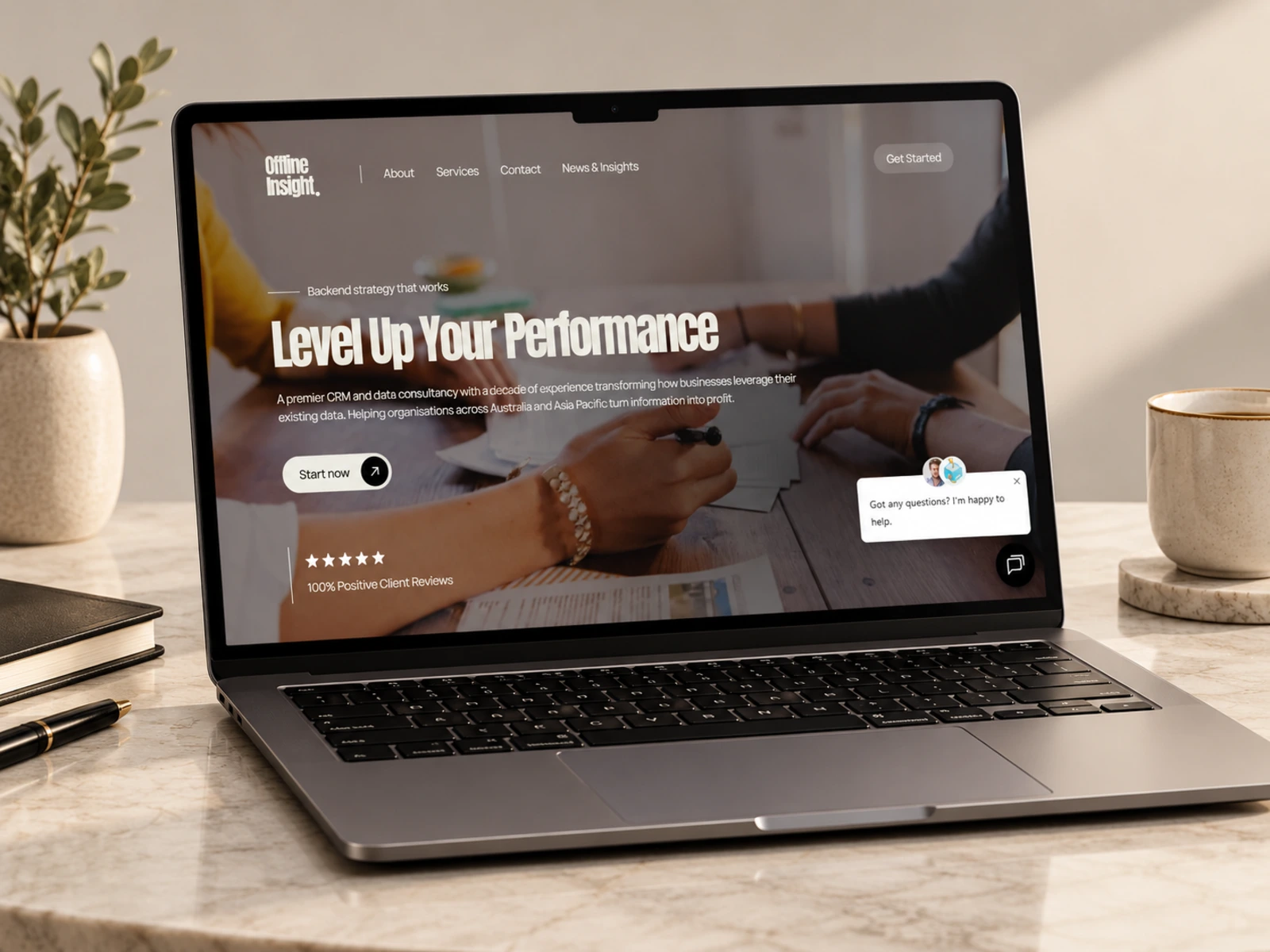
Hero Section
The hero was designed around a strong outcome-oriented message:
Level Up Your Performance
Supporting copy introduces Offline Insight as a CRM and data consultancy helping businesses use the information they already have more effectively.
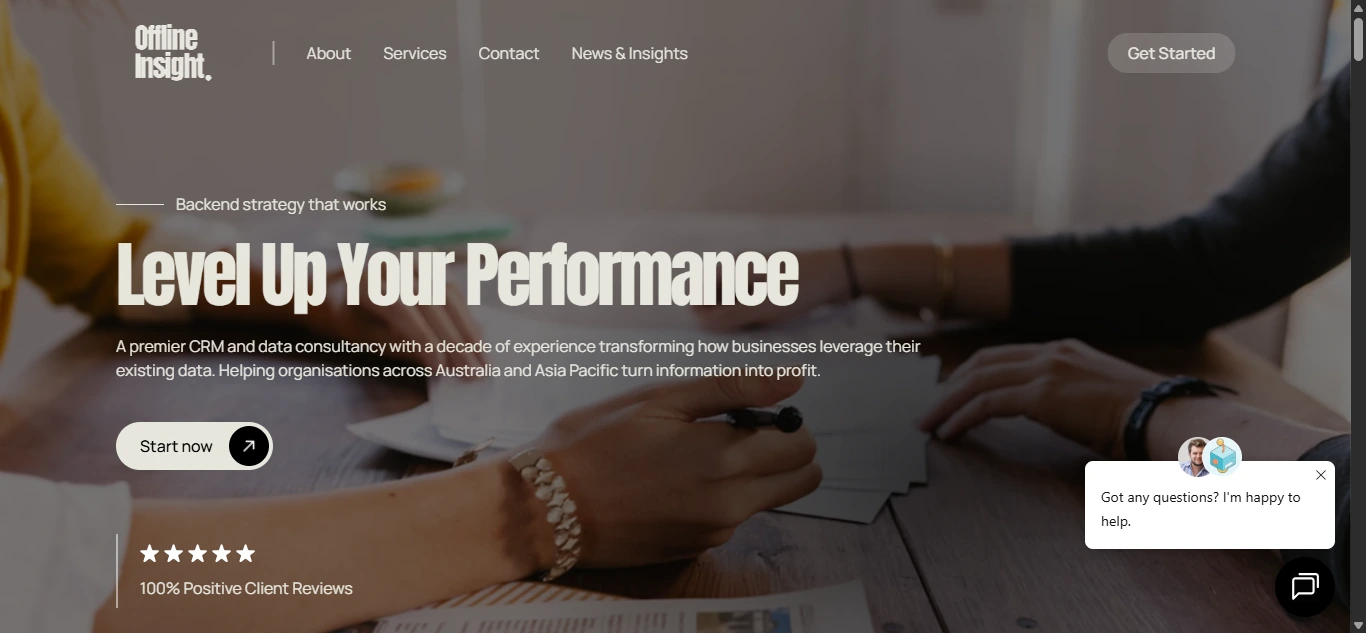
The CTA remains simple:
Start Now
This gives visitors a clear next step without immediately asking them to understand every service.
Visual Direction
The website needed to feel technical enough for CRM and data consulting but human enough for business decision-makers.
I used a clean B2B visual system built around:
Bold typography
Strong business imagery
Structured content blocks
Generous spacing
Controlled accent colors
Clean cards
Clear CTA hierarchy
Minimal decorative elements
The interface feels professional without turning into a traditional corporate IT website.
Typography
A clear typography hierarchy was especially important because the content includes technical concepts.
I created styles for:
Hero messaging
Service headings
Team-specific benefits
Process sections
FAQ questions
Article titles
CTAs
Supporting explanations
Large headings introduce the key idea while shorter supporting paragraphs explain the detail.
This keeps long consulting pages easy to scan.
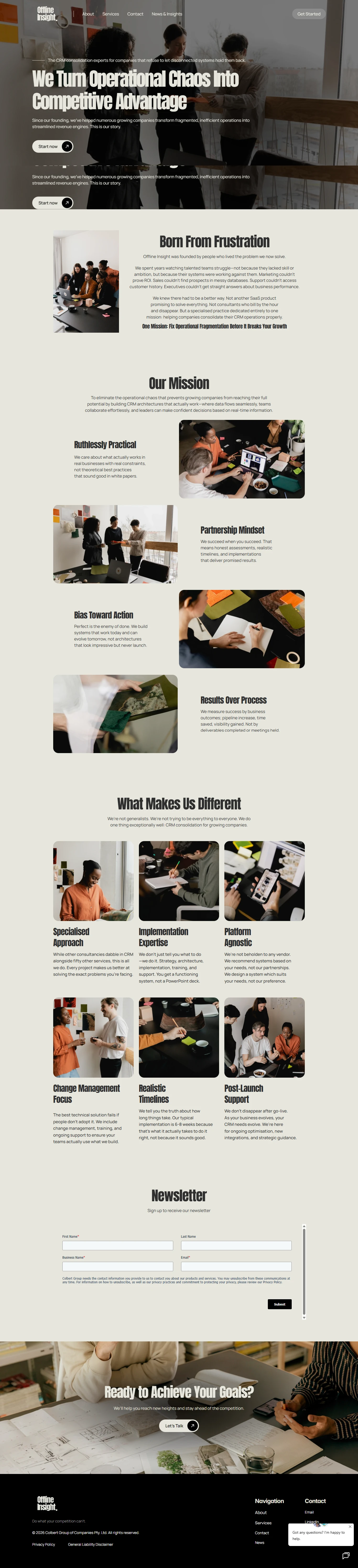
Team-Based Problem Solving
One of the strongest sections is the breakdown for marketing, sales, and support.
Rather than presenting one generic CRM solution, the interface shows how the same connected data environment affects each department differently.
This makes the service more tangible.
A marketing manager can see the attribution benefit.
A sales leader can see the pipeline benefit.
A support manager can see the customer-context benefit.
The same service becomes relevant to multiple decision-makers.
Service Architecture
The core consulting services are separated into clear offerings.
Sales Operations Excellence
Focused on areas such as:
Sales process audits
CRM pipeline configuration
Lead routing
Sales activity tracking
Process optimization
Marketing Operations Optimization
Designed around:
Marketing technology audits
Automated lead capture
Campaign attribution
Nurture sequences
Marketing automation
Full CRM Consolidation & Implementation
The most complete engagement, covering:
Existing-system audits
Data and process mapping
Platform configuration
Integrations
Automation
Reporting
Dashboard setup
DIY Strategy Sessions
For businesses with internal capability but needing expert direction, the site also introduces a lower-commitment consulting option with a strategy session and development plan.
This makes the offering accessible to companies at different stages of CRM maturity.
Pricing Approach
Most larger engagements use bespoke pricing.
Rather than showing arbitrary package prices for complex implementation work, the website encourages companies to discuss their requirements first.
The DIY consulting session is positioned differently, with a clearer session-based price.
This creates a useful distinction between:
Defined advisory work
and
custom implementation projects.
Trust & Expertise
For a CRM consultancy, credibility comes largely from experience and approach.
The website reinforces this through positioning around:
A decade of CRM and data experience
Work across Australia and Asia Pacific
Platform-agnostic recommendations
Implementation expertise
Practical business experience
Change management
Ongoing support
Offline Insight also emphasizes that it is not tied to a single CRM vendor, allowing recommendations to be based on client requirements rather than platform partnerships.
That positioning was given strong visibility because it helps remove concern around biased recommendations.
About & Founder Story
The About experience gives more context to why Offline Insight exists.
The business was built around a frustration with disconnected systems and the operational problems they create.
Instead of telling a generic consultancy story, the messaging focuses on real business issues:
Marketing cannot prove ROI.
Sales cannot find the right prospects.
Support lacks customer history.
Leadership cannot get reliable answers quickly.
This makes the company story directly relevant to the customer's own challenges.
Implementation Process
The website explains that CRM transformation involves more than simply installing software.
The experience communicates a broader implementation approach covering:
Assessment → Architecture → Implementation → Training → Adoption → Ongoing Optimization
This is important because one of the biggest concerns around CRM projects is whether the team will actually use the finished system.
Offline Insight addresses this directly through training, change-management support, and continued optimization after launch.
FAQ Experience
The FAQ addresses the objections most likely to appear before a consultation.
Topics include:
How to get started
Moving from spreadsheets to CRM
Industries supported
Pricing
Team adoption
Post-launch support
This content appears close to the conversion point so visitors can remove final uncertainties without needing to contact the business first.
Insights & Educational Content
The News & Insights section creates a second layer to the website.
Instead of only selling consulting services, Offline Insight publishes educational content around:
CRM selection
Data strategy
System fragmentation
Real estate CRM
Financial services CRM
Spreadsheet limitations
Business analytics
The content is organized into categories such as The Breakdown, The Basics, and News.
This gives the brand a platform for demonstrating expertise while also supporting organic search.
Responsive Design
The responsive experience needed to work particularly well for business decision-makers reading content on laptops, tablets, and phones.
I optimized:
Navigation
Long headlines
Service cards
Team benefit sections
FAQ interactions
Blog cards
Contact forms
CTA visibility
Business imagery
Content spacing
On mobile, multi-column sections transition into a simpler vertical structure while keeping the same hierarchy.
5. Website Architecture
The architecture was designed around a focused B2B customer journey.
Homepage
The homepage communicates:
Value Proposition → Approach → Marketing/Sales/Support Benefits → Services → FAQ → Consultation CTA
About
Provides deeper context around the company mission, values, implementation philosophy, and what differentiates Offline Insight from broader IT consultancies.
Services
The services structure supports multiple levels of engagement, including:
Sales Operations
Marketing Operations
CRM Consolidation
Implementation
Data Integration
Automation
Analytics
Strategic Consulting
DIY Advisory
News & Insights
Acts as the main educational content hub.
Visitors can explore CRM, data, operations, and industry-specific topics while the business builds long-term search visibility.
Individual Articles
Each article receives a dedicated content page with:
Title
Category
Publication date
Author
Long-form content
Supporting images
Author profile
Related business context
This turns expertise into a searchable content library.
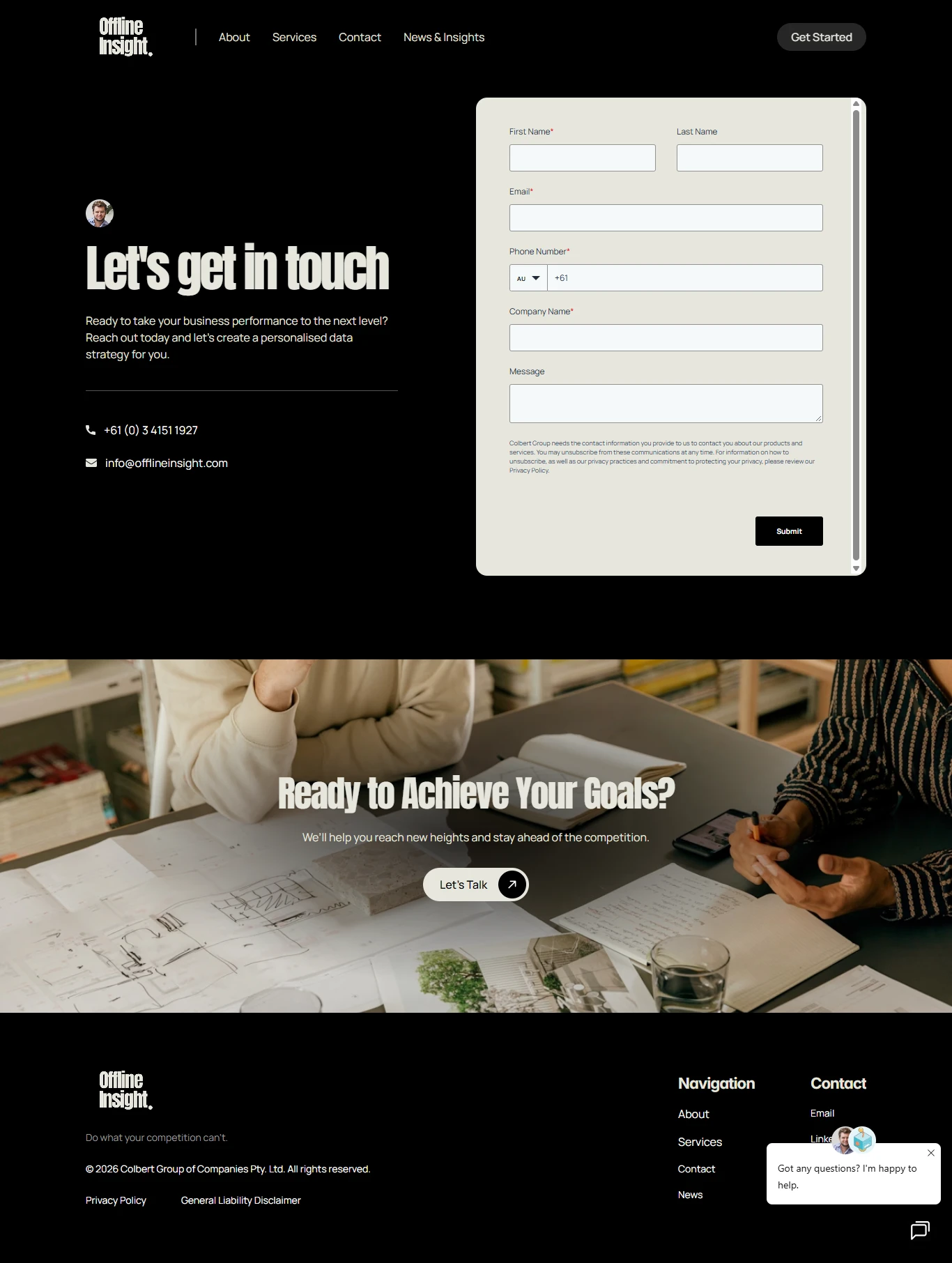
Contact
The Contact page creates a straightforward pathway for businesses ready to discuss their CRM or data challenges.
Visitors can contact the team directly or submit an enquiry for a personalized data strategy.
Strategy Session Landing Page
A dedicated consultation pathway supports businesses interested in discussing CRM and data strategy before beginning a larger implementation.
6. Webflow Development
Once the UX structure and visual system were established, I translated the experience into a responsive Webflow website.
The development focused on building a flexible B2B marketing platform that could grow alongside the consultancy.
Key development areas included:
Responsive Webflow development
Reusable service components
CMS-powered News & Insights
Article templates
Author components
Category filtering
Responsive navigation
Contact forms
Consultation landing pages
FAQ interactions
Reusable CTA sections
Service cards
Custom hover states
Subtle scroll interactions
Responsive imagery
Clean class structure
Semantic heading hierarchy
SEO-conscious architecture
Open Graph configuration
Accessibility-conscious form states
Image optimization
Performance optimization
Cross-browser testing
Cross-device testing
The modular build makes it easier to add new services, articles, case studies, landing pages, and campaigns without redesigning the site.
7. Design & Development Process
Research → UX Structure → Wireframes → UI Design → Design System → Webflow Development → CMS Setup → Responsive Optimization → Testing → Launch
Research
I started by understanding the problems Offline Insight solves and the people involved in buying CRM consulting.
The website needed to make sense to:
Business owners
Executives
Marketing leaders
Sales leaders
Support teams
Operations teams
The main question became:
How do we explain a complex CRM transformation without making someone feel like they need technical knowledge to understand it?
UX Structure
I organized the journey around:
What problem do you solve? → Does it apply to my team? → What can you help with? → Why should I trust you? → What happens during implementation? → How do we start?
This became the foundation of the website.
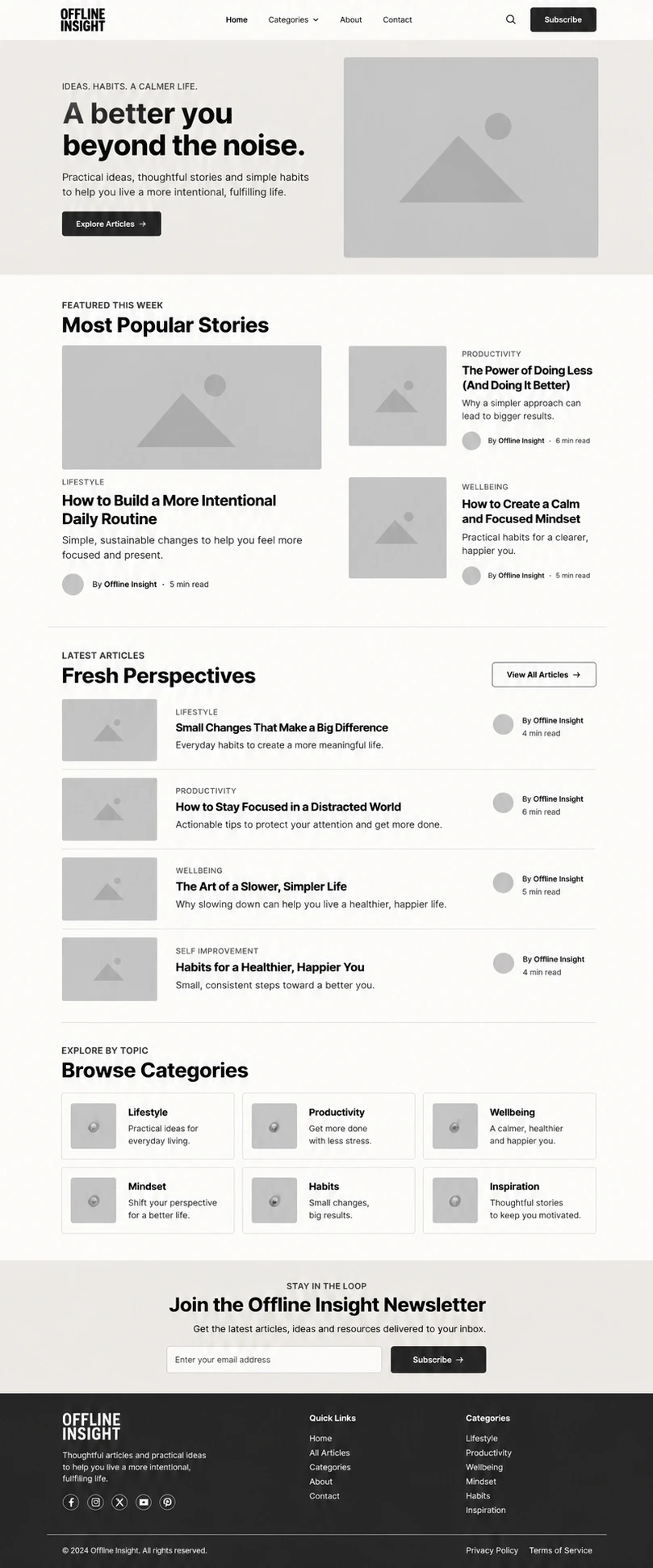
Wireframes
The wireframing stage established:
Hero hierarchy
Team-specific sections
Service cards
Consultancy positioning
FAQ
Insights content
Conversion areas
The focus was on making the message understandable before introducing detailed visual styling.
UI Design
The wireframes were transformed into a clean and modern B2B consultancy interface.
Rather than relying heavily on technical diagrams, the design uses business-focused imagery and structured content to keep the platform approachable.
The final visual direction balances technology, strategy, and human expertise.
Design System
Reusable styles were created for:
Typography
Colors
Buttons
Service cards
Team sections
Article cards
Author profiles
FAQs
Forms
CTAs
Navigation
Section spacing
Responsive behavior
This ensures consistency across both marketing and editorial content.
Webflow Development
The approved interface was translated into modular Webflow components.
The structure was kept flexible so the business could continue launching new service pages and campaigns without creating inconsistent layouts.
CMS Setup
Webflow CMS was structured around the content most likely to grow over time.
This includes:
Articles
Categories
Authors
Insights
Future case studies or resources
The CMS allows the team to publish new thought-leadership content without rebuilding layouts manually.
Responsive Optimization
Each section was individually reviewed across desktop, tablet, and mobile.
Special attention was given to:
Long technical headlines
Benefit lists
Service cards
Article pages
Forms
FAQs
Navigation
This keeps information easy to consume regardless of screen size.
Testing
Before launch, I reviewed:
Navigation
Contact forms
Consultation links
Service CTAs
FAQ interactions
CMS articles
Category pathways
Responsive layouts
Image behavior
Browser consistency
Launch
The final stage focused on accessibility, responsive consistency, page speed, SEO foundations, content readability, and making sure every major page had a clear pathway toward consultation.

8. Key Features
Custom Webflow B2B website
CRM consultancy positioning
Data strategy messaging
Marketing-team solution sections
Sales-team solution sections
Customer-support solution sections
Sales operations services
Marketing operations services
Full CRM consolidation
Data integration
Automation strategy
Dashboard and reporting positioning
Platform-agnostic consultancy messaging
DIY consulting option
Consultation conversion flow
Interactive FAQs
Webflow CMS
News & Insights hub
Category-based articles
Author profiles
Contact forms
Responsive navigation
Reusable Webflow components
SEO-conscious content structure
Custom interactions
Accessibility considerations
Performance optimization
Cross-device responsive design
9. Final Result
The final Offline Insight website turns a complex CRM and data consultancy into a clear, practical, and business-focused digital experience.
Visitors do not need to understand CRM architecture before they understand the value.
The website begins with recognizable operational problems and then shows how better-connected data can improve marketing, sales, customer support, reporting, and decision-making.
Separating the experience by team also helps different stakeholders quickly understand what the consultancy can do for them.
At the same time, service pages, founder positioning, a platform-agnostic approach, implementation support, FAQs, and educational content help build confidence before the visitor reaches out.
The Webflow CMS gives Offline Insight a scalable platform for ongoing thought leadership, industry insights, educational articles, and future service content.
The result is a modern, credible, and conversion-focused Webflow website that turns technical CRM consulting into a clear business conversation, helping growing companies understand the cost of disconnected systems and giving them an obvious path toward fixing them.
Like this project
Posted Oct 21, 2026
Built a Webflow site for Offline Insight that makes complex CRM and data services clear, with responsive UX/UI, CMS insights, and consultation flows.
Likes
4
Views
9
Timeline
Feb 11, 2026 - Apr 16, 2026